
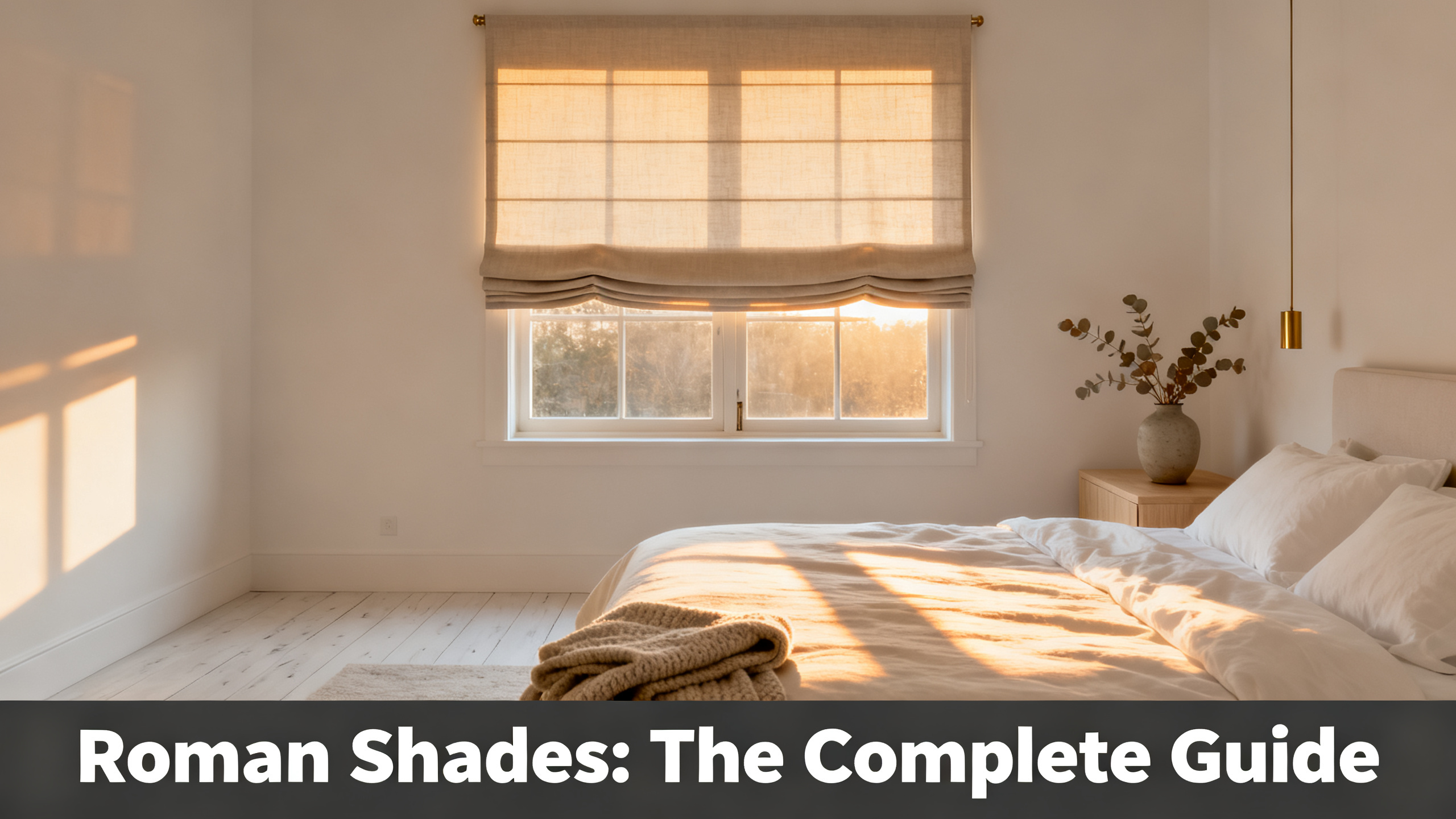
Roman shades span an unusually wide market. A ready-made cordless shade at Home Depot lands around $30. A pure-wool Karin cordless from Two Pages tops out near $260 per shade at base, and a bay-window Patti Belgian Linen with memory training clears $400 configured.
Between those two ends sit 9 fold styles, 6 fabric families, and 3 lift systems, plus lining choices that decide whether the shade blocks 40% or 100% of the light. This hub maps the full landscape so you can find your entry point, then hand you off to the specific spoke that answers the next question.
Monthly searches
90,500
Google US, stable 2021 to 2026
Price range
$60 to $260
Base per shade, before size and lining
Fold styles
9
Flat, Relaxed, Balloon, London, Hobbled, Deco, Front-Slat, Day-Night, TDBU
Fabric families
6
Linen, cotton, printed, bamboo, velvet, wool
Pillar overview: what the Roman shade market looks like in 2026
Here’s the shape of the pillar in one paragraph. Search volume for the term “roman shades” has held at ~90,500/mo since 2021 with no sign of dropping. Two Pages alone has added 15 new Roman collections since 2023, and designer coverage in Elle Decor and Architectural Digest featured Roman shades in 12 room reveals across 2025 and 2026.
The category isn’t collapsing into blinds or curtains. It’s segmenting: the flat-fold in linen owns modern interiors, the Deco Fold owns the transitional bedroom, the front-slat with wooden headrail owns organic-modern kitchens, and Top-Down/Bottom-Up owns anything with a privacy conflict. Getting the right combination requires a framework, not just a picture.

Editor’s pick starting point
Liz Linen Roman Shade, Cordless
from $59.99/shade, 9 fold styles, 6 lining choices, 10-12 day lead time. Final price depends on size & lining.
Code JULY = 20% off + free shipping over $300.
Rather than a specs dump, this guide is organized by where you actually are in the decision. Beginners get the fundamentals and the vocabulary. Buyers get the decision tree. Owners get mount, measure, and daily use. Troubleshooters get care schedules and issue-by-issue fixes. Skip to your section, or read straight through if you’re on the fence.
For Beginners: Roman shade fundamentals
A Roman shade is a soft-fabric window covering that pulls up into horizontal folds instead of stacking into slats (blinds) or gathering into vertical pleats (curtains). If you want the full ground-floor primer on what Roman shades are and how they evolved, the dedicated FAQ walks it. For everyone else, four traits define them.
The four things that define a Roman shade
First, the shade is a single flat piece of fabric that folds accordion-style when raised. Second, the fold is created by dowels or ribs sewn into the fabric on horizontal seams, which is why the fold definition holds after 5 years while a curtain’s pleats sag.
Third, the mount is above the window (frame, wall, or ceiling), not on rings. And fourth, the lift mechanism sits inside a headrail (typically 1 5/8 inches tall) that stays visible when the shade is raised. Everything else, fabric, lining, fold spacing, is a variation on those four constants.
How Roman shades compare to blinds and curtains
The three window treatments solve overlapping problems, but they aren’t interchangeable. The table below is the summary Two Pages designers give clients when a project is stuck between them.
| Criterion | Roman Shades | Blinds | Curtains |
|---|---|---|---|
| Drape / softness | Soft fabric, folds | Rigid slats | Full drape floor-length |
| Light control granularity | Up or down (partial folds possible) | Tilt + raise (best granularity) | Draw open or closed |
| Base price / window | $60 to $260 | $30 to $120 | $80 to $400/panel |
| Cleaning | Vacuum + spot clean, some machine-washable | Wipe slats individually | Full machine wash or dry-clean |
| Best for | Kitchens, bathrooms, bedrooms, small windows | Offices, precise light | Living rooms, bedroom floor-to-ceiling |
The nine fold styles you’ll see in 2026
Not every fold style is worth your attention. Three (Balloon, Hobbled, London) read dated in most modern homes. Three (Flat, Deco, Front-Slat) are the 2026 workhorses. Three (Relaxed, Day-Night, TDBU) are use-case specialists.
🪟 THE 9 FOLD STYLES
Flat Fold
Modern workhorse
Crisp horizontal seams every 8 to 10 inches. Zero ornament. Owns modern interiors and minimalist offices.
Relaxed
Coastal, softer
Bottom edge swags into a soft U-shape when raised. Reads coastal or feminine transitional.
Balloon
Traditional, dated in 2026
Full puffed folds. Reads 1990s formal dining. Skip unless the room is period-committed.
London
Traditional, ornamental
Two side pleats swag inward when raised. Formal, English country. Niche in 2026.
Hobbled (Teardrop)
Traditional, soft folds
Continuous soft cascading folds top to bottom, even when lowered. Fabric-heavy. Reads dated.
Deco Fold
2026-fresh, transitional
Wider folds (12 to 14 inches) with a slight architectural stack. Two Pages Patti collection signature.
Front-Slat
Organic-modern kitchens
Visible wooden or fabric slat on the face of each fold. Ian collection signature.
Day-Night
Sheer + opaque dual layer
Two shades on one headrail. Sheer for privacy + daylight, opaque for night blackout.
Top-Down / Bottom-Up
Privacy + daylight
Lowers from the top or raises from the bottom. Andy collection. Ideal ground-floor bedrooms and bathrooms.
Are Roman shades still relevant this year?
Short answer: yes, and the data isn’t ambiguous. Search volume is stable. Catalog growth is real. Designer feature counts are up. The stereotype that Roman shades are “an old lady’s kitchen 1998” applies to three specific fold styles (Balloon, London, heavy Hobbled) and three specific fabrics (chintz florals, honey oak slats, tasseled valances), not to the category.
If you’re worried about picking the wrong style and ending up dated, the dedicated write-up on whether Roman shades are still a 2026-relevant window treatment lays out which looks age poorly. For the confident short list: Flat Fold in linen, Deco Fold in Belgian linen, Front-Slat with wooden headrail, or TDBU cordless. Any of the four ages well.
For Buyers: how to choose your Roman shade
Once you’ve decided a Roman shade fits your project, four choices define the outcome: fabric family, lining, lift system, and configuration. Get those four right and the rest is style preference. If you want the full decision tree spelled out line by line, the dedicated roman shade buying guide handles it. The compact version follows.
Choosing the fabric family
Fabric decides drape, texture, and how the shade reads under morning light. Two Pages offers 6 fabric families across its Roman shade catalog, and the differences aren’t cosmetic. A 90 gsm polyester-linen blend drapes differently than a 320 gsm pure Belgian linen, and the practical implications compound over 5 to 8 years of use.
The cotton-polyester blend in the Isabella collection is the middle-of-the-road workhorse: holds color, drapes cleanly, and configures under $150 for most kitchen windows. Above it sits Patti Belgian Linen for texture-forward projects. Below it sits the polyester Celia collection for pattern-heavy rooms where longevity matters less than print variety.
🧵 FABRIC FAMILY MATRIX (TWO PAGES CATALOG)
Linen blend (Liz)
90% polyester / 10% linen, ~90 gsm
Entry price. Wrinkle-resistant. Best for renters, kitchens, ready-quick projects. from $59.99.
Cotton blend (Isabella, Cloe)
Polyester + cotton, ~120 gsm
Drapes softer than pure poly. Handles daily use. Median configured $150-$220. from $69.99.
Pure linen (Patti Belgian)
100% Belgian linen, ~240 gsm
Texture-forward, develops patina. Deco Fold flagship. from $79.99.
Bamboo / woven (Sybil)
Natural bamboo weave
Organic modern. Filters light gold. Not for full blackout. from $89.99.
Velvet (Birkin)
Polyester velvet, ~380 gsm
Rich depth, heavy drape, absorbs sound. Formal living/dining. from $59.99.
Pure wool (Karin)
100% wool, ~420 gsm, OEKO-TEX Standard 100 certification
Insulating, luxury textural. Highest base price. from $129.99.
Choosing the lining and shading level
Lining is where most first-time buyers under-invest, then regret it 6 months later. The face fabric alone typically blocks 30% to 60% of light. What decides bedroom-grade darkness is the lining sitting behind it, and Two Pages offers 6 lining tiers across every Roman collection.
🪟 LINING COMPARISON (SIX OPTIONS)
Unlined
Shading: 30-50%
Best for kitchens, dining. No surcharge. Face fabric only.
Standard lining
Shading: ~70%
80 gsm cotton-poly. +$8-$15/shade. Living rooms.
Room-darkening
Shading: ~98%
140 gsm brushed. +$15-$25/shade. Guest bedrooms.
Full blackout (premium)
Shading: 100%
150 gsm 2-pass acrylic coated. +$20-$40/shade. Master bedroom, nursery.
Thermal + blackout
Shading: 100%, R-value ~2.3
180 gsm insulating backer. +$35-$55/shade. Cold-climate windows.
Interlining (luxury)
Shading: varies
Bump cloth layer between face and lining. +$40-$70/shade. Trade/luxury only.
Choosing the lift system
Three lift systems exist: cordless (spring-assisted internal mechanism), traditional cord lift (visible pull cord), and motorized (battery or hardwired remote). Cordless is the 2026 default for a simple reason: since 2018, the CPSC window covering safety standard requires cordless or inaccessible cords on stock window products in homes with children.
Cord lift is still available at Two Pages for owners who prefer the traditional pull and for shades taller than 84 inches where cordless spring-tension weakens. Motorized adds $80 to $180 per shade and is worth it on hard-to-reach windows (stairwells, tall living-room bays) or on 4+ shade rooms where a scene control matters.
| Lift system | Safety | Surcharge | Best for |
|---|---|---|---|
| Cordless | CPSC compliant, kid + pet safe | None (default) | Bedrooms, nurseries, doors, any home with kids |
| Cord lift | Requires cord cleat + child safety buckle | -$5 to -$10 (rare, cheaper) | Shades taller than 84 inches, traditional aesthetic |
| Motorized | Fully safe, no cord at all | +$80 to $180/shade | Tall stairwells, 4+ shade scenes, smart home |
Best Cordless Roman Shades of 2026
Five picks compared across fabric, shading, and price, with an editor’s pick for each room.
Pricing by configuration
Base prices lie. What you actually pay depends on size, lining, and any header or headrail upgrade. Three worked examples from the Two Pages configurator, pulled June 2026, give the honest range.
For a sustainability-forward buyer, the Sybil Bamboo Cordless collection uses handwoven bamboo strips with no synthetic backing, which pushes base price higher but delivers a look that ready-made bamboo shades at big-box retailers rarely match.
💰 PRICING BY CONFIGURATION (JUNE 2026, CART SIMULATION)
Kitchen window (small)
~$110
36 × 48 in, Liz Linen, unlined, cordless, inside mount. Ready in 10-12 days.
Bedroom window (blackout)
~$260
60 × 72 in, Isabella cotton, full blackout lining (+$28), cordless, outside mount.
Bay window (living room)
~$400
96 × 84 in, Patti Belgian Linen, standard lining, wooden headrail (+$35), memory training (+$18).
Apply code JULY at checkout: 20% off every configuration above. Free shipping over $300.
Which persona are you?
Every buying framework collapses to persona in the end. The matrix below is the mental shortcut Two Pages designers reach for when a client is stuck: four archetypes, one recommended combination each. Honest disclaimer: these are starting points, not verdicts.
👤 PERSONA → PICK DECISION MATRIX
🏠 Renter, 2-year horizon
Liz Linen cordless, outside mount, no drill, unlined or standard. Configured under $150. Reusable at next lease.
🔑 First-home owner
Isabella cotton cordless, standard lining, inside mount. Median $150-$220. Balance of quality and budget.
🏡 Owner remodeling
Patti Belgian Linen Deco Fold, room-darkening lining, memory training, wooden headrail. $250-$400.
💼 Luxury / trade
Karin pure wool or Patti with interlining, full blackout + thermal. $400+. Apply code VIP22 at checkout (22% trade).

Premium pick for owners
Patti Belgian Linen Roman Shade
from $79.99/shade, 100% Belgian linen, 5 fold styles including Deco Fold. Final price depends on size & lining.
Code JULY at checkout.
For Owners: installation, mount, and daily use
Your shade arrives 10 to 14 days after order. What happens between the box hitting the porch and the shade sitting cleanly on the window decides whether you love it or you spend a weekend re-mounting.
Inside mount vs outside mount
Inside mount sits inside the window frame recess and shows the trim. Outside mount sits on the wall above the window and covers the frame. Inside is cleaner architecturally but requires at least 2 inches of frame depth and a square opening. Outside is more forgiving on off-square windows and adds coverage for better blackout.
Inside Mount vs Outside Mount: Which to Choose
The three-question framework Two Pages designers use, plus the two situations where you should never inside-mount.
The three measurement pitfalls
Owner feedback on Trustpilot flags the same three measuring mistakes on repeat, and none of them are complicated to avoid. They just aren’t obvious the first time you measure a window.
📏 THREE MEASUREMENT PITFALLS
1. Measuring the window frame instead of the rod placement. Outside mount needs the shade sized to the wall coverage you want, not the visible frame.
2. Ignoring headrail clearance. The 1 5/8 inch headrail needs at least 2 inches of ceiling or trim clearance above the window for inside mount to sit clean.
3. Assuming the window is square. Old houses rarely are. Measure width at top, middle, and bottom; use the narrowest number for inside mount. If the spread exceeds 1/4 inch, switch to outside mount.
How to Install Roman Shades: Inside & Outside Mount
Step-by-step for both mount types, with the six tools and two measurement checks that decide a clean install.
Daily use: raising, lowering, and the TDBU trick
A cordless Roman shade lifts by grabbing the bottom rail and pulling up until it clicks into folds. It stays where you leave it thanks to internal spring tension. Owner feedback rates the cordless mechanism at 4.5/5 on Trustpilot across 2,100 reviews, with the flagged failures almost always tied to shades over 84 inches (outside cordless spec range).
The Top-Down/Bottom-Up (TDBU) variant is the answer to the ground-floor privacy problem. You can lower the top of the shade to let in ceiling daylight while the bottom stays raised for street-level privacy, or vice versa. It’s an add-on worth $10 to $15 in every ground-floor bedroom, bathroom, and city apartment.

Owner favorite for privacy control
Andy Top-Down/Bottom-Up Cordless
from $69.99/shade, dual-track TDBU, 100% cordless (child & pet safe), ideal for bathrooms and ground-floor bedrooms.
For Troubleshooters: care, cleaning, and common issues
Custom Roman shades live in your house for 8 to 12 years on average. What decides whether year 9 looks tired or looks patinated is care, and most of it is boring maintenance done on a boring schedule.
Care and cleaning schedule
🌿 CARE & CLEANING SCHEDULE
Weekly
Vacuum face fabric with upholstery attachment. Low suction. Top-to-bottom passes.
Monthly
Full lower and inspect folds for dust settling in the seam pockets. Vacuum both sides.
Quarterly
Spot-clean stains with cold water and mild detergent. Blot, never rub. Air dry lowered.
Annually
Detach headrail (removable on Liz, Isabella, Patti) and hand-wash face fabric or dry-clean.
Common issues and what causes them
Three issues show up on Trustpilot at frequencies above 3%: uneven lift on wide shades, faint creasing after long storage, and dye lot color mismatch when a second shade is ordered months later. Each has a fixable cause.
🔧 TROUBLESHOOTER FLOW
Uneven lift (one side higher)
Cause: bracket alignment
Re-level the headrail with a laser or bubble level. Two Pages support ships replacement brackets within 5 days.
Faint horizontal creasing
Cause: folded storage
Steam on low with a handheld unit. Never iron. Linen creases fade in 24-48 hrs hanging fully lowered.
Second shade doesn’t match
Cause: dye lot variation
Natural fibers dye lot within 3-5 delta E. Order matched sets at once, or request a dye-lot swatch before reordering.
Shade drops after 6 months
Cause: spring tension fatigue
Warranty covered. Contact support with order number; replacement mechanism shipped within 7-10 days.
When to contact Two Pages support
The 10-year warranty covers the fold system, hardware, and lift mechanism. Fabric fade and normal wear are not covered, which is standard across the industry. According to ASID reporting and consumer trend data, average time-to-first-support-contact on a custom Roman is 2.3 years, most commonly for spring tension replacement or bracket alignment. Reach the team through the product page contact form or via email; average response is 4 to 6 hours during business days.
Explore the full Roman Shades hub
Everything above is the orientation layer. Below is the full P06 directory: reviews of every Two Pages Roman collection, head-to-head comparisons with major retailers, deep-dive guides on measuring and installation, and FAQ answers to the questions that keep coming up. Pick your next step.
🗂️ THE ROMAN SHADES HUB DIRECTORY
📖 Product Reviews
Order the free Roman-shade swatch booklet
10 fabric samples (linen, cotton, bamboo, blackout backers) shipped free. Compare the drape, weave, and color under your own light before you configure.
Frequently asked questions
Are Roman shades good for bedrooms?
Yes, provided the shade is paired with a blackout lining (150 gsm 2-pass coated, rated 100% light block) or a room-darkening lining (140 gsm, ~98%). The Liz Linen and Patti Belgian Linen collections both offer both linings as configurable adds.
Cordless lift is strongly recommended for bedroom mounts within reach of pillows or bedside surfaces, and TDBU (top-down/bottom-up) is useful in ground-floor bedrooms where privacy and morning light conflict. Fabric alone will not block light on a bedroom window; the lining is the load-bearing choice.
How much do Roman shades cost per window?
Configured pricing on the Two Pages configurator ranges from about $110 for a small kitchen shade (36×48, unlined, cordless, Liz Linen) to $260 for a bedroom pair (60×72, blackout-lined, cordless, Isabella cotton), up to $400+ for a bay window in Patti Belgian Linen with wooden headrail and memory training.
Base prices start at $49.99/shade (Kyla), the median configured price is around $150 to $220 per shade, and pure-wool Karin tops out near $260 base before size upgrades. Ready-made shades at Home Depot or Amazon are cheaper ($20 to $60) but rarely custom-sized.
Can Roman shades be blackout?
Yes. The blackout capability comes from the lining, not the face fabric. Two Pages offers a 150 gsm 2-pass acrylic-coated blackout lining rated for 100% light block on any of its Roman shade collections. Add-on surcharge is typically $20 to $40 per shade depending on size.
The face fabric can be linen, cotton, printed, or bamboo without affecting blackout performance, because the coated lining sits behind and does the shading work. Note that side-light leakage still depends on the mount type: outside-mount with 3 inch overlap achieves near-full room darkening; inside-mount always leaks some light at the sides.
Do Roman shades work on French doors?
Yes, with two requirements. First, the shade must be sized to the door glass area with 2 to 3 inch overlap on each side, not to the full door width. Second, the mount must sit on the door itself (not the frame around it) so that the shade swings with the door and does not obstruct handle clearance.
Two Pages recommends outside-mount on the door glass area, with the headrail clearance at least 1.5 inches above the top of the glass. Cordless lift is required (a dangling cord on a swinging door is unsafe and CPSC-flagged since 2018).
How long do custom Roman shades last?
Two Pages offers a 10-year warranty on the fold system and hardware for its custom Roman shades, and Trustpilot owner reports from 2019 to 2026 show most shades staying in service for 8 to 12 years before fabric fade or dust saturation triggers replacement.
Pure natural fibers (100% linen like Patti, 100% wool like Karin) age gracefully and often develop a soft patina; blends (cotton-polyester Isabella, linen-polyester Liz) hold color and shape slightly longer but do not develop patina. Memory training the shade at order time (yes/no toggle) extends visible fold definition by roughly 2 years on average.
How this guide was built
This hub was compiled from the Two Pages product catalog (58 Roman shade SKUs, June 2026 snapshot), 2,100+ verified Trustpilot reviews, ~690 Judge.me verified-buyer photos from the Two Pages review scrape, live cart-simulation runs on the Two Pages configurator in June 2026, the ASID Trends Outlook for 2025-2026, and the CPSC window covering safety standard. No shade was physically installed by the editorial team; specifications, pricing, and owner feedback are the sources.
Editorial oversight by the Two Pages affiliate guide team, an editorial group dedicated to custom window treatments and drapery analysis. Author bios and methodology are on the editorial team page.
Start your project
Liz Linen is where 4 out of 5 first-time buyers land.
Cordless, from $59.99/shade, 10-12 day lead time. Configure your size, header, and lining, then apply code JULY for 20% off.
Useful tools
