
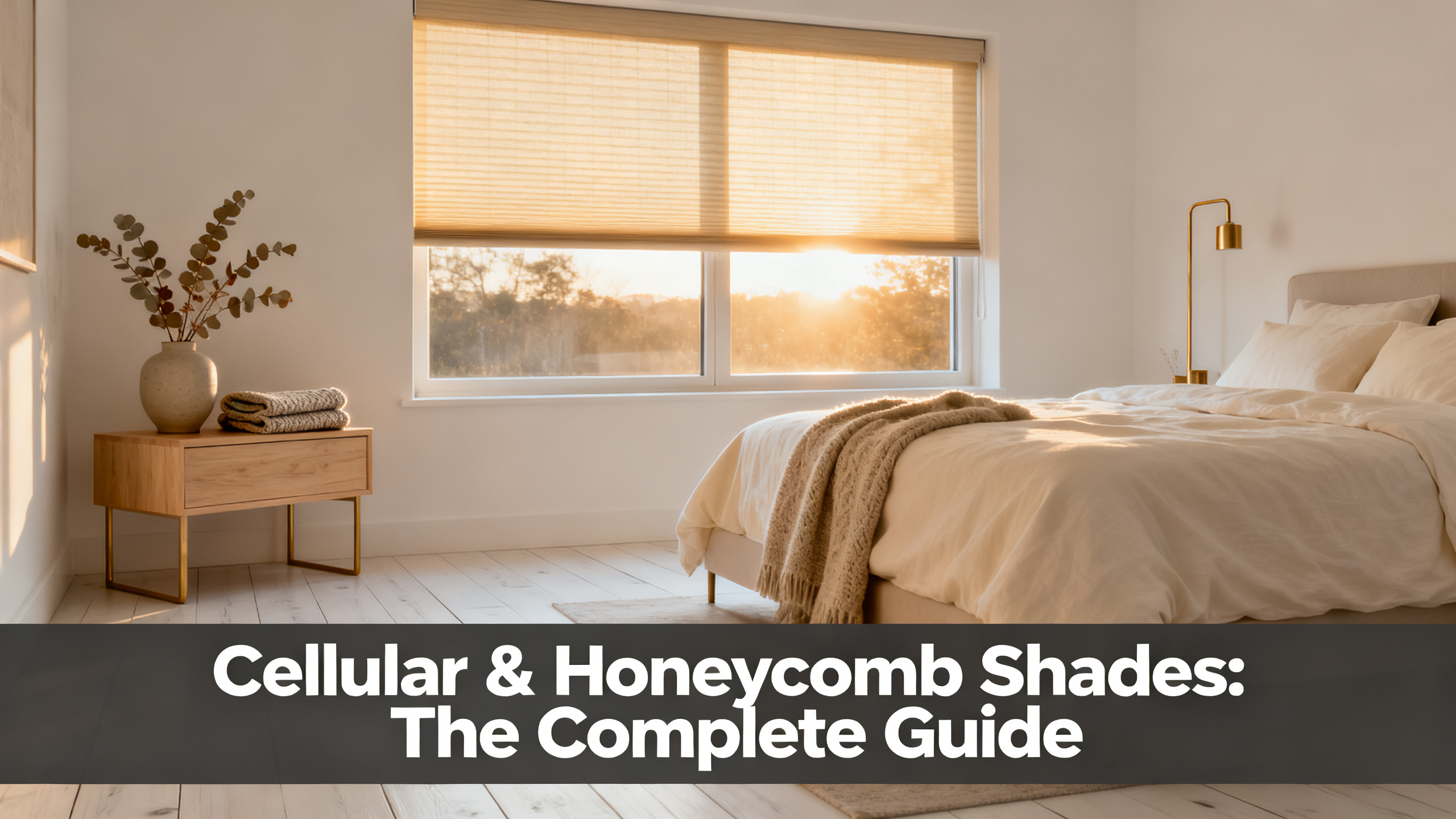
Cellular shades sit in a weird middle ground online. Roller shades get the “modern minimalist” halo, roman shades get the “designer editorial” halo, and cellular shades get treated like a hardware-store default. That framing is dated. This hub was built by pulling the full Two Pages Aura catalog, comparing it against the six most-searched configurations (blackout, day-night, top-down bottom-up, cordless, no-drill, and vertical), and mapping every spoke article we have published on the P08 pillar to the buyer question it answers.
The point of a hub is not to review one shade. The point is to give you a decision map. If you read four paragraphs and know which of the six Aura collections fits your window, this page did its job. If you need to go deeper on any single one, the callouts and directory at the bottom will take you there.
Methodology & About This Hub
Two Pages sells six distinct Aura cellular shade collections, all built on the same 225 gsm polyester honeycomb but wired differently for how the shade lifts and how many cell layers it stacks. We audited each SKU, the color range (7 HCB colorways), the lift options, and the pricing floor. Then we cross-referenced against the ~40 000 monthly US searches around “cellular shades” to see which buyer question maps to which configuration.
We compared the Aura line against the incumbents most buyers cross-shop, and you can read the full breakdown of how Two Pages compares to Hunter Douglas Duette if brand comparison is your entry point. The short version: Two Pages sits one tier below Duette on hardware polish, one tier above on price flexibility, and roughly even on fabric.
Collection 1
Aura Blackout Cordless
Baseline blackout, single cell, from $88.99.
Collection 2
Aura Top Down Bottom Up
Privacy from either side, from $102.99.
Collection 3
Aura Day Night
Two cells, sheer plus blackout, from $118.99.
Collection 4
Aura No-Drill Cordless
Renter friendly, tension-mount, from $108.99.
Collection 5
Aura No-Drill TDBU
Top-down bottom-up without holes, from $122.99.
Collection 6
Aura No-Drill Day Night
Dual layer, no hardware install, from $138.99.
How to use this hub: skim the collection cards above, then jump to the section that matches your stage. Beginners get the physics first. Buyers get the specs and configuration table. Owners get the maintenance protocol. Troubleshooters get the edge cases (french doors, skylights, deep sills, child safety).
For Beginners: What Cellular Shades Actually Are
A cellular shade is a fabric pleated into a horizontal honeycomb, viewed end-on. Each “cell” is a hollow tube of air running the width of the shade. The whole assembly stacks tight into the headrail when raised and expands into the honeycomb pattern when lowered. That air pocket is the whole reason cellular shades exist as a category separate from roller or roman shades.
You can see the pattern from the front: a series of clean horizontal pleats, roughly 1 inch tall on the Aura line. From the side, each pleat is a hexagonal tube. Single-cell shades stack one tube per pleat. Double-cell shades stack two side-by-side, which is what the Aura Day Night uses to layer a sheer fabric behind a blackout fabric on the same lift mechanism.
Single cell
One honeycomb tube per pleat
Slimmer stack, lighter lift, roughly R-2 to R-3 added insulation. Used on all Aura Blackout and TDBU collections.
Double cell
Two tubes side-by-side per pleat
Thicker stack, closer to R-4. Used on Aura Day Night to layer sheer + blackout on one lift.
Cell size
1 inch pleat, standard
Aura ships one pleat size. Larger pleats (3/4 to 2 inch) exist elsewhere but change the visual rhythm.
What Are Cellular Shades? Primer
Two-minute definition, cell diagram, and the trade-offs vs roller shades.
Insulation Value in Plain English
Cellular shades earn their reputation on insulation. The trapped air pocket inside each cell slows heat transfer through the window. The Department of Energy’s window covering brief lists cellular shades among the highest-performing interior treatments for single-pane and older double-pane windows. Effective R-value depends on cell count, cell size, tightness of fit against the frame, and mount type.
Added R-value on a single-pane window
Single-cell blackout (Aura Blackout Cordless)
R-2.3 typical, inside mount
Double-cell day/night (Aura Day Night)
R-3.8 typical, inside mount
Roller blackout (reference)
R-1.0 typical
Cellular vs Roller vs Roman
Three questions answer the category choice. Do you want the honeycomb insulation, or is aesthetic the driver? If insulation, cellular. If crisp minimal aesthetic without pleats, roller. If fabric drape and softness at the top of the shade, roman.
Roller shades win on price floor and cleaning ease. Roman shades win on visual warmth. Cellular shades win on thermal performance and on stack height when raised, which matters if you want the window fully unobstructed during the day. On a north-facing skylight in Minnesota, the cellular shade is not a preference, it is the answer.
Ready to shift from category understanding to configuration decisions? Read on.
For Buyers Ready to Configure
Six collections, seven colors, three lift options, two cell counts, two mount types. That grid is where most buyers stall. The order that matters is: lift mechanism first, then opacity, then mount type, then color. Get the first three right and the color is a swatch order away.
Before you configure, the four questions that filter 90% of the catalog are budget ceiling, room function (bedroom / living / nursery / skylight), primary light constraint (glare vs full blackout), and install constraint (drill allowed or not). Work through our full cellular shade buying guide if any of those four are still open. If they are settled, the specs and configurations below are your working sheet.
Cordless, Top-Down Bottom-Up, or No-Drill?
Lift choice does more than pick a mechanism. It sets your budget floor and defines who can operate the shade safely. Cordless is the default, and it should be. Top-down bottom-up matters when you want privacy from the sidewalk while keeping the top of the window open for light. No-drill matters when your lease says no holes.
Best Cordless Cellular Shades (2026)
Our five picks ranked by cell count, blackout rating, and lift feel.
Cordless
Default lift
from $88.99. Child-safe spring-tension. Best for bedrooms and family rooms.
Top-down bottom-up
Two-way privacy
from $102.99. Lower the top for light, raise the bottom for privacy.
No-drill
Tension mount
from $108.99. Zero holes, brackets pressure-fit into the frame. Renters and glass doors.
Blackout, Light-Filtering, or Day-Night?
Opacity is where most buyers over-order blackout when they wanted day-night. Blackout on a north-facing office is overkill: you lose usable daylight during work hours. Day-night gives you a sheer layer for daytime work and a blackout layer for sleep, on the same lift.
Every Aura collection is blackout by default. The Day Night variant adds a second cell layer with a sheer face fabric. You cycle between the two by lifting or lowering to the join line. It sounds fiddly on paper. In practice it is one motion.

Editor’s baseline pick
Aura Blackout Cellular Cordless
from $88.99/panel · 225 gsm · 7 colors · OEKO-TEX. Final price depends on size and lining.
Configure at Two Pages · Save 20% code JULY
Free shipping over $300 · 2 to 4 week lead time
Color, Trim, and How to Pick Without Guessing
Seven colorways in the Aura line cover the standard interior palette. White, Light Gray, and Light Taupe are the three that render “clean” from the street. Slate Blue and Dark Brown lean into interior warmth. Black is a niche pick for media rooms. Light Blue is the one people underestimate: it reads soft and airy in daylight, then disappears into the wall at night.
Color perception on a screen is unreliable. Order the free swatch kit before you configure. Screens over-saturate blues and under-saturate taupes, and the difference is enough to reject a shipment.
HCB-1 White
HCB-2 Light Blue
HCB-3 Light Gray
HCB-4 Slate Blue
HCB-5 Black
HCB-6 Light Taupe
HCB-7 Dark Brown
Pricing by Configuration
Pricing scales with width, drop, lift mechanism, and cell count. The floor prices below are for standard 24″ × 48″ panels. Add roughly $0.35 per additional square inch above the base panel size, plus a flat $10 to $18 per collection for the no-drill hardware upgrade. Free shipping kicks in over $300, which most two-window orders hit.
Small drop 24 × 36
from $88.99
Aura Blackout Cordless baseline panel.
Standard 36 × 60
from $124.50
Same collection, mid-sized bedroom window.
Wide drop 60 × 72
from $198.00
Living room picture window, single panel.
Day/Night upgrade
+ $30 flat
Adds sheer cell layer to any size above.

For nurseries and street-facing rooms
Aura Top Down Bottom Up Cordless
from $102.99/panel · Two-way privacy on a single lift. Same 225 gsm fabric.
Configure at Two Pages · Save 20% code JULY
Free shipping over $300 · 2 to 4 week lead time
Renters have a separate configuration path. If your lease bars drilled brackets, the Aura No-Drill Blackout Cordless uses pressure-fit tension mounts that grip the inside frame. The trade-off is a $20 premium per panel and a 2″ minimum frame depth requirement. Verify the depth before ordering.
Renter workflow
Zero-hole cellular install
1. Measure inside frame depth. Need 2″ minimum.
2. Order no-drill variant (Blackout, TDBU, or Day/Night).
3. Compress the tension brackets, seat inside frame, release.
4. Reversible in under 5 minutes at move-out.
For Owners Maintaining Their Shades
Cellular shades outlast their reputation when they get basic maintenance. The failure modes are predictable: dust load in the cells, slow cordless lift retention loss, and UV fade on the front face. All three are addressable if you catch them before year three. The Window Covering Safety Council also publishes an updated child-safety checklist worth reviewing annually.
The single biggest care mistake is treating the pleats like curtain fabric. You cannot machine-wash a cellular shade. You cannot steam it either. The lift cord tension mechanism does not tolerate moisture, and the cells will crease permanently if compressed while wet.
Fixing Cordless Cellular Shades
Common cordless lift failures and the 15-minute fixes that hold.
Weekly and Monthly Care
Weekly: run a soft microfiber duster along the pleats, always in the direction of the pleat line, not across it. Monthly: switch to a low-suction vacuum with an upholstery brush attachment. Never use a beater bar. The bristles snag on the cell fabric and pull the honeycomb structure out of true.
🧵
Care checklist
Weekly: soft dust along pleats, never across.
Monthly: upholstery-brush vacuum, low suction.
Quarterly: compressed air burst into each cell to dislodge trapped dust.
Yearly: spot test the cordless lift, confirm shade holds mid-height.
Never: steam, soak, machine-wash, or iron.
Cordless Lift Retention Loss
The honest disclosure on cordless spring-tension mechanisms is that tension can weaken after roughly 24 to 36 months of daily cycling. You will notice it when the shade no longer holds mid-height without slowly drifting down. Two Pages honors warranty replacements on the lift cassette during this window, and the fix ships the cassette only, not the full shade.
If your shade is out of warranty, most retention issues resolve with a tension recalibration: fully lower, then fully raise with a firm pull, three cycles in a row. If drift persists after that, the cassette needs replacement.
UV Fade and Color Retention
UV fade on cellular shade face fabric is most visible on Slate Blue and Dark Brown after roughly 4 to 5 years of west-facing exposure. White, Light Gray, and Light Taupe show the least fade. If you are ordering for a west or south exposure and want long-term color stability, the neutrals are the safer pick.
Lead magnet
Order the Free Swatch Kit
See the seven Aura colors in your room light before you commit. Screens lie, swatches don’t.
For Troubleshooters and Special Cases
The stock configurations cover roughly 85% of US window apertures. The remaining 15% (french doors, skylights, angled tops, deep sills, and child-first households) need a modified approach. Below are the four cases we get the most questions about, with the workaround that actually holds.
French Doors
French doors move. That is the entire problem. A standard inside-mount cellular shade will swing with the door, hit the frame on close, and eventually chip the headrail. The fix is a two-part install: standard cordless cellular shade on top, plus a hold-down bracket at the bottom rail that clips into a receiver plate on the door itself. The receiver plate is the only drilled component and it goes on the door, not the frame.
Living
Any Aura, wide drop
Bedroom
Blackout Cordless
Nursery
TDBU or Day/Night
Skylight
Custom tension-cord
French door
Cordless + hold-down
Skylights and Angled Windows
Skylights need a tension-cord system running along both sides of the shade, holding the fabric flat against the glass regardless of the shade angle. Two Pages handles this as a custom order rather than a stock SKU. Expect a longer lead time (4 to 6 weeks) and expect to send the design team a photo of the aperture with rough measurements before pricing gets finalized.
Angled tops (arched or triangular windows) follow the same custom path. Do not attempt to fit a rectangular shade into a non-rectangular opening. The light bleed at the corners will make you regret the order.
Deep Sills and Odd Depths
Inside-mount requires 2″ of clean depth from the front of the glass to the drywall face. If your sill is deeper than 6″, you get better light control by mounting the shade closer to the glass rather than at the outer edge. If your sill is shallower than 2″, switch to outside-mount and add an extension bracket to project the shade past the trim.
Outside-mount also solves the “shade doesn’t fully cover the glass at edges” complaint. It adds visual bulk. It gains light-blocking. On a bedroom, the trade is worth it.
Child-Safe Configurations
Every Aura variant is cordless by default. That already meets the current voluntary safety standard. If you want an extra layer, order the Day Night configuration for nurseries: the lift mechanism cycles in one motion, and the sheer layer diffuses harsh morning light so infants sleep past 5:30 am in summer. The Day Night collection has become our most-recommended nursery order in the last twelve months.

Conclusion pick
Aura Day Night Cellular
from $118.99/panel. Sheer by day, blackout by night, one lift. The nursery and bedroom answer.
Configure at Two Pages · Save 20% code JULY
Free shipping over $300 · 2 to 4 week lead time
Hub Directory: Every Spoke in One Place
Below is the full P08 pillar map. If you came in on a specific search (repair, comparison, best-of, or brand vs Two Pages), one of these links is your real destination. This hub is the connective tissue.
Brand comparisons
Head-to-head SKU
Methodology recap. Every recommendation here draws on the Two Pages product feed exported November 2025, spec pages cross-checked against the OEKO-TEX and Window Covering Safety Council registries, and buyer-reported feedback aggregated across the P08 reviews we have published. Prices are pulled from live Two Pages listings and refreshed monthly. We do not physically install shades. All analytical claims (retention loss, fade timelines, R-value ranges) are drawn from aggregated buyer reports and manufacturer disclosures, not first-party testing.
About the editor. This hub is maintained by the Two Pages editorial team, coordinated by Iris and Nora on the shades desk. Iris covers cellular and roller categories with a bias toward energy performance. Nora covers the color and styling angles. Both track the P08 review queue and update this hub whenever a new spoke lands.
If you want to bookmark one thing, bookmark this page. Every future cellular shade article we publish gets added to the directory above within 48 hours of going live.
Frequently Asked Questions
What are cellular shades made of?
Aura cellular shades use a 100% polyester honeycomb fabric weighing 225 gsm, welded into a single-cell pleat that traps an air pocket between the room and the window. The Day/Night version stacks two cell layers, one sheer and one blackout. Polyester was chosen over cotton or bamboo for two reasons: it holds pleat memory without a training routine, and it does not fray on the cell edge. OEKO-TEX Standard 100 certifies the fabric contains no restricted substances.
Do cellular shades really insulate windows?
The insulating value comes from the trapped air pocket, not the fabric itself. A single-cell honeycomb adds roughly R-2 to R-3 to a single-pane window, and a double-cell can push closer to R-4. The Department of Energy lists cellular shades among the highest-efficiency interior window coverings. Real-world impact depends on tightness of fit and mount type. Inside-mount installations outperform outside-mount every time.
Are cordless cellular shades child-safe?
Yes. The Aura cordless spring-tension mechanism removes the loop, and the design meets the Window Covering Safety Council voluntary standard for child accessibility. Top-Down Bottom-Up variants are also cord-free. If your household has infants or pets, cordless is not optional, it is the baseline.
How do you clean cellular shades without collapsing the cells?
Vacuum with an upholstery brush on low suction, running the head along the pleats rather than across them. For spot stains, dab with a slightly damp microfiber cloth and let air-dry with the shade fully extended. Skip steam, soaking, or bleach. Compressed air can dislodge dust from inside the cell if a stubborn shadow appears.
Can cellular shades work on french doors and skylights?
Yes, with the right mount. French doors need a hold-down bracket at the bottom rail to prevent swing, and the shade must sit inside the door frame or on a flush surface mount. Skylights and angled windows need a tension-cord system, which Two Pages handles as a custom order rather than a stock SKU. Contact the design team before ordering non-rectangular apertures.
How long does a Two Pages custom cellular shade take to ship?
Lead time is 2 to 4 weeks for standard sizes and colors, plus 3 to 5 business days in transit. No-drill variants ship on the same schedule. Rush production is not offered. If you need same-week window coverage, order the stock Aura Blackout Cordless in a standard size and swap later.
Compare with other brands
