
Free interactive tool
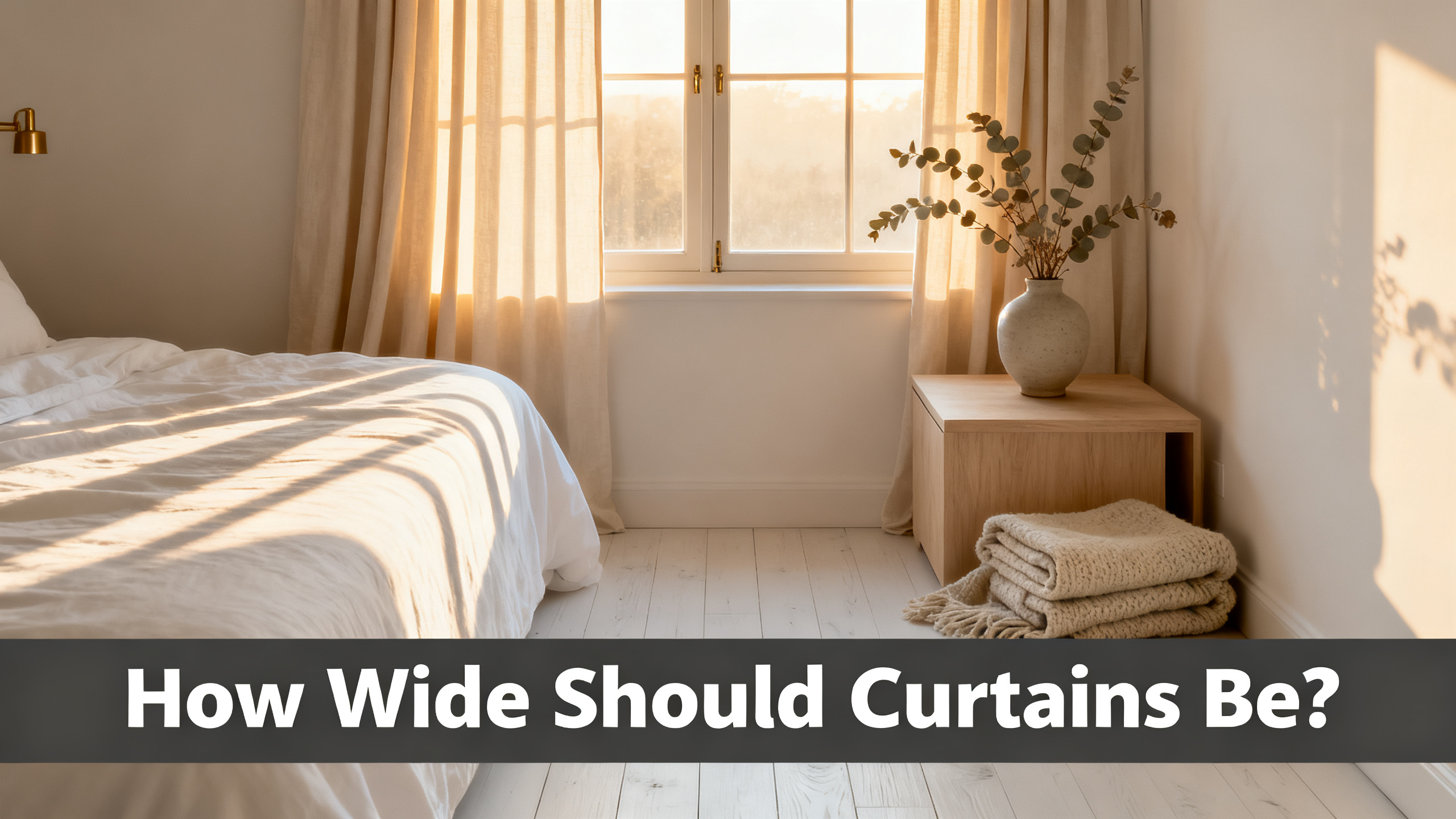
How Wide Should Curtains Be? The 2x Rule + Live Fullness Calculator
Type your rod, pick a header, drag the fullness. The curtain redraws its folds live, and the numbers below it are the ones you enter into any custom order form.
Your window · folds redraw as you type
Total fabric width
144"
Per panel, the order-form number
72"
Pleats per panel
Ratios match the ones worked in this article: 2x floor for pleated headers, 1.5x acceptable for grommet and rod pocket, 2.5x to 3x for sheers. Shadehunt may earn a commission on Two Pages orders. See our affiliate disclosure.
More free Shadehunt tools
The calculator above returns the three numbers this article exists to explain: total fabric width, per-panel width, and the pleat or grommet count that width produces. Drag the fullness slider under 2x on a pleated header and watch the drape flatten in the drawing: that failure mode is the rest of this page.
Done right, one panel stacks off the glass and reads like a wall of soft fabric across the whole window. Done wrong, it hangs like a tube, pulls flat, and shows a strip of rod at each side. The difference is one number: how wide your panel total is compared to your rod length.
That number sits at the heart of the classic 2x rule, and it decides more of the finished look than the color, the header style, or the price per panel combined. According to The Spruce curtain sizing reference, the rule has held for decades because pleated fabric physically needs volume to fold and settle into place. If you want the wider context, the install and measure curtains hub maps every install variable that touches this one.
The 2x Rule at a Glance
📐
Rod length
Measured bracket to bracket. Not the window trim. Not the glass. Usually 16 to 24 inches wider than the frame.
✖️
Times 2 (the multiplier)
2x for pleated headers as the floor. 1.5x for grommet or rod pocket. 2.5x to 3x for sheers.
🪟
Panel total width
Combined fabric width across all panels on the rod. Not each panel individually.

The panel sized for the 2x rule
Liz Linen Extra Wide Curtains Pleated
from $59.99/panel · 10% linen 90% polyester · 350 gsm heavyweight · pinch pleat header · 112-inch fabric width · one panel covers what two standard panels used to. Final price depends on size and lining.
Use code JULY for 20% off · Free shipping over $300
The 2x Rule, Stated Plainly
Panel total width equals rod length multiplied by at least 2. That is the rule. It is not per panel, it is not the window measurement, it is not the sum of the two halves of the rod. It is total fabric width across every panel that will hang on the rod, and it needs to be at least twice what the rod itself measures bracket to bracket.
The reason is what happens when the panel is closed. Pleated fabric folds on itself in a repeating accordion, and each fold consumes roughly half the flat width of the fabric. A panel exactly the width of the rod has nothing to fold with. It stretches flat, exposes the header hardware between the pleats, and reads visually as a bedsheet on a curtain rod.
Fullness Ratio Comparison
1.5x fullness
🔲
Reads flat. Acceptable on grommet and rod pocket with heavy fabric. Not enough for any pleat.
2x fullness
🔳
The safe floor. Pinch pleat, ripple fold, and goblet sit right at 2x on 250 to 350 gsm fabric.
2.5x fullness
🟫
The designer standard. Pleats sit rounder, drape reads softer, hold-marks stay through steaming.
3x fullness
⬛
Sheer and lightweight linen territory. Below 150 gsm needs the volume to look intentional.
The Math: Rod Length x Fullness Ratio
Sounds like fabric math for the sake of math. It shows up the moment the sun rises through the wrong side of an under-full panel. Here is the calculation, worked from the most common rod sizes.
For a 60 inch rod, panel total width equals 60 x 2 = 120 inches at the 2x floor, or 150 inches at 2.5x. For a 72 inch rod, that becomes 144 to 180 inches total. For a 96 inch rod covering a wide living-room bay, you are looking at 192 to 240 inches of fabric across all panels combined. Below is the same math worked from 30 to 144 inch rods.
Curtain Size Calculator (Free Tool)
Enter rod length and fullness ratio, get total panel width in inches plus recommended panel count. Skips the manual math on odd rod sizes.
⚠️ Common Mistake
Rounding down the fullness ratio to save on fabric cost. A panel ordered at 1.7x fullness for a pleated header stays visibly stretched flat for the entire life of the drape. That savings on ounces of fabric shows up on the wall every day.
Step 1: Measure the Rod, Not the Window
Bracket to Bracket, Not Trim to Trim
The rod is the reference. Not the window trim, not the glass, not the interior frame. The panel hangs from the rod and needs to cover the rod, so the rod length is what feeds the 2x calculation.
A common miss: measuring the window at 36 inches, ordering two 36-inch panels for a total of 72 inches of fabric, and then hanging them on a rod that spans 52 inches bracket to bracket. That is only 1.4x fullness on the rod, well below the 2x floor. The panels pull flat, the drape reads stingy, and the fabric cost is already spent.
How to Measure for Curtains (Complete Guide)
Rod projection, return-to-wall, drop calculation, and the two-tape measurement pass that catches out-of-square frames before you order.
If the Rod Is Not Up Yet: Add 16 to 24 Inches to Trim Width
If the hardware is still in a box, use this rule: window trim width plus 8 to 12 inches per side equals the rod length. So a 36-inch window becomes a 52 to 60 inch rod. That extra projection is the stack-back space, where the folded panel sits during the day.
📏 Measurement Tip
Wider projection buys two things at once: more visible glass during daytime (panel stacks fully off the frame), and better center-closure at night (the panel wraps past the trim by an inch, killing side light gaps).
Curtain Rod Length & Height Calculator
Rod still in the box? The interactive calculator turns window width, ceiling and crown into rod length, mounting height and bracket count, then feeds this page’s fullness math automatically.
⚠️ Common Mistake
Ordering panels to the window width, then discovering the installed rod is 20 inches wider. The panels look adequate against the glass and starved against the rod. Return shipping on custom panels is rarely free.
1.5x vs 2x vs 2.5x vs 3x: Which Ratio for What Header
Grommet, Rod Pocket, Tab Top
Grommet, rod pocket, and tab-top headers slide onto the rod directly, without pleats. They form soft casual waves instead of engineered folds. On these headers, 1.5x can pass in casual rooms and casual budgets, especially with heavier fabric (250 gsm or more) that holds its own shape.
Push to 2x if the room is formal, if the panel is a lightweight linen, or if the header is going to be closed regularly. Sliding a tab-top back and forth loosens its shape faster than a pinch pleat, and extra width buys forgiveness.
Pinch Pleat, Ripple Fold, Goblet, Inverted Pleat
Pleated headers are engineered folds. Each pleat consumes a chunk of flat fabric that the finished header does not display. The pleat count is calibrated to the fabric width ordered, so a panel starved of fabric arrives with pleats that stretch flat between the hooks instead of standing round.
For any pleated header, 2x is the floor and 2.5x is the design standard. Two Pages sizes pleat count based on ordered fabric width, so a 120-inch panel ordered for a 60-inch rod (2x) gets more pleats than a 90-inch panel on the same rod (1.5x), and the pleat depth stays consistent across the header.
Sheer and Light Layers
Sheers and semi-sheers below 150 gsm read see-through by design. At 2x fullness, the fabric is thin enough that the volume disappears against the light coming through it. Aim 2.5x to 3x for sheers, per This Old House on drape fullness. The extra width is what makes sheers register as intentional soft treatments and not as forgotten drop cloths.
Fabric Density × Fullness Ratio Grid
150 gsm × 1.5x
Reads sheer and starved. Sheer stops looking intentional.
150 gsm × 2.5x
Sheer sweet spot. Airy volume without opacity.
250 gsm × 2x
The versatile default. Works on pleats and grommets alike.
250 gsm × 2.5x
Living-room formal. The pleats round well, the drape reads intentional.
350 gsm × 2x
Heavyweight linen or velvet. 2x is enough because the density holds shape.
350 gsm × 2.5x
Luxury drapery reading. Substantial folds, deep pleats, formal register.
One Panel or Two? The Single-Panel Trap
Picture a 96-inch rod with two 52-inch panels: they meet in the middle and pull flat. Now picture a single 104-inch panel on the same rod, pushed to one side. It bunches asymmetric, hides the stack-back on the empty side, and reads like the window was framed for a magazine cover but the fabric is on strike.
How Many Curtain Panels Do I Need?
Panel-count logic per rod width, when to jump from two to four, and why odd numbers of panels almost always create a visible seam problem.
Two panels split at the center is the traditional default. Each panel equals the rod length, so both together deliver 2x fullness on the rod. On rods over 96 inches, four panels can be cleaner (two at each side, meeting in a soft center overlap) but every added panel adds one visible seam at the meet-line.
Single Panel vs Two Panels vs Four Panels
Rod up to 40″
Single panel works. Push to one side or stack fully to the side each morning. Common on kitchen and bathroom windows.
Rod 40″ to 72″
Two-panel split at the center. The default for living rooms, bedrooms, and dining rooms with standard windows.
Rod 72″ to 144″
Two extra-wide panels or four standards. Extra-wide skips the interior seams. Four standards multiplies meet-lines to three.
⚠️ Common Mistake
Single-panel installations on rods over 40 inches. The panel bunches to one side, hides all the stack-back on the empty half, and leaves a visual imbalance no wall paint can compensate for.
The Extra-Wide Panel Alternative
Standard Panel Width Caps Out at 52 to 54 Inches
Real talk on Amazon curtain panels: nearly every standard retail panel runs 50 to 54 inches of fabric width. That is a factory-loom constraint, and it holds across most brands you can order in two days.
On a 60-inch rod at 2x, you need 120 inches of total panel width. Two 54-inch panels give 108 inches, close to 2x but not there. Two 60-inch panels get you exactly 2x, but standards do not come in that width. The result: designers either accept a slightly under-full drape, or stack three panels on the rod with two visible seams. Neither is clean.
Standard Panel Widths on the Market
Retail standard
50-54″
Amazon, Target, IKEA. Factory-loom cap. Multi-panel required past 30″ rods.
Two Pages standard
Up to 96″
Custom width per panel, made to order. Covers 48″ rods at 2x with one panel.
Two Pages Extra Wide
112″
Single-panel coverage at 2x on rods up to 56″. No interior seams on wide windows.
The 112-Inch Fabric Width Case
Where standard retail widths lose to custom fabric width every single time: rods over 56 inches. The Liz Linen Extra Wide product page lists 112 inches of fabric width per panel, which is roughly double what standard retail delivers. Two Extra Wide panels cover a 108-inch rod at exactly 2x fullness with only one seam at the center meet-line, versus four standards with three interior seams.
The Liz Linen Extra Wide review covers how the pleat count and header structure hold up on the wider fabric, and how the 350 gsm density carries the extra weight without sagging. The Liz Linen Extra Wide configurator lets you enter the exact rod length and returns the recommended panel count, header spec, and pleat spacing based on the fabric-width math above.

One Extra-Wide Panel Solves the 2x Rule Without Layering
Standard curtain panels top out at 54 inches of fabric width, so a wide window needs two or three side by side, with visible seams at the meet-lines. Liz Linen Extra Wide runs 112 inches of fabric width per panel and delivers the full 2x fullness on rods up to 56 inches without a joint. from $59.99/panel, pinch pleat header, 6 neutral colorways.
Sliding Doors, French Doors, and Patio Rules
Extra Stack-Back for Door Swing Clearance
If it were my sliding door, I would order one extra-wide panel and skip the seam problem entirely. Sliding doors have a moving track that panels must clear when open, so the rod needs projection 18 to 24 inches past each side of the door, not the usual 8 to 12 for a fixed window.
On a 72-inch sliding door, that becomes a 108-inch rod. Apply the 2x rule: 108 x 2 = 216 inches of panel total. That is four standard panels (with three seams) or two Extra Wide panels (with one center seam only).
French Doors Keep the 2x Rule at Each Door
French doors are a different problem. Each door swings independently, so panels on a rod above both doors need to clear the swing on either side. The 2x rule still applies to the full rod length, but the practical solution is often a single wide panel per door (mounted on individual rods above each door frame), giving each door its own 2x coverage at door width.
How the 2x Rule Changes on Doors
Sliding door 72″
Rod 108″ (18″ projection each side). Total panel width 216″ at 2x. Two Extra Wide panels or four standards.
French doors 60″
One rod above both (96″ total) or one rod per door (36″ each). Panel per door needs 72″ of fabric at 2x.
Patio door 96″
Rod 144″ (24″ projection each side). Total panel width 288″ at 2x. Two Extra Wide panels is the seam-free option.
⚠️ Common Mistake
Sliding door panels sized 2x rod but not projected far enough. The panel bunches against the door track when open, blocks the actual door slide, and forces you to shove fabric aside every time you step onto the patio.
5 Symptoms Your Panels Are Too Narrow
Because sometimes the panels are already on the rod and the question is: are these wide enough. Below are the visual and functional flags that read as under-full drape.
5 Symptoms of Under-Full Panels
🔻
Pleats stretch flat
Visible hooks between pleats. Header reads wired instead of gathered.
📏
Rod visible when closed
Strips of rod peek at each side of the panels, especially in morning light.
🔲
Flat vertical face
No accordion folds. Panel reads like a bedsheet stapled to the rod.
☀️
Center light gap
Two-panel meet-line does not overlap, leaving a vertical daylight strip.
🔀
Stack-back too shallow
Open panels do not clear the glass. Window reads visually cluttered during the day.
The Bridge: The Panel Sized for the Number You Just Calculated
Now the width math is done. Rod length times fullness ratio equals total panel width, split across the panel count that fits your window size. The one number that decides how a drape reads on the wall is settled.
See 38 Linen-Blend Colorways in Hand Before Committing to 112 Inches of Fabric
A wide panel doubles the visual weight of the wrong color. The Liz Linen booklet ships for $3.99 so you can hold each colorway against the wall paint, the sofa upholstery, and the morning light before ordering a $200+ panel set. Same fabric as the Extra Wide line, same 350 gsm density.
Panel choice is the last variable. On rods up to 40 inches, any standard panel gets you to 2x cleanly. On rods from 40 to 56 inches, one Two Pages Extra Wide at 112 inches of fabric width covers the full 2x with a single seamless panel. On rods over 56 inches, two Extra Wide panels replace the four standards that would otherwise crowd your rod with interior seams.
You Have the Width. Order the Panel Built to Fill It.
Liz Linen Extra Wide ships in 6 neutral colorways, all 350 gsm, all with the pinch pleat header sized to hold 2x fullness on rods up to 56 inches without a seam. from $59.99/panel. Code JULY (20% off) · Free shipping over $300 · lead time 10 to 12 days.
Frequently Asked Questions
How wide should curtains be compared to the window?
Panel total width should equal 2 to 2.5 times the rod length, not the window width. On a 60-inch window, the rod usually extends 8 to 12 inches past each side to give the panels stack-back space, so the rod runs 76 to 84 inches. Multiply that rod by 2 for the total panel width: 152 to 168 inches of fabric across all panels combined. Ordering to the window instead of the rod is the top reason wide windows read stingy.
What is the 2x rule for curtains?
The 2x rule states that the combined width of all curtain panels on a single rod should equal at least 2 times the rod length. This delivers the fullness needed for a pleated or gathered header to sit right, not stretch flat. For pinch pleat, ripple fold, and goblet headers, 2x is the floor. For grommet and rod pocket, 1.5x can pass. For sheers, aim 2.5x to 3x because low-density fabric needs more volume to look intentional.
How wide is a standard curtain panel?
Retail standard panels run 50 to 54 inches of fabric width per panel. That is why a 60-inch rod needs two panels side by side to hit 2x fullness. Two Pages Extra Wide panels run 112 inches of fabric per single panel, which covers a rod up to 56 inches at full 2x fullness without a seam at the meet-line.
How much wider than my rod should each panel be?
On a two-panel split, each panel should equal the rod length so both together give 2x. On a 72-inch rod, order two panels of at least 72 inches wide each, for 144 inches total. On sheer or very airy fabric, size each panel at 1.25 to 1.5 times the rod length individually. Panels sized only to half the rod (rod length total for both) read stingy and pull flat at the center.
Do you need to double the width of curtains for pleats?
For pinch pleat, goblet, ripple fold, and inverted pleat headers, yes, 2x minimum is what makes the pleats sit right instead of stretching flat between the hooks. Two Pages configures the pleat count based on the fabric width you order, so 112-inch Extra Wide panels get more pleats than 54-inch standards, and the pleat depth stays consistent. Skimping to 1.5x on a pleated header creates gaps between the pleats.
How wide should curtains be for sliding glass doors?
Sliding doors typically run 60 to 96 inches wide, so extend the rod 18 to 24 inches past each side for door swing clearance, then apply the 2x rule to the full rod. On a 72-inch sliding door with a 108-inch rod, you need 216 inches of panel width total. Two Pages Extra Wide at 112 inches per panel lets you cover this with two panels seamlessly, versus four standard panels with three visible seams.
Is 1.5x fullness enough for curtains?
For grommet, rod pocket, and tab-top headers, 1.5x can pass in casual rooms, casual budgets, and for very heavy fabric that holds shape on its own. For pleated headers of any kind, 1.5x is not enough. The pleats will stretch flat between hooks, the header will look wired instead of gathered, and the panel will read like a shower curtain. When in doubt, 2x.
Should curtains touch the floor or hang above?
Curtains should graze the floor by half an inch, or puddle 2 to 6 inches. Panels stopping above the floor look like they shrunk in the wash. Floor length is the safe designer default. A 2-inch puddle adds a soft romantic drop that works with heavy linen and velvet. A 6-inch puddle reads formal but requires steaming every few weeks. Cafe length is a kitchen decision, not a living-room or bedroom one.
