
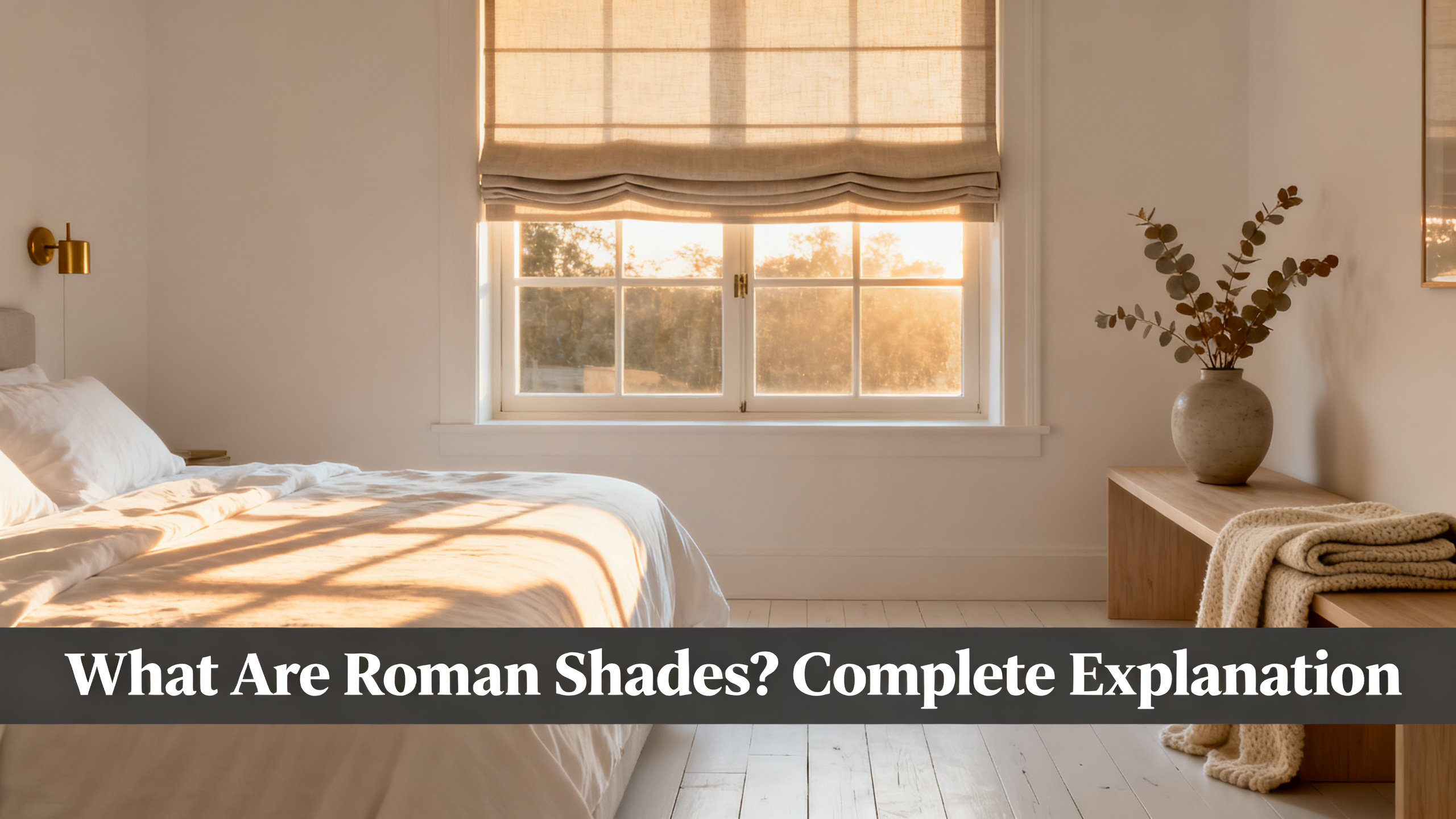
Roman shades are fabric window coverings that fold up into horizontal pleats when raised, and hang flat when lowered. The category combines the soft look of a curtain with the compact stack of a blind, and comes in nine distinct fold styles across custom widths up to 71 inches.
The Definition, Up Front
A Roman shade is a fabric panel that folds up in horizontal pleats via a cord, chain or cordless lift.
9 fold styles. 6 lining options. 3 lift systems. 2 mount configurations.
Sits between rigid blinds and full-length curtains, on the fabric-forward side.
The name traces to Ancient Rome, where linen awnings called vela were rigged over the Colosseum with a rope-and-pulley system that gathered the fabric into folds. The mechanism carried into Italian palazzo interiors in the 1600s, then into American Waverly catalogs in the 1970s, and now sits in a mature US market with roughly 90,500 monthly searches for the base term. The Wikipedia entry on Roman shades covers the etymology in more depth for readers who want the historical thread.
The rest of this piece maps the anatomy component by component, the nine folds and how they differ, the three lift mechanisms and who each one is for, the six lining tiers with their shading rates, the two mount options, and how Roman shades sit next to blinds, curtains and cellular shades in the 2026 window treatment landscape. That framework is unpacked one level deeper in the Roman shades complete guide.

The Roman shade the definition points to
Liz Linen Window Roman Shade, Loop Cord Lift
from $59.99/panel · 90 percent polyester 10 percent linen · 38 colorways · loop cord lift · 6 lining options · custom widths 18 to 71 inches, drops 12 to 90 inches. Final price depends on size and lining.
Use code JULY for 20% off sitewide · Free shipping over $300
The Anatomy of a Roman Shade
Sounds like one product. It is eight components pretending to be one product, and naming each of them makes the rest of the article legible. A Roman shade breaks down into a headrail, a fabric panel, a fold construction, rear rings and cords, a lift mechanism, a bottom rail, mount hardware, and an optional lining.
Roman Shade Anatomy · 8 Components
| Component | Function | Two Pages Spec (Liz Linen) |
|---|---|---|
| Headrail | Mounts to window frame or wall, houses the lift mechanism | 1 5/8″ h × 1 1/8″ d aluminum |
| Fabric panel | The visible face of the shade, hangs flat when lowered | 90% polyester 10% linen, ~90 gsm |
| Fold construction | Determines the raised silhouette and the era the shade reads | 9 fold styles catalog-wide |
| Rear rings + cords | Sewn to the back at 6 to 8 inch intervals, gather the fabric into folds | Nylon cord, polyester rings |
| Lift mechanism | Cord, cordless, or continuous chain — how the shade raises and lowers | 3 systems (cord, cordless, loop cord) |
| Bottom rail | Weights the fabric so folds stack evenly, also hides the last cord loop | Aluminum rod, detachable for wash |
| Mount hardware | Brackets that attach the headrail to frame (inside) or wall (outside) | 1 1/4″ h × 1 3/4″ d brackets |
| Lining (optional) | Second fabric layer behind the face, changes light control 0 to 100% | 6 lining tiers available |
Reading the table quickly: the headrail carries the lift, the fabric panel is what the room sees, the rear rings and cords do the folding math, the bottom rail weights the fold so it stacks cleanly, and the lining is where 30 to 100 percent of the shade’s light control comes from. Everything else is packaging around those five decisions.
The Nine Fold Styles at a Glance
The fold is the single decision that shapes the personality of the shade. Two Pages offers nine distinct fold constructions, and they split cleanly into three families: flat, pleated, and specialty.
Flat folds read as architecture. Pleated folds read as fabric. Specialty folds read as tradition or novelty.
Are Roman Shades Outdated in 2026?
Once the anatomy is clear, the next question buyers ask is whether the category still reads current. Short answer: yes, except for three specific looks. Long answer in the sibling FAQ.
The 9 Fold Styles Two Pages Catalogs
1. Flat Fold
Crisp architectural face, no visible pleat when raised. The modern default.
2. Deco Fold
Subtle horizontal seam every 8 to 12 inches, flat when raised.
3. Relaxed Fold
Soft intentional swag at the hem, transitional and coastal rooms.
4. Hobbled Fold
Permanent horizontal folds even when raised. Heavier, tailored look.
5. Balloon Fold
Puffy volume at the base. 1990s Waverly signature. Dated in most rooms.
6. London Fold
Elegant curved pool at hem, formal dining and study rooms.
7. Austrian Fold
Shirred vertical folds, ornate. Reads theatrical, rare in 2026.
8. Front Slat
Flat face with rear horizontal slats for structure. Andy collection.
9. Valanced
Built-in top valance covering the headrail. Traditional or Ian collections.
Reading the grid, the two folds that carry the “modern Roman” reading in 2026 editorial coverage are flat and deco. The Patti Linen Deco Fold Roman Shade is a clean example of a deco fold in a warm-neutral linen blend, and the Liz Linen loop cord lift covers the flat fold family. If it were my own dining window, the pick would be a flat fold in a Liz 1908 series linen blend, cordless, inside mount, no lining.

The Three Lift Mechanisms
The lift decides how the fold happens and who can safely operate the shade. Two Pages offers three systems, and each has a distinct use case.
The 3 Lift Systems, Compared
Cord Lift
Pro: most common, budget-friendly, easy stop-at-any-height.
Con: not WPMA compliant for kid rooms and nurseries.
Best for: living, dining, adult bedrooms.
Cordless
Pro: lift via bottom rail push-pull, WPMA compliant, clean face.
Con: +$20 to $40 premium vs cord lift.
Best for: kitchens, bedrooms, nurseries, kid rooms.
Continuous Chain / Loop Cord
Pro: loop on a bead chain, precise micro-positioning, no lift limit.
Con: loop stays visible on the side, needs cord cleat for kid safety.
Best for: large drops above 60 inches, tall windows.
Cord lift is what the mental image of “Roman shade” usually points to. Cordless is what the mental image should point to in 2026 for any room with a child under eight. The Window Covering Manufacturers Association (WPMA) publishes safety guidance recommending cordless for those rooms, and Two Pages defaults to cordless on nursery and kid-room configurations.
The continuous chain, or loop cord lift, sits in a niche: tall windows where a single pull cord would need a 6-foot reach. The Liz Linen loop cord lift belongs to that category and handles drops up to 90 inches with precise stop-at-any-height positioning.
A fourth mechanism deserves a mention even though it is not a fold-changing decision: top-down-bottom-up cordless. The shade lowers from the top independently of the bottom lift, so the buyer keeps sky light while covering eye level. It is not a novelty, it is a different answer to the same “how do I get privacy without darkening the room” question.

The Lift That Rewrites the Category.
Top-down-bottom-up cordless. The Andy shade lowers from the top and raises from the bottom independently, so the buyer keeps sky light while covering eye level. from $109/panel, linen front slat, cordless, 6 lining options. Not a novelty. A different answer to the same question.
The Six Lining Options
Picture a north-facing bedroom window at 6 am in June. The lining decides whether the room reads dawn or dusk. The fold decides whether the shade reads architectural or fabric. Both matter, but on operational days-per-year, the lining does more work than the fold.
Two Pages offers six lining tiers, each with a distinct shading rate.
The 6 Lining Tiers · Shading Rate
Unlined
0%
Fabric alone. Softest light diffusion. Kitchen and dining.
Sheer Liner
10-20%
Minimal blockout, adds body to the fold, daytime privacy.
Room-Darkening
60-70%
Home office, screen glare control, adult bedroom.
Blackout
95-100%
Nurseries, north-facing bedrooms, shift-worker sleep.
Thermal
85%
Energy loss zones, drafty single-pane windows.
Cotton Flannel
40%
Acoustic dampening, luxury drape hand.
Rule of thumb: bedroom and nursery default to blackout, kitchen and dining default to unlined or sheer, north-facing rooms and energy loss zones take thermal, home office takes room-darkening for screen glare.
Cotton flannel is the outlier. It does not lead on light control but on acoustic dampening and drape hand. It sits inside primary bedrooms and libraries where fabric weight is part of the aesthetic.
Inside Mount vs Outside Mount
The mount is where the shade physically attaches to the window architecture. Two options, one rule of thumb.
Inside mount sits inside the window frame reveal, shows the wall trim around the shade, and produces the cleanest architectural read. It needs at least 2 inches of depth in the frame reveal to house the headrail.
Outside mount attaches to the wall or trim above the frame, covers a wider area than the window opening itself, and delivers better edge-to-edge light blockout because the fabric extends past the frame.
Inside vs Outside Mount, One Rule
Inside mount sits inside the window frame and shows the trim around the shade. Outside mount attaches to the wall above the frame and covers a wider area. Inside mount needs at least 2 inches of depth in the frame reveal. Below 2 inches, outside mount is the default.
Roman Shade vs Roman Blind vs Curtain vs Cellular
The category makes more sense next to its neighbors. Four common alternatives sit adjacent to Roman shades on the window covering shelf, and each one competes on a different axis.
Real Talk on Roman Shade vs Roman Blind
In American English they are the same product. In British English “Roman blind” is the standard term. On US search “Roman shades” outranks “Roman blinds” 5 to 1 by volume. Two Pages uses the US label. If the buyer sees “Roman blind” on a UK site, that is not a different category, just a regional label.
Roller shades are a single continuous fabric wrap on a top roller. No fold, no pleat, no fabric texture at rest. Minimalist and commercial-look residential, priced $30 to $80 at the ready-made entry point.
Cellular shades use a honeycomb structure that traps air between two fabric layers for insulation. Functional-first, not textural. Rectangular efficient stack, $40 to $90 at entry.
Venetian blinds are horizontal slats, structurally different from any fabric shade. Slats tilt for light control rather than stack. The 2018-to-2026 decline in designer usage is measurable and steady.
Window Treatment Comparison · 5 Categories
| Category | Material | Stack When Raised | Light Control | Best Rooms | Custom Entry |
|---|---|---|---|---|---|
| Roman shade | Fabric panel, 9 folds | Horizontal pleats stacked | 0-100% via 6 linings | Kitchen, dining, bedroom | $59.99/panel |
| Roller shade | Single fabric wrap | Rolled cylinder at top | Depends on fabric spec | Office, minimalist | ~$45/panel |
| Cellular shade | Honeycomb structure | Flat rectangular stack | 50-99% varies | Cold rooms, north-facing | ~$50/panel |
| Venetian blind | Horizontal slats | Slats tilt then stack | Slat angle dependent | Utility, garage | N/A ready-made only |
| Curtain panel | Full-length fabric | Gathers on side (no raise) | 0-100% via linings | Living, primary bedroom | ~$79/panel |
Reading the table, Roman shade is the fabric-forward category with the widest custom range and the softest visual at rest. Roller and cellular shades are functional-first. Venetian is a slat category, structurally different. Curtain panels are the full-length hanging complement, not a substitute — they layer on top of a Roman shade in the most common living-room configuration.
Roman Shade Buying Guide
The buying decision maps to 5 questions: room function, light control, fold, fabric, lift. The full buying guide walks the buyer through each, with room-by-room recommendations.
Where Roman Shades Fit in the 2026 Market
Now, before scaling the anatomy into the rest of the Two Pages catalog, one grounding question: where does the category sit in 2026? The Google Trends five-year data for the base term is stable, with a slight upward drift year over year.
US search volume for roman shades sits at roughly 90,500 per month across 2021 to 2026. Two Pages added 15 new Roman shade collections since 2023. Elle Decor and Architectural Digest continue featuring Romans in editorial room reveals through 2025 and 2026. That is a mature category, not a fading one.
Roman Shade Timeline · From Vela to Custom Online
Ancient Rome
Vela awnings
Linen panels rigged over the Colosseum with rope-and-pulley folding.
1600s Italy
Palazzo pull-fold
Mechanism moves indoors, silk and damask fabric families.
1970s US
Waverly revival
Ready-made floor plans, balloon and valanced folds dominate.
2010s Custom
Online tailoring
Two Pages and peers, flat and deco folds lead 2026 editorial.
The category is stable because it does what nothing else on the window does at once: soft fabric visual, compact stack when raised, custom fit to any window, and wide fabric range from unlined linen to blackout thermal. It sits between rigid blinds and full-length curtains functionally and aesthetically, and the buyer who wants that middle position has one main category to choose from.
Before the Fold, the Fabric. Order the Swatch First.
Every fold and every lining sits on a fabric. The Liz Linen Blend Booklet ships all 38 colorways flat for $3.99. Tape 4 candidates to the actual window frame in morning, noon and evening light. The wall undertone tells the buyer which of the 38 is the right neutral. That decision happens before the fold decision, not after.

A Roman shade is a fabric panel that folds upward in horizontal pleats when raised. Nine fold styles, three lift mechanisms, six lining options, two mount configurations. The category sits between rigid blinds and full-length curtains, wins on fabric texture and custom range, loses to roller and cellular on operational minimalism. The rest is a matter of pairing the fold to the room, the fabric to the wall undertone, the lining to the light problem, and the lift to the household.
Now You Know the Category. Here Is the Canonical Pick.
Liz Linen Window Roman Shade, Loop Cord Lift: from $59.99/panel, 90 percent polyester 10 percent linen, 38 colorways, 6 lining options, custom to 71 inches wide, lead time 3 to 4 weeks handcrafted. Code JULY for 20% off · Free shipping over $300. Or step back and explore the full Roman shades hub for every fold, fabric and lining decision.
FAQ
What is the difference between Roman shades and Roman blinds?
In American English, none. Roman shades and Roman blinds refer to the same product: a fabric panel that folds up in horizontal pleats when raised. British English uses Roman blind as the standard label, US English uses Roman shade. On US search volume, Roman shades outranks Roman blinds roughly 5 to 1, so US retailers standardize on shade. If the buyer sees Roman blind on a UK site or a British lifestyle magazine, that is not a different category.
How do Roman shades work?
Rear cords run through rings sewn onto the back of the fabric panel at 6 to 8 inch intervals. When the buyer pulls the front cord or pushes the bottom rail (cordless), the rear cords tighten and stack the fabric into horizontal folds from the bottom up. When lowered, the fabric hangs flat. Nine distinct fold constructions produce nine distinct raised silhouettes, from flat and architectural to soft balloon.
What are the different types of Roman shades?
Two Pages catalogs nine fold styles: flat fold (crisp architectural face), deco fold (subtle horizontal seams every 8 to 12 inches), relaxed fold (soft intentional swag), hobbled fold (permanent horizontal folds even when raised), balloon fold (puffy volume, 1990s look), London fold (curved pool at hem), austrian fold (shirred vertical), front slat (flat face with rear slats), and valanced (built-in top valance). Fold determines both the raised silhouette and the era the shade reads.
Are Roman shades good for privacy?
Yes, and better than most alternatives at full drop. Fabric weight of 90 gsm polyester linen blend blocks direct sightlines from the outside during daylight. At night with interior lighting on, the shade needs a room-darkening or blackout lining to prevent silhouette leakage, since backlit fabric becomes semi-transparent regardless of face weight. For nighttime bedroom privacy, always pair the shade with at least a room-darkening 60 to 70 percent lining.
Do Roman shades block light completely?
Only with a blackout lining. Unlined Roman shades block 0 percent, sheer liner 10 to 20 percent, room-darkening 60 to 70 percent, blackout 95 to 100 percent, thermal insulated 85 percent, cotton flannel 40 percent. For north-facing bedrooms and nurseries where the buyer needs pre-dawn light control, only the blackout lining tier delivers the “no visible outline of the window” result. Read the The Spruce primer on Roman shades for a cross-reference on lining tiers.
Are Roman shades cheaper than curtains?
Roughly comparable at the mid-range, cheaper at the low end, more expensive at the top end. Ready-made Roman shades start around $30 to $50 per window at big-box retailers, custom Roman shades from a specialty maker like Two Pages start at $59.99 per panel for Liz Linen Loop Cord Lift and scale to $249 for a fully lined blackout deco fold on a 71 inch window. Custom full-length curtain panels start around $79 and scale similarly. The custom range overlaps almost entirely.
Can Roman shades be used with curtains?
Yes, and it is one of the most common layered treatments. The Roman shade sits inside the window frame for privacy and light control, the curtain panels hang outside on a rod for softness, height illusion and thermal insulation. This layered approach is standard in living rooms and primary bedrooms where the buyer wants both operational light control and full-length fabric drama. Choose a Roman shade fold that reads restrained (flat or deco) so the curtain does the visual work.
