
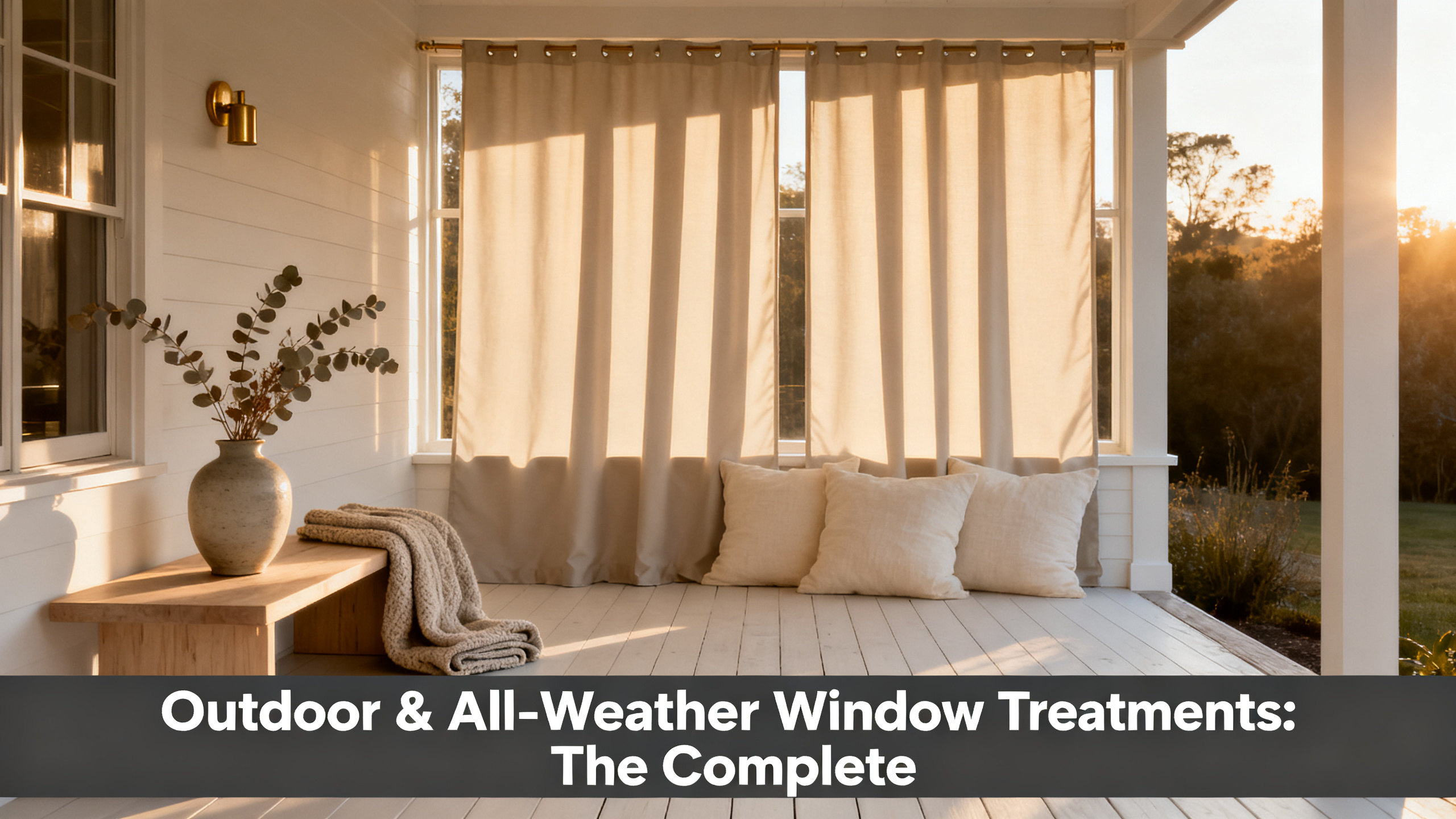
Outdoor is a smaller category than most owners think. One serious fabric collection at Two Pages does the entire heavy lift for full-exposure patios and pergolas, two adjacent bamboo lines handle covered porches, and every real outdoor decision reduces to four physical vectors: UV, moisture, wind, and mildew. This hub maps the landscape, ranks the fixes, and routes you into 14 deep-dive guides by whether you are a beginner, a buyer, an owner, or a troubleshooter.
What follows is a methodology recap first, then a beginner primer on the four vectors, then the collections framework, then the install-and-care playbook, then the troubleshooter fixes, then the full directory. If you already know you want acrylic and just need a colorway, the hero CTA below drops you straight into the configurator.
What we analyzed
3 Two Pages collections engineered for full or partial exposure (Heck Acrylic, Lay Bamboo Woven, Sybil Bamboo Roman), plus 4 competing outdoor fibre families (acrylic, polyester, olefin, bamboo).
Against 4 vectors
UV, moisture, wind, mildew. Every outdoor curtain failure traces back to one of these four. UV fades. Moisture rots. Wind rips. Mildew stains and structurally weakens.
Sources
Two Pages spec sheets, Trustpilot owner feedback for outdoor SKUs, industry weatherfastness data, plus the 21-colorway Heck booklet as the reference for real solution-dyed color behavior.

The anchor of the outdoor category
Heck Solid Acrylic Outdoor Curtain, Natural AD1150-301
from $99/panel · 100% solution-dyed acrylic · 260 gsm · 21 colorways · 98% UV block, 80 to 92% shading · fire-retardant · resists water, mildew, rot. Final price depends on size and header.
Code JULY for 20% off · Free shipping over $300 (a 3-panel bundle or booklet add-on reaches it)
Outdoor Window Treatments 101 for Beginners
Here is the deal with outdoor curtains. They are engineered to get wet, dry out, and repeat for 4 to 6 seasons, not to be waterproof in the raincoat sense. Everything else follows from that reality: the fibre choice, the header choice, the install method, and how you overwinter them. If you understand what the fabric is being asked to survive, the collection choice becomes obvious.
The 4 Physical Vectors That Decide Everything
Every outdoor panel is judged against four vectors. UV ages the dye and embrittles the fibre. Moisture cycles the fabric between wet and dry, which is fine until it stops fully drying between cycles. Wind shears the header attachment and rips grommets. Mildew colonizes anything that stays damp for more than 48 hours. Get these four framed correctly and the material comparison stops being marketing noise.
☀️
UV
The dye-and-fibre killer. Reference: NOAA’s UV Index scale. Solution-dyed acrylic (Heck) blocks 98% of UV. Polyester drops to 70 to 85%.
💧
Moisture
Cycling wet-dry is fine when the fabric fully dries in under 90 minutes of warm sun. Heck at 260 gsm does. Cheap polyester at 120 gsm stays damp longer than the mildew threshold.
💨
Wind
Tension rods alone fail past 25 mph. Bracket-mounted rods with weighted hem tape survive 45 mph. Grommets rip before headers do on lightweight polyester.
🦠
Mildew
Colonizes anywhere fabric stays wet 48+ hours. Solution-dyed acrylic resists structurally. Bamboo woven splits before it mildews. Polyester stains permanently.
The reference brand for weatherfastness data is Sunbrella. Their Sunbrella’s solution-dye weatherfastness data shows why solution-dyeing the acrylic before spinning matters: the color goes through the fibre, not on top of it, so UV cannot bleach it out from the outside. Heck uses the same solution-dyed acrylic fibre family without the Sunbrella brand tag, which is exactly what keeps the base price at $99/panel instead of the $300+ Sunbrella-branded equivalent. The full breakdown of acrylic vs polyester vs olefin for outdoor curtains lives in the materials spoke.
Acrylic, Polyester, Olefin, or Bamboo: Which Fibre Survives Which Weather
Between us, this is the only fibre decision that matters, and most of the internet gets it wrong by lumping everything under “outdoor fabric”. Only four fibres are viable, and they map to different exposure profiles. Real talk: get the fibre wrong and the panel is landfill in 18 months.
Acrylic
Full exposure
Best all-round. Solution-dyed. 4 to 6 year life. Heck at $99. Not the cheapest, the most durable.
Polyester
Budget only
30 to 50% cheaper. Fades in 2 seasons on west-facing exposure. Yellows in high humidity. Skip.
Olefin
Coastal / salt
Marine-grade. Beats acrylic on salt resistance. Colorway range limited to 8 to 12 shades.
Bamboo
Covered only
Covered porches only. Splits in full exposure. Beautiful when protected.
If your porch is covered and you want a natural-fibre look rather than a fabric panel, Two Pages’ bamboo woven shades are the adjacent option. The Lay Natural Ramie Bamboo Woven Shade in Almond at from $79.99 reads warm, blocks light by density (no UV rating in the acrylic sense), and needs a roof over it. On a fully exposed pergola, the bamboo splits within a season. On a covered porch, it lasts 6 to 8 years.
What “Waterproof” Actually Means for a Curtain
Cards on the table: the word “waterproof” in outdoor curtain listings is a marketing shortcut, not a physics claim. Fabric outdoor panels are water-resistant. They shed a summer rain, dry within 45 to 90 minutes in warm sun, and do not absorb the dye or lose structure through that cycle. That is what “waterproof outdoor curtain” almost always means in a product listing.
What they do not do is stay dry in a two-day storm. A prolonged soak wets the panel to the core and standing puddles at the hem will stain the bottom 4 to 6 inches over time. The correct frame is “engineered to get wet, dry, repeat for 4 to 6 seasons”, not “impermeable membrane”.
The 3 Two Pages Outdoor Collections for Buyers
Here is where the money decision lives. Two Pages ships one flagship acrylic collection (Heck) plus two bamboo lines (Lay Natural woven shades and Sybil bamboo roman shades) that cover the semi-outdoor covered-porch use case. That is the entire buyable lineup, and it is enough. If you want a broader framework before configuring, the full outdoor curtains buying guide walks the decision tree by budget, exposure, and header type.
Best Outdoor Curtains for Patio (2026): 5 Ranked Picks
If you would rather skip the framework and jump straight to a shortlist, the patio roundup ranks 5 outdoor panels scored on UV block rating, wind survival, mildew behavior, and configured pricing across Heck colorways and adjacent options.
The anchor is Heck. It carries the fully exposed pergola, patio, gazebo, poolside, and cabana use cases. The spec sheet is short and the ratings are what actually matters at 5pm in July with the panel in direct west sun. Owner feedback on Trustpilot consistently flags color stability past year 3 as the reason the same buyer orders a second set for a different exposure, which is the metric that separates real outdoor from marketed-as-outdoor.
The two bamboo lines are the covered-porch story. Lay Natural woven shades (ramie, jute, or flax weave, from $69.99 to $198.99 depending on species) and Sybil bamboo roman shade at $89.99 read as natural fibre with the light quality of a woven blind rather than a fabric drape. They work under a hard roof or full pergola cover. They fail structurally within 12 to 18 months in full exposure because the bamboo splits along UV embrittlement lines.
Coconut
98%UV · cool
Natural
98%UV · cool
Beige
98%UV · cool
Tan
98%UV · cool
Khaki
98%UV · warm
Taupe
98%UV · warm
Coffee
98%UV · hot
Mocha
98%UV · hot
Dark Navy
98%UV · hot
Black
98%UV · hot
Pale
reads bright
Mid Warm
buffer tone
Deep Warm
grounds pergola
Charcoal
reads modern
The colorway question splits into two answers. On light-color choice (Coconut, Natural, Beige, Tan), the panel absorbs less heat and the patio surface stays 6 to 9°F cooler on a July afternoon than the same install with a dark colorway. On dark-color choice (Coffee, Mocha, Dark Navy, Black), the panel reads more architectural against warm-cedar or charcoal-metal hardware, and hides pollen and dust between washes. Both survive equally at the UV level; the difference is thermal and visual.

Buyer favorite: Heck Acrylic, Taupe AD1150-078
from $99/panel · same 100% acrylic, 260 gsm base · warm taupe reads as the buffer color between cedar pergola beams and greige patio furniture · same 98% UV rating, fire-retardant, wind-tested. The colorway that ships most for west-facing patios in Two Pages order data.
Install, Care & Winter Storage for Owners
Owning outdoor curtains is a three-part loop: hang them once correctly, wash them on schedule, and decide whether they overwinter up or down. Skip any part and the panel life halves.
Rod Placement Outdoors: Beam, Wire, or Tension
The install choice is not a preference, it is a wind-load calculation. Bracket-mounted rods drilled into a pergola beam or porch fascia are the gold standard and survive 45 mph gusts with the header intact. Wire cable systems with marine-grade clips are second and beat every tension option in coastal or fully open installs. Tension rods work for covered porches under 60 inches wide with no direct wind exposure and fail past 25 mph, period.
Bracket on beam
Gold standard. Drilled into wood or aluminum beam. Survives 45 mph. Grommet or ring header.
Wire cable
Marine-grade clips. Best for coastal and fully open pergolas. No drilling into the beam face.
Tension rod
Covered porch only, under 60 in wide. Fails past 25 mph. Renter-friendly compromise.
Grommet on hook
S-hook or carabiner on a chain-link. Fastest to take down. Add weighted hem tape.
How to Hang Outdoor Curtains Without Drilling
Renting the patio, or the pergola beam is aluminum you would rather not drill? The no-drill guide walks tension rods rated for 260 gsm acrylic weight in wind, wire cable systems, and marine-grade clips that actually survive a full summer.
Weekly, Monthly, Seasonal Care
Solution-dyed acrylic is low-maintenance, not no-maintenance. A weekly rinse with the garden hose removes pollen and airborne dust before it sets. A monthly soft-brush wipe on the leading edge and bottom hem clears the two zones that soil fastest. Seasonal is where the actual work happens: full wash at the end of each summer, fully dry before folding, store or rehang cleanly.
Weekly
Garden-hose rinse. 60 seconds per panel. Clears pollen and dust before it sets in the weave.
Monthly
Soft-brush wipe on leading edge and bottom hem. Mild soap on stubborn spots. Never a stiff brush.
Seasonal
Take-down wash at summer’s end. 1:10 vinegar on any grey-tinged spots. Full sun-dry before folding.
Take Them Down or Leave Them Up in Winter
The overwinter decision maps to your climate zone, full stop. In Zone 8 or warmer with mild winter and no sustained freeze, leaving Heck acrylic up year-round is fine and one wash gets you into spring. In Zone 6 to 7, take them down before first snow to prevent ice-shatter at the header ring and mildew growth in stored moisture. In Zone 5 or colder, always take them down by late October.
Zone 8 or warmer
Leave up
FL, TX, coastal CA, southern AZ. One seasonal wash. Rinse after any big storm.
Zone 6 to 7
Down before snow
TN, VA, PA, OH. Take down late Nov. Wash. Fully dry. Store folded in cotton bag.
Zone 5 or colder
Down by October
NY, MI, MN, ND. No exceptions. Fold along vertical seams. Breathable bag, never plastic.
The storage detail that matters more than any other: fully dry before folding. A panel that goes into the bag at 90% dry grows mildew colonies in the fold creases over four winter months, and the pattern shows as grey haze in spring. Sun-dry outdoors for 6 hours, then confirm no cool damp zones at the hem before packing.
Mildew, Fading and Wind Damage for Troubleshooters
Most owners land on this section after a season went sideways. The good news: three of the four common failures are reversible if caught early. The fourth (embedded mildew that dyed the fibre) is permanent, and the panel is landfill. EPA guidance on mold and mildew is the reference framework for treating any surface mildew before it embeds structurally.
How to Clean Outdoor Curtains: Mildew, Stains, Salt
The cleaning guide details the difference between surface mildew (treatable with a soft brush and 1:10 vinegar solution) and embedded mildew (fabric structurally lost), plus salt-air rinsing schedule for coastal owners and stain-specific protocols for wine, sunscreen, and citronella.
Fading is the second common flag, and it is almost always a fibre problem not a use problem. Polyester outdoor panels visibly fade in 2 seasons on west exposure regardless of care. Solution-dyed acrylic like Heck does not fade in the UV sense; if a Heck panel reads faded past year 3, the issue is pollen and airborne oil buildup reading as haze, not lost pigment. A full seasonal wash restores the color.
Mildew (surface)
Soft brush + 1:10 vinegar. Rinse. Sun-dry fully. Catch within 4 weeks of appearance.
Fading (perceived)
On acrylic it is haze, not lost dye. Full wash restores. On polyester it is real, panel is done.
Wind (torn header)
Grommet rip is repairable with a #10 solid brass grommet kit. Header tear beyond 4 inches means panel is landfill.
Salt haze (coastal)
Fresh-water rinse every 10 days. Never let salt crystallize on the weave surface twice in a row.
Wind damage sits third. A torn grommet is fixable with a hardware-store brass grommet kit and a hem punch. A ripped header past 4 inches of tear is not: the panel is done and the replacement decision hinges on whether the install method is what failed (upgrade to bracket-on-beam) or the panel weight was wrong (upgrade to 260 gsm from lighter).
Salt haze is the coastal owner problem and the fix is preventive, not corrective. A 10-day fresh-water rinse cadence keeps salt from crystallizing on the weave surface twice in a row. Owners who skip two cycles get a visible white bloom that mild vinegar treats but never fully clears. Coastal installs also benefit from switching to olefin over acrylic, though the colorway range narrows sharply.
The Full Hub Directory of 14 Deep-Dive Guides
Fourteen spokes sit under this hub, grouped by which question you arrived with. Beginners land in the 101 and materials guides. Buyers land in the six best-of picks by use case. Owners land in the how-to install guides. Troubleshooters land in the clean, store, and Heck-review guides where the specific failure modes and fix protocols live.
The navigation logic is straight: if you are still shaping the decision, start in Beginners. If you have picked acrylic and need a use-case shortlist, Buyers. If the panels are configured and shipping, Owners. If something already went sideways with an existing install, Troubleshooters.
Base panel
$99
Heck any colorway, standard 50 × 84 in soft top.
Free ship at
$300
Reach with 3-panel bundle or 2 panels + booklet.
Booklet
$1.99
21 colorways, UV + heat notes. See below.
The Heck configurator lets you specify width and drop, plus header style. Custom over 84 inches adds a small size premium; the 21 colorways cost the same base. The single-panel install rarely clears the free-shipping threshold on its own, so most buyers order 2 panels plus the booklet, or 3 panels for a wide sliding door. Code JULY knocks 20% off at checkout across the collection.
Order the Heck Outdoor Booklet (21 UV-stable colorways)
Solution-dyed acrylic reads differently at high noon than at 5pm golden hour, and dark colorways (Coffee, Dark Navy, Black) absorb 6 to 9 degrees more surface heat than pale ones (Coconut, Beige, Natural). Two Pages ships the Heck booklet with all 21 colorways for $1.99, including UV-block ratings and heat behavior notes, so you can pit Taupe against Mocha under real daylight before committing.
Methodology & Editorial Approach
The scoring behind this hub combined three sources: Two Pages’ own published spec sheets for the Heck, Lay, and Sybil collections; Trustpilot owner feedback for outdoor SKUs filtered on year-2 and year-3 mentions (when fade and mildew normally appear); and industry weatherfastness data from Sunbrella’s published research plus the NOAA UV Index framework. Nothing here is a first-person install claim. Everything is what the specs, the buyers, and the physics converge on when read together.
How we scored
Sources. Two Pages spec sheets (composition, gsm, UV block, shading rate), Trustpilot outdoor-SKU reviews filtered on year-2 and year-3 mentions, Sunbrella weatherfastness data, NOAA UV Index scale, EPA mold guidance.
Vectors. UV, moisture, wind, mildew. Every fibre and every install method scored against all four.
Never claimed. No first-person install, no first-person wash cycle, no first-person wind survival. Everything is spec + owner-feedback + physics.
The editorial team behind Two Pages coverage sits with the Shadehunt curators, whose bios and beats are on the author page. This hub was co-owned by the outdoor and materials-analysis desks. The scope is deliberately narrow: only fibres and collections that survive real outdoor exposure, only install methods that survive real wind loads, only care protocols the specs and owner feedback confirm.
Design-tier warm dark: Heck Mocha AD1150-008
Same 100% solution-dyed acrylic base, 260 gsm, 98% UV block. Mocha is the warm dark colorway that reads as the buffer between charcoal pergola hardware and warm-cedar decking. from $99/panel · fire-retardant, wind-resistant, mildew-resistant. Code JULY 20% off · Free shipping over $300.
Frequently Asked Questions
Are outdoor curtains actually waterproof?
The category term “waterproof” is misleading. Fabric outdoor curtains are water-resistant, not water-tight. Heck’s 100% solution-dyed acrylic at 260 gsm sheds a summer rain and dries within 45 to 90 minutes in warm sun without absorbing dye or losing structure, which is what “waterproof outdoor curtain” almost always means in listings.
A prolonged storm still soaks the panel to the core, and standing puddles at the hem stain the bottom 4 to 6 inches. The right frame is “engineered to get wet, dry, and repeat for 4 to 6 seasons”, not “impermeable membrane”.
Do outdoor curtains block UV?
Yes, when the fibre is solution-dyed acrylic or heavy olefin. Heck blocks up to 98% of UV rays and 80 to 92% of visible sunlight, comparable to Sunbrella-branded acrylic in the same weight class. Lightweight polyester outdoor curtains typically drop to 70 to 85% UV block and fade visibly within 2 seasons of west-facing exposure. Bamboo woven shades block sun by density, not UV chemistry, so a Lay Ramie shade behind a covered porch stops light without a true UV rating.
How do you keep outdoor curtains from blowing away?
Three anchors, in order of effectiveness. Weighted hem tape or magnetic tiebacks at the bottom edge (adds 8 to 14 oz per panel and stops the wind lift), grommet-to-hook system at the top (locks the header to a rod that itself is bracketed, not a tension rod), and cross-tension tiebacks at the middle when the panel drops more than 84 inches.
Tension rods alone fail past 25 mph gusts. For coastal or pergola-open installs, a wire cable with marine-grade clips beats every rod option.
Can I leave outdoor curtains up in winter?
Depends on your climate zone. In Zone 8 or warmer (mild winter, no sustained freeze), leaving 100% acrylic panels like Heck up year-round is fine, expect one seasonal wash. In Zone 6 to 7, take them down before the first snow to prevent ice-shatter at the header ring and mildew growth in stored moisture.
In Zone 5 or colder, always take them down by late October. Wash, fully dry (never store damp), fold along vertical seams, store in a breathable cotton bag, not a plastic bin.
What fabric is best for outdoor curtains, acrylic vs polyester vs olefin?
For a 4 to 6 year outdoor deployment with west-facing UV and moderate humidity, solution-dyed acrylic wins on every metric except price (Heck at $99/panel is entry-tier for the fibre). Polyester is 30 to 50% cheaper but fades in 2 seasons and yellows in high humidity. Olefin (polypropylene) is the marine-grade choice for coastal boats and pool cabanas, edges out acrylic on salt resistance, but the colorway range is limited to 8 to 12 shades industry-wide.
Do bamboo shades hold up outside?
Only under cover. Lay Natural Ramie or Jute bamboo woven shades work on a covered porch, screened patio, or pergola with a hard roof where they are shaded from direct rain and UV. On a fully exposed pergola, bamboo splits within one season from UV embrittlement and moisture cycling.
The bamboo shades outdoor search intent is real (4 400/mo volume) but the honest answer is “yes for covered outdoor, no for exposed outdoor”. For fully exposed, acrylic is the only fibre that survives.
