
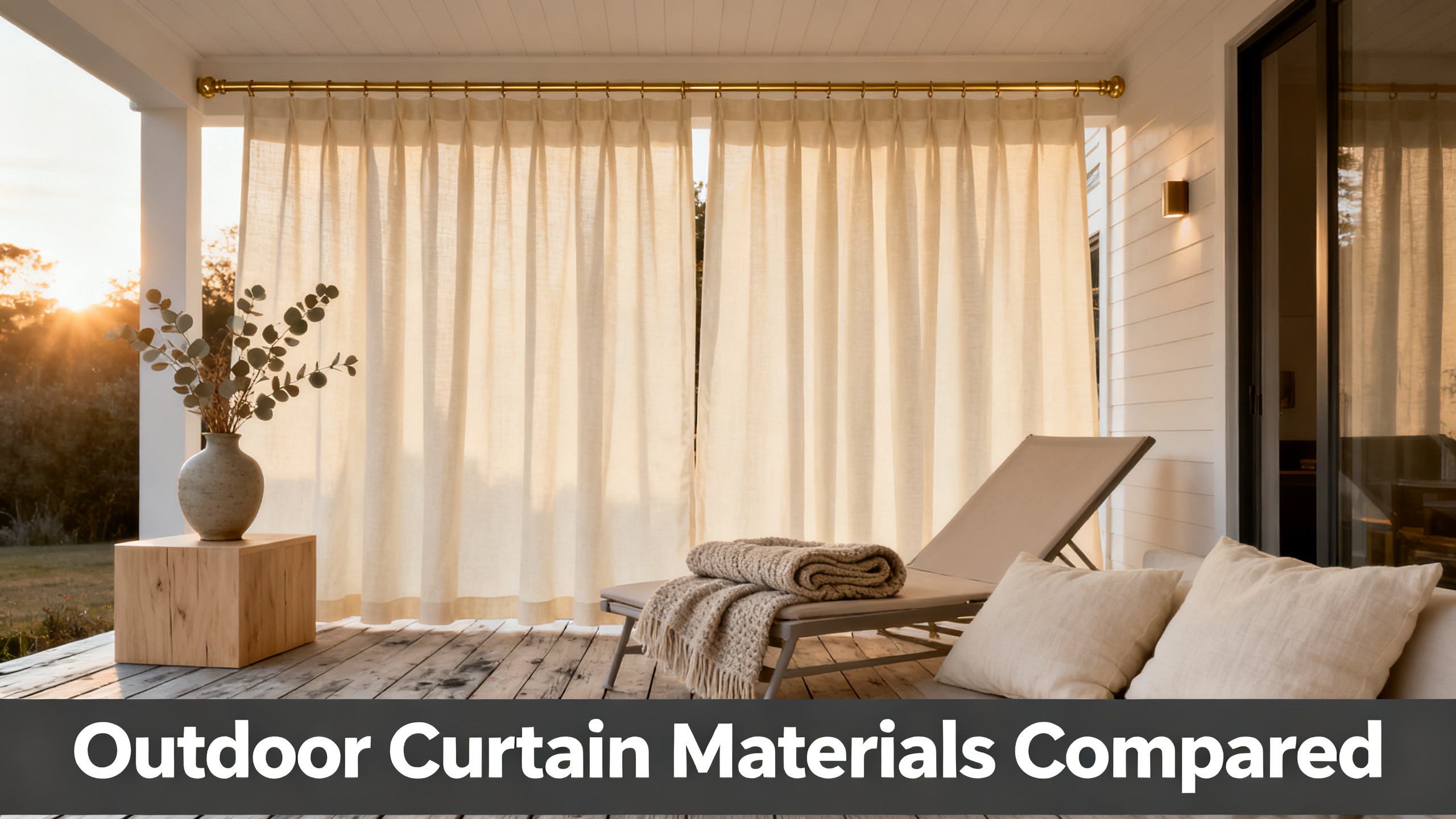
Balcony renter, deck owner, pergola builder. Three patios, three fibers, three price tiers. The temptation is to pick the panel first and let the fiber sort itself out. That works on a balcony. It does not work on a deck, and it costs you twice on a pergola.
This guide flips the order. Pick the fiber that matches your exposure and your horizon, then let the panel choice fall into place. Two Pages catalogs only acrylic in the outdoor lineup, so the recommendations stay honest about when acrylic earns its premium and when a cheap polyester from the big-box shelf is the smarter call. The wider context on patio shading, screens and bamboo lives in our outdoor window treatments hub.
🧭 Decision flowchart: which fiber for your patio
Q1. Exposure?
Open balcony / direct sun → high UV stress. Covered patio → moderate. Screened porch → low. The higher the stress, the more fiber matters.
Q2. Budget per panel?
Under $50 → polyester. $60 to $120 → olefin. $99 to $250 → acrylic. Outdoor-rated rod and rings add $40 to $90.
Q3. Horizon?
2 years (rental) → polyester is fine. 3 to 5 years (covered patio) → olefin or acrylic. 5+ years (owner) → acrylic, no debate.
Two Pages catalogs the acrylic answer (Heck Solid Acrylic Outdoor Curtain, $99/panel). For polyester and olefin, market context is below.

Editor’s pick acrylic
Heck Solid Acrylic Outdoor Curtain
from $99/panel · 100% acrylic 260 gsm · 80-92% shading · up to 98% UV · 21 colors. Final price depends on size and panel count.
Use code JULY for 20% off · Free shipping over $300
What Makes a Fiber “Outdoor” in the First Place
An indoor curtain that lives on a patio is not an outdoor curtain. It is a polyester sheet wilting in slow motion. Three traits separate an actual outdoor fiber from a misplaced indoor one: UV stability at the molecular level, mildew resistance under sustained humidity, and abrasion resistance for wind that flexes the same fold three thousand times a season.
UV stability is the silent killer. The AATCC 183 UV transmission test method is the protocol behind every “98% UV protection” line on a spec sheet. Acrylic posts the strongest numbers because the fiber is solution-dyed: color goes through the strand, not painted on top. Polyester gets there only with surface coatings that wear off in roughly 18 to 24 months under direct sun.
Mildew and water resistance
Mildew needs water plus organic matter plus time. Olefin (polypropylene) wins this round because the fiber itself does not absorb water. Acrylic is close behind, with a tight weave that dries quickly. Polyester sits last because the weave is looser and the fibers wick.
None of the three are truly waterproof on their own. A panel that sits in standing water or hangs in a fully enclosed shower will eventually wick through. Water-resistant is the honest claim. Waterproof requires a continuous coating.
Abrasion and GSM range
Wind is a slow-cycle abrasion machine. The fold at the rod cycles through 200 motions an hour on a breezy day, and the hem brushes the floor or the railing each one. Acrylic and olefin both handle the load well in the 240 to 280 gsm range. Polyester at the same weight wears at the hem first.
| Trait | Acrylic (Heck) | Olefin | Polyester |
|---|---|---|---|
| UV stability | Best in class, 95-98% | Strong, 85-93% | Weak past 18 months |
| Mildew resistance | High (tight weave, dries fast) | Best (zero water absorption) | Low without treatment |
| Abrasion (Wyzenbeek) | 30,000+ rubs | 35,000+ rubs | 15,000 rubs |
| Hand-feel | Natural, drape-forward | Synthetic but supple | Plastic, stiff |
| GSM sweet spot | 240-280 gsm | 220-280 gsm | 180-260 gsm |
| Lifespan (covered) | 5-7 years | 3-5 years | 2-3 years |
| Price per panel | $99 to $250 | $60 to $120 | $20 to $50 |
| Washable | Hose only, not machine | Cold soap, no dryer | Machine cold, air dry |
Real talk on the 98% UV claim: it is real, but it is measured on a brand-new panel in lab conditions. A three-year-old acrylic panel still blocks the high 80s. A three-year-old polyester panel blocks barely 60%. The decay curve matters more than the day-one number.
For Renters on a Balcony or Small Deck (Polyester Wins, Within Limits)
Picture the rental scenario: 6 by 10 foot balcony, west-facing, no permission to drill, lease ends in 18 months. Budget for the entire opening is $80 to $150 including the rod. The temptation to chase a $200 acrylic panel here is real, and it is the wrong call.
Polyester earns its place at the bottom of the market because the math works for short horizons. A $30 panel that fades at month 20 is still a fair trade when you are moving at month 18. The big-box shelves (IKEA, Amazon basics, Wayfair budget tier, even a few Target outdoor lines) all play in this band, and the best waterproof outdoor curtains roundup covers the picks that survive a rainy Pacific Northwest winter on a covered balcony.
☀️ UV and shading by fiber
95-98%
Acrylic UV block
Holds through year 5. Solution-dyed at the strand.
85-93%
Olefin UV block
Strong at install. Drops to 70s by year 4.
60-80%
Polyester UV block
Surface coating wears at month 18. Then half that.
Where polyester quietly fails on the rental balcony is mildew. A north-facing or shaded corner balcony with poor airflow grows visible mildew on a polyester panel by month 4 of a Seattle or Atlanta summer. The remedy is a 1:4 vinegar-and-water spray and a soft brush, which gets you another season. The remedy stops working past month 14.
The other quiet failure is hand-feel after a wash cycle. Polyester comes out of the machine slightly stiffer each time because the fiber bunches at the weave intersections. By the third wash, the panel sounds like paper when it folds. Acrylic does not do this, but acrylic also costs four times more. If it were my balcony, polyester under $40 is the right call. If it were my deck, no.
For Owners with a Covered Patio or Deck (Acrylic Earns Its Premium)
Scenario shifts. 12 by 16 foot covered patio, owned home, 5 to 10 year horizon, $400 to $800 budget for the full opening including rod and hardware. This is where the fiber decision flips from “what is cheapest” to “what costs the least per year of service”.
Outdoor Curtains Buying Guide (Waterproof, UV-Resistant)
Once the fiber decision is made, the next four are shading rate, mount, lining and lead time. The full buying guide walks each one.
Solution-dyed acrylic at 260 gsm is the answer the market keeps returning to. The dyes used by Two Pages on the Heck panel meet the OEKO-TEX Standard 100 textile certification for no harmful chemical residue, which matters when the same fabric is breathing over a dining table or a daybed for years.
Trustpilot owner feedback on the Heck panel is consistent across hot-humid markets: two summers on a Gulf Coast pergola, mildew has not set in on south-facing panels, surface dirt rinses off with a garden hose, and the Natural colorway has softened by maybe one shade after 18 months of direct exposure. No outdoor fabric stays catalog-color forever. Acrylic just decays slower than polyester by a factor of roughly three.
🌿 Lifespan by fiber and exposure
Acrylic 260 gsm
Covered patio: 5-7 years
Fully exposed: 3-5 years
Olefin 240 gsm
Covered patio: 3-5 years
Fully exposed: 2-3 years
Polyester 200 gsm
Covered patio: 2-3 years
Fully exposed: 18-30 months
Coastal salt air compresses every fiber lifespan by roughly 30 percent. Seasonal winter takedown extends each band by about 12 months.
Best Outdoor Curtains for Patio (2026 Picks)
Five picks compared by use case, including the editor’s call on when acrylic is worth the premium and when bamboo or blackout layers do better.
The olefin compromise (Sunbrella Furniture tier)
Olefin is the fiber that gets less attention than it deserves. Sunbrella sells olefin under its Furniture tier as the lower-priced sibling to its premium acrylic awning line. Outdoor specialists like Frontgate and a handful of Wayfair brands ship olefin panels in the $60 to $120 band, which sits squarely between the polyester floor and the acrylic ceiling.
The case for olefin is mildew. Polypropylene fiber simply does not absorb water, so mildew has no anchor. The case against is hand-feel: olefin still reads synthetic next to acrylic, and the abrasion-tight weave gives the panel a slightly plasticky drape that softens but never disappears. For a covered porch on a 3 to 5 year horizon, olefin is a defensible compromise. For an owner planning 7 years, acrylic is the floor.

Owner Pick: 260 gsm Acrylic, 5-Year Horizon
from $99/panel · the fiber that earns its price over a deck or covered patio. 100% acrylic stays color-true through three Gulf Coast summers based on Trustpilot owner reports.
For Luxury or Permanent Pergola Installs (Acrylic Is the Floor, Not the Ceiling)
Different scenario again. Permanent pergola, custom widths, 7 to 10 year horizon, $1,200 to $3,000 budget for the full opening, possibly an indoor-outdoor sunroom or lanai involved. At this tier, acrylic stops being the premium option and starts being the entry point. The question shifts from “which fiber” to “which acrylic, in what weight, with what custom finishing”.
The Heck Solid Acrylic Outdoor Curtain product page covers the in-stock SKU at 260 gsm, which is the right floor for a permanent install. Above that, custom acrylic shops (Sunbrella Awning Grade, specialty marine canvas houses) push into the 320 to 400 gsm range for situations where the panel doubles as wind break on an exposed bluff or coastal lanai. The hand-feel stays natural even at 400 gsm because acrylic does not stiffen the way polyester does at the same weight.
Heck Solid Acrylic Outdoor Curtain: Full Review
Deep dive on the only true outdoor acrylic SKU in the Two Pages catalog, with Trustpilot owner feedback after two summers on a Florida pergola.
Lanai, sunroom and indoor-outdoor transitions
Picture the moment the late-afternoon sun hits the west-facing pergola at 4pm in July. The acrylic panel is doing two jobs: filtering the heat by roughly 12 to 18 degrees behind the closed panel, and keeping the dining table linens from fading. A lanai or sunroom adds a third job: visually bridging the indoor textile language (linen drapery inside) with the outdoor wear-tolerant language outside. Acrylic threads the needle better than the other two because the drape and color depth read closer to a heavy indoor linen than to a synthetic.
For glass slider transitions specifically, the sliding glass door curtains comparison covers the picks that handle the indoor side of the same opening. The pattern most owners settle into is acrylic outside, linen-blend inside, on a single continuous track when the patio is roofed and the slider geometry allows.
When the covered pergola needs blackout polyester (Atlanta)
One edge case overrides the acrylic-first rule: when the covered pergola is fully enclosed (three or four walls including glass or canvas), no rain exposure, and the use case is outdoor cinema or sleeping cabana. At that point the priority flips to blackout opacity, and a heavy blackout polyester wins because acrylic does not naturally achieve 99% blackout without a coating. The Atlanta Room Divider Blackout Curtain Kit from Two Pages ships at 99% blackout on a ceiling track and is the right pick for that narrow scenario, even though the fiber is polyester.
When to skip outdoor curtains entirely
Storm-exposed coastal install with sustained 30+ mph wind, full salt air, no covered structure. No fabric panel survives this for long. The right answer is exterior roller shades or motorized screens, not curtains. Acknowledge the limit and redirect the budget.
🎯 Persona-to-fiber match
🏙 Renter / Balcony
Horizon: 18-24 months
Budget: $20-50/panel
Fiber: polyester. IKEA / Amazon tier.
🏡 Owner / Covered Patio
Horizon: 5-7 years
Budget: $99-150/panel
Fiber: acrylic. Heck is the standard.
🌴 Luxury / Permanent Pergola
Horizon: 7-10 years
Budget: $200-400/panel
Fiber: acrylic 280-400 gsm custom.
Pricing by Fiber Tier and Spec Sheet for Acrylic
Three price tiers across the three fibers, with little overlap. The sticker price tells you almost exactly what fiber is in the bag, and the lifespan math tells you whether the price is fair for your horizon.
💵 Real market pricing per panel
Polyester
$20-50
IKEA, Amazon basics, Wayfair budget.
Olefin
$60-120
Sunbrella Furniture, Frontgate, mid-tier specialists.
Acrylic
$99-250
Two Pages Heck, Sunbrella Awning, marine canvas houses.
Add $40-90 per opening for an outdoor-rated rod and rings. None of the three ship hardware in the base price.
The Heck panel sits at the entry of the acrylic tier, which is the relevant reference for everything above it. Spec sheet below.
📋 Heck Solid Acrylic Outdoor Curtain (canonical acrylic reference)
100% acrylic, solution-dyed
260 gsm (7.7 oz/yd²)
80-92% visible light block
Up to 98% (AATCC 183)
4-in-1 soft top (only header offered)
Unlined (design intent)
52″ / 100″ wide, 84″ / 96″ / 102″ / 108″ drops
21 colorways across neutrals, deep tones, brights
5-7 days in-stock, 10-12 days custom colorways
OEKO-TEX dyes, fire-retardant, wind-resistant (catalog)
What to Do Next (3 steps)
The fiber decision narrows the catalog from hundreds of panels to maybe a dozen. Three steps close the loop without committing to a panel you have not seen at scale.
📋 Your 3-step plan
Step 1
Audit exposure
Note west or south-facing direction, covered vs open, hours of direct sun, and any salt air. This locks the fiber tier.
Step 2
Order acrylic swatches
If acrylic is the answer, the $1.99 Heck booklet shows all 21 colorways at fabric scale. Color reads cooler under direct sun than on a screen.
Step 3
Configure panels
Measure rod placement, panel width with 2x fullness, drop to floor or hover. Configure on Two Pages with the JULY code at checkout.
Order the 21-Color Heck Acrylic Booklet
Acrylic reads cooler in person than on screen, and color depth differs sharply between a Beige under noon sun and the same Beige under a screened porch. The booklet ships flat for $1.99 and shows all 21 colorways at full fabric scale.
Honest closing call: acrylic does not win every scenario. Polyester under $50 is the right answer for the rental balcony you are leaving in 18 months. Olefin is a defensible compromise on a covered porch with a 3 to 5 year horizon and tight budget. But on a 5+ year owner install, on a deck or pergola, acrylic at 260 gsm pays for itself by year 3 and keeps paying through year 7. That is the fiber math, separated from the panel marketing.
Pick the Fiber That Pays for Itself
For most owners, acrylic clears the bar polyester cannot. The Heck panel ships at 260 gsm with 80-92% shading and up to 98% UV blocking. from $99/panel. Code JULY (20% off) · Free shipping over $300 · 21 colors · 5-7 day ship on in-stock.
FAQ
What is the best fabric for outdoor curtains?
Solution-dyed acrylic at 240-280 gsm is the best fabric for outdoor curtains in most owner contexts. It blocks 95-98% of UV under AATCC 183, resists mildew on covered patios, holds color through 5-7 years of seasonal exposure, and has a hand-feel closer to a heavy indoor linen than to a tarp. Olefin (polypropylene, sold mainly under Sunbrella Furniture and a few outdoor specialists) is the budget acrylic alternative at slightly lower UV stability and slightly higher abrasion resistance. Polyester is the cheapest, the lightest and the first to fade, fine under $50/panel for a 2-year balcony setup, weak past that horizon.
Acrylic vs polyester for outdoor curtains: which lasts longer?
Acrylic outdoor curtains at 260 gsm typically last 5-7 years on a covered patio with seasonal storage and 3-5 years fully exposed. Polyester at the same weight typically lasts 18-30 months fully exposed and 3 years covered, because polyester is not UV-stable at the molecular level and the dyes oxidize faster. The cost-per-year math usually favors acrylic past month 24, even though the upfront price is two to four times higher per panel.
Is olefin better than polyester for outdoor curtains?
Olefin (polypropylene) is meaningfully better than polyester for outdoor use, mainly on mildew resistance, abrasion resistance and color stability. Olefin fiber does not absorb water at all, which means mildew has nothing to grow on, and the abrasion rating sits between polyester and acrylic. Hand-feel is still synthetic compared to acrylic, and high-heat cleaning damages the fiber. Expect 3-5 years on a covered patio and 2-3 years fully exposed at roughly half the price of premium acrylic.
What GSM should outdoor curtains be?
240 to 300 gsm is the proven sweet spot for outdoor curtains across all three fibers. Below 200 gsm the panel flaps in wind and wears at the hem inside one season. Above 320 gsm the panel strains standard tension rods and is awkward to remove for winter. The Heck Solid Acrylic Outdoor Curtain sits at 260 gsm, which is the dead-center of that range and the reference number to compare against when shopping a polyester or olefin alternative.
Are 100% acrylic outdoor curtains waterproof?
No. 100% acrylic outdoor curtains are water-resistant rather than waterproof. The acrylic weave repels surface moisture and dries fast after rain, and the fiber itself does not absorb water in the way cotton or polyester does. But there is no continuous waterproof coating, so a panel sitting in standing water or in a fully enclosed shower will eventually wick through. For true waterproofing on a covered shower or outdoor bath, a coated SKU (the Heck Solid Waterproof Shower Curtain, same fabric family, different finish) is the right pick.
Can I machine wash outdoor curtains?
Polyester outdoor curtains can usually be machine washed on cold gentle, then air-dried flat. Olefin can be cleaned with mild soap and lukewarm water but loses fiber integrity past 90F, so skip the dryer. Acrylic outdoor curtains should not be machine washed. The UV-stable finish on a 100% acrylic panel is damaged by agitation and the panel shrinks unevenly. Clean acrylic in place with a garden hose, a soft brush and mild soap, then dry shaded before re-hanging.
Is Sunbrella the same as 100% acrylic outdoor fabric?
Sunbrella’s premium awning and marine lines use 100% solution-dyed acrylic, the same fiber family as the Two Pages Heck Outdoor Curtain. Sunbrella’s furniture-tier and budget lines use olefin (polypropylene) or polyester blends, which are different fibers with shorter outdoor lifespans. When comparing, the fiber composition on the spec sheet matters more than the Sunbrella brand name. A 100% acrylic 260 gsm panel from any reputable maker will behave similarly under UV and weather, regardless of brand.
How much should I budget per panel for outdoor curtains?
Polyester outdoor curtains sit at $20 to $50 per panel on Amazon and IKEA, fine for a 2-year balcony or rental terrace. Olefin curtains run $60 to $120 per panel through Sunbrella Furniture-tier resellers and outdoor specialists, fair value for a 3-5 year covered patio. Acrylic curtains run $99 to $250 per panel through outdoor specialists and custom houses including Two Pages, the right tier for a 5-7 year owner install on a deck, pergola or covered patio. Add $40-90 per opening for a sturdy outdoor-rated rod and rings, sold separately on every brand.
