
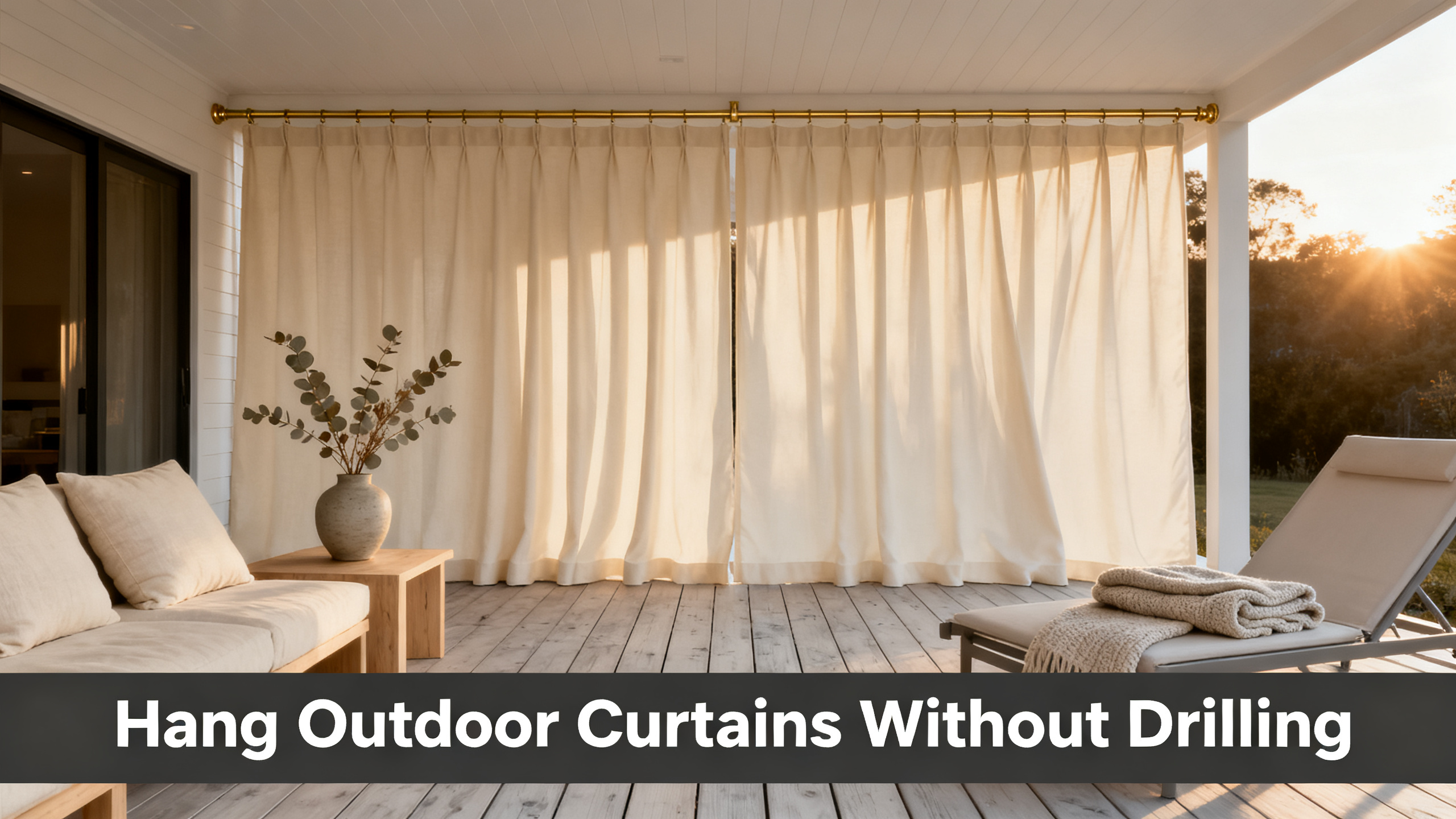
Most renters and new patio owners reach for a tension rod the same way they would inside, then discover at panel #2 that the rod sags an inch in the middle and the whole install reads sloppy. The fix starts before you buy hardware: measure the path the rod will travel, not the window frame. The surface, the span, and the panel weight all decide which no-drill route will actually hold for a season.
This guide walks the five viable paths in order of how often they win: tension rod, ceiling hook or adhesive track, wire system, heavy-duty adhesive hooks, and clamp-on brackets. For the wider context on outdoor fabric and shading, our outdoor window treatments hub sits one click away.
🧭 The 5 no-drill paths at a glance
🪢
1. Tension rod
Two rigid perpendicular surfaces, span 30 to 72 in.
🪝
2. Ceiling hook / track
Covered patios, wood beams or smooth stucco.
🧲
3. Wire system
Wide pergolas, spans over 72 in.
🧷
4. Adhesive hooks
Vinyl siding, painted wood, smooth stucco.
🗜️
5. Clamp-on brackets
Aluminum metal pergolas and railings.
Each path matches a specific surface and weight range. Pick the panel first, then read the path that fits your support.

The panel these paths are built for
Heck Solid Acrylic Outdoor Curtain
from $99/panel · 100% acrylic 260 gsm · 4-in-1 soft top header (works with rings, tension rods, hooks, wire) · 21 colors. Final price depends on size and panel count.
Use code JULY for 20% off · Free shipping over $300
Step 1: Pick the Panel Before You Pick the Path
Why panel weight drives everything
Every no-drill solution lives or dies on the math between two numbers: how much your panel weighs, and how much your support can hold. Get the order wrong, buy hardware first, and you end up returning a $40 tension rod because the panel turned out to be heavier than the rod’s safe load. Read the spec sheet on the panel before you put anything in a cart.
A standard 100 by 96 inch acrylic outdoor panel at 260 gsm weighs roughly 2.5 pounds. A 52 by 84 inch panel weighs closer to 1.3 pounds. Two of those on the same rod equals 2.6 pounds plus the weight of the rings and rod itself, which is the load any no-drill solution actually has to carry. The Heck Solid Acrylic Outdoor Curtain product page lists the panel weights and the OEKO-TEX Standard 100 textile certification in the same fabric block, so weight and chemistry are both visible before you order. You can configure a Heck panel with the exact width and drop your support can handle, which is the right order of operations.
Outdoor Curtains Buying Guide: 4 Questions, 1 Decision
The decision framework for picking acrylic vs polyester vs olefin, shading and UV percentages decoded, and the right Two Pages SKU per exposure level.
The 4-in-1 soft top header advantage
Heck panels ship with a 4-in-1 soft top header, which is the single most useful header you can have when hardware is up in the air. The same header accepts standard 1.6 inch inner diameter rings (for tension rods), rod pocket pass-through (for thin rods), clip-on rings (for wires), and back-tab loops (for hook systems). One panel covers four of the five paths in this guide without modification.
The 5th path (clamp-on brackets) still works, you just route it through a thin rod and rings like a tension rod install. The point is, the panel does not lock you into a specific support before you have measured the surface.
Step 2: Tension Rod Path (Easiest, Renter-Safe)
How a tension rod stays put (and where it fails)
A tension rod is a two-piece tube with a spring inside and a rubber end cap on each side. You compress it between two rigid perpendicular surfaces, the spring pushes outward, and friction at the end caps holds everything in place. No drilling, no adhesive, removable in 10 seconds. For a pergola opening between two wood posts, a covered patio between two stucco walls, or a balcony between two concrete columns, this is the path that wins 70% of the time.
Real talk on what a $4 tension rod can hold: nothing useful. The budget rod sold in a 6-pack at a discount store is rated for sheers under 1 pound, will arch in the middle within a week, and will pop loose the first time wind cycles the panel. A proper outdoor tension rod is a single 1 inch diameter steel-core piece with internal spring tension, costs $18 to $40, and holds the load described in the next paragraph.
📏 Tension rod weight and span guide
Span 30 to 48 in
1 in rod
Safe load 5 to 6 lb. Fits two 52 in Heck panels.
Span 48 to 72 in
1.25 in rod
Safe load 7 to 8 lb. Fits one 100 in Heck panel.
Span 72 in and up
Switch path
Tension rods sag. Move to wire system or split into two spans.
Always leave 6 inches of expansion headroom between the rod’s minimum span and your opening width.
Matching rod diameter to panel weight
The rule of thumb: rod diameter scales with span, not panel count. A 100 inch wide single panel on a 60 inch span needs a 1.25 inch rod even though the load is only 2.5 pounds, because the rod itself flexes under the panel’s centerline pull. Two 52 inch panels on the same 60 inch span need the same 1.25 inch rod for the same reason.
Heck Solid Acrylic Outdoor Curtain: Full Review
Specs deep-dive, owner feedback after two summers on a Florida pergola, and the panel weight numbers you need to size a tension rod correctly.
Where tension rods fail every time: openings with no perpendicular wall on one side (open pergola corner), surfaces that are soft (EIFS stucco, drywall), spans wider than 72 inches, and panels heavier than 8 pounds combined. If any of those describe your install, skip to Step 3.
Step 2bis: Ceiling Hook + Track (Covered Patios)
Wood beam vs concrete vs stucco
When the ceiling is the only stable surface above your opening (no perpendicular walls), the install goes overhead. Wood beam ceilings take a screw-in eye hook in seconds, but that’s still drilling, so for the no-drill version you want a wrap-around beam clamp with an integrated hook. Stucco and finished concrete ceilings take an adhesive-mounted ceiling track, which is what kits like the Atlanta Room Divider ceiling-track kit review walk through in detail.
🏠 Ceiling support by surface type
🪵 Wood beam
Wrap-around beam clamp + S-hook. Holds 15+ lb per clamp. Zero permanent change.
Best for 4×4 and 4×6 pergola rafters.
🧱 Concrete (smooth)
Adhesive ceiling track with pressure-cure mount. Holds 6 to 8 lb/ft when surface is degreased.
Cure time 24 hours before load.
🎨 Stucco (textured)
Self-leveling primer first, then track. Avoid EIFS soft stucco. Holds 4 to 5 lb/ft on prepped surfaces.
Textured stucco is the riskiest no-drill surface.
When adhesive track is the only no-drill route
Condo balconies with concrete ceilings, covered patios with stucco soffits, and apartment porches with painted ceilings all share the same problem: no perpendicular walls, no exposed beams, and a lease that says no holes. Adhesive ceiling track is the answer in all three cases, but the surface prep matters more than the brand. Wipe with isopropyl alcohol, dry for 30 minutes, mount the track, wait 24 hours, then load the panel.

Covered Patio Variant: Atlanta Ceiling Track Kit
from $200.99/kit · ceiling track and panel included · 99% blackout · 8 colors · spans 3′ to 18′ wide. The kit ships with adhesive-compatible track mounts for stuccoed concrete ceilings, so the install stays no-drill when the surface allows it.
Step 3: Wire / Cable System (Wide Pergolas)
Wire gauge, turnbuckle, sag math
Once the span clears 72 inches, tension rods bow under the panel’s centerline pull and lose their grip on the end-cap surfaces. The fix is a stainless steel wire tensioned between two anchors, with rings or clip-on hangers riding the wire. A 1/8 inch stainless cable holds 340 pounds working load at full tension, which is well over any residential curtain install.
Best Outdoor Curtains for Patio (2026)
The roundup of patio-tested panels with weights, shading rates, and best mount paths per pick. Useful if your install path narrows your panel choice.
🧰 Wire system parts list (no-drill version)
- Stainless wire: 1/8 inch, 7×19 strand, sold by the foot. Budget $1.50/ft.
- Turnbuckle: 5/16 inch eye-to-eye, holds wire under tension. One per wire.
- Wrap-around aluminum anchor: clamps the pergola post or beam without drilling. Two per wire (one per end).
- Ferrule kit: aluminum sleeves to terminate the wire at each end. 4 per wire.
- Drapery rings: 1.6 inch inner diameter, clip-on style, 8 to 12 per panel.
Skip the eye-bolt anchor (drilled) in favor of the wrap-around clamp anchor (no-drill). The 30 dollar difference is what makes the install reversible.
Rings vs clips on wire
On a wire system, the soft top header on a Heck panel slides onto either standard rings (run the wire through the ring) or clip-on rings (clamp the panel’s header directly). Clips win for thin panels and quick adjustment, rings win for heavy panels and a cleaner drape. Expect a 1 to 2 inch sag at midpoint over a 144 inch span even when properly tensioned, which reads natural rather than sloppy on outdoor installs.
Step 4: Adhesive Heavy-Duty Hooks (Stucco, Vinyl Siding)
Weight limits per outdoor hook brand
For openings where the surface is smooth (vinyl siding, painted wood trim, finished metal), heavy-duty outdoor adhesive hooks are the cleanest path. The category leader is 3M Command’s Outdoor line, and the published weight limits are conservative for a reason: shear strength drops 30 to 40% after a few wet-dry cycles. Plan two hooks per panel minimum, with a third in the middle for any span over 48 inches.
🧷 Outdoor adhesive hook weight limits
3M Command Outdoor Large
7.5 lb
Per hook on smooth surfaces. Best documented outdoor adhesive line.
3M Command Outdoor Medium
4 lb
Per hook. Use 3 minimum for a 100 inch Heck panel rod.
Generic outdoor adhesive
2 to 3 lb
Cheaper but published limits inconsistent. Discount with 50% safety margin.
Always wipe with isopropyl alcohol and wait 1 hour after mounting before loading. See 3M Command outdoor adhesive hook product guidance for surface compatibility.
Surface prep that determines whether they hold
Where adhesive hooks lose every time: dirty surfaces, freshly painted surfaces (under 30 days cure), textured EIFS stucco, raw cedar, and anything that has been exposed to UV-degraded silicone caulk. The hook itself is fine; the substrate is not bonding. If it were my rental balcony, I’d test one hook with a 5 pound dumbbell for 48 hours before committing to the full install.
Step 5: Clamp-On & C-Clamp Brackets (Aluminum Frames)
Where clamp-ons win over tension rods
Modern metal pergolas (Costco-tier, Coolaroo, EZ-Up) ship with aluminum tubing in the 1.5 to 3 inch outer diameter range. Tension rods do not work on these because the rod’s end cap cannot compress against a curved tube. Clamp-on brackets are purpose-built for this: a U-bracket or C-clamp wraps the tube, a set screw tightens, and a threaded mount accepts a thin rod or eye-hook. No drilling into the aluminum, fully reversible.
| Install path | Best surfaces | Bad surfaces | Max panel load | Reversible? |
|---|---|---|---|---|
| Tension rod | Wood post, concrete column, brick | EIFS stucco, drywall, curved aluminum | 5 to 8 lb (span dependent) | Yes |
| Wrap-around ceiling hook | Exposed wood beam | Finished flat ceiling | 15+ lb per clamp | Yes |
| Adhesive ceiling track | Smooth concrete, finished stucco | EIFS, raw concrete, peeling paint | 4 to 8 lb/ft | Yes (residue cleanup) |
| Wire system (wrap anchor) | Wood post, metal post, brick column | Flat wall (no anchor purchase) | 340 lb wire / 8 lb panel realistic | Yes |
| Adhesive hooks | Vinyl siding, painted wood, smooth metal | Textured stucco, raw wood, new paint | 7.5 lb per hook (Command Large) | Yes |
| Clamp-on bracket | Aluminum pergola post 1.5 to 3 in | Wood post, brick (use other path) | 10 to 15 lb per clamp | Yes |
When none of the 5 paths work
The honest answer: if your opening has no perpendicular walls, no ceiling, no metal frame, and no surface that takes adhesive, your no-drill options are exhausted. At that point, the path forward is either a freestanding outdoor curtain stand (two vertical poles with weighted bases, sold as patio decor) or a quick conversation with the landlord about a single drilled anchor with a renter-funded patch on move-out. Most landlords approve the latter for $20 in spackle.
Pro Tips Before You Hang
Three things that separate an install that lasts a season from one that you redo in October. Read all three before the panel goes up.
💧
Tip 1: Plan for drainage
Acrylic panels shed water but the bottom hem holds a thin film for hours after rain. Mount the rod or wire so the bottom of the panel clears the patio floor by 2 to 3 inches to prevent capillary wicking into deck wood or concrete. The bottom hem is 1.5 inches; add 1 inch of clearance minimum.
💨
Tip 2: Weight the bottom for wind
Add curtain weights (small lead or steel disks sewn into the bottom hem) on installs facing prevailing wind. The 2.5 pound panel weight reads light when a 20 mph gust pushes it horizontal. Weighted hems also reduce stress on the upper anchors, which extends adhesive hook life by 30 to 40%.
📆
Tip 3: Take them down for winter
Acrylic outdoor curtains hold up 4 to 7 years covered, 2 to 4 years exposed. Seasonal takedown extends the upper limit. The same logic protects no-drill hardware: adhesive hooks degrade in freeze-thaw cycles, wire tension drifts in cold, tension rod rubber caps stiffen and crack.
Now Your Path Is Solved: Order the Right Panel
Your support is decided, the hardware list is short, and the install path is reversible. The next decision is the panel itself: width, drop, colorway, and whether to invest in a swatch booklet first. Acrylic reads differently under direct sun than under a phone screen, and a $1.99 booklet is the cheapest insurance against a $400 panel that lands the wrong khaki.
Order the 21-Color Heck Outdoor Booklet
Acrylic reads differently under direct sun than under a screen. The booklet ships flat for $1.99 and shows all 21 colorways at scale on real fabric before you commit to a $400 panel order.
For fully exposed patios and pergolas, the Heck panel is the catalog pick: 260 gsm acrylic, 80 to 92% shading, 21 colorways, the 4-in-1 soft top header that fits all five install paths above. For covered patios where blackout is a priority, the Atlanta ceiling track kit is the all-in-one route. Configure the size to your span, apply code JULY at checkout, and the install is on a 5 to 7 day timeline for in-stock colors.
Order the Panel That Matches Your No-Drill Path
100% acrylic, 260 gsm, soft top header compatible with tension rods, rings, wire systems, and ceiling hooks. from $99/panel. Code JULY (20% off) · Free shipping over $300 · 21 colors · ships in 5-7 days for in-stock panels.
FAQ
Can you really hang outdoor curtains without drilling any holes?
Yes, on most surfaces. The five viable no-drill paths are tension rods, ceiling hooks and adhesive ceiling tracks, wire and cable systems, heavy-duty outdoor adhesive hooks, and clamp-on brackets. Each path works for a specific surface and panel weight range. The constraint is rarely whether a no-drill solution exists, it is whether your specific surface (stucco, vinyl, aluminum, wood, concrete) supports the path that matches your panel weight. A 260 gsm acrylic panel like the Heck weighs about 2.5 pounds per standard panel, which sits inside the limits of every path described in this guide.
How much weight can an outdoor tension rod hold?
A residential outdoor tension rod (1 inch diameter, steel core, rated for 30 to 60 inch span) holds 5 to 8 pounds of panel weight safely when properly compressed between two perpendicular surfaces. A 100 inch wide Heck panel at 260 gsm weighs roughly 2.5 pounds, so a single rod easily supports two panels on a standard pergola opening. For spans wider than 72 inches or panels heavier than 8 pounds, step up to a 1.5 inch diameter rod with internal spring tension, or switch to a wire system. Tension rods fail when one of the two surfaces is soft (drywall, EIFS stucco) rather than rigid (wood, brick, concrete).
Do 3M Command outdoor hooks work for hanging curtains?
For light panels and short drops, yes. The 3M Command Outdoor Large hook is rated for 7.5 pounds per hook under dry conditions and explicitly tested for vinyl siding, painted wood, smooth metal, and finished stucco. Plan for two hooks minimum per panel (one at each end of a small rod), and add a third in the middle for spans over 48 inches. The shear strength drops sharply when the adhesive cycles between wet and dry repeatedly, so this path works best on partially covered porches rather than fully exposed pergolas. Always follow the manufacturer’s surface prep instructions (isopropyl alcohol wipe, 1 hour cure before loading).
What is the best no-drill option for a stucco wall or stucco ceiling?
Adhesive-mounted ceiling track or a heavy-duty Command-style hook on the flattest stucco face you can find. Avoid mechanical fasteners (tension rods especially) because EIFS-style stucco is too soft to compress against. The Atlanta Room Divider Blackout Curtain ceiling track kit ships with adhesive-compatible track mounts that work on smooth-finished stucco ceilings; rougher textures need a thin self-leveling primer first. For walls only, clamp-on brackets that grab a structural feature (window casing, exterior trim) are often more reliable than adhesive on textured stucco.
Will tension rods sag with heavy outdoor curtains over time?
A tension rod sized correctly for the span will not sag noticeably within the first season, but most installs do drift downward 2 to 4 mm over 6 to 12 months as the rubber end caps compress and as wind cycles the panel. Re-tensioning quarterly fixes this. The classic mistake is buying a budget tension rod (under $10) rated for 28 to 48 inches and using it for a 72 inch span: the rod arches in the middle the day it is loaded. Match the rod’s stated minimum span to your actual opening with at least 6 inches of expansion headroom.
How do I hang outdoor curtains on an apartment balcony without violating renter rules?
Three paths typically survive renter scrutiny: tension rods between perpendicular walls (no permanent change), Command-style adhesive hooks (removable cleanly per the manufacturer instructions), and clamp-on brackets that grip the existing railing. All three are reversible and leave no holes. Wire systems usually require an eye-bolt anchor, which is a drilled fastener and may be off-limits unless you use a non-drilling alternative like a wrap-around aluminum railing bracket. Check the lease for “no alterations” language; tension rods and adhesive paths are explicitly exempted in most US apartment lease templates.
Can I hang curtains from a metal pergola without drilling holes in the aluminum?
Yes, this is exactly the use case for C-clamp and pipe-clamp brackets. These clamp around the existing aluminum tubing (typically 1.5 to 3 inch outer diameter on modern metal pergolas) and provide a threaded mount for a rod or eye-hook. The clamp tightens via set screw, so the aluminum sees a small contact pressure rather than a drilled hole. For pergolas with 2 inch posts, a 2 inch pipe clamp with rod-cradle is the standard. Brands like Coolaroo and EZ-Up sell these as their no-drill accessory line.
What is the maximum panel size you should hang with a no-drill solution?
A practical ceiling for no-drill paths is a 100 inch wide by 108 inch long panel at 260 gsm, which weighs roughly 3.2 pounds. Above that, panel weight starts to exceed individual adhesive hook limits and tension rod safe loads when stacked two panels per rod. For a single 12-foot pergola opening, plan two panels (52 inches wide each) on a 1 inch diameter tension rod, or one wide panel on a wire system with rings. For openings beyond 14 feet, the only viable no-drill paths are wire systems with wrap-around anchors or clamp-on track. Anything wider becomes a drilled install, full stop.
