
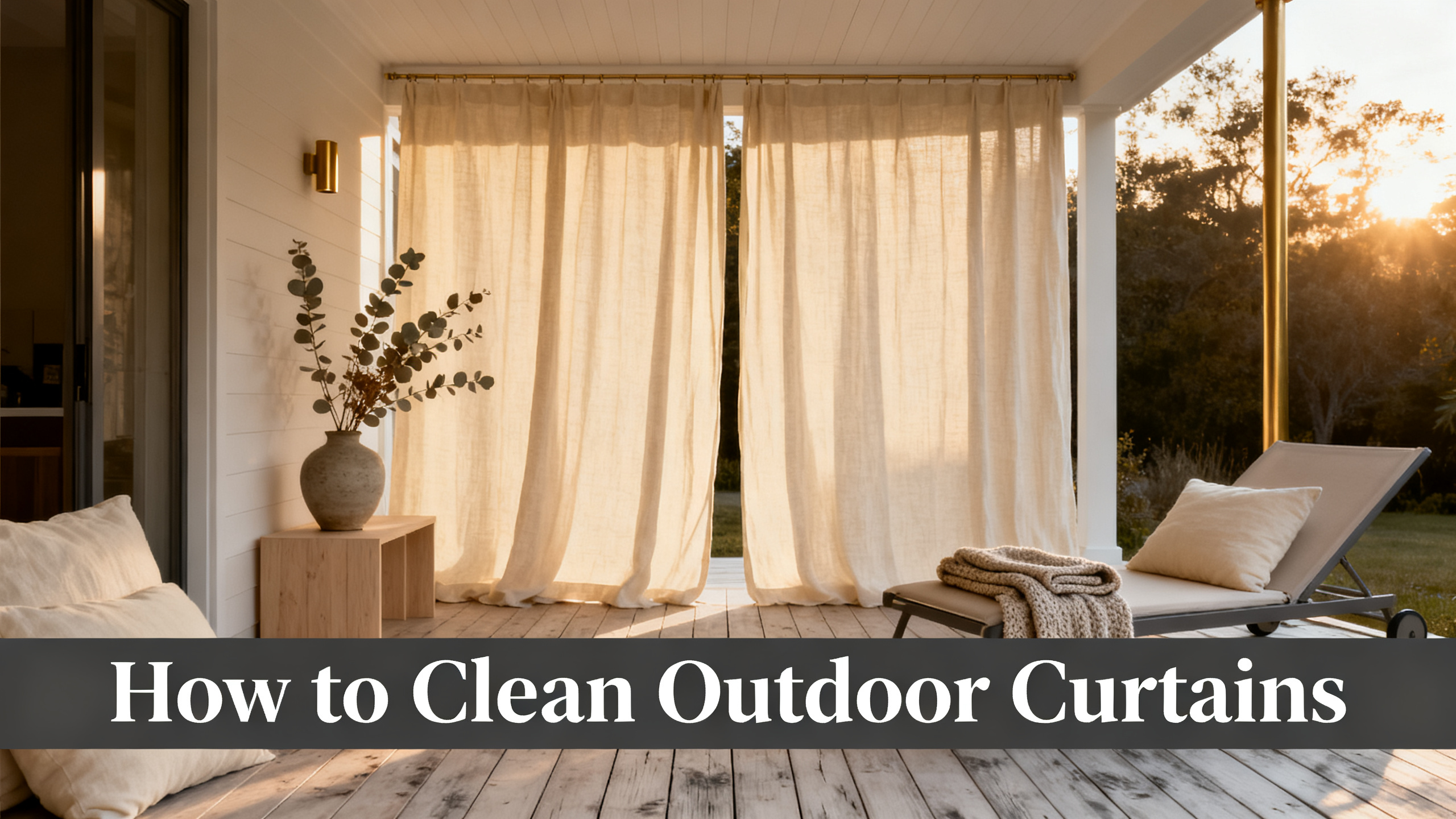
Here is the honest math on cleaning outdoor curtains. Done right, the whole process takes 25 minutes per panel and adds two to three summers to the lifespan. Done wrong, the soft top header warps in the dryer, the Beige colorway bleaches into off-white before the season ends, and you replace a $99 panel a year earlier than you should have.
This guide walks the five-step process that works on acrylic, olefin, and polyester without wrecking any of them, with the specific protocols for the three contaminants owners actually deal with: mildew, stubborn stains, and coastal salt creep. The angle is fabric-first, because the cleaning agent that saves olefin is the same one that ruins acrylic. For the broader context on outdoor fabric selection, weather ratings, and mount hardware, the full outdoor window treatments hub sits one click away.
🧰 Tools & supplies checklist (before you start)
🪣 Tools
- Garden hose with shower setting
- Soft-bristle scrub brush
- 5-gallon bucket
- Spray bottle (32 oz)
- Microfiber towels (3-4)
- Clean ground tarp
🧴 Cleaning agents
- White vinegar (acrylic mildew)
- Mild dish soap (Dawn, Method)
- Oxygen bleach (olefin and polyester only)
- Warm fresh water (salt creep)
- Optional: enzyme spray for organic stains
Budget under $15 in supplies if you do not already own them. Most are reusable across full seasons.

The panel this guide is built around
Heck Solid Acrylic Outdoor Curtain
from $99/panel · 100% acrylic 260 gsm · mildew resistant · 21 colors · cleans with garden hose and mild soap. Final price depends on size and panel count.
Use code JULY for 20% off · Free shipping over $300
Step 1: Read the Care Tag and Identify Your Fabric
Fiber matters more than brand. The same cleaning routine that keeps a 100% acrylic Heck panel pristine will dissolve a polyester sheet, and the oxygen bleach that brightens olefin will eat through acrylic dye. Before you reach for any cleaner, find the care tag and confirm what you are working with.
The Heck Solid Acrylic Outdoor Curtain product page specifies 100% acrylic at 260 gsm with a mildew-resistant finish certified under the ASTM D2020 mildew resistance test for fabrics. That label tells you the fabric slows fungal growth under normal humidity. It does not say mildew-proof, and that distinction matters for the cleaning protocol you pick.
Outdoor Curtain Materials Compared: Acrylic vs Polyester vs Olefin
Cleaning protocols diverge by fiber. The three-way breakdown explains why bleach is fine on olefin and ruins acrylic.
| Fabric | Cleaning agents safe to use | Hard no | Drying method |
|---|---|---|---|
| Acrylic (Heck, Sunbrella premium) | Vinegar 50/50, mild dish soap, oxygen bleach (diluted, test first) | Chlorine bleach, pressure washer, machine wash | Shade-dry flat, 4-6 hours |
| Olefin (Sunbrella budget, Outdura) | Oxygen bleach, dilute chlorine bleach (white only), dish soap | High-heat dry, iron, fabric softener | Shade or low sun, 3-5 hours |
| Polyester (budget outdoor) | Mild dish soap, oxygen bleach (sparingly) | Chlorine bleach (past 3 uses), high heat, machine agitation | Shade-dry flat, 4-6 hours |
Polyester and acrylic require opposite cleaning agents at the chlorine end. Skipping the tag check is the most common reason a single cleaning session shortens a panel’s life by two seasons. Spend the 30 seconds.
Warning: never assume the fabric is acrylic
Polyester and olefin tolerate cleaning agents that destroy acrylic dye. If the tag is missing, do a small burn test on a hem corner: acrylic melts to a hard black bead, polyester melts to a soft black bead with a sweet smell, olefin curls and burns clean with a paraffin smell.
Step 2: Identify What You Are Cleaning Off
There are six contaminants that show up on outdoor curtains in the real world: mildew, pollen, bird droppings, wine and food spills, salt creep, and ground-up patio dust. Each one takes a different cleaning agent, and applying the wrong one either sets the stain or wrecks the fabric. Diagnose before you apply.
Heck Solid Acrylic Outdoor Curtain: Full Review
The deep-dive on the acrylic fabric this guide is built around, including the mildew-resistance finish that changes which cleaner you should reach for.
Mildew is the priority contaminant on any panel that lives outside. It shows as black or dark green spotting, usually on the side facing the wall or the bottom hem where moisture pools. The CDC mold and mildew cleanup guidance recommends gloves and an N95 mask for any mildew area larger than a square foot, which is a meaningful share of a full 100W x 96L panel.
🔍 Stain diagnosis matrix
Salt creep is the coastal-install signature. It shows as a white crystalline rim along the bottom hem, builds up after onshore wind weeks, and stiffens the hand-feel of the fabric if left untreated. Coastal owners on Trustpilot consistently mention rinsing salt-exposed panels monthly during summer to prevent the fiber from going brittle. Skipping it compresses lifespan by roughly 30%.
Warning: pressure washers shred a 260 gsm acrylic weave
Even on the lowest setting, a pressure washer disrupts the woven structure of acrylic outdoor fabric. The visible damage shows up as fuzzed-up patches that no longer shed water. Garden hose only, on shower setting, top-down.
Step 3: Spot-Treat Mildew, Stains, and Salt
Spot-treatment is where the fiber-specific recipes earn their keep. The three workhorses cover 90% of the contaminants you will encounter: vinegar 50/50 for acrylic mildew, oxygen bleach for olefin and polyester stains, and warm water with dish soap for salt creep on any fabric.
🧪 Three DIY cleaning solutions (recipes)
🍶 Vinegar 50/50 (acrylic mildew)
16 oz distilled white vinegar + 16 oz cool water in a 32 oz spray bottle. Shake. Spray liberally, wait 10 minutes, scrub gently with soft brush, rinse.
🧂 Oxygen bleach (olefin / polyester)
2 tbsp sodium percarbonate in 1 gallon warm water. Stir until dissolved. Apply with sponge, wait 15 minutes, soft brush, rinse twice. Safer than chlorine, slower-acting.
🌊 Warm water + dish soap (salt creep)
1 tsp Dawn in 1 gallon warm fresh water. Sponge on the salt rim, wait 5 minutes, scrub gently in the direction of the weave, rinse fully. Repeat if rim persists.
The process for all three recipes follows the same pattern: pre-rinse the area with clean water to lift loose particles, apply the solution, wait the dwell time, agitate with a soft brush in the direction of the weave (never across), then rinse twice with the garden hose until the runoff is clear. Soft brush only. Stiff bristles flatten the acrylic pile and leave a permanent matte streak.
Warning: chlorine bleach is dangerous on every acrylic colorway
It strips the solution-dye that makes acrylic colorfast and weakens the fiber bonds the manufacturer engineered against UV. Always test any cleaning agent on a 1-inch hem corner for 15 minutes before treating the full panel.
If the stain has eaten the fiber, no amount of cleaning will bring the panel back. Mildew that has gone past surface spotting into the weave looks like grey shadowing in raking light and feels permanently soft to the touch. At that point, replacing a single panel costs less than the time and chemicals to chase the stain.

When the Stain Won’t Lift: Replace One Panel, Not the Set
from $99/panel · sold individually · 21 colorways still in production · 5-7 day ship on in-stock. If mildew has eaten the fiber, swapping one Heck panel is cheaper than re-doing the patio.
Step 4: Do a Full Hose-Down Rinse
After spot-treatment, the panel needs a full flush to lift residual cleaning agents and dissolved contaminants. Garden hose, shower setting, top-down, until the runoff is clear. This step alone takes 5-8 minutes per panel and is the single most overlooked one.
⚖️ Hose in place vs demount on a tarp
✅ In place (panel still hung)
- Faster: 8 min per panel
- No remount labor
- Drains naturally
- Best for routine seasonal cleaning
- Limits: cannot rinse the back side fully
🪧 Demount on a tarp
- Thorough: both sides accessible
- 15-20 min per panel
- Requires re-hanging
- Best for deep mildew or salt rims
- Lets you inspect header integrity
Mild soap added to the rinse water helps with film-type residue (pollen, smoke from a nearby fire pit, pollution film in urban patios). Skip soap entirely if you used vinegar or oxygen bleach in the previous step, since the residue interactions can leave streaks on darker colorways.
Warning: never machine wash, never tumble dry, never iron
The 4-in-1 soft top header on the Heck panel is sewn for outdoor hanging only. Tumble drying warps the header, machine agitation pulls the weave open, and an iron melts the acrylic fiber bonds in seconds. Hose, shade, hang. That is the entire approved sequence.
The reason all of this matters is straightforward. The cleaning routine you commit to is the single biggest variable in outdoor curtain lifespan, larger than the colorway, larger than the install method, larger even than the exposure direction.
📊 Lifespan impact: cleaning routine vs neglect
✅ With this 5-step routine
7-10 years
Heck acrylic 260 gsm, covered pergola, seasonal storage. Coastal: subtract ~30%.
❌ No care at all
2-4 years
Same fabric, same install. Mildew eats the fiber by year 2, color softens by year 3.
25 minutes per panel, four times per season. The math is in your favor.
Step 5: Dry, Store, and Prevent Recurrence
Drying outdoor curtains correctly is where most people undo all the work from the previous four steps. Shade-dry flat for 4-6 hours, never in direct sun on a wet acrylic panel. Wet acrylic in direct UV can spot-bleach where water beads sit, leaving permanent lighter circles on darker colorways.
How to Store Outdoor Curtains in Winter
Cleaning is half the battle. The other half is folding, sealing, and shelving panels for 4 to 5 months without trapping moisture.
🌥️ Drying conditions: what works, what wrecks
Shade-dry flat
4-6 hours, on a clean tarp under a roof, ambient airflow. Approved for every fabric.
Direct sun on wet acrylic
Spot-bleaches where water beads sit. Use only after the fabric is touch-dry, never on a soaking panel.
Tumble dry
Warps the 4-in-1 header in one cycle. Melts polyester at high heat. Never appropriate for any outdoor curtain.
Once the panel reads bone-dry on both sides (press a microfiber towel against the back, look for moisture transfer), it is ready to re-hang. For renters and rod-shy owners, re-hanging without drilling new holes stays the right path, since each season’s mount-and-demount inevitably loosens whatever bracket was originally there.
If you are planning to add a colorway match, accept that three years of UV softens every acrylic colorway by 5 to 10%. The Heck Natural variant you bought in spring 2023 reads a touch warmer today than the fresh swatch will. For replacement panels, the Heck Natural AD1150-301 remains the catalogue’s most forgiving choice for hiding the gap between weathered and fresh, since the warm undertone reads consistent across UV-aged ranges.
Color-Match Before You Order a Replacement
Three years of UV softens every acrylic colorway by 5 to 10%. The 21-color booklet ships flat for $1.99 and lets you hold a fresh swatch against your weathered panel before committing.
How Often Should You Actually Clean?
Frequency tracks exposure, not calendar. Covered pergola or porch panels need 2 deep cleanings per year, fully exposed patio panels need 4, and coastal installs need 6 plus a monthly fresh-water rinse during onshore-wind months. The math is exposure-hours, not seasons.
📅 Maintenance frequency calendar
🌸 Spring
Deep clean #1: hose-rinse + pollen check after winter storage. 25 min/panel.
☀️ Summer
Monthly rinse if coastal or under heavy pollen. Spot-treat any bird droppings within 48 hours.
🍁 Fall
Deep clean #2: full process before winter storage. Inspect for mildew on bottom hem.
❄️ Winter
Panels stored dry, breathable bag, off concrete floor. No cleaning required if storage is correct.
Red flags that force an immediate cleaning between scheduled passes: any mildew odor on the fabric, color shadowing visible in raking light, a white salt rim along the hem, or a sudden stiff hand-feel that the fabric did not have a month ago. Each of these signals fiber-level contamination that compounds week over week.
Bridge: When Cleaning Is Not Enough
Sometimes the right answer is replacement, not another cleaning pass. If after a full hose-down the panel still smells musty, still shadows visibly in raking light, or feels permanently stiff in the hand, the fiber has been compromised at the structural level. Cleaning at that point is throwing time at a problem that needs a new panel.
The three indicators that say “replace, do not clean” are mildew that has penetrated past the surface into the weave (you will see grey shadowing on the back side after a clean), color loss greater than roughly 15% versus the original (compare to a hidden hem fold), and header sag where the 4-in-1 soft top no longer holds line when hung dry. If the panel is past saving, the outdoor curtains buying guide walks you through choosing a replacement fabric that matches what you have.
Cleaned and Still Looks Tired? Start Fresh.
100% acrylic, 260 gsm, mildew and UV resistant, 21 colorways. from $99/panel. Code JULY (20% off) · Free shipping over $300 · in-stock colorways ship in 5-7 days.
FAQ
Can I machine wash outdoor curtains?
No. Acrylic, olefin, and polyester outdoor curtains all share one rule: machine washing damages the UV-stable finish, distorts the soft top header, and shrinks the panel unevenly. The Heck Solid Acrylic Outdoor Curtain ships with a 4-in-1 soft top header sewn specifically for outdoor hanging, not for tumble agitation. For deep cleaning, hose-rinse flat on a clean tarp, spot-treat by hand, then shade-dry.
How do I remove mildew from outdoor curtains?
Mix a 50/50 white vinegar and water solution in a spray bottle, apply liberally to mildew spots, let sit 10 minutes, then scrub gently with a soft-bristle brush. Rinse with a garden hose on shower setting until the water runs clear. For acrylic panels, never use chlorine bleach: it strips the dye and weakens the fiber. The CDC mold cleanup guidance recommends gloves and an N95 mask for any mildew area larger than a square foot.
Is bleach safe on outdoor curtains?
Only oxygen bleach (sodium percarbonate) is broadly safe across outdoor fabrics. Chlorine bleach is fine on white olefin, dangerous on every acrylic colorway, and risky on polyester past three uses. Always test on a hidden hem corner for 15 minutes before treating the full panel. If the test area lightens, switch to vinegar-based or oxygen-based cleaning.
How do I clean salt off outdoor curtains in coastal installs?
Salt creep dissolves in warm fresh water, so a dish soap and warm water rinse is the right protocol. Wet the affected area, scrub with a soft brush, rinse fully, repeat if the crystalline rim is still visible. Coastal owners on Trustpilot consistently mention rinsing salt-exposed panels monthly during summer to prevent fiber stiffening. Skipping salt removal compresses outdoor curtain lifespan by roughly 30%.
Can I pressure wash outdoor curtains?
No. A 260 gsm acrylic weave will shred under the impact pressure of a typical pressure washer, even on the lowest setting. The garden hose on shower setting delivers enough volume to flush mildew, pollen, and dust without disrupting the weave. If a panel is stained deeply enough that you would reach for a pressure washer, the right move is replacement, not aggressive cleaning.
How often should I clean outdoor curtains?
Frequency tracks exposure. Covered pergola or porch panels need 2 deep cleanings per year (spring and fall). Fully exposed patio panels need 4 per year (one per season). Coastal installs need 6 per year, plus a monthly fresh-water rinse during onshore-wind months. Between schedules, any mildew odor, color shadowing, or salt rim triggers an immediate spot-clean.
How long do outdoor curtains last with proper care?
Acrylic outdoor curtains at 260 gsm typically last 7 to 10 years with the cleaning routine in this guide, versus 4 to 7 years with sporadic cleaning, and only 2 to 4 years with no care at all. The Heck Solid Acrylic Outdoor Curtain owner feedback on Trustpilot consistently mentions year-five performance still acceptable when panels are taken down for winter and cleaned twice a season. Coastal salt air compresses every number by about 30%.
What is the difference between mildew resistant and mildew proof?
Mildew resistant means the fabric finish slows fungal growth under normal humidity, but standing water or trapped moisture will still allow mildew to establish. Mildew proof would mean fungal growth is fully prevented, which is not a claim any consumer outdoor fabric legitimately makes. The ASTM D2020 test method certifies resistance, not proof. The practical implication: even on Heck’s acrylic, dry the panel fully before re-hanging and never store it damp.
