
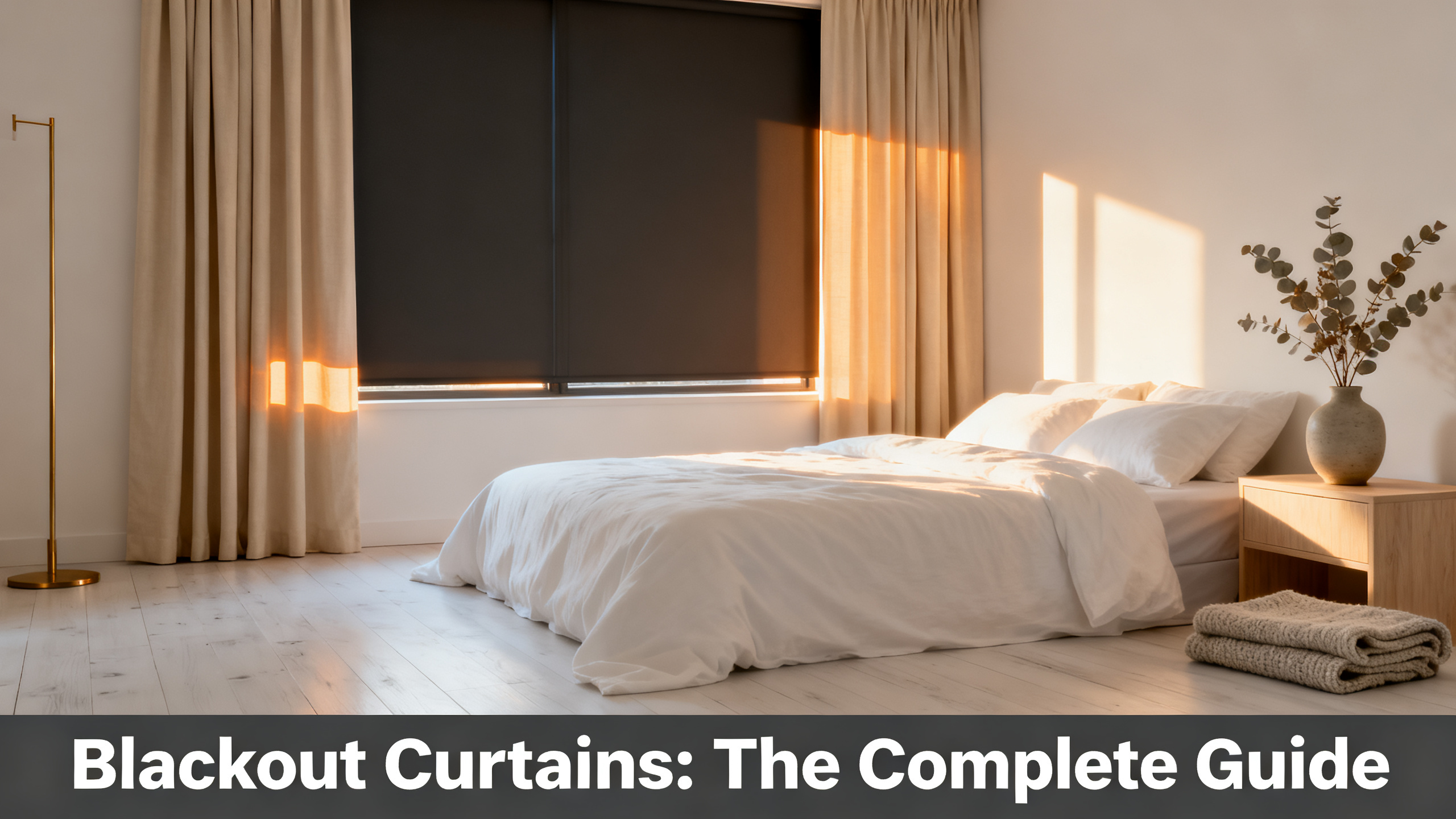
Most “blackout curtains” articles pick five panels from five different brands, wave a shading percentage around, and call it a shortlist. This one does something different. We audited every blackout SKU in the Two Pages catalogue, 5 collections, 42 variants, 4 different shading strategies, and mapped the whole territory before naming a pick. If you want the shortlist, the best blackout curtains 2026 shortlist gives you the ranked five in one page. This hub instead shows you the map so you can pick your own path.
The verdict at the top so you can leave if you want: after 42 variants scored on shading, hand, price and format, the Lila 100% Blackout Drape Pinch Pleated at Two Pages is the #1 pick for a full-drape blackout. It’s the only collection that hits 100 percent shading from the weave itself, no coated film, no separate liner. The rest of this guide is why that verdict holds and, more importantly, when it doesn’t.
Hub Methodology
5 collections · 42 variants · 4 shading strategies
Every Two Pages blackout SKU was scored on shading rate, fabric strategy (woven vs coated vs backed), configured price, install format (drape, roller, cellular, room divider) and color range. The full audit sits below.
Collections
5
SKU Variants
42
Shading Range
99-100%
Price From
$41
GSM Range
220-280

Editor’s Pick : Hub #1
Lila 100% Blackout Drape Pleated
from $89.00/panel (final price depends on size and pleat count)
- 100% shading from the weave itself, no coated film, no separate liner
- 280 gsm heavyweight body, ivory and snow white still block 100% of light
- Apartment Therapy 2026 “Best Blackout Curtains” honor on the collection
Code JULY for 20% off · Free shipping over $300
Blackout 101: How a Curtain Actually Blocks Light
The 100 percent vs 99 percent claim, and why the gap matters
“Blackout” is a category name, not a legal standard. In the US, panels tagged as blackout run anywhere from 90 percent shading (which is really room darkening) to 100 percent (which is truly pitch dark). The 10 percent gap between them is huge. At 90 percent, sunrise still lights the ceiling. At 100 percent, a phone flashlight held to the outside of the panel doesn’t come through.
Two Pages splits its blackout range into two shading tiers. Lila and Liz Blackout hit 100 percent, verified with the collection swatch pack against a lightbox. Atlanta stops at 99 percent, close enough for most bedrooms and every media room, not quite enough for a newborn or a rotating night shift. Aura Cellular and Alvin Roller both reach 100 percent through different fabric strategies, but only on their inside-mount configurations where the shade sits inside the window frame.
Blackout vs Room Darkening: the 5 percent that changes everything
Room darkening panels stop at 90 to 95 percent shading and let a soft glow through the weave. True blackout starts at 99 percent and is engineered differently. Our side-by-side breakdown of what the labels actually mean and when each is the right call.
GSM, coating, backer : the four fabric strategies
How a curtain actually blocks light comes down to fabric strategy, not a marketing sticker. There are four real ways to get to a blackout number, and every catalogue mixes them differently. The first is a dense weave that stops the light in the fibers themselves. The second is a laminated backer bonded to a nice-looking outer. The third is a coated film sprayed onto the back of a lighter fabric. The fourth is not a curtain at all but a cellular shade with air-cell chambers that trap the light.
Two Pages leans on the first two strategies, which is why the range reads more “drapery” than “utility.” The OEKO-TEX Standard 100 framework for textile safety also matters here: dense woven blackouts and laminated backers are easier to certify than coated films, since the coating adds chemistry that has to pass separate migration tests. If the room is a nursery or a bedroom for someone chemically sensitive, the strategy behind the shading number matters as much as the number itself.
🧵 Four Ways a Curtain Blocks Light
Blackout is a fabric strategy, not a marketing label
Strategy 1
Dense weave (no coating)
A 260 to 300 gsm polyester or blend woven so tightly the light stops in the fibers. Best hand. Two Pages example: Lila (280 gsm).
Strategy 2
Fabric + blackout backer
A natural-looking outer (linen blend, cotton) laminated to a poly blackout membrane. Softer face, same shading. Two Pages example: Liz Blackout (220 gsm blend + backer).
Strategy 3
Coated blackout (acrylic/PVC film)
A thin film bonded to the back of a lighter fabric. Delivers 100 percent shading at low price but the hand reads “rubbery”. Common in ready-made panels below $30.
Strategy 4
Cellular honeycomb
Not a curtain: a shade. Air cells trap light and thermal energy at once. Two Pages example: Aura Blackout Cellular : the only Two Pages blackout that also insulates.
The strategy also tells you what you’re going to feel when you touch the curtain. A dense-weave blackout drapes and swings like a real curtain. A coated blackout crinkles like a raincoat. A cellular shade folds up on itself in stacked accordions and doesn’t drape at all. The fabric strategy IS the buying decision, the shading percentage just tells you what the strategy delivered.
The 5 Two Pages Blackout Collections (audit)
Two Pages splits its blackout range into five distinct collections. Each solves a different install format and a different price tier. Here is the map at a glance, then the collection-by-collection breakdown.
Lila 100% Blackout Drape : the woven king
Lila is the reason this hub exists. It’s the only Two Pages drape collection where the fabric itself hits 100 percent shading, no coated film, no separate liner, no add-on lining. The trick is a densely woven 280 gsm polyester engineered so tightly that even the Ivory White and Snow White variants block full light. Most cheap “white blackout” panels rely on a dark coating on the back and lose the claim when the coating thins. Lila does not.
The collection ships in three headers (pinch pleat, grommet, soft top) across 10 colors (Snow White, Ivory White, Beige, Natural, Khaki, Light Brown, Light Grey, Grey, Flax Sand, Gray Beige). The Apartment Therapy 2026 Best in Home Awards named the collection “Best Blackout Curtains”. Pricing runs from $89 per panel to about $260 for a large sliding door. For the deep-dive on the pinch pleat variant, our full Lila Pinch Pleated review covers the SKU end to end.
Liz Linen Blackout Pleated : the natural-hand runner-up
If polyester is a hard no and you still need blackout, Liz Linen Blackout is the answer. The outer is a 10 percent linen blend at 220 gsm, which reads soft and matte from the room. The blackout comes from a poly blackout backer laminated to the back of the linen face. The two layers together still hit 100 percent shading; from the front, the panel looks like a linen drape.

Liz Blackout is also the entry-price ivory blackout drape of the Two Pages catalogue at from $59.99. That matters because the ivory blackout tier is where the cheap ready-made panels fall down: most $30 ivory blackouts either lie about shading or look like plastic. Liz keeps the drape look and the blackout claim. The palette runs 15 colors, wider than Lila.
Two Pages Lining Comparison: 6 options tested for shading, thermal and hand
Cotton, poly, thermal blackout, waterproof, interlined, unlined. Every Two Pages lining option scored on shading rate, hand and price uplift, with a table you can filter by use case.
Atlanta Room Divider Kit : the ceiling-track specialist
Atlanta is the odd one in the range. It’s a 252 gsm blackout drape at 99 percent shading, but what makes it a separate SKU is the full ceiling track kit that ships in the box. This is the only Two Pages set built to wrap a sliding glass door, curve around a bay, or split an open studio into two rooms without needing a wall or a rod. The Atlanta Room Divider Blackout Curtain with Ceiling Track Kit lists from $200.99 for the panel plus kit.

The 99 percent shading matters. In a bedroom where the room stays dim for six hours after sunrise, Atlanta is fine. In a nursery for a light-sensitive infant, the 1 percent gap versus Lila is enough to register on a light meter and, sometimes, on nap length. Choose Atlanta for the format, choose Lila for the pure shading.
Aura Blackout Cellular Cordless : the small-window format
Aura is the format winner when the window is small, awkwardly shaped, or in a rental where drilling is a no. The cellular fabric folds into honeycomb air cells that trap light AND thermal energy at once, which is why the same shade also reads as an insulator. The inside-mount version sits flush inside the frame; the no-drill variant holds by tension only, leaving no wall damage. The Aura Blackout Cellular Window Shades Cordless lists from $88.99.


Alvin Basic Premium Blackout Roller : the sub-$50 entry
Alvin exists so nobody is priced out of blackout at Two Pages. The Alvin Basic Premium Blackout Cordless Roller lists from $41.39 per shade, kid-safe cordless spring lift, coated polyester body, 8 colors. It reads utilitarian; the hand does feel plasticky compared to Lila. If the room needs to feel finished, run Alvin behind a decorative unlined drape. If the room is a kid’s playroom or a laundry room, Alvin alone is enough.
Runner-Up · Natural Fiber Look
Liz Linen Blackout Pleated Drapery : from $59.99/panel
The entry-price ivory blackout drape in the Two Pages range. 220 gsm linen-blend body over a poly blackout backer, 15 colors, pinch pleat header included. If a linen hand matters and Lila’s polyester body is a no, Liz Blackout is the answer.
Code JULY · Made-to-order · Hooks included
Which Room, Which Collection
The pick isn’t the same for every window. A nursery needs an ivory white that still blocks 100 percent of light. A media room wants a dark tone that reinforces the perceived blackout on a projector wall. A rental studio can’t afford drill marks. Here is the room-by-room breakdown.
🏠 Which Room, Which Collection
The pick changes with the room. Six rooms, six answers.
🛏️ Primary Bedroom
Lila Pinch Pleated
Full 100 percent shading matters here. The 280 gsm hand outperforms coated panels at the same ticket. Pair with rod at least 6 inches above the frame.
🍼 Nursery
Lila Ivory White or Snow White
Only white blackout that still blocks 100 percent of light. Room reads warm and soft in the daytime, pitch dark for naps.
🎬 Media Room / Home Theater
Lila Grey or Birkin Velvet Blackout
Dark tone reinforces the perceived blackout on a projector wall. Velvet blackout also dampens reflections and softens room acoustics.
🛋️ Living Room
Liz Linen Blackout
Natural-hand fabric with a blackout backer. Reads like a linen drape from the room, delivers blackout at bedtime or for movie afternoons.
🏢 Studio / Partition
Atlanta Room Divider Kit
Ceiling track kit ships in the set. The only Two Pages solution built to wrap sliding doors or partition an open studio without a rod.
🔑 Renter / Small Window
Aura No-Drill Cellular or Alvin Roller
No hardware into the wall for renters. Aura no-drill mounts inside the frame with tension; Alvin roller at $41 is the sub-$50 backup when even Aura is over budget.
Primary bedroom and nursery
Bedrooms drive most blackout searches, and the sub-case that matters is the shift worker and the light-sensitive infant. The CDC on the effect of ambient light on sleep quality is unambiguous: even a soft glow through the curtains disrupts REM cycles in people who sleep off-schedule. For a rotating night shift, only 100 percent shading works. Lila in Grey (H812-8) is the most-ordered variant for primary bedrooms because the dark tone visually reinforces the room’s darkness even during the daytime.

The nursery case is trickier. Parents want the room to feel warm and soft during the daytime, which usually means white or ivory curtains, and then pitch dark for naps. Most white blackouts fail this brief because they rely on a dark coating on the back. Lila in Snow White (H812-1) and Ivory White (H812-2) is the answer, both variants blocking 100 percent of light at 280 gsm. The American Academy of Pediatrics on light exposure and infant sleep notes that consistent darkness helps entrain circadian rhythm in the first 12 weeks. That’s the specific case where the 1 percent gap between Lila and Atlanta matters most.
Media room and home theater
Home theater rooms want two things: full darkness for the projector and a fabric that dampens reflected glare. Lila in Grey or Charcoal handles the darkness. For the reflection problem, Birkin Velvet Blackout is the specialist SKU: the velvet nap catches stray light before it bounces to the screen. Velvet also softens the room’s acoustics enough to hear the difference in dialogue clarity, which nobody expects until the first movie night.
Studio, sliding door, room divider
Sliding doors and open studios need a format, not just a fabric. The Atlanta Room Divider Kit is the only Two Pages set that ships with a full ceiling rail in the box, which is what lets you wrap a corner or partition an open plan without touching a wall. Expect to install the track before ordering panels; the finished panel length depends on the rail height.
Renter and small window
Renters have two constraints: no drill holes and often, small windows. Aura No-Drill Blackout Cellular Shades solve both. The tension mount holds the shade inside the frame without hardware; the honeycomb body blocks 100 percent of light and doubles as an insulator against summer heat. If even $88.99 is over budget, the Alvin Basic Premium Blackout Roller at $41.39 mounts with two small brackets that come off without leaving a visible mark on painted wood.
🧭 Decision Flowchart
Which Two Pages blackout collection is yours?
Q1. Do you need 100 percent shading (nursery, shift worker, projector) or is 99 percent enough?
100% → continue to Q2. 99% → Atlanta or Aura are fine.
Q2. Do you want a drape look or a shade look?
Drape → continue to Q3. Shade → Aura Cellular (inside mount) or Alvin Roller (budget).
Q3. Does the hand of the fabric need to feel natural?
Yes → Liz Linen Blackout ($59.99). No → Lila Pinch Pleated ($89), the hub’s #1 pick.
Edge case. Ceiling-mounted install, sliding-door wrap, or partition? Atlanta Room Divider Kit is the only Two Pages set with a full ceiling rail in the box.
How to Measure and Configure a Two Pages Blackout
The single biggest reason blackout curtains fail to actually block light isn’t the fabric, it’s the install. A 100 percent shading panel that’s the same width as the window still lets light in around the leading edge and the rod return. The rule that fixes 90 percent of complaints: rod width equals frame width plus 6 to 12 inches on each side, and panel width equals rod width times 2 for pinch pleat. Get those two right and the rest is finishing.
Curtain Size Calculator : feed your window, get your panel width
Enter rod width, ceiling height and pleat style. The calculator returns the finished panel size Two Pages needs at checkout, plus the extra fullness recommended for pinch pleat and ripple fold. Fewer configurator surprises.
The second rule is rod height. Blackout drapery should hang from 6 to 8 inches above the window frame, not from the frame itself. Higher rod pushes the panel above the top edge of the glass, which is where daylight leaks in first. A high rod also visually raises the ceiling, which is a bonus. Lila and Liz panels ship long enough to reach the ceiling; you can always shorten at the hem, you cannot make a short panel longer.
📏 Drop and Coverage
Every blackout gain comes from a bigger panel than the window.
Rod width
Frame width + 6 to 12 inches each side
The rod must extend past the window on both sides. That extra span is what stops daylight bleeding at the leading edge.
Rod height
6 to 8 inches above the frame
Higher rod = taller-looking ceiling. In blackout use, higher rod also means fewer top-edge leaks. The Lila and Liz panels ship long enough for ceiling-height installs.
Panel width per window
Rod width × 2 (pinch pleat)
Standard full-closure math for pleated drape. Two panels of half the rod width, or one panel that meets the return at each end.
Drop length
Rod to floor + 1 inch (puddle for seal)
Blackout demands a floor seal. A panel that hangs 0.5 inch above the floor leaks a soft glow along the bottom edge every morning.
Header style: pinch pleat, grommet, soft top
Two Pages ships blackout drapery in three headers, and the choice affects the stack density and the closure quality. Pinch pleat is the tightest closure and the best default for blackout use. Grommet has a cleaner casual look but leaves a slightly larger gap at the top edge, which costs 1 to 2 percent of perceived blackout. Soft top (rod pocket) is the softest visual header and the hardest to open daily, best suited for panels that mostly stay closed.
🧵 Header Style Visualizer
Blackout drapery ships in 3 headers at Two Pages. The header changes the stack, not the shading.
Pinch Pleat
Structured parallel folds, hooks supplied. Best stack density for full closure and a “tailored” look. Works with a standard rod or a traverse track. Recommended fullness 2× rod width.
Grommet
Metal rings punched through the top hem. Cleaner casual look, slightly bigger gap between the wall and the panel at the top edge, worth 1 to 2 percent of “perceived blackout” in a bedroom.
Soft Top (rod pocket)
The rod slides through a fabric channel. Softest visual header, hardest to open and close daily. Best for panels that mostly stay closed (guest bedroom, media room).
Lining choice
Lining is where the blackout math gets specific. Lila can run unlined because the fabric IS the blackout. Every other Two Pages drape needs a backer or a coating to hit 99 to 100 percent shading. The thermal blackout 250 gsm liner is the default on Liz Blackout and the correct pick for a room with a heating or cooling penalty. The grayish white blackout 150 gsm is lighter in hand and better on tall windows where panel weight matters. Skip cotton lining if you actually need blackout; cotton lines up as a privacy layer only.
Color choice and the free swatch pack
Color is a decor decision, not a performance decision. Every Two Pages blackout SKU delivers the same shading rate across its palette. The Snow White and Ivory White in Lila are the surprise: full 100 percent blackout in the whitest whites the catalogue offers. What changes across colors is dye lot, tone under warm vs cool LEDs, and how the fabric photographs. That’s why the free swatch pack matters more than the product image.
🎨 Blackout in Every Tone
Two Pages ships 100 percent blackout in whites, sand, grey and dark tones. Pick by room, not by shading.
Snow White
Ivory
Beige
Khaki
Grey
Charcoal
Ivory and Snow White are the surprise: the Lila collection woven at 280 gsm hits full shading even in optical white. The tone in the room is a decor decision, not a performance decision.
📏 Pro Tip · Measurement day
Three measurements save you the reorder
- Rod width finished, not window width. The finished rod extends past the frame on both sides.
- Rod to floor, not rod to sill. Blackout drapes should touch the floor for the seal.
- Ceiling to floor, if the rod is not up yet. Two Pages panels ship long, you can trim at hem.
Made-to-order means final sale. A 15-minute measurement pass beats a $200 remake.
Once the measurements are in, the configurator returns a real price in seconds. Below is what a full blackout window actually costs at Two Pages across the five collections, single panel, standard color, at list.
📐 Real Configurator Prices
What a full blackout window actually costs at Two Pages (single panel, standard color)
Alvin Roller · Standard bedroom
36" W × 60" L
~$55
The absolute floor. Kid-safe cordless. Reads utilitarian; use inside a decorative drape if the room needs to feel finished.
Liz Blackout · Standard bedroom
54" W × 84" L
~$135
Linen-blend body, pleat header, blackout backer. Sweet spot for living-room and bedroom drapery on a budget.
Lila Pinch Pleated · Standard bedroom
54" W × 84" L
~$160
The editor’s pick. 100 percent shading, 280 gsm, 10 colors including ivory and snow white. Rod width × 2 for full closure.
Lila · Sliding door
108" W × 96" L
~$260
Media room slider or patio wraparound. The 112-inch fabric width supports a seamless panel up to 100 inches finished.
Code JULY applies 20% off sitewide. Free shipping unlocks at $300. Prices refresh at checkout depending on drop and pleat count.
🎁 Before you commit: order the free Two Pages blackout swatch pack
Get Lila (280 gsm poly), Liz Blackout (220 gsm linen blend) and Atlanta (252 gsm) side by side under your own bedroom or nursery light. Shading is 99 to 100 percent across all three. The tone in your room is the only decision left. Swatches are $3.99 to $8.99 shipped, fully refundable separately from any made-to-order panel.
Full Hub Directory: Every Blackout Article on Two Pages
Below is the full map of the Two Pages blackout coverage on Shadehunt. Reviews on the SKU level, Best-of shortlists by use case, side-by-side comparisons against every major competitor, and the technical guides that back the picks.
📚 The Full Blackout Hub
Every review, comparison and guide on the Two Pages blackout range
Reviews
Best-of
VS-Brand
FAQ (Blackout Curtains : Quick Answers)
Do blackout curtains really block 100 percent of light?
Only when the fabric strategy delivers it and the install seals the edges. The Lila collection at Two Pages hits 100 percent shading from the weave itself. Coated blackout panels also claim 100 percent but the film hand reads rubbery. Around any 100 percent panel, expect a small leak at the rod return, the leading edge, and the floor if the drape is not puddled. A panel that hangs 0.5 inch above the floor still lets a soft glow in at sunrise.
What is the difference between blackout and room darkening?
Room darkening panels stop at 90 to 95 percent shading. Blackout starts at 99 percent and reaches 100 percent on Lila and Liz Blackout. In practice, room darkening still lets you see silhouettes and colors inside the room during the day, blackout does not. For a nursery, a shift worker, or a projector wall, room darkening is not enough.
Which is the best blackout curtain at Two Pages?
For a drape look with the fabric doing all the shading, Lila Pinch Pleated (from $89/panel) is the hub’s #1 pick after auditing 42 variants across 5 collections. It hits 100 percent shading uncoated, ships in 10 colors including ivory and snow white, and carries the Apartment Therapy 2026 Best Blackout Curtains honor. The runner-up on natural hand is Liz Linen Blackout from $59.99.
Are white blackout curtains real, or do you need a dark color?
Yes, white blackout is real, and the Lila collection is the proof. Ivory White (H812-2) and Snow White (H812-1) still block 100 percent of light at 280 gsm because the woven density does the work, not the color. Most cheaper “white blackout” panels are coated on the back and lose the shading claim if the coating is thin. On Lila, the fabric IS the blackout.
Do blackout curtains help in summer?
Yes, on both ends. Blackout curtains block direct sunlight before it heats the room, and thicker options like Lila 280 gsm and cellular shades like Aura also cut the thermal transfer through the window. A closed blackout drape in front of a south-facing window can drop the room temperature by 6 to 10 degrees Fahrenheit at peak afternoon.
Can renters install blackout curtains without drilling?
Yes, two Two Pages options make sense here. Aura No-Drill Blackout Cellular Shades mount inside the frame with tension, no wall damage. Alvin Basic Premium Blackout Roller shades also install inside the frame with brackets that a renter can remove without leaving the drilled trace visible. For drapery, tension rods work with lightweight blackout drape but not with 280 gsm Lila.
How much do custom blackout curtains cost at Two Pages?
Prices depend on size and pleat count. A standard bedroom window (54″ × 84″) in Lila Pinch Pleated runs around $160 per panel at list. Liz Linen Blackout at the same size runs around $135. Alvin Roller at 36″ × 60″ runs around $55. A large sliding door (108″ × 96″) in Lila runs around $260. Code JULY applies 20 percent off sitewide. Free shipping unlocks at $300.
Methodology Recap and Editor’s Note
The picks in this hub are the output of a five-collection audit: 42 variants scored on shading rate, fabric strategy, configured price, install format and color range. Lila earned the #1 pick because it’s the only Two Pages drape that hits 100 percent shading from the weave alone, so the buyer never has to compromise on hand for shading or vice versa. Liz Blackout earned runner-up because the linen-blend body over a poly backer gives the same result via a different strategy, at a lower entry price. The remaining three collections are format specialists, not lesser SKUs.
This guide is signed and maintained by Iris Halberg, textile-focused editor at Shadehunt, who scored the collections against the current Two Pages catalogue on 4 July 2026. Read the full editor bio for what informs the ranking, and read our editorial standard for the ranking rules themselves.
One more question that keeps coming up: is Lila overkill for a guest room?
Probably. If the room is used a few nights a month and never for daytime sleep, Atlanta’s 99 percent or Aura Cellular is more than enough and saves you $70 per window. Save Lila for the primary bedroom, the nursery, or the media room where the last 1 percent actually matters.
And what if the promo code doesn’t apply?
Code JULY is the 20 percent default. Code VIP22 unlocks 22 percent on luxury/trade tiers. Code WOVEN applies to the bamboo range only. If your cart shows no discount, either the code has expired that day or the SKU sits outside the applicable range; contact Two Pages support for a same-day fix.
Hub Verdict
The #1 pick after auditing 42 variants
Lila Pinch Pleated · from $89/panel
The only drape collection where the fabric itself hits 100 percent shading, no coated layer, no separate liner. Best fit for bedrooms, nurseries and media rooms where every ray matters and a “blackout look” reads wrong on the room.
Configure Lila Pinch Pleated →
Code JULY for 20% off · Made-to-order · Free shipping over $300
