
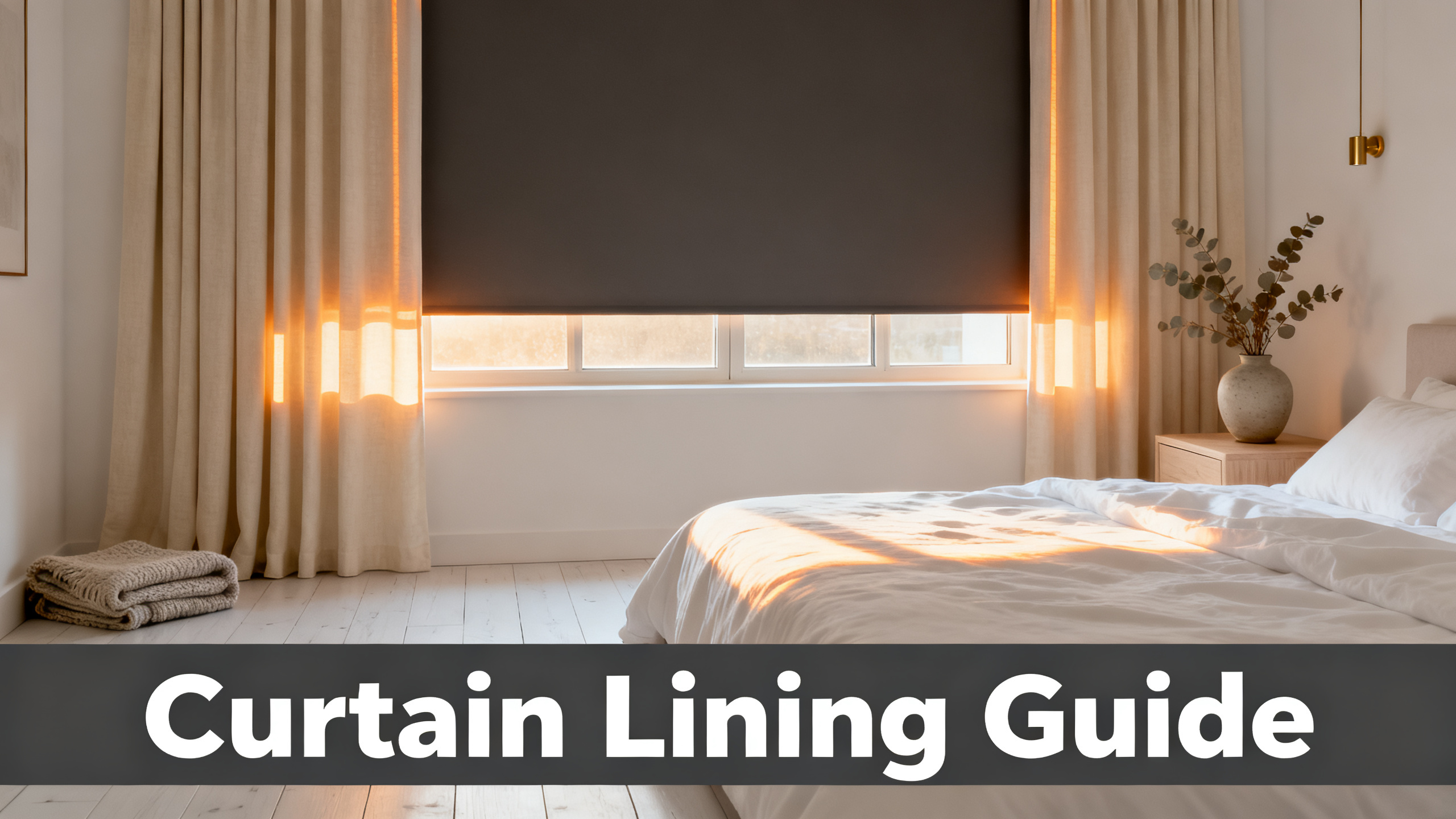
Four questions answer 90 percent of lining choices. Get them wrong and you buy the wrong lining twice: once when the shading rate does not match the room, and once when the retrofit clip liner starts sagging at month six.
Two Pages ships six distinct linings on its drapery lines: unlined, cotton, room darkening, blackout thermal, 100 percent coated, and interlining. Each has a shading rate, an R-value, a price add, and a drape signature that behaves differently in a north-facing bedroom than in a south-facing living room. For the wider scope on blackout construction and coated fabrics, our Two Pages blackout curtains hub maps the ranked picks and the physics behind each build.
Before committing a custom order, most buyers benefit from the Two Pages 6-type lining booklet, a $2.99 cut-swatch set that lays all six lining families side by side under indoor light.
🧭 Decision framework: four questions before you pick a lining
🌙 Q1. Light
How much daylight do you want blocked? Range spans 30 percent (unlined) to 100 percent (coated).
🌡️ Q2. Temperature
Does the window face temperature swings? Blackout thermal adds R-2.0, interlining adds R-2.5.
👁️ Q3. Privacy
Street level or upper floor? Cotton lining at 55 to 70 percent shading kills silhouettes without total dark.
💰 Q4. Budget
The Liz Linen lining delta runs +$28 (cotton) to +$113 (blackout thermal), interlining +$65.

Editor’s pick for lined ready-made
Liz Linen with Blackout Thermal Lining
from $188.99/panel · 100 percent shading rate · 250 gsm thermal blackout backer · 38 face colors · triple pleat · sizes 52×84 to 72×108. Final price depends on size and lining choice.
Use code JULY for 20% off · Free shipping over $300
The Decision Framework: Four Questions Before You Pick a Lining
Every lining conversation runs into the same four variables. Light comes first because it drives the two most visible failure modes: too much sunrise in a north-east bedroom, and too much streetlight glow through a south-facing living room after dark. The right lining answer is not “as much blackout as possible” but the lowest shading rate that solves the actual problem.
Temperature is the second variable and the one most buyers underestimate. The US DOE energy-efficient window coverings guidance puts winter heat retention from a heavy blackout thermal build at up to 25 percent versus an unlined panel. That savings shows up on the HVAC bill, not in the room aesthetics, and it explains why colder-climate owners default to blackout thermal even in low-light rooms.
Privacy is question three and it separates into daytime and nighttime cases. Daytime privacy is easy: unlined linen at 90 gsm blurs silhouettes fine. Nighttime privacy over a street with sodium lamps is a different physics problem entirely, and it needs at least 55 to 70 percent shading to prevent the room from lighting up from the outside.
How to Measure for Curtains: Complete Guide
Before you pick a lining, get the drop and coverage right: rod-to-floor math, return depth, and why a lined panel needs a wider stack-back allowance than an unlined one.
Budget closes the framework. On Liz Linen ready-made 52×84, the deltas are precise: unlined base $75.99, cotton +$28, room darkening +$45, blackout thermal sold at $188.99 all-in. Interlining is custom-only at +$65. Lila 100 percent coated is a flat $89 because the blackout is baked into the face fabric. Those five numbers cover 95 percent of Two Pages lining decisions.
| Lining | Shading rate | R-value | Price add (Liz Linen 52×84) | Drape signature |
|---|---|---|---|---|
| Unlined | 30 to 40% | R-0.9 | Base $75.99 | Breezy, translucent |
| Cotton | 55 to 70% | R-1.1 | +$28 | Structured, soft fold |
| Room darkening | 80 to 90% | R-1.4 | +$45 | Medium weight, clean pleat |
| Blackout thermal | 95 to 99% | R-2.0 | Sold at $188.99 lined | Heavy, straight fall |
| 100% coated | 100% | R-1.8 | Flat $89 (Lila) | Flat, slightly stiff |
| Interlining | 85 to 92% | R-2.5 | +$65 custom-only | Classic bell fold |
Unlined Privacy: When You Do Not Need a Lining
With the framework in place, the shading-rate ladder becomes a menu, not a maze. Unlined starts the ladder at 30 to 40 percent shading, which is what a 90 gsm linen delivers naturally without any backer. The panel reads translucent in direct sun, structured in overcast light, and holds a soft breezy movement because there is no lining weight fighting the fold.
The natural fit is the Liz Linen unlined privacy panel review at $75.99 ready-made, sold with a triple pleat header and OEKO-TEX certified linen face. Owner feedback on Trustpilot puts this build in living rooms, upstairs bedrooms, and dining rooms where the primary job is daytime softness with a light privacy layer.
🌙 Shading rate ladder
Unlined
30-40%
Cotton
55-70%
Room dark
80-90%
Blackout thermal
95-99%
100% coated
100%
Where unlined fails is predictable. Streetlight glow bleeds through the linen weave at night. Thermal loss is a real number: R-0.9 versus R-2.0 for the blackout thermal build translates to noticeably colder glass in January. And in bedrooms east of the sunrise line, the panel does nothing to stop a 6am wake-up. Unlined is the right answer for privacy-only rooms, not for sleep or temperature-sensitive spaces.
Cotton Lining: The Mid-Tier Default
Cotton lining is the upgrade most owners quietly settle into. It sits at 55 to 70 percent shading, adds +$28 on Liz Linen ready-made, and uses a 140 gsm cotton backer stitched into the panel with matching color. The face fabric keeps its linen texture, the fold gets structured without going stiff, and the room reads warmer without going dark.
The Two Pages cotton backers are OEKO-TEX Standard 100 textile certification compliant, which matters if you are lining a nursery, a kitchen, or a room where anyone with fabric sensitivity spends real time. The certification is stitched-label verified, not marketing copy.
Cotton is the right pick for owner mid-tier bedrooms without harsh winter, north-facing living rooms that never see direct sun, and any street-facing window where nighttime privacy matters more than blackout. Skip it for east-facing bedrooms with morning sun, home theaters, and any room where the HVAC bill is a real concern.
🌡️ Thermal R-value by lining
Unlined
R-0.9
Baseline linen weave
Cotton
R-1.1
Mild HVAC assist
Room darkening
R-1.4
Meaningful in mixed climates
Blackout thermal
R-2.0
DOE reference build
100% coated
R-1.8
Coating instead of batting
Interlining
R-2.5
Historic-house standard
Room Darkening Lining: 80 to 90 Percent Shading
Room darkening is the middle-ground build, and it is often mislabeled as blackout in retail copy. The construction is a stitched poly-cotton blend at 180 gsm, no coating, no thermal batting. Shading lands at 80 to 90 percent, R-value at R-1.4, and the Liz Linen add is +$45.
Blackout vs Room Darkening, in Numbers
The two terms get used interchangeably in retail copy, but the shading rates differ by 15 to 25 points. This guide pins down the number for each construction.
The best use case is the light-sleeper who wants morning daylight softened without full darkness. Owner feedback on Trustpilot flags this as the sweet spot for east-facing bedrooms where the buyer wants to know it is morning without getting a 6am face-full of sun. It is also the right pick for guest rooms, mid-tier home offices, and any window where soundproofing matters mildly (the extra mass helps but does not solve).
Where room darkening falls short is total-block use cases. A shift worker sleeping through daytime hours will notice the 10 to 20 percent light bleed. A home theater projector will pick up the leak on the screen. And in a nursery where the goal is total dark for daytime naps, 80 to 90 percent is not enough. Those cases jump to blackout thermal or 100 percent coated.
Blackout Thermal Lining: 95 to 99 Percent Shading Plus R-2.0
Real talk on blackout thermal: it doubles panel weight, which is the whole point, and it also doubles the hem allowance you need at the bottom. The build is a 250 gsm thermal blackout backer in white, stitched into the panel with a factory-set 1.5 inch bottom hem and reinforced side tucks. Shading hits 95 to 99 percent, R-value R-2.0, and the ready-made lined build ships at $188.99 on Liz Linen 52×84.
The thermal case is the strongest argument here. DOE modeling puts winter heat retention from this construction at up to 25 percent versus an unlined panel, and summer solar gain rejection at similar magnitudes. That number shows up in real HVAC bills over a full heating season, not in the room aesthetics.


Best case pockets: master bedroom north-facing, home office with screen glare, HVAC-conscious owners in mixed climates, and any room where blackout matters equally in summer solar and winter cold. Skip if the priority is a light breezy drape or if the rod hardware cannot carry the doubled panel weight.
👥 Who is it for, by lining family
Unlined
Renter privacy, upstairs bedroom, dining room, daytime only.
Cotton
Owner mid-tier bedroom, street-facing living room, nursery daytime.
Room darkening
Light-sleeper east bedroom, guest room, mid-tier home office.
Blackout thermal
Master bedroom north, HVAC-conscious owner, screen-glare office.
100% coated
Home theater, nursery daytime nap, shift-worker daytime sleep.
Interlining
Historic-house owner, formal dining, luxury master, 4-season control.
100 Percent Coated Blackout: The Total-Block Case
Coated blackout is a different construction from stitched-liner blackout, and the difference matters. Instead of stitching a separate 250 gsm backer to the panel, coated blackout bakes a triple-weave polymer layer into the face fabric itself. Shading hits 100 percent, no light bleed at the seams, no lining shifting behind the face over time.
The Two Pages coated build is Lila 100 percent Blackout Drape Pleated at flat $89, sold in 10 colors with triple pleat, grommet, or soft top headers. The face fabric is 220 gsm with a triple-weave coating on the reverse, and the panel reads slightly stiffer than a linen build because the coating flattens the drape. Owner feedback on the Lila 100 percent blackout complete review flags the shipping-crease issue: panels arrive with fold lines that release after a week of hanging, but the first-day photos look worse than the two-week photos.
Best Blackout Curtains for 2026
If you already know you want coated 100 percent blackout, the ranked roundup compares Lila, Atlanta Room Divider, and Liz Linen Blackout side by side with shading data.
If it were my nursery window, I would pick coated Lila over stitched blackout every time and skip the interlining upsell. The total-block use cases (home theater, nursery daytime nap, shift-worker daytime sleep, dark-room master) all reward the 100 percent shading over the R-0.2 thermal gap between coated and blackout thermal.

Total-Block Case: Lila 100 Percent Blackout Coated
from $89/panel · triple-weave coated fabric (no separate liner) · 100 percent shading · 10 colors · triple pleat, grommet, soft top. The lining is built into the face fabric, which is why it beats stitched-liner constructions for home theaters and nursery windows.
Interlining: The Luxury Third Layer
Picture the moment a heavy drape catches the afternoon light and holds its bell shape: that fold comes from the interlining, not the face fabric. Interlining is a soft flannel bump layer stitched between the face and the standard lining, adding weight, thermal mass, and the classic proportioned drape that historic-house restorations and formal dining rooms depend on.
The shading rate lands at 85 to 92 percent (not 100 percent, because interlining is about weight and thermal, not maximum light block). Thermal R-value climbs to R-2.5, the highest of the six lining families. The Liz Linen add is +$65 custom-only, and lead time bumps from 5 to 7 business days ready-made to 8 to 12 business days for the interlined build.
Best case pockets: 1920s historic-house masters, formal dining rooms with 10-foot ceilings, cold-climate owners running 4-season temperature control, and any drape where the fold weight is part of the design language. Where interlining is the wrong call: rentals, minimalist rooms, and any panel you plan to launder at home. Interlining is dry-clean-only, and retrofitting it to an existing panel is not a job the Two Pages workshop takes.
Pricing by Configuration
Configured pricing for the Liz Linen ready-made ladder is precise and reads clean at cart. The base unlined 52×84 sits at $75.99, cotton adds $28 (final $103.99), room darkening adds $45 (final $120.99), and the blackout thermal ready-made lined build ships at a flat $188.99 because it uses a different SKU with the backer pre-integrated at the factory.
💰 Pricing by lining configuration (Liz Linen 52×84 ready-made)
Unlined
$75.99
Base price, no add
Cotton
$103.99
+$28 cotton add
Room darkening
$120.99
+$45 stitched liner
Blackout thermal
$188.99
All-in lined SKU
100% coated (Lila)
$89.00
Flat, no lining add
Interlining
+$65
Custom-only add
Lila 100 percent coated is priced differently because there is no lining to add. The $89 panel already carries the blackout coating in the face fabric. Interlining is custom-only and adds +$65 to whatever custom-drop configuration you build.
🧵 Drape and weight impact by lining
Unlined
Breezy movement, translucent, softest fold.
Cotton
Structured drape, panel holds pleat without stiffness.
Room darkening
Medium weight, straighter fall, clean pleat retention.
Blackout thermal
Heavy weight, dead-straight vertical fall, formal read.
100% coated
Flat, slightly stiff, coating flattens softness.
Interlining
Classic bell shape, weighted fold, historic proportion.
Code JULY takes 20 percent off every lining configuration, and free shipping activates over $300, which two blackout thermal panels reach without additional pairing. Cart-simulation on the Two Pages configurator returns the stack-back width delta per lining choice, which matters for measuring the rod length before ordering.
🧮 Two Pages configurator (Liz Linen, size 52×84)
Size
52 W x 84 L
Header
Triple pleat
Lining
Blackout thermal
Total per panel
$188.99

Order the 6-Type Lining Booklet
The $2.99 booklet ships all six Two Pages lining families in cut swatches: unlined, cotton, room darkening, blackout thermal, coated 100 percent blackout, and interlining. It answers the shading-rate question by hand before you commit a custom order.
What to Do Next: A Three-Step Plan
The clean path from decision to hanging panel is three steps and roughly two weeks of calendar. Step 1 is the lining booklet: $2.99 for cut swatches of all six families, so the shading-rate call happens in hand under your own indoor light rather than on a phone screen. Step 2 is a room-by-room light and temperature audit: which windows face east, which face south, which sit above a lit street, which drive HVAC losses in your climate. Step 3 is configuring the panel with the matched lining on the Two Pages site.
📋 The three-step plan
Step 1
Order the booklet
The $2.99 Lining Booklet 6 Types ships cut swatches of every family for hand comparison.
Step 2
Audit each room
Note direction, street exposure, HVAC pain points. Match each window to a shading rate.
Step 3
Configure and order
Liz Linen for 60% of cases, Lila coated for theater and nursery, unlined for privacy-only.
For the majority of homes, blackout thermal on Liz Linen covers the master and any HVAC-sensitive room, Lila 100 percent coated covers the total-block cases (theater, nursery, shift-worker), and unlined Liz Linen handles the pure-privacy rentals and the daytime living spaces where softness matters more than shading.
Order Liz Linen with the Right Lining, Priced End-to-End
38 face colors, 6 lining options, triple pleat by default. Ready-made in 5 sizes 52×84 to 72×108. from $188.99/panel for the blackout thermal build. Code JULY (20% off) · Free shipping over $300 · Lead time 5 to 7 business days ready-made, 8 to 12 custom.
Frequently Asked Questions
Do curtains need lining?
Not always. Unlined curtains block 30 to 40 percent of light, which is enough for daytime privacy in linen or cotton but too little for sleep, screen glare, or thermal control. Add a lining when the room faces east or south, when you sleep past sunrise, when the window sits above a street with night lighting, or when the HVAC bill spikes in winter or summer. In an upstairs guest room with mild sun exposure, an unlined 90 gsm linen like Liz Linen at $75.99 does the whole job.
What is the difference between blackout and thermal lining?
Blackout refers to shading rate (how much light is blocked). Thermal refers to R-value (how much heat is retained). Two Pages ships a combined blackout thermal backer at 250 gsm scoring 95 to 99 percent shading and R-2.0. A pure thermal lining without blackout coating scores lower on shading (roughly 70 to 80 percent) but similar R-value. A pure blackout coating without thermal batting scores 100 percent shading but a lower R around 1.8. The Two Pages blackout thermal build is the combined case.
Is 100 percent blackout better than room darkening?
Better for total-block use cases (home theater, nursery, shift-worker sleep), not better as a general default. Room darkening at 80 to 90 percent shading softens daylight for morning sleep and reads more natural at the window. 100 percent coated blackout like Lila kills the room dead, which is exactly what a nursery or projection room needs. For a normal master bedroom, room darkening at +$45 on Liz Linen is often the sweeter spot than coated at flat $89.
How much does adding a lining cost?
On Liz Linen ready-made 52×84 the deltas are: unlined base $75.99, cotton +$28, room darkening +$45, blackout thermal +$113 (ready-made lined build sold at $188.99 all-in). Interlining is custom-only at +$65. Lila 100 percent coated is a flat $89 because the blackout is in the face fabric with no separate lining add. Code JULY takes 20 percent off all configurations. Free shipping activates over $300, which two blackout thermal panels reach.
Can you add a lining to existing curtains?
Yes, but results are inconsistent. Retrofit linings clip on with drapery hooks or attach with velcro strips, both of which shift weight distribution and change drape at the header. Trustpilot feedback on retrofit clip linings notes uneven hem hang and hook wear over 6 months. Two Pages sells its linings as stitched-in on new panel orders only. If your existing curtains are past 3 years of daily use, reordering with the matched lining is usually the better math.
What is interlining and when do you need it?
Interlining is a soft flannel bump layer stitched between the face fabric and the standard lining, adding R-2.5 thermal value and a classic bell-shape drape. It is standard in historic-house and formal dining installations and adds +$65 custom-only on Liz Linen. Skip it for rentals, minimalist rooms, or panels you plan to launder at home (interlining is dry-clean-only). Pick it for master suites, 4-season temperature control, and any drape where the fold weight is part of the design.
Does a blackout lining make the curtains look bulky?
The blackout thermal at 250 gsm roughly doubles panel weight from unlined 90 gsm to a stitched build near 340 gsm face-plus-lining. That weight lets the panel hang straighter and hold pleats cleaner, which most owners read as more expensive-looking, not bulkier. The stack-back allowance at the sides widens by roughly 2 to 3 inches per panel, so measure the rod length with the lined width in mind. The Two Pages configurator returns the calculated stack-back with each lining choice.
Which lining is best for privacy without blocking light?
Cotton lining at 55 to 70 percent shading is the closest match for privacy without full darkening. It blocks silhouettes from the street at night while still letting daytime light diffuse through. The +$28 add on Liz Linen ready-made is the most common upgrade Two Pages ships for street-facing living rooms. If the priority is strictly nighttime privacy, room darkening at 80 to 90 percent is the safer call.
