
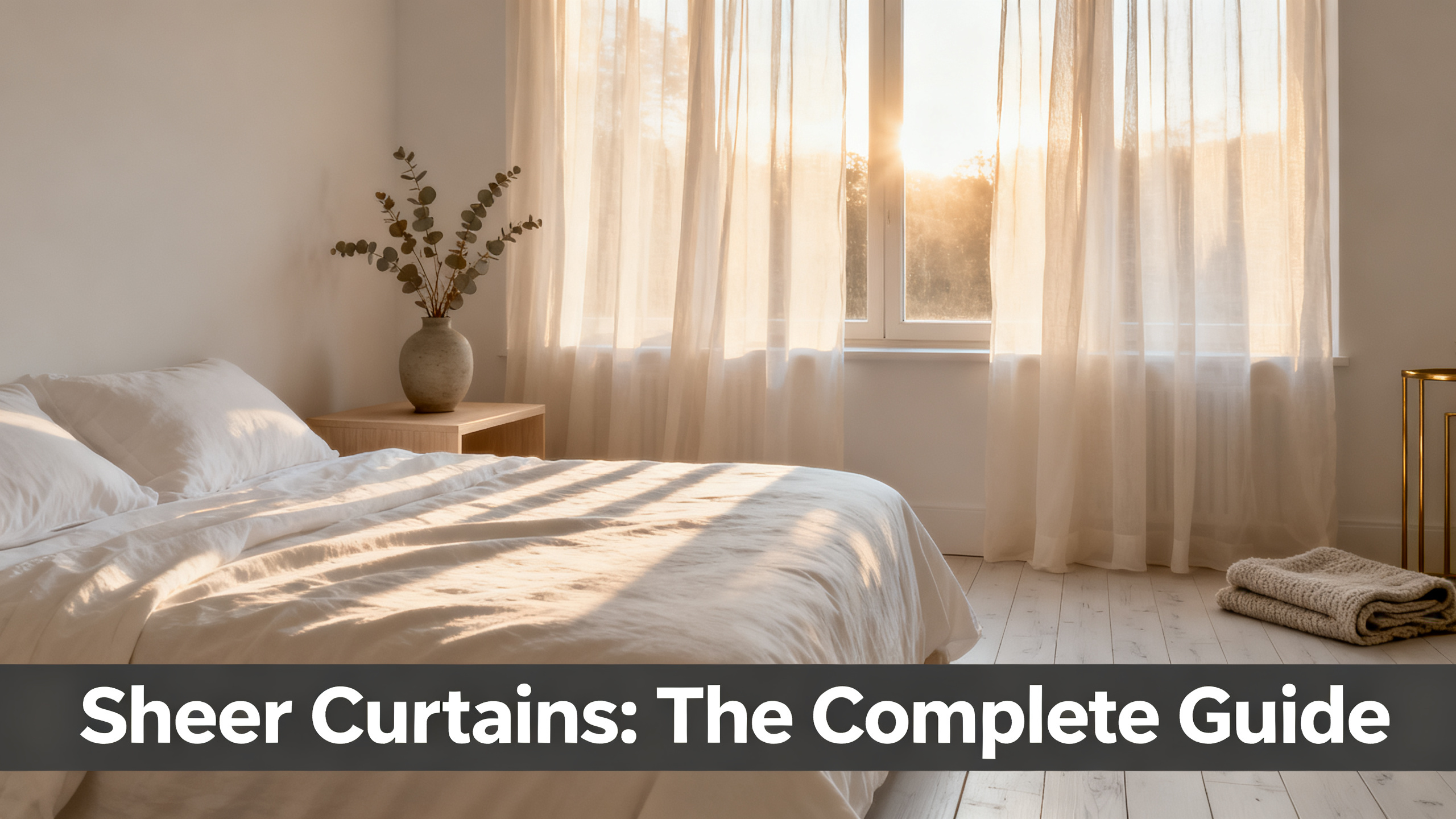
Sheer Curtains, In Three Questions
Two things to know before we go any further. First, “sheer” is not one fabric, it is a whole family that runs from featherweight voile to embossed jacquard. Second, most sheer buyers get one thing wrong at checkout, and it costs them a resew. This guide answers the three questions people actually type into Google before dropping $28.99 to $69 per panel: what are sheer curtains, why go custom instead of ready-made, and where do they actually work.
📚 QUICK ANSWER BOX
What are they?
Lightweight fabrics (25 to 110 gsm) that filter 5 to 60 percent of light and give daytime privacy. Voile, linen, cotton, and jacquard are the four main weaves.
Why custom Two Pages?
Sheers need 2.5 to 3x fullness or they hang flat. Ready-made panels usually deliver 1.5x. Two Pages sizes to your rod and adds pleated headers ready-mades cannot match.
Where do they work?
Living rooms, dining rooms, sunrooms, offices, and patio doors. Bedrooms and nurseries only if layered behind a blackout drape.
You are here because sheer curtains are the one window treatment that photographs perfectly and disappoints just as often at home. The reason is boring: fullness ratio, fabric weight, and rod height. The rest of this article walks through each one before showing you six Two Pages sheers that solve the classic mistakes.

🪟 EDITOR’S ENTRY PICK
Scandina Solid Voile Sheer
from $28.99/panel · 50 gsm 100% polyester voile · pleated or soft-top · 2 colors · custom sized. Final price depends on size & lining.
20% off with JULY · free shipping over $300
Sheer Materials 101
What “sheer” actually means
Here is the deal with the word “sheer”: it describes an opacity range, not a specific fiber. Anything lightweight enough to see silhouettes through at 3 feet counts. That includes 25 gsm ballroom voile and 110 gsm embossed jacquard, which are wildly different products at the window.
The industry uses a rough split. True sheer filters 5 to 25 percent of light. Semi-sheer filters 25 to 60 percent. Beyond 60 percent you are into light-filtering drapery, which reads opaque from outside and stops being called sheer.
🪟 SHEER OPACITY SPECTRUM
5%
Featherweight voile
Scandina 50 gsm
15%
Lightweight sheer
Flynn 55 gsm
25%
Linen sheer
Joy 70 gsm
40%
Jacquard semi
Freya 80 gsm
55%
Embossed semi
Florida 85 gsm
Values = approximate light-filtering ratio at midday, south-facing exposure.
Voile vs linen vs cotton vs jacquard
Voile is the featherweight sheer people picture first. Polyester voile (Scandina, Flynn) drapes cleanly, resists creasing, and holds pleats. It is the cheapest way to get soft light diffusion. The trade-off is honest: 100% polyester, so not a natural fiber.
Linen sheer (Joy) uses actual flax yarns spun loose enough to stay translucent. It weighs more than voile at similar opacity, drapes with body, and reads warmer against morning light. Linen also wrinkles more and costs about double. Cotton sheers sit between the two in feel but yellow faster in direct sun.
Jacquard semi-sheers (Freya) use a woven pattern that adds visual interest without going full opaque. Embossed weaves (Florida) do the same trick with heat-set relief instead of yarn weaving. Both read as “textured white” from six feet away, which flatters minimalist and Scandinavian interiors.
🌿 SHEER FIBER COMPARISON
Polyester voile
Drape: cleanest · Wrinkle: low · Cost: lowest · Natural? no
Linen sheer
Drape: heavy body · Wrinkle: visible · Cost: ~2x voile · Natural? yes
Cotton sheer
Drape: softer · Wrinkle: medium · Cost: medium · Natural? yes, yellows in sun
Jacquard / embossed
Drape: structured · Wrinkle: low · Cost: mid-tier · Natural? blend
Weight and light-filtering percentages
Fabric weight (gsm) is the single spec that predicts how a sheer will behave. Below 40 gsm you get near-transparent ballroom voile, which needs perfect fullness or it floats aimlessly. Between 45 and 60 gsm sits the sweet spot for most homes: Scandina and Flynn class. Above 80 gsm you cross into semi-sheer that starts blocking meaningful light.
Light-filtering percentages come from lab methods like the AATCC light-filtering test method, which measures transmittance under standardized illumination. Two Pages sheer specs are usually stated as approximate midday transmittance because real windows vary with exposure, glazing, and season. For fabric safety, sheer collections that carry the OEKO-TEX Standard 100 label are certified free of the tested harmful substances, which matters for nurseries and bedrooms in particular.
📏 GSM LADDER – SHEER FABRICS
25-40 gsm
Airy voile – floats on breeze, near-transparent
45-60 gsm
Standard sheer – Scandina, Flynn class
65-80 gsm
Linen sheer – Joy, Freya class
80-110 gsm
Semi-sheer – Florida embossed, jacquard
For deeper coverage of flax weaves across every weight tier, the linen curtains hub maps every gsm option side by side. That guide is the parent pillar for anyone leaning natural fiber over polyester.
Use Cases: Which Room Fits a Sheer?
Sheers are the right call in some rooms, and a costly mistake in others. The variable is almost always time of day when the room is used, not decor style. Below is the six-room breakdown before we get into specific picks.
☀️ ROOM USE-CASE GRID
Living room
✅ Ideal solo or layered
Dining / sunroom
✅ Perfect solo
Bedroom
⚠️ Only layered with blackout
Nursery / kids
⚠️ Only layered, choose OEKO-TEX
Patio / sliders
✅ Great, needs weighted hem
Home office
✅ Cuts screen glare without dimming
Living rooms
Living rooms are the natural home for sheers. You want daytime softness, glare reduction, and a window that reads as decor rather than glass. A 50 to 80 gsm sheer in a pleated header gives you that in a way blinds never will.
Bedrooms
Real talk on bedrooms: sheers alone are almost always the wrong call. They block roughly 5 to 25 percent of morning light, so a south or east facing bedroom will read as sunrise-lit by 6am. Public health bodies including the WHO/CDC guidance on daylight and circadian sleep are clear that morning light disruption cuts total sleep time. If you want sheers in a bedroom, our full walkthrough on layering sheers with drapes shows the double-rod setup that solves it.
Nurseries and kids
Same principle as bedrooms, doubled. Nap schedules collapse if the room brightens at 5:30am. Sheers here belong on the outer rod, with a blackout drape on the inner rod. Choose OEKO-TEX certified fabrics for anything in a room a child sleeps in.
Patio doors and sliders
Sliders are sheer’s second-best window. The long uninterrupted run flatters full-length drape, and daytime privacy for a backyard is exactly what a sheer delivers. Two notes: order with a weighted hem or the panel will flag every time the door opens, and go for a soft-top header instead of pleated if the door will pass through the fabric daily.
Featured Two Pages Sheer Picks
Six sheers cover every use case in the Two Pages catalog. If you want the shortlist without the specs, jump to our best sheer curtains roundup instead. Otherwise, here is the working shortlist with fabric, weight, and price. Cart simulation on the Two Pages configurator gives the base per-panel price; final delivered price depends on your rod width, drop, and lining choice.
🎨 SHEER COLOR SWATCH MATRIX
Scandina
White HN906-5
Scandina
Beige HN906-4
Florida
Plain D128-36
Florida
Slub Khaki D128-2
Florida
Slub White D128-0
Florida
Leaf D128-116
Freya
Sand Beige S501-3
Freya
Warm Ivory
Joy
Linen White S803
Joy
Flax Natural
Cady
Ivory 1908-2
Cady
Grey Beige 1908-6
Scandina Solid Voile – entry pick

from $28.99/panel · 50 gsm · 100% polyester voile · 2 colors (White HN906-5, Beige HN906-4). Cheapest entry point to a genuinely custom sheer. Fabric width runs 110 inches, which matters because it means one panel can cover a standard 100 inch rod at proper fullness without seaming.
Where I would pick Scandina: living room bay windows, dining rooms, and anyone testing custom curtains for the first time. Where I would skip it: rooms where you want a natural fiber feel. Polyester voile drapes clean but never reads as linen.
Florida Embossed Semi-Sheer – most versatile

from $59.00/panel · ~85 gsm · 8 embossed textures. Florida is the pick when you want texture without opacity. The heat-set relief gives the panel visual weight from six feet, then dissolves into soft diffusion up close. Eight patterns cover plain, slub, leaf, jacquard, and fishbone options.
Honestly, at 55 to 70 percent light filtering, Florida is on the semi-sheer edge, not a true sheer. That is a feature for privacy-conscious buyers and a bug for anyone chasing full luminous diffusion.
Florida Embossed Semi-Sheer Review
Full teardown of the 8 embossed textures, light-filter behavior at 6am, and drape verdict for south-facing rooms.

🎨 MOST VERSATILE
Florida Embossed Semi-Sheer
from $59.00/panel · 8 embossed textures · 55-70% light filtering · pleated or soft-top. Final price depends on size & lining.
Joy 100% European Flax Linen Sheer – editor’s linen pick

from $69.00/panel · ~70 gsm · 100% European flax linen. The natural fiber pick. Joy uses actual European flax spun open enough to translate light the way linen does: warm, textured, and quietly casual. It costs about 2.4 times Scandina, and it earns the premium if you care about fiber.
⭐ EDITOR’S PICK
Joy 100% European Flax Linen
from $69.00/panel · natural flax · pleated header · warmest daylight color. Final price depends on size & lining.
Freya Linen Jacquard Semi-Sheer – texture pick

from $49.00/panel · ~80 gsm · linen blend jacquard · 20 color/pattern options. Freya is what you order when a plain white sheer would read as too anonymous. The jacquard weaves in a subtle pattern (branch, dot, geometric) that adds daylight interest.
⭐ EDITOR’S PICK
Freya Linen Jacquard Semi-Sheer
from $49.00/panel · 20 patterns · pleated · natural warmth. Final price depends on size & lining.
Scandina Voile Soft Top – casual pick
from $28.99/panel · same voile as Scandina Pleated, soft-top header. Same fabric, different header. Pick this over pleated when the panel will pass through a patio door or when your interior leans casual. Soft top gathers loosely on a rod pocket, which is easier to slide but delivers less crisp fullness.
Cady Linen-Sheer Patchwork – statement pick
from $54.99/pair · linen + sheer patchwork · sold in matched pairs. Cady is the design pick, a linen top half stitched to a sheer bottom that filters light through the lower window while blocking the top view. Order as a pair (both panels included), 12 color options.

⭐ EDITOR’S PICK – STATEMENT
Cady Linen-Sheer Patchwork
from $54.99/pair · linen top + sheer bottom · 12 color combos · sold as pair. Final price depends on size.
🧵 HEADER STYLE VISUALIZER (SHEERS)
Pleated (triple pinch)
Sharpest fullness. Best for living rooms and formal spaces. Needs rings + rod.
Soft top (rod pocket)
Casual gather. Easier to slide. Ideal for patio doors used daily.
Grommet
Not offered on most sheers – grommets pull featherweight fabric unevenly.
🧮 SPECS COMPARISON – 6 PICKS
| Collection | Fabric | GSM | Light filter | Base price | OEKO-TEX |
|---|---|---|---|---|---|
| Scandina Voile Pleated | 100% polyester | 50 | ~5% | $28.99 | Yes |
| Florida Embossed | Poly blend | 85 | 55-70% | $59.00 | Yes |
| Joy European Flax | 100% linen | 70 | ~25% | $69.00 | Yes |
| Freya Jacquard | Linen blend | 80 | ~40% | $49.00 | Yes |
| Scandina Soft Top | 100% polyester | 50 | ~5% | $28.99 | Yes |
| Cady Patchwork (pair) | Linen + sheer | Blend | Mixed | $54.99/pair | Yes |
How to Measure, Hang and Layer Sheers
Measure
Sheers demand more fabric than opaque drapes. Aim for 2.5x to 3x fullness ratio to the rod width because featherweight fabric collapses into a flat rectangle without density. For an 80 inch rod, that means 200 to 240 inches of finished panel width, usually split across two 100 to 120 inch panels.
📏 MEASURE SHEER IN 4 STEPS
1
Measure rod width not window width. Rod extends 4-8 inches past frame each side.
2
Multiply by 2.5-3x for total panel width. That is your ordering width.
3
Measure drop from rod top to floor. Add 0.5 inch for kiss-floor, 4-8 inches for puddle.
4
Split into panels. Two panels per window unless the rod exceeds 130 inches.
Curtain Size Calculator
Enter rod width and finished drop, get panel count and yardage in one click.
Hang
Rod placement is where most sheers underperform. Mount the rod 4 to 8 inches above the window frame, not directly on it, so the panel reads as ceiling-high. Extend the rod 4 to 8 inches past the frame on each side so the panel clears the glass when stacked open. Return depth (bracket to wall) should be 3 to 4 inches minimum for pleated headers.
How to Hang Sheer Curtains
Rod height, return depth, and puddle break rules that keep voile from looking undersized or floppy.
Layer
Layering sheers with opaque drapes is the answer to almost every bedroom problem. Mount a double rod: sheer on the outer (window-facing) track, blackout or room-darkening drape on the inner (room-facing) track. Daytime you draw the drape open and let the sheer do its diffusion job. Nighttime you draw the drape shut for privacy and light control.
💼 LAYERING DIAGRAM – DOUBLE ROD
Outer rod (window side)
Sheer panel. Stays drawn most of the time. Diffuses light + daytime privacy.
Inner rod (room side)
Blackout or room-darkening drape. Drawn at night. Controls sleep + nighttime privacy.
Bracket spec
4 inch return outer, 3 inch return inner. Standoff prevents fabric friction.
TRY BEFORE YOU BUY
Order sheer swatches for $1.99
Scandina voile, Florida embossed, Freya jacquard, Flynn lightweight. See drape, weight and daylight color-shift in your own room before configuring a full panel.
Sheer Curtains Hub Directory
This hub links out to every sheer-specific piece of coverage on the site: individual product reviews, brand comparisons, style guides, and the tools you need to size and place them. Use the grid below as the starting point.
📚 SHEER CURTAINS HUB DIRECTORY
Reviews
Comparisons
The reviews above are structured deep-dives: full specs, cart simulation pricing, and honest flags where Trustpilot feedback disagrees with catalog claims. The comparisons take on the head-to-head questions readers actually ask. The how-to guides handle the mechanical details that turn a $200 order into a room you love or a room you resew.
How We Compiled This Hub and FAQ
Methodology
Every collection on this page was evaluated across five axes: fabric composition, weight (gsm) versus stated light-filtering performance, header options, OEKO-TEX or equivalent certification status, and configured base price per panel from the Two Pages cart simulation. Cross-checks against verified owner feedback (Trustpilot, Judge.me) flagged the discrepancies between catalog claim and real-world drape. No panels were physically installed by the editorial team; all analysis is spec-based and review-verified.
About the editors
This hub was compiled by the Two Pages editorial desk, a team that has evaluated over 100 curtain collections against catalog data and reviewer photos. Read more about the team and the review methodology on the editorial page.
Sheer curtains FAQ
What is the difference between sheer and semi-sheer curtains? Sheer typically means 5 to 25 percent light-filtering (voile, lightweight linen, 40 to 70 gsm). Semi-sheer sits at 25 to 60 percent (embossed voile, jacquard, 70 to 110 gsm).
Do sheer curtains give any privacy at night? Almost none once interior lights are on. Sheers give daytime privacy only. For nighttime privacy, layer with a blackout lining behind the sheer.
What size sheer panels should I order? For proper drape, sheer panels want a fullness ratio of 2.5x to 3x the rod width. For an 80 inch rod that is 200 to 240 inches of finished panel width, usually split across two panels.
Can sheer curtains work in a bedroom? Not on their own. They block only 5 to 25 percent of morning light. Layer them in front of a blackout drape on a double rod.
How do I clean sheer curtains without shrinkage? Cold gentle wash in a mesh bag, hang damp on the rod to air-dry. Never tumble dry: high heat shrinks voile and semi-sheer 3 to 5 percent permanently.
