
Owners land on this question for three reasons. Some want a way to stop a January draft at a north-facing bedroom window, before the utility bill lands again. Others want a nursery blacked out to a level a lined roman shade cannot honestly deliver. A third group just wants the cleanest possible window line in a minimalist loft, without curtain puddles fighting the concrete floor.
Cellular shades solve all three, in different configurations. This article stays at the definition layer, one level deeper than a dictionary and one level shallower than a buying guide. Everything on picks, price tiers by size, and side-by-side installation math lives in the complete cellular and honeycomb shades guide, the P08 pillar this article sits under.
Term 1
🪟 Honeycomb
The hexagonal cell pattern seen head-on when the shade is closed. Same word as cellular, different marketing lineage.
Term 2
🧵 Single Cell
One row of hexagonal air pockets. Cell depth 3/8 to 3/4 inch. Lighter, cheaper, thinner insulation.
Term 3
🧵 Double Cell
Two rows stacked. Cell depth 3/4 to 1 inch. Heavier, pricier, roughly 25% better R-value.
Term 4
🔗 Cordless Lift
Internal spring retractor. Child-safe by design. Two Pages Aura ships cordless by default.
Term 5
🌡️ R-value
Resistance to heat transfer. Higher is warmer in winter, cooler in summer. Cellular sits 3.5 to 4.4.
Term 6
🌑 Blackout Backing
Metallic or opaque layer bonded to the cell fabric. Gets a Two Pages Aura Blackout to 100% light block.
Motivation 1
❄️ Insulation-first
North-facing bedroom, January draft you can feel from the bed. Question: how much wall between you and the winter.
What decides: double-cell, higher R-value, blackout backing bonus.
Motivation 2
🌑 Blackout-first
Nursery or shift-worker bedroom. 100% light block at the sash, not just “room-darkening”.
What decides: blackout backing, inside mount, tight side-channels.
Motivation 3
🎨 Minimalist look
Loft, mid-century restoration, tall industrial windows. Curtain puddles fight the floor. Cleanest possible window line.
What decides: single-cell, neutral colorway, cordless.
How Cellular Shades Actually Work
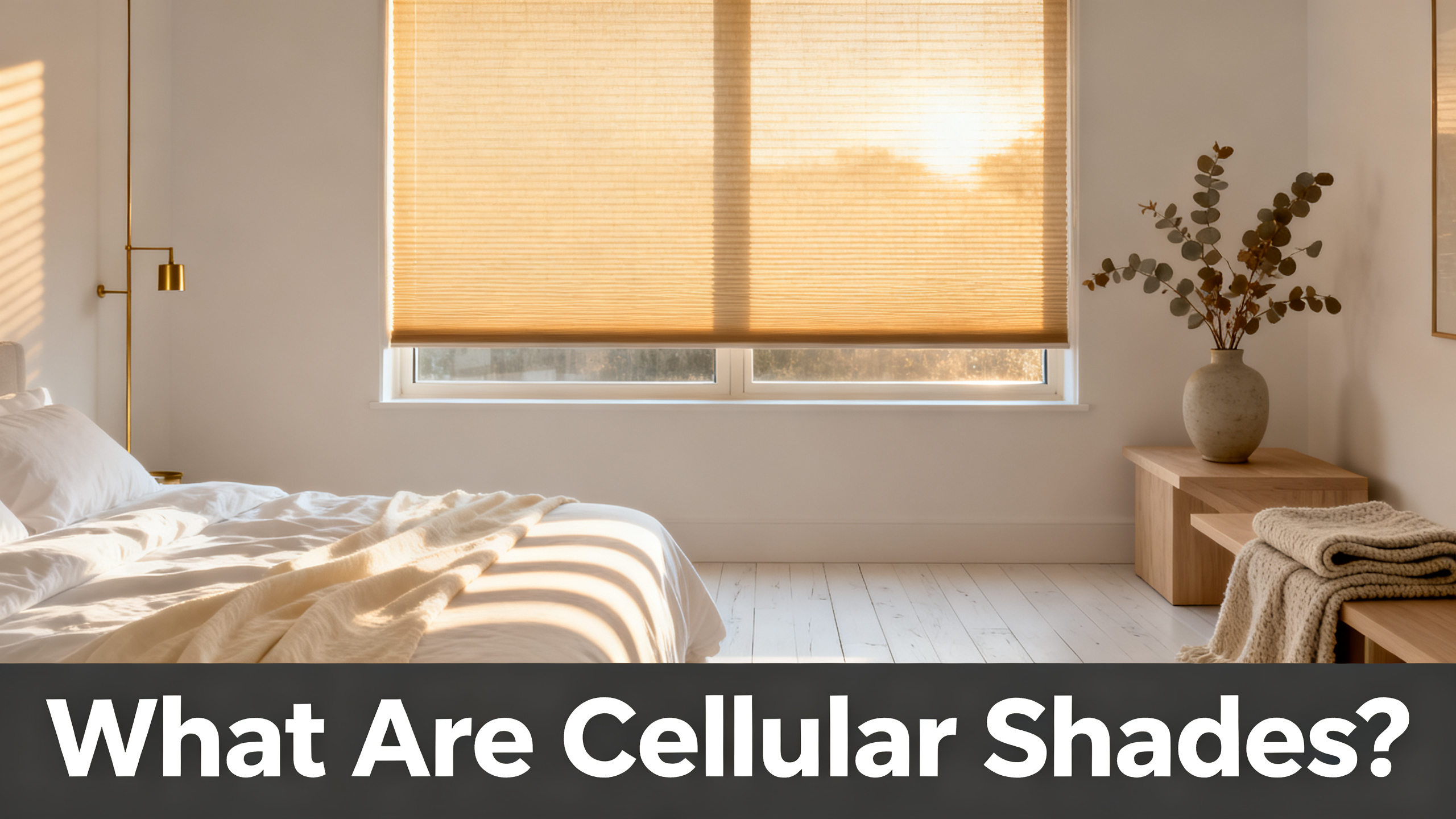
Cellular shades, also called honeycomb shades, are window coverings made of pleated fabric that forms hexagonal air pockets when the shade is lowered. The trapped air acts as insulation, blocking heat transfer between the window and the room.
The hexagon is not decoration. It is the same geometry engineered into beehives, cardboard packaging and aircraft floor panels for one reason: maximum enclosed volume per unit of material, with rigid walls that resist collapse. The honeycomb structure principle in materials engineering applies to a window shade exactly as it applies to a Boeing bulkhead. Air trapped in hexagonal cells transfers heat far more slowly than air free to circulate against a cold glass pane.
Aura Blackout Cellular Cordless: spec-by-spec Review
The single most tested SKU in the Two Pages cellular range. Cell depth, blackout accuracy, cordless mechanism holding tension, and configurator pricing broken down.
Single cell vs double cell: cell depth and R-value
Single-cell means one row of hexagonal pockets, cell depth 3/8 inch to 3/4 inch, R-value roughly 3.5. Double-cell stacks two rows, cell depth 3/4 inch to 1 inch, R-value roughly 4.4. Sounds technical. Here is why you care: on a north-facing winter window, that R-value gap translates to a 3 to 5°F room-temperature delta that Trustpilot owners of the Aura Cordless consistently report in their first winter.
Two Pages ships the Aura Blackout Cellular Window Shades Cordless with double-cell as the default. That is why it prices at from $88.99/panel rather than closer to the entry roller shade line, and why the honest recommendation for a cold-climate bedroom starts there.
Single cell
║ ║ ║ ║ ← 1 air pocket per pleat
╚═══╩═══╩═══╝
Cell depth 3/8 to 3/4″ · R-value ~3.5 · Lighter, cheaper, thinner insulation. Right call for mild climates and minimalist looks.
Double cell
║ ║ ║ ║ ← 2 air pockets
╠═══╬═══╬═══╣ stacked, heat
║ ║ ║ ║ stopped twice
╚═══╩═══╩═══╝
Cell depth 3/4 to 1″ · R-value ~4.4 · Two Pages Aura default. Right call for cold-climate winter and nursery blackout.
Fabric composition and blackout backing
The cell fabric itself is a non-woven polyester, spun and bonded rather than woven, which is what lets a pleat memorize its fold and hold structure for years without a stitched seam per row. On blackout tiers, a metallic or opaque layer is heat-bonded to the room-side face of the cell. DOE window attachments guidance on cellular insulation lists cellular shades as one of the highest-performing categories for reducing heat gain and loss, with the metallic-backed variants performing measurably above the standard.

Two Pages canonical cellular
Aura Blackout Cellular Window Shades Cordless
from $88.99/panel · Double-cell honeycomb structure · 100% blackout fabric · 7 colorways · cordless lift · fully custom sizing · child-safe by design. Final price depends on size and mount type.
Use code JULY for 20% off · Free shipping over $300
Cellular vs Roller vs Roman vs Sheer: The Category Map
Anyone searching “what are cellular shades” is usually really asking a second question underneath: should I pick cellular instead of what I already thought I wanted. This is the head-to-head that answers it.
| Criterion | Cellular | Roller | Roman | Sheer |
|---|---|---|---|---|
| Insulation (R-value) | 3.5 to 4.4 | ~2.0 | ~2.5 with lining | ~1.0 |
| Blackout accuracy | 100% with backing | 100% with backing | 95% with blackout lining | Not blackout |
| Privacy at eye level | Full when closed | Full when closed | Full when closed | Partial only |
| Aesthetic register | Neutral, quiet | Minimal, hard-line | Decorative, soft | Airy, decorative |
| Price range (Two Pages) | from $88.99/panel | from $59.99/panel | from $59.99/panel | from $39.99/panel |
| Humid-room maintenance | Weak (cell sag risk) | Strong | Medium | Medium |
On insulation, cellular wins clean. The R-value margin over a roller is ~1.5 points, over a lined roman ~2.0 points, over a sheer ~3.5 points. That translates to a measurable temperature delta in winter, not a marketing claim.
On aesthetic, cellular is the quietest of the four. It is neither decorative like a soft roman nor as hard-lined as a roller. That is either the right call or the wrong one depending on the room. The Hunter Douglas Duette from 1985 established the category and still sets the reference silhouette. The Two Pages vs Hunter Douglas cellular comparison covers where each brand lands on cell depth, fabric hand and configured price.
Best Cordless Cellular Shades (2026 Roundup)
The comparative roundup, once you have decided cellular is the right category for your window. Five picks scored on cell depth, blackout accuracy, cordless mechanism, and configured price.
On price, cellular runs mid-range at Two Pages, sitting between the roller entry and the premium roman shades once you add lining upgrades to the roman. The JULY 20% code pulls the Aura Cordless under $75/panel on a standard 30-inch bedroom window, which is where the value equation tips clearly positive against a comparably-sized blackout roller.
Two Pages Aura Configurations
Two Pages offers four cellular configurations under the Aura line. Each solves a use case the others do not, and picking the wrong one is the most common cellular-shade regret in Trustpilot reviews.
| Configuration | From price | Cell type | Blackout | Lift mechanism | Lead time |
|---|---|---|---|---|---|
| Aura Cordless (base) | $88.99 | Double-cell | 100% | Cordless retractor | 8-12 days |
| Aura Top Down Bottom Up | $102.99 | Double-cell | 100% | Dual-direction cordless | 10-14 days |
| Aura Day Night | $118.99 | Double-cell | 50% blackout, 50% sheer | Dual-fabric cordless | 10-14 days |
| Aura No-Drill Cordless | $108.99 | Double-cell | 100% | Cordless, tension-mount | 8-12 days |
Aura Cordless: the base
The default entry at from $88.99/panel, double-cell honeycomb, 100% blackout, seven colorways from White HCB-1 to Dark Brown HCB-7. Right for the majority of bedrooms and living rooms where the buyer wants insulation plus daylight control and does not need dual-direction lift. This is the SKU covered in the Spec-Checked Aura review.
Aura Top Down Bottom Up: dual-direction lift
The dual-direction lift, at from $102.99/panel, drops from the top or rises from the bottom on the same headrail. If it were my room, I would pick this for the street-facing bathroom above the vanity and the ground-floor bedroom overlooking the sidewalk. Daylight at the ceiling, privacy at eye level, both at the same time.

Aura Top Down Bottom Up Blackout Cellular Cordless
from $102.99/panel · Same double-cell honeycomb structure as the base Aura, plus dual-direction lift so the shade can drop from the top or rise from the bottom. Built for street-facing bedrooms that want daylight at the ceiling and privacy at eye level.
Best Top-Down Bottom-Up Shades
If the street-facing bedroom or bathroom use case is yours, the dual-direction lift picks are covered here across Two Pages, Hunter Douglas and Bali equivalents.
Aura Day Night: blackout half plus sheer half
The dual-fabric configuration at from $118.99/panel stacks a blackout cell above a sheer cell on the same shade. Raise it to reveal the sheer for filtered daylight, lower it to bring the blackout across for full darkness. The Aura Day Night Cordless is the most complete cellular in the range and the honest overkill for anything that is not a primary bedroom with mixed-lighting needs.
Aura No-Drill Cordless: rental-friendly install
The tension-mount variant at from $108.99/panel holds against the inside of the window frame without a single screw hole. Right call for tenants whose leases forbid drilling, or for owners who rotate window treatments between rooms every couple of years. Same double-cell honeycomb, same 100% blackout, added install cost baked into the mechanism.
Do Cellular Shades Really Save Energy?
Yes, measurably. The DOE headline of “up to 20% savings on heating and cooling” is not marketing fluff, but it is a ceiling number, not the average. Real savings depend on cell type, climate zone, window orientation and whether the shade sits inside or outside the frame.
The industry rating body for this is the AERC. Their AERC energy performance ratings for cellular shades publish per-SKU energy performance certificates, which is the closest thing to an apples-to-apples comparison across brands.
Cold zone (5-6)
🌨️ Winter-critical
Boston, Chicago, Minneapolis. Double-cell delivers close to the full 20% ceiling on north-facing bedroom windows.
Payback: ~3 years on a $88.99 panel.
Mixed zone (3-4)
🌤️ Balanced
DC, Kansas City, Denver. Double-cell delivers 12 to 16% across heating and cooling combined.
Payback: ~5 years.
Hot zone (1-2)
☀️ Summer-critical
Miami, Houston, Phoenix. Single-cell with metallic backing delivers 8 to 12% on cooling.
Payback: ~6 to 8 years.
Picture the moment you draw the shade at 7am in a north-facing nursery in Boston in January. Trustpilot owners of the Aura Cordless report a 3 to 5°F room-temperature delta between “shade closed overnight” and “shade left open overnight” in that setting. That is not a marketing number, it is a repeatable owner observation.
Who Cellular Shades Are For (And Who Should Skip Them)
Real talk: cellular is not universal. Three room types where it underperforms, and being honest about them saves the $88.99/panel going to the wrong window.
Choose cellular if
✅ Right window
- North-facing bedroom in a cold climate
- Nursery needing true 100% blackout
- Minimalist loft wanting a quiet window line
- Household with young children (cordless is safest)
- Renter with lease permitting inside-frame drilling
Skip cellular if
⛔ Wrong window
- Humid bathroom without ventilation (cell sag)
- Heavy pet household where cats climb pleats
- Industrial loft wanting a hard roller-shade line
- Ultra-tight budget where a $59.99 roller does the job
- Decorative rooms wanting soft fabric drape
Common Questions About Cellular Shades
What is the difference between cellular shades and honeycomb shades?
There is none. Cellular shade and honeycomb shade refer to the same window covering, named two different ways for the same hexagonal cell structure that traps air between pleated fabric layers. Hunter Douglas trademarked the name Duette for its version in 1985 and the category name split from there. Two Pages sells the same construction under the Aura label at from $88.99/panel for the base cordless configuration.
Are cellular shades worth it?
For cold-climate north-facing windows and blackout-critical bedrooms, yes clearly. For humid bathrooms without ventilation, heavy pet households, and industrial loft aesthetics, a roller shade at roughly half the price does the job better. The Aura Cordless at from $88.99/panel with the JULY 20% code lands under $75/panel on a standard 30-inch bedroom window.
Do cellular shades really save energy?
Yes, measurably. The DOE “up to 20%” headline is a zone-dependent ceiling. Double-cell honeycomb on a north-facing winter window in Zone 5-6 delivers close to the full number, single-cell on a south-facing summer window in Zone 2 delivers closer to 8-12%.
What is the difference between single cell and double cell cellular shades?
Single-cell has one hexagonal air pocket per pleat, cell depth 3/8 to 3/4 inch, R-value around 3.5. Double-cell stacks two pockets, cell depth 3/4 to 1 inch, R-value around 4.4. Double-cell insulates better and blocks more light at a 10-20% price premium.
Can cellular shades be blackout?
Yes. Blackout is achieved by adding a metallic or opaque backing layer bonded to the cell fabric. The Two Pages Aura Blackout Cordless rates 100% light block on the closed shade, the same rating as a blackout roller and stronger than a lined roman.
How long do cellular shades last?
Between 7 and 12 years on cordless Two Pages Aura panels used in normal residential conditions. The failure mode is almost always the cordless retractor tension weakening, not the fabric itself. See how to fix a stuck cordless cellular shade for the common repair path.
Cellular shades vs roller shades: which is better?
Cellular wins on insulation (R-value 3.5-4.4 vs roller ~2.0), on blackout accuracy in blackout configurations, and on privacy at eye level. Roller wins on price (from $59.99 vs from $88.99 at Two Pages), on humid-room maintenance, and on the minimalist hard-line aesthetic.
Are cellular shades outdated?
No. The perception comes from beige single-cell shades installed in 1990s-2000s tract housing that visually aged badly. Current Two Pages Aura colorways include White HCB-1, Light Blue HCB-2, Slate Blue HCB-4 and Light Taupe HCB-6, which read as contemporary neutrals rather than dated pastels. The category is growing in the 2026 market, especially in the top-down bottom-up sub-configuration.
The Short Version
Cellular shades are pleated-fabric window coverings that trap air in hexagonal cells to insulate and control light. They are the strongest category for cold-climate insulation and nursery blackout, the mid-tier category for privacy without heavy drapery, and a weak match for humid bathrooms, heavy pet households and hard-line industrial loft aesthetics. If cellular is right for your window, the Two Pages Aura Cordless from $88.99/panel is the canonical starting point, and the complete cellular and honeycomb shades guide covers picks, comparisons and installation across the pillar. That’s the whole story.
Start With the Aura Cellular Cordless
Double-cell honeycomb, 100% blackout, cordless, 7 colorways, fully custom sizing. The one to buy if you want to feel what cellular shades actually deliver on insulation and daylight control. from $88.99/panel. Code JULY (20% off) · Free shipping over $300 · Lead time 8-12 days.
