
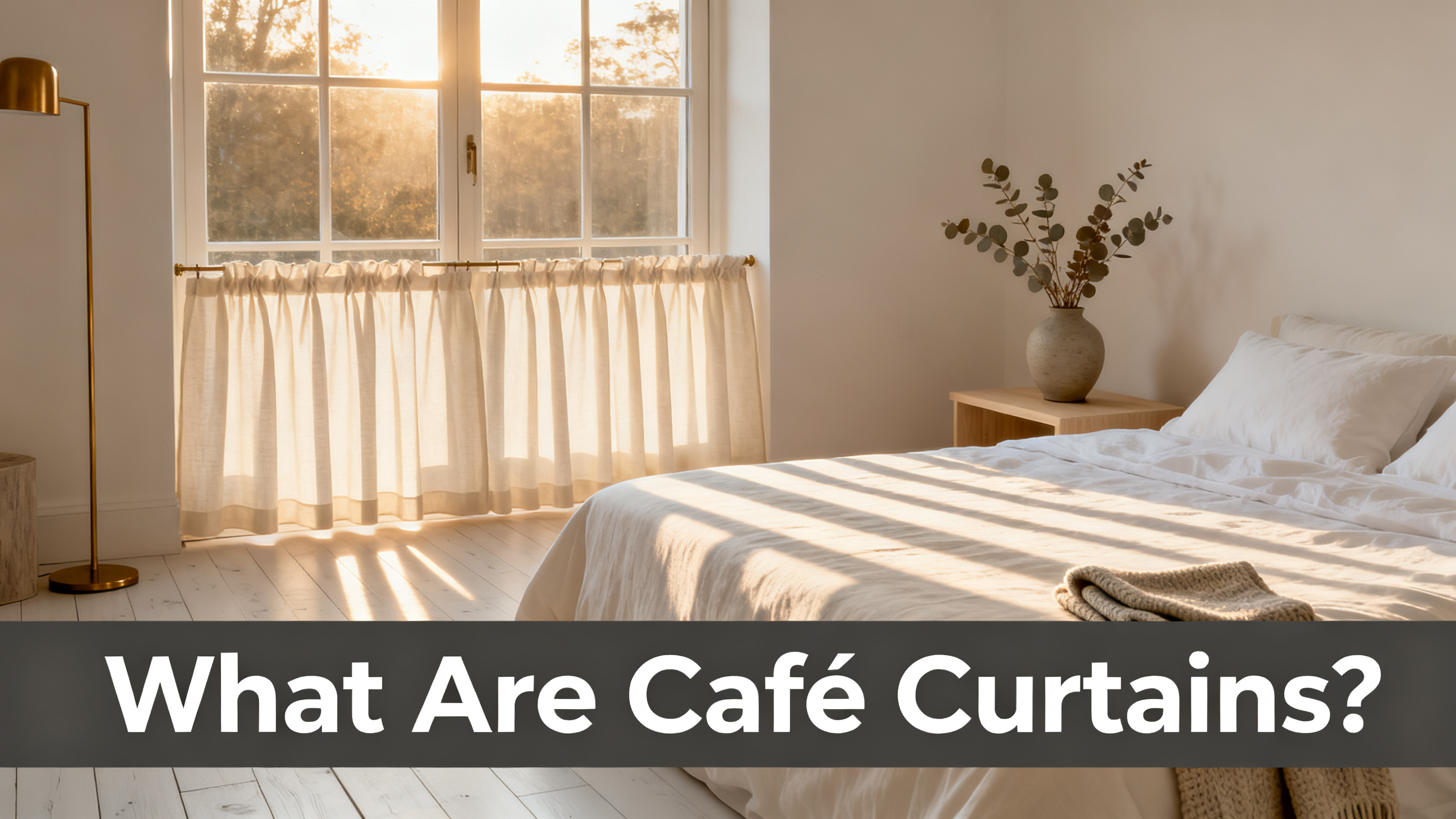
🪟 Café Curtain Decoder: 3 things to know before you read further
Format
Short panels that cover the lower half of a window only. Top half stays open for daylight.
Height
Standard panel is 36 inches tall. Rod sits at the mid-sash line, typically 44 to 52 inches from the floor.
Function
Sink-level privacy without blocking backlight. Made for kitchens, bathrooms, breakfast nooks, and low-sill windows.
Two Pages sells three café collections at custom sizes: Liz Linen Pleated, Sara Le Print Linen, and Milo eyelet rings for the hardware.
Café curtains are short curtain panels that cover only the lower half of a window, mounted at mid-sash on a slim rod. The top half stays open for daylight while the bottom half handles the privacy work. The standard finished panel is around 36 inches tall, which drops from the mid-sash rod down to a clean sill clearance. That is the whole format, in one sentence.
Where the confusion starts is that “café curtain” gets mixed up with valance, tier curtain, and full-length panel almost every day of the year. Those four formats look adjacent on a Pinterest board and behave nothing alike on a real window. This guide walks the format, the length rules, the use cases where it actually works, and how it fits into the wider Two Pages catalog. For the pillar view, our café curtains and valances hub maps every spoke around this format.

Two Pages editor pick for café curtains
Liz Linen Pleated Cafe Curtains
from $59.99/panel · 350 gsm slub linen-blend (10% linen, 90% polyester) · pinch pleat header, sold by the panel · 5 muted colorways · OEKO-TEX Standard 100 fabric · free Body Memory Shaping. Final price depends on size and lining.
Use code JULY for 20% off · Free shipping over $300
A Short History of the Café Curtain
The format traces back to 19th century Parisian cafés, where owners wanted street-level privacy for seated customers without giving up daylight on the upper glass. A short panel on a brass bistro rod solved both at once: passersby could not stare at the coffee cups, but the espresso machine still caught the afternoon light. You can find the format documented in the curtain history and terminology on Wikipedia under short-panel and tier configurations.
American kitchens picked up the style in the 1930s and 1940s during the mid-century farmhouse era, when the sink was a social room and the window above it deserved a soft finish. The format faded through the 1980s minimalist swing, when bare glass and Venetian blinds took over. Its European origin, closely tied to 19th and 20th century Parisian café culture, kept the name attached to bistros even as home kitchens moved on.
🎨 The café curtain across four eras
1830s Paris
Brass bistro rod, half-window privacy for seated customers.
1930s USA
Kitchen sink revival, cotton gingham and ruffled headers.
1960s Farmhouse
Country style, floral prints, tab tops on wooden rods.
2020s Revival
Neo-cottage, Japandi kitchen, English country. Muted linen-blend, pinch pleat.
The current revival started around 2022 with the neo-cottage aesthetic and accelerated through the English country and Japandi kitchen movements in 2024 and 2025. What is on the wall in 2026 is not the 1980s floral polyester version. It is a 350 gsm linen-blend slub in muted sand, cream, or ivory, on a slim iron rod, sometimes with a pinch pleat header for a cleaner drop.
How Café Curtains Differ From Valances, Tiers and Full-Length Panels
Café vs Valance
A valance covers only the top 12 to 18 inches of a window as a decorative header, often layered over blinds or a shade beneath. A café curtain covers the bottom 30 to 48 inches for functional privacy. The two are opposites in position and can be layered on the same window: valance on top, café on the bottom, sash rod between them for the middle band of glass.
Café vs Tier Curtain
Tier curtain is the broader American retail term for any short curtain sold as a two-panel set. Café curtain is the more specific format inside that category: a lower-half panel mounted at mid-window on a bistro rod, almost always in a kitchen. All café curtains are tier curtains, but not every tier curtain is café-styled. On the Two Pages catalog, the collections labeled “cafe” are the mid-mount, lower-half format specifically.
Café vs Full-Length Panel
Full-length drapes reach from the top of the window (or higher) down to the floor, typically 84 to 108 inches long. Café panels are 36 to 48 inches. Their functions are opposite: full-length drapes darken and enclose the room, café curtains preserve daylight while veiling the lower half. Choosing between them is not a style question. It is a light and coverage question.
| Format | Coverage | Standard height | Rod placement | Primary function |
|---|---|---|---|---|
| Café curtain | Bottom 40 to 60% | 36 in | Mid-sash | Lower-half privacy, keeps backlight |
| Valance | Top 15 to 20% | 12 to 18 in | Above frame | Decorative header, hides hardware |
| Tier curtain | Bottom half (broader category) | 24 to 48 in | Mid-sash or paired | Umbrella term, includes café |
| Full-length panel | Full window plus floor drop | 84 to 108 in | Above frame or ceiling | Full privacy, light control, room enclosure |
The four formats co-exist inside layered schemes more often than you would think. A cottage kitchen in Vermont might carry a valance up top, a café at the sink, and a full-length linen panel on the adjacent dining bay. Same room, three formats, three functions.
Café Curtain Buying Guide (2026)
Step-by-step decision framework: header choice, length by window height, lining trade-offs, hardware compatibility. The next layer of depth once the format itself is clear.
Café Curtain Length and Rod Height
The standard finished panel is 36 inches tall. That number is not arbitrary. It matches the drop from a mid-sash rod on a typical American double-hung kitchen window down to a clean 2 inch clearance above the sill. If the sill sits above a counter (common on a sink window), the rule shifts to leaving 4 to 6 inches of daylight above the frame instead.
Rod placement follows the sash. On a double-hung window, the mid-sash line is exactly where the top of the lower pane meets the bottom of the upper pane. Mounting the rod at that seam hides the horizontal break of the sash inside the rod line, which reads much cleaner from across the kitchen than a rod placed randomly between the two.
How to Make Café Curtains (DIY Walkthrough)
If you prefer sewing your own from yardage: measurement chart, header maths, and hem depth for a hand-finished panel.
📐 Café curtain height standards
Panel height
36 in
Standard drop, sash to sill
Rod height
44 to 52 in
From floor, kitchen sink window
Mount point
Mid-sash
Where upper and lower panes meet
Sill clearance
2 in
Above sill, to avoid humidity wick
Two Pages sells the café collections cut to the exact inch you order, which lets you match the rod height and sill clearance without the ready-made compromise of 36 or 45 inches only. That matters more than it sounds on windows where the sash line sits at an odd 51 inches or where the sill is right on top of a stone backsplash edge.
Test the Fabric on Your Kitchen Sill
A café panel sits 18 to 24 inches from a sink, in steam and grease-lit backlight. Order a Two Pages fabric swatch, tape it to the lower sash for 48 hours, and see how the slub texture handles morning haze before you commit to a custom order.
Where Café Curtains Actually Work Best
Kitchen sink and counter windows
Picture the 7 am steam over an espresso pot, the mail carrier walking past the front hedge, and the Meyer lemon on the sill catching backlight. That is the exact scenario a café panel is designed for. The window sits low, the sink or counter sits in front of it, passersby have a direct line of sight into the lower third of the room, and cutting the upper half of the glass off from daylight would waste the best light in the kitchen.
Best Café Curtains for Kitchen (2026)
Editor-picked shortlist for the sink window scenario: 5 collections compared on fabric, print, hardware, and grease resistance.
Bathroom and powder rooms
Small bathroom windows above a vanity or a tub run into the same trade-off as kitchen sinks: full privacy would kill the daylight, no privacy is not an option. A café panel handles the eye-level band without darkening the upper glass. Fabric choice matters here in a different way: humidity-resistant weaves hold up better than pure linen over years of shower steam.
Breakfast nooks, home bars, sink skirts
Beyond the core kitchen and bath use cases, café curtains work in breakfast nooks (where a low banquette window benefits from soft veiling), home bar backsplashes (as a textile backdrop behind bottles), and even as sink skirts on freestanding utility sinks in laundry and mudrooms. Two Pages sells the same panels for all four applications; the difference is the rod and the mounting hardware, not the panel itself.
🪟 Where a café panel earns its place
Kitchen sink
Primary scenario. Privacy plus backlight, no compromise.
Bathroom vanity
Eye-level band, humidity-tolerant weave preferred.
Breakfast nook
Low banquette window, soft veiling for morning light.
Home bar
Textile backdrop behind bottles, hides utility shelving.
Sink skirt
Freestanding utility sink base, laundry, mudroom.
Not a fit
Bedroom privacy, blackout, sound, tall living-room windows.
If the window is not above a sink, a counter, or a low sill with eye-level exposure to a street or neighbor, café curtains are almost always the wrong format. A full-length linen panel or a roman shade will serve better. The café format solves a very specific problem, and outside that problem it stops being useful.
Header Style Choices for Café Scale
At full-length scale, the header style is a background detail. At 36 inch café scale, the header is a much larger share of what the eye reads, and the wrong choice unbalances the panel. Two Pages carries the café format in pleated (Liz Linen, Sara Le) and offers pinch pleat as the default. Other headers exist across the wider curtain catalog but only some of them scale down cleanly.
🧵 Header styles that scale down to 36 in
Pinch pleat
Structured, holds shape on short drops. Cottage and neo-cottage kitchens.
Rod pocket
Casual, soft gather. Classic bistro and French farmhouse.
Grommet
Modern edge, metal ring visible. Reads industrial at café scale.
Tab top
Country farmhouse, visible fabric tabs. Works with wood rods.
Pinch pleat is the safer default when you want a clean, structured drop and the panel is going near a stone counter or a designed backsplash. Rod pocket reads casual and older-farmhouse. Grommet reads modern and industrial, sometimes too heavy for a small panel. Tab top belongs on wooden bistro rods in country kitchens.
Two Pages Café Curtains Options
Liz Linen Pleated Cafe (entry, OEKO-TEX)
Liz Linen Pleated Cafe Curtains are the cleanest starting point in the Two Pages catalog. The fabric is a 350 gsm heavyweight slub weave (10% linen, 90% polyester) that carries an OEKO-TEX Standard 100 baseline at the fabric level. Colorways run muted: Snow White, Ivory White, Beige White, Sand Beige. Base price is from $59.99/panel, sold by the panel with pinch pleat header standard. For the full breakdown of drape, header behavior, and value at multiple sizes, our Liz Linen café curtains honest review walks the whole picture.
Sara Le Print Linen Pleated Cafe (designer, patterned)
Sara Le is the designer-collab option: same 350 gsm linen-blend as Liz, but printed in a rotating range of florals, leafy scrolls, and plaid tartans. Prints include Stone SL-A4 (plaid leaf), Travertine SL-A3 (warm sister), Bronze SL-A5 (reddish leafy), Porcelain SL-J8 (soft floral), and Vintage Linen SL-J1 (cream floral). Base price is from $89.99/panel. The Sara Le café collection is the pick when the print is doing the design lifting in a small kitchen.
Milo Café Eyelet Rings (hardware pairing)
Two Pages does not sell a dedicated café rod, so hardware pairs with either a third-party bistro rod or with Two Pages rod pocket collections. The Milo Café Eyelet Rings (pack of 18) are the branded ring option: 3/4 inch inner diameter, 1 inch outside diameter, warm gold or black finish, $26.99 per pack. They are an upsell separate from the panel order and worth budgeting for at the same time you configure the fabric.
💼 Two Pages café roster
Entry
Liz Linen Pleated
from $59.99/panel
350 gsm slub, 5 muted colorways, OEKO-TEX Standard 100.
Designer
Sara Le Print Linen
from $89.99/panel
350 gsm printed, plaid and floral prints, pinch pleat.
Hardware
Milo Eyelet Rings
$26.99 / 18 pack
Metal, 3/4 in inner, warm gold or black finish.


Between the three, Liz is the entry-level default for anyone who wants the format done cleanly at a fair price, Sara Le is the pick when the print carries the room, and Milo rings are the hardware detail that separates a considered setup from a ready-made one. Configure a swatch first, decide the header, then commit the size. For the full pillar map, our café curtains and valances hub shows every spoke around this format.
Start With a Custom Café Panel
Liz Linen Pleated Cafe Curtains are the cleanest starting point in the Two Pages catalog: 350 gsm slub weave, pinch pleat header, and free Body Memory Shaping so the panel keeps its structure after two weeks of steam and stove heat. from $59.99/panel. Code JULY (20% off) · Free shipping over $300 · lead time 7 to 10 days. For the wider format context, our café curtains and valances hub maps every spoke in the pillar.
Frequently Asked Questions
What are café curtains in one sentence?
Café curtains are short curtain panels that cover only the lower half of a window, mounted at mid-sash on a slim rod, so the top half stays open for daylight while the bottom half provides privacy. The standard panel height is around 36 inches, which fits under most kitchen sink and bathroom windows. The format originated in 19th century Parisian cafés and returned to American kitchens in the 1930s. It is still one of the most efficient window treatments for the specific case of a window above a sink, a counter, or a low sill.
What is the difference between café curtains and tier curtains?
Tier curtain is the broader American retail term for any short curtain sold in a two-panel set. Café curtain is the more specific format inside that category: a lower-half panel mounted at mid-window on a bistro rod, most often in a kitchen. All café curtains are tier curtains, but not all tier curtains are café-styled (some tiers cover the top of a small window, and some are sold in stacked pairs). On the Two Pages catalog, the collections labeled “cafe” are the mid-mount, lower-half format specifically.
What is the difference between café curtains and a valance?
A valance covers only the top 12 to 18 inches of a window as a decorative header, often over blinds or a shade underneath. A café curtain covers the bottom 30 to 48 inches of the window for functional privacy. The two formats can be layered on the same window: valance up top, café panel at the bottom, sash rod in between for the middle band. That layered scheme is common in English cottage and modern farmhouse kitchens.
What length are café curtains?
The standard finished length is 36 inches, which drops from a mid-sash rod down to just above the window sill. Some cottage kitchens go longer at 42 or 48 inches when the window is tall or when the sill is high enough that the panel needs to reach a counter. Two Pages sells café collections custom-cut to the exact inch, which lets you match the rod height and sill clearance without ready-made compromise. The rule of thumb for the bottom hem is a 2 inch clearance above the sill.
How high should you hang a café curtain rod?
The rod sits at the mid-sash line of the window, typically 44 to 52 inches from the floor for a standard kitchen window. On a double-hung window, the mid-sash line is exactly where the top of the lower pane meets the bottom of the upper pane. Mounting the rod at that seam hides the visual break of the sash inside the rod line. For a window above a counter, measure from the counter surface up to a point 4 to 6 inches below the top of the frame and place the rod there.
Where did café curtains originate?
The format traces back to 19th century Parisian cafés, where owners wanted street-level privacy for seated customers without giving up daylight through the upper glass. American kitchens picked up the style in the 1930s and 1940s as part of the mid-century farmhouse revival, then the format faded through the 1980s minimalist era. It returned in the 2020s neo-cottage and English country kitchen revival, where warm textiles and pattern re-entered the design language.
Are café curtains outdated in 2026?
No. Café curtains are having a strong revival in 2026, driven by the neo-cottage, English country, Japandi kitchen, and modern farmhouse trends. The format solves a real problem (sink-window privacy without blocking backlight on plants or over-the-counter workspace) that no other window treatment solves as elegantly. What is outdated is the 1980s heavy floral polyester version. The current café curtain trend leans on 350 gsm linen-blend slub, muted palettes, and pinch pleat or rod pocket headers.
Do café curtains block light or provide blackout?
No. Café curtains are designed to preserve daylight through the upper half of the window and provide only lower-half privacy. If you need blackout, either add a roller shade above the café panel that pulls down over both halves, or choose a full-length blackout drapery instead. The Two Pages Liz Linen Pleated Cafe collection is unlined by default; adding a blackout lining is possible on the pleated header version but changes the drape weight and adds cost.
