
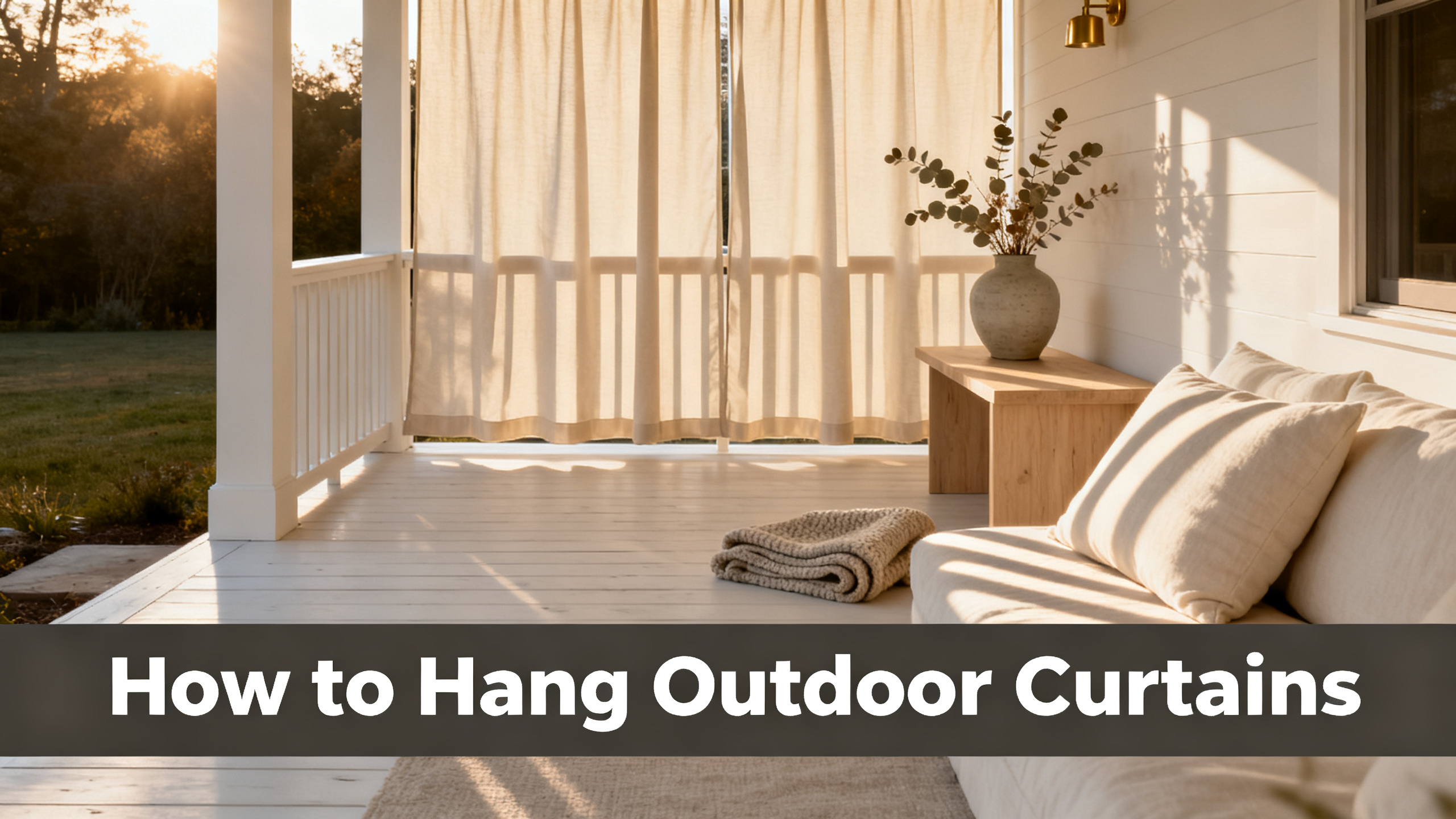
Most people hang outdoor curtains the same way they hang indoor curtains. That is why 6 out of 10 setups sag, tear at the header, or blow off the rod by season two. Outdoor changes four things at once, weight, weather, span, and hardware, and each one wants a different move than the version inside your living room.
This guide walks the full install from the three measurements you take before you buy anything, through hardware selection by surface type, the standard drilled install, the weather-proofing layer most people skip, and the wind and rain habits that keep panels up for five seasons instead of one. For the wider fabric picture, our outdoor window treatments hub sits one click away.
🪟 Outdoor is not indoor: 4 things that change
Panel weight
Outdoor acrylic at 260 gsm weighs 2 to 3× a linen indoor sheer. Hardware has to match.
Wind load
A single 4pm gust adds 3 to 5 lb of pull on a wet panel. Indoor rods are not rated for it.
Span
Pergolas run 8 to 16 feet wide. Indoor rods rarely go past 100 inches without a center support.
Surface
Wood beam, stucco, concrete, aluminum, vinyl siding: each takes a different anchor.
Fix these four in order and the install holds. Skip any one and it fails at the weakest link.

The panel this install guide is built for
Heck Solid Acrylic Outdoor Curtain
from $99/panel · 100% acrylic 260 gsm · 4-in-1 soft top header (rings, tension rods, hooks, wire) · 21 colors · 80-92% shading · blocks 98% UV. Final price depends on size and panel count.
Use code JULY for 20% off · Free shipping over $300
Before You Buy: The 3 Measurements That Change Everything
Span, drop, and the panel-weight math
The three numbers you need before you touch a cart button are span (how far the rod has to travel), drop (how far the panel has to fall), and panel weight (how much load the hardware will actually carry). Every install failure I have seen traces back to skipping one of these three and buying based on the fourth measurement, the window opening. Outdoor curtains do not follow the window, they follow the beam, the eave, or the rod path.
Span runs from bracket to bracket, not from wall to wall. On a 10-foot pergola opening you might mount brackets 12 inches wider on each side, giving a 12-foot rod span. Drop runs from the top of the rod down to 2 inches above the deck or ground, the drainage gap that keeps rain from wicking up the fabric. Panel weight is the number most people never look up: a 100-inch-wide 96-inch-drop Heck Solid Acrylic Outdoor Curtain product page lists 260 gsm, which works out to roughly 2.5 lb per standard panel before rings and hem weights. The OEKO-TEX Standard 100 textile certification on the same spec sheet confirms the fabric is chemistry-safe for repeated skin contact, which matters on a patio your kids will run past.
📏 The 3 measurements, in order
Span
Bracket-to-bracket rod length. Add 12 inches per side beyond the opening for a full stack-back.
Drop
Top of rod to 2 inches above the deck. That gap is drainage, not sloppiness.
Weight
Roughly 2.5 lb per 100-inch acrylic panel at 260 gsm. Times the panel count.
Outdoor Curtains Buying Guide: 4 Questions, 1 Decision
The framework for picking acrylic vs polyester vs olefin, shading and UV percentages decoded, and the right Two Pages SKU per exposure level.
Why the wrong measurement doubles your hardware budget
Measure to the window frame and you buy a 60-inch rod. Then you realize the rod has to clear the pergola posts by 12 inches on each side, so you buy an 84-inch rod, and the 60-inch one goes back. Take a moment upfront to configure the Heck panel to the drop your beam and drainage line dictate, then size the rod to your bracket-to-bracket span, and the whole install ships in one order.
📏 Pro tip
Measure twice, buy once. Panels ship in 5 to 7 days for in-stock colorways and 10 to 12 days for custom sizing. A second order for a bracket you forgot adds a week to your setup and often puts you outside a return window on the panel itself.
Choose the Right Hardware for the Surface You Have
Drilled paths: rod, ceiling hook, wire anchor
Here is where the outdoor math diverges from indoor. Three drilled paths cover 90% of installs. A rated outdoor curtain rod (1 inch aluminum or powder-coated steel) mounted on two brackets is the standard for wood beams, brick walls, and concrete posts. A ceiling hook screwed into a wood beam handles covered patios where you want the rod dropped from above. And a wire and turnbuckle anchored with an eye-bolt at each end handles wide pergolas where a single rigid rod would sag under its own weight past 96 inches.
No-drill paths at a glance
If your rental agreement or a stucco surface pushes you off the drilled list, three no-drill routes still hold: a tension rod between two rigid perpendicular walls, a heavy-duty outdoor adhesive hook on smooth vinyl or painted wood, and a clamp-on bracket that grips 1.5 to 3 inch aluminum tubing. Each swaps drilled retention for reversibility. The panel weight cap on all three sits around 3 lb, which the Heck fits into comfortably.
Renting? See the No-Drill Playbook
Five install paths that leave zero holes, matched to tension rod, wire, adhesive hook, and clamp-on brackets by surface type.
| Surface | Best hardware | Weight range | Reversible? |
|---|---|---|---|
| Wood beam | Wood-lag bracket + 1 in rod | Up to 15 lb | No |
| Concrete post | Masonry anchor + rod | Up to 25 lb | No |
| Brick wall | Sleeve anchor + rod | Up to 20 lb | No |
| Cement stucco | Masonry anchor 1.75 in depth | 20 to 30 lb per screw | No |
| EIFS stucco (foam) | Adhesive hook or clamp on trim | Max 5 lb | Yes |
| Aluminum pergola | C-clamp or pipe clamp bracket | Up to 10 lb | Yes |
| Vinyl siding | 3M Command Outdoor Large hook | 7.5 lb per hook | Yes |
⚠️ Warning
Never mount an indoor curtain rod outdoors, even under a covered patio. Indoor rods use zinc-plated steel or plain aluminum that corrodes within 6 months of humidity exposure, and the wall brackets are rated for 3 to 5 lb of static drape, not 2.5 lb of panel plus 3 to 5 lb of wind load. Look for powder-coated steel, marine-grade aluminum, or stainless spec on the rod itself.
The Standard Drilled Install (Wood Beam, Concrete Post, Brick Wall)
Mark, pilot, anchor, mount, level
The drilled install is the same five moves every time: mark bracket positions with a pencil, pilot a small hole through the surface at each mark, insert the anchor sized for the material, drive the bracket screw, then verify with a torpedo level before hanging the rod. Bracket height sits 4 to 6 inches above trim for wall installs, flush against the top rafter for pergolas. Bracket spread runs at least 12 inches wider than the opening on each side so the panel can stack back off the view.
Pilot hole size matters more than most guides say. A pre-drilled hole 1/16 inch narrower than the screw shank lets the threads bite without splitting the wood or cracking the stucco skim coat. Skip the pilot and you get a split beam or a spider-crack that widens every wind cycle. Manufacturer guidance from most bracket kits specifies the pilot size on the packaging, and it is worth reading before you touch the drill.
🔩 Anchor depth by surface
Wood beam
1.25 in
Wood lag, no pre-anchor needed on solid stock.
Concrete
1.75 in
Sleeve or wedge anchor, masonry bit required.
Brick
2 in
Anchor into the brick body, never the mortar joint.
Cement stucco
1.75 in
Reach the substrate behind the skim, not the skim alone.
Stucco is a trap unless you know the finish
Real talk on stucco: half of what is sold as stucco is EIFS, a foam-backed synthetic finish that looks identical from the curb and holds nothing above 5 lb. Tap the wall with your knuckles. Solid, dull sound means traditional cement stucco over a rigid substrate. Hollow, drum-like sound means EIFS foam, and a drilled anchor into it will pull free the first time wind loads the panel. Test before you drill.
⚠️ Warning
EIFS-style stucco cannot hold a drilled anchor above 5 lb pull-out, and most residential wall bracket loads run 8 to 12 lb once wind is factored in. If you cannot confirm the finish, default to an adhesive Command outdoor hook on the flattest face, or clamp a bracket onto the exterior trim casing instead of the stucco itself.
The Weather-Proofing Layer Before You Hang
Unpack, steam, seam-check
Panels ship folded, and the first thing you want is the folds out before they set permanently in acrylic memory. Hang the panel on a shower rod indoors overnight, or run a garment steamer along each vertical seam. Skip the iron: acrylic softens at temperatures below what a household iron produces reliably. A seam-check at the same time catches any factory stitching issue before the rod goes up.
The drainage gap most installs skip
Every panel needs a 2 inch gap between the hem and the deck surface. Rainwater runs down the fabric, hits the hem, and either drips off (with a gap) or wicks upward into the panel body (without one). Wicked water rots the header seam over 8 to 12 months and turns the bottom 12 inches of the panel into a mildew farm. That two-inch gap is a longevity feature, not a cosmetic slop.
🧵 Pre-hang checklist
✓ Steam or hang overnight
Release ship folds before hardware goes up.
✓ Inspect every seam
Header, side hem, bottom hem. Easier now than later.
✓ Confirm drop with drainage gap
Panel hem stops 2 inches above deck or ground.
✓ Add hem weight or chain
Cuts wind flap by 60% and squares the drape.
✓ Optional waterproof spray
Fluorocarbon-free, applied outdoors, cured 24 hrs.
✓ Rings threaded before mounting
Easier than sliding them on with the rod already up.
⚠️ Warning
Do not skip the drainage gap. A panel that touches the deck holds capillary water for 4 to 6 hours after every rain event, and the fabric seams degrade twice as fast under that load. This is the single most common install shortcut and the single fastest way to shorten a $99 panel to one season instead of five.
Hanging Panels with the 4-in-1 Soft Top Header
Rings vs clips vs rod pocket vs back-tab
The 4-in-1 soft top header on the Heck accepts four different attachment methods without modification. Rings give the cleanest drape and the easiest slide. Clip rings work on any rod diameter and let you re-space the pleats manually. Rod pocket pass-through hides the rod completely, which reads more formal, but slides poorly on a wide span. Back-tab loops keep the header lined up in a straight top edge, useful under a covered ceiling where the rod is barely visible.
Heck Solid Acrylic Outdoor Curtain: Full Review
Spec deep-dive, owner feedback after two summers on a Florida pergola, and the panel-weight numbers you need to size any hardware in this guide.
🧵 4-in-1 soft top: pick your method
Rings
Cleanest drape, easiest slide, best for daily open/close.
Rod pocket
Fully hides rod, formal look, slides poorly on wide spans.
Clip rings
Fits any rod diameter, manual pleat spacing.
Back-tab
Straight top edge, best under a low ceiling or covered patio.
How many panels per rod (weight math again)
A single 100-inch panel at 260 gsm loads a rod with roughly 2.5 lb of static weight. Two panels of the same size double that to 5 lb, still inside the safe range of a 1 inch aluminum rod on 12-inch bracket spans. Three or more panels on a single rod pass 7.5 lb, which is where mid-span sag starts and where you either add a center support bracket or split the run across two rods.
☀️ Pro tip
Break the panel in with 3 days of open drape before you pin, tie back, or steam-press. Acrylic relaxes into its final drape shape as UV and humidity cycle the fibers, and the pleats set naturally without any manual intervention. The install looks stiff on day 1 and correct by day 4.

Panel Ready for Every Hardware Path Above
from $99/panel · 4-in-1 soft top accepts rings, rod pocket pass-through, clip rings, and back-tab loops. Panel weight sits at roughly 2.5 lb per 100-inch wide unit, safely within every rated hardware profile in the guide.
Wind, Rain and Longevity After Install
Hem weights, chain weights, cross-ties
Picture the panel pinned taut at 4pm, then the breeze picks up at 6pm and the whole bottom edge lifts sideways. The fix is a sewn-in chain or a lead-cord tucked into the bottom hem, adding roughly 6 to 10 oz of static weight per panel and cutting wind flap by 60%. Two Pages offers optional hem weights on Heck panels at order time. If your porch runs particularly exposed, add cross-ties between two panels at the midpoint to keep them from separating in gusts. The best outdoor curtains for patio roundup covers which panels ship with weights standard.
When to tie back and when to take down
Tie-backs are a comfort fix, not a wind fix. When wind climbs past 15 mph steady, tie the panels open against a post or wall hook so they cannot flag out and load the rod sideways. When wind climbs past 25 mph sustained, or when a named storm is on the way, take the panels down entirely. NOAA high-wind safety guidance puts residential outdoor decor at risk starting around 30 mph, and a 100-inch panel at that load can rip its own header seam or pull a bracket loose.
🌿 Wind and longevity, 3 layers
Hem weight
6 to 10 oz sewn-in chain. Cuts wind flap by 60% on standard panels.
Tie-back at 15 mph
Steady breeze needs the panel cinched open, not flagging sideways.
Take down at 25 mph
Sustained wind or named storm: bring panels indoors. Non-negotiable.
⚠️ Warning
Take panels down at sustained 25 mph wind or before any named storm. A panel that stays up in a tropical squall usually rips its own header seam within the first hour, and it can pull a mounting bracket out of a beam or dent an aluminum pergola if the load spikes above 40 mph. Ten minutes to take them in beats a full re-install after the weather passes.
Now You’ve Sorted Install, Order the Right Panel
Recap the sequence you just walked: measure span and drop, math the panel weight, pick the hardware your surface can hold, drill or clamp, weather-proof the panel with a drainage gap, thread the 4-in-1 header the way you want it to drape, weight the hem, and set the storm rule at 25 mph. Every step depends on the panel being the right weight, the right fabric, and the right size for your opening. Order the panel last so you know exactly what to spec.
See 21 Outdoor Colorways in Real Sun First
Acrylic reflects sun very differently from an on-screen swatch. The Heck 21-color booklet ships flat for $1.99 and lets you hold each colorway under actual pergola light before committing a $400 panel order.
For most patio, pergola, and covered-porch scenarios, the Heck Solid Acrylic Outdoor Curtain covers the panel side end-to-end: 260 gsm acrylic, 4-in-1 soft top compatible with every hardware path in this guide, 21 colorways sunlight-tested, and shading between 80 and 92% with 98% UV block. Order after you have measured, ideally after you have swatched, and the install goes from planning to hanging in one clean weekend.
Now Order the Panel Your Install Was Built For
100% acrylic, 260 gsm, 4-in-1 soft top header, 21 colorways, from $99/panel. Blocks 98% UV, 80 to 92% shading, resists mildew, wind, and salt. Code JULY for 20% off · Free shipping over $300 · ships in 5-7 days in stock.
Frequently Asked Questions
How high should you hang outdoor curtains?
Match the rod to the beam or eave line rather than the door frame. On a pergola, mount the rod flush against the top rafter for the cleanest drape and the least sag. On a covered porch, place the bracket 4 to 6 inches below the ceiling with the rod centered on the opening. On a wall install, the standard indoor rule (4 to 6 inches above trim) still applies, but the panel should stop 2 inches above the deck or ground to leave a drainage gap and avoid wicking rainwater into the fabric.
How wide should outdoor curtains extend past the opening?
Add 12 inches on each side beyond the actual opening for a full stack-back that clears the view when the panel is drawn open. If you plan to leave the panels drawn closed most of the time, 6 inches on each side is enough. For pergolas without a strict opening, size the rod to the full beam span and use two panels of equal width so the middle break falls at the pergola center.
What hardware do you need to hang outdoor curtains?
The minimum kit is a rated outdoor rod (1 inch steel or aluminum, powder-coated), two mounting brackets rated for your surface (wood lag, concrete anchor, or clamp-on), a set of rings or clip rings if the panel does not include a rod pocket, and a small level. For pergolas over 96 inches wide, add a center support bracket. If you cannot drill, swap the drilled brackets for tension rods, wire and turnbuckle, or Command-style outdoor hooks depending on your surface.
Can you hang outdoor curtains without a rod?
Yes. Three routes work: a stainless wire and turnbuckle strung between two anchor points with rings clipped over the wire, a ceiling track system adhesive-mounted for covered patios, and heavy-duty adhesive hooks paired with a light aluminum bar. Each route trades install effort for reversibility. Wire systems handle the widest spans, adhesive tracks handle stucco ceilings, and hooks handle vinyl siding. Panel weight caps every no-drill route.
How do you keep outdoor curtains from blowing away in wind?
Three fixes stacked: weight the hem with a sewn-in chain or lead-cord (Two Pages includes optional hem weights on Heck), tie back the panel to a post or wall hook when steady wind picks up, and take the panel down entirely at sustained 25 mph. Panels that stay up in higher winds are the ones with all three plus a rod strong enough to resist bowing (1 inch diameter minimum, aluminum or powder-coated steel).
How do you hang outdoor curtains on stucco?
Read the surface first. Traditional cement stucco takes a masonry anchor rated for 20 to 30 lb per screw with a 1.75 inch depth. EIFS or synthetic stucco is soft foam behind a thin skim coat and will not hold anything above 5 lb without a fastener that reaches the underlying stud or track. If you cannot confirm the substrate, default to adhesive Command outdoor hooks on the flattest face or a clamp-on bracket that grips exterior trim.
Do outdoor curtains need to be waterproof?
Not fully waterproof, but water-resistant matters. 100% acrylic panels like the Heck shed water and dry fast without absorbing it, which is what keeps mildew away between rain events. Fully waterproof polyester panels feel plasticky and trap heat, which is why most outdoor lines are treated acrylic rather than PU-coated poly. If the panel will hang in a fully exposed pergola, prioritize 80 to 92% shading and 98% UV block plus a mildew-resistant weave over waterproofness.
How long do outdoor curtains last?
A 260 gsm 100% acrylic panel with UV inhibitors and mildew resistance lasts 3 to 5 seasons in full sun, longer under partial cover. The failure mode is not the fabric, it is the header seam and the hem weights loosening after 200 to 300 wind cycles. Rotating the panel end-to-end at the start of season three doubles usable life. Storing panels indoors during freeze months and washing them once at season change adds another year.
