
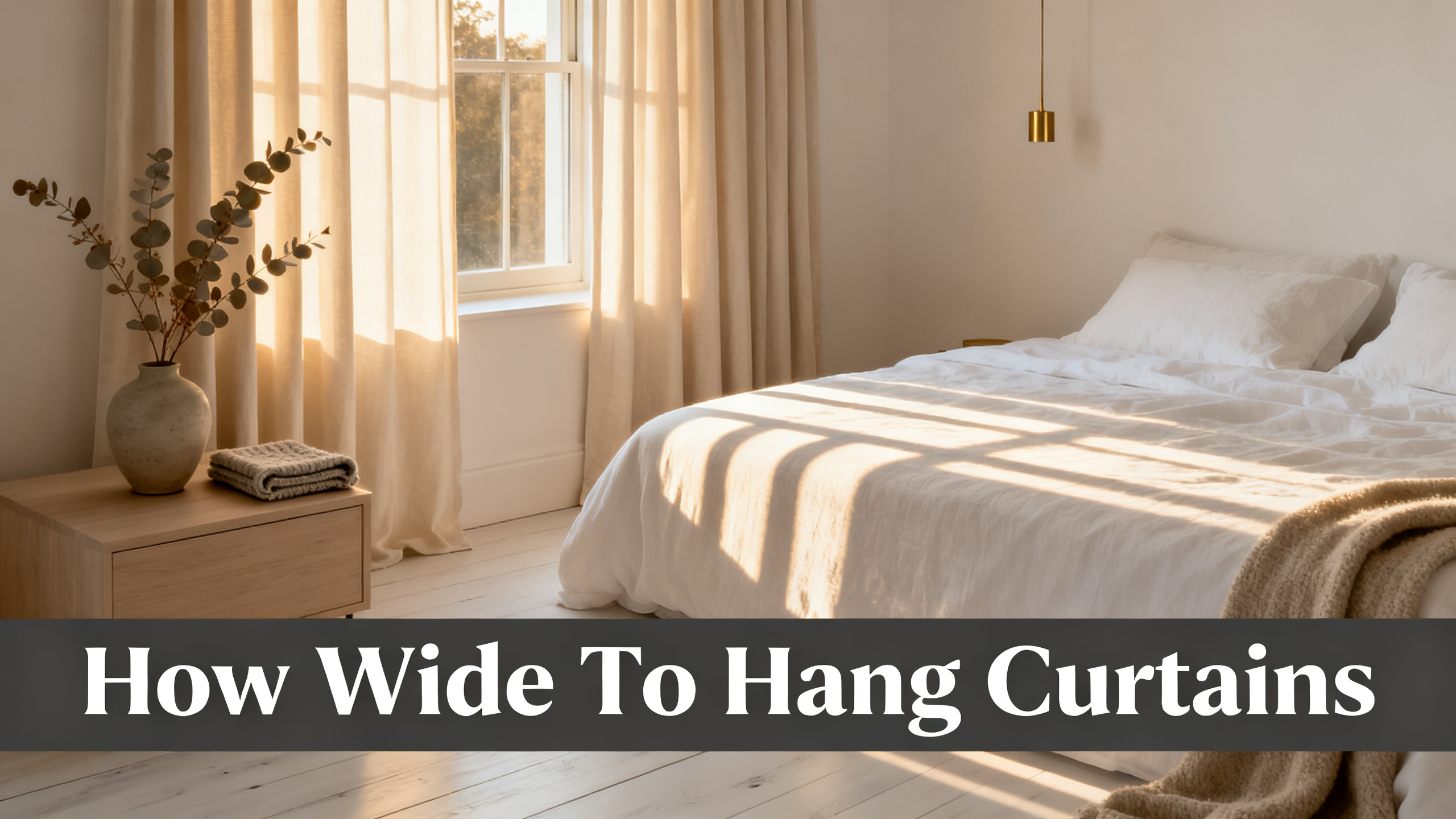
Width is the axis most homeowners underestimate. Height gets all the attention, drop gets the puddle-versus-kiss drama, but the second panels look skimpy drawn shut, it is almost always a width problem. The rod is too short, the fullness ratio is too tight, or someone counted panels instead of inches.
Two numbers do most of the work here. Rod length and fullness ratio. Get those right and the panels look intentional whether drawn open or closed. Prep first, then the math, then the ordering flow.
🧰 BEFORE YOU MEASURE
The 10-Minute Prep for a Clean Width Reading
📏
Metal tape measure (25 ft)
Cloth tapes stretch. A 60-inch window reads 61.5 with a soft tape and your fullness math breaks.
📐
Painter’s tape
Flag the rod extension on both sides of the window before you drill. See the coverage first.
🖊️
Notepad or notes app
Log window width, rod length, target fullness, and stack-back. Do not do this in your head.
🪟
Window frame access
Measure the frame edge to edge, not the glass. Also note trim depth for outside-mount rods.
🧮
Calculator
Rod length × fullness ratio ÷ panel width. Three multiplications, one division.
⏱️
10 minutes per window
Measuring plus the fullness decision. Ordering is the extra 3 minutes on the configurator.

🪟 EDITOR’S PICK FOR WIDE WINDOWS
Liz Loft Pleated Curtains, 112″ Fabric Width
The widest single panel in the Two Pages catalog. Covers a 60-inch window in one panel at true 2× fullness. 350 gsm linen blend, memory-trained pleats.
From $59.99/panel
Final price depends on size & lining. Code JULY for 20% off. Free shipping over $300.
The Width Rule
The universal rule is short. Your rod extends 6 to 12 inches past the window frame on each side, and your panels combined equal at least 2× the rod length in fabric. That is the number designers polled by Architectural Digest agree on more than any other. Everything else is refinement.
The two variables carry all the weight. Rod length decides where the stack-back sits when the curtains are drawn open, and fullness ratio decides how the panels read when they are drawn shut. Before we get into rod extension and fullness math, our complete guide to hanging curtains covers the fundamentals every width calculation depends on.
Here is what those numbers look like on a standard 60-inch bedroom window. This is the shape most people are working with, and the diagram below is a good gut check before you start drilling anything.
📐 THE WIDTH RULE
How Wide the Rod, and How Wide the Panels
WINDOW WIDTH
60″
Standard bedroom window, frame edge to frame edge.
ROD LENGTH
72″ to 84″
6 to 12 inches past the window on each side. The stack-back parks off the glass.
TOTAL PANEL WIDTH
144″ to 168″
Rod length × 2. That is 2× fullness, the designer default.
STACK-BACK
14″ to 18″
Where the drawn-open panel parks. That is why the rod extends past the frame.
5 Steps to the Right Width
Boring number, real impact. The whole process is five moves and you can do them in one pass if you have the tape measure and a notepad in hand. The order matters, because Step 3 depends on the answer from Step 2.
Step 1 is the measurement itself. Frame edge to frame edge, not glass. A window that reads 58 inches at the glass is often 62 inches at the outside of the trim, and that is the number your rod cares about.
Step 2 and 3 are the width decisions. How far past the window does the rod extend, and how much fullness do you want. Both are covered in their own sections below, so treat the numbered card as the map and the sections after as the detail.
Step 4 and 5 are the math that pops out the answer. Multiply rod length by fullness ratio, then divide by the width of a single panel. Round up on the division. Never down.
🧭 STEP-BY-STEP
Five Steps From Window to Ordered Panels
STEP 1
Measure the window frame
Edge to edge, not glass. Note trim depth if the rod will sit inside the recess.
STEP 2
Add rod extension
6 to 12 inches each side. Cap the extension at 12″ past the frame for standard rooms.
STEP 3
Pick a fullness ratio
2× for pleated and grommet, 2.5× for sheers and rod-pocket, 3× for luxury drapes.
STEP 4
Multiply for total panel width
Rod length × fullness ratio = total inches of fabric needed across all panels.
STEP 5
Divide by panel width
Total ÷ single panel width = number of panels. Round up. Two Pages’ Liz Loft is 112″ per panel.
⚠️ MISTAKE TO AVOID
Do not round down when Step 5 spits out 1.7 panels. Round up. A 1.7-panel result at 2× fullness collapses back to 1.5× fullness the moment you take the shortcut. That is the number one width regret in every homeowner forum.
Rod Extension Past the Window
The rod extends past the window for one reason. When the panels are drawn open, all that fabric has to go somewhere. That parking spot is called the stack-back, and it needs to sit off the glass so daylight actually enters the room.
The working range is 6 to 12 inches per side. Six is the minimum that clears the stack from the glass in most rooms. Twelve is the designer trick that fakes a wider window and reads intentionally architectural. Anything past 12 inches starts to feel disconnected, like the rod belongs to a different window.
How to Hang a Curtain Rod (The Anchor-First Method)
Stud placement, toggle bolts, and the bracket spacing that stops a wide rod from sagging in the middle.
One thing worth flagging on the hardware side. A rod that extends 12 inches past a 60-inch window is a 84-inch rod, and 84 inches unsupported in the middle will bow under a full weight of pleated linen. Add a center bracket past 72 inches. Two Pages’ 350 gsm Liz Loft is heavier than most ready-made panels, so plan for the support.
📐 ROD EXTENSION
How Far the Rod Extends Past the Window
MINIMUM
3″ per side
Absolute floor. Any less and the drawn-open panel covers the glass.
STANDARD
6″ to 8″ per side
Bedroom and dining room defaults. Stack-back sits off the glass, window reads slightly wider.
DESIGNER LOOK
10″ to 12″ per side
Living rooms with narrow windows. Fakes width, lets more daylight through when open.
CAP
12″ per side
Past this, the panel starts to look disconnected from the window. Exception: floor-to-ceiling walls.
How Full Should the Panels Be
Fullness is the ratio between fabric width and rod length. 2× is the designer default, and it earns that title because it reads full without paying for luxury yardage. A 72-inch rod at 2× wants 144 inches of fabric across the panels combined. Two 84-inch-wide panels or one 144-inch custom panel both hit that number.
If it were my room and I had a sheer or a rod-pocket header, I would push to 2.5×. Light fabric under 100 gsm looks intentional at 2.5× and thin at 2×. The extra half-multiplier is what separates a sheer that looks curated from one that looks like an afterthought.
Three-times fullness is the luxury number. Reserve it for velvet, silk, or heavy linen at 400 gsm and above on a big picture window. On a 60-inch bedroom window it reads theatrical and eats a huge stack-back. On a 120-inch living room wall of glass, it is exactly right.
🧵 FULLNESS RATIO
How Much Fabric Per Inch of Rod
1.5× fullness
❌ Reads skimpy
Most ready-made panels default here. Drawn shut, you can see the wall through the folds.
2× fullness
✅ Designer default
Pleated, grommet, tab top. Reads full without paying for luxury yardage.
2.5× fullness
✅ Sheers & rod pocket
Light fabrics need more yardage to look intentional. Sheers under 100 gsm should be 2.5×.
3× fullness
Luxury / velvet
Heavy drapes at 400+ gsm read best at 3× on a big picture window. Priciest, most theatrical.

📐 SKIP THE FULLNESS GUESSWORK
One Panel, One 60-Inch Window, True 2× Fullness
A 112-inch fabric width fits a wider window in a single made-to-order panel. No stacked seams, no scrimped fullness, no math past step 2 of the configurator.
⚠️ MISTAKE TO AVOID
Ready-made panels default to 1.5× fullness because it lowers the shelf price. Two panels on a 60-inch window look bare drawn shut, no matter how nice the fabric is. Either buy four ready-made panels (two per side) or go custom width. Real talk, four cheap panels beat two premium panels for pure width every time.
How Many Panels Do You Need
For windows up to 50 inches, two ready-made panels reach 2× fullness because each panel is 50 to 54 inches wide off the shelf. That is the shape most bedrooms are working with, and the ready-made market is priced for exactly this window.
For windows between 60 and 90 inches, four ready-made panels do the job. Two per side, seams hidden in the pleats. This is the cheap trick that actually works, as long as the panel color matches across dye lots. Order all four at once from the same store, same batch.
Past 90 inches, the seam question turns awkward. A custom-width single panel keeps the fabric continuous. Two Pages’ Liz Loft ships up to 112 inches per panel, which covers most windows in a single piece. Sliding doors and picture windows past 120 inches move to four custom panels.
🪟 PANEL COUNT
Two Panels, Four Panels, or One Wide Made-to-Order
Two ready-made panels
Windows up to 50″. Each panel is 50″ to 54″ wide off-the-shelf. Gets you to 1.5× to 2× fullness.
Four ready-made panels
Windows 60″ to 90″. Two on each side, seams hidden in the pleats. Cheap trick, works.
Two custom-width panels
Windows up to 100″ total rod length. Two Pages’ Liz Loft ships up to 112″ per panel.
FOUR CUSTOM-WIDTH PANELS
Picture windows & sliding doors past 120″. Two per side at 100″+ each, full 2.5× fullness.
Common Width Mistakes to Avoid
Mistake number one is mounting the rod at the exact window edge. The drawn-open panels then eat 4 to 8 inches of glass on each side, and the room reads darker than it should. Sounds technical. In practice it means you lose ten percent of your daylight because you saved yourself 20 minutes of measuring.
How High to Hang Curtains: The Universal Rule
Width without the right height still reads wrong. The 4-to-6-inch above-the-window logic.
Mistake number two is skimping on fullness because the sticker shock hits. Two premium 50-inch panels on a 72-inch rod is 1.4× fullness, which reads bare no matter how nice the fabric is. Four cheap panels at 2× beat two premium panels at 1.4× every time, full stop.
⚠️ MISTAKE TO AVOID
Forgetting the stack-back adds up. A 3-inch skimp on each side of a 60-inch window costs 6 inches of coverage, which is 10% of the window. Small on paper, obvious in the room the first morning you open the curtains and half the glass is still blocked.
Mistake number three is mixing panel widths across a single rod. Two 50-inch panels plus one 32-inch panel to “get to 132 inches” reads like a math homework fix. Width is one axis of five. For the fuller checklist that combines height, rod extension, panel length, header, and lining decisions, our hang curtains properly walkthrough is the companion piece to bookmark.

FREE SWATCH KIT
See Liz Loft in the Light of Your Actual Room
A panel that covers a 60-inch window still reads differently in a north-facing bedroom than a south-facing living room. Get the swatch card before you commit the width.
Frequently Asked Questions
How wide should curtains be compared to the window?
Curtains should give a total fabric width of at least 2× the rod length, not the window width. For a 60-inch window with a rod extending 6 inches on each side (72-inch rod), you want 144 inches of fabric across all panels combined. That is the designer default. Skimping to 1.5× reads bare when the panels are drawn shut, which is exactly when width matters most.
How far past the window should the curtain rod extend?
6 to 12 inches per side is the working range. Six inches is the bedroom or dining room default. Ten to twelve inches is the designer trick that fakes a wider window and lets more daylight through when the panels are drawn open. The absolute minimum is 3 inches, and anything past 12 inches starts to look disconnected from the window.
How many curtain panels do I need for a window?
For windows up to 50 inches, two ready-made panels reach 2× fullness. For 60-to-90-inch windows, four ready-made panels (two per side) hide the seams in the pleats. Past 90 inches, a custom-width single panel (Two Pages’ Liz Loft ships up to 112 inches per panel) covers the width without stacked seams. Sliding doors and picture windows past 120 inches need four custom panels.
What is a 2× fullness ratio for curtains?
2× fullness means the total fabric width is twice the rod length. On a 72-inch rod, that is 144 inches of fabric across the panels combined. It is the standard for pleated, grommet, and tab-top headers. Sheers and rod-pocket panels look better at 2.5× because thin fabric needs more yardage to read intentional. Velvet or heavy linen at 400+ gsm can carry 3× on a big picture window.
Should the rod be wider than the window frame?
Yes, almost always. The rod extends past the window so the drawn-open panels park off the glass (the stack-back) and the window reads slightly wider. Mounting the rod at the window edge is the most common width mistake: even fully open, the panels then eat 4 to 8 inches of glass on each side. Extend 6 to 12 inches per side and the window opens up.
Now You’ve Measured. Here’s How to Order.
Recap in three lines. Rod length equals your window width plus 6 to 12 inches on each side, capped at 12. Fullness ratio is 2× for pleated and grommet, 2.5× for sheers and rod-pocket, 3× only for velvet on picture windows. Panel count is total fabric width divided by single panel width, rounded up.

The ordering flow is short. Feed rod length and window width into the Liz Loft configurator, pick a header (Loft pleat is the safe bet), add memory training so the fullness holds after a few draws. Ten to twelve business days later, panels arrive cut to your exact width.
🪟 NEXT STEP
Now You’ve Measured. Here’s How to Order.
Feed your rod length and window width into the Liz Loft configurator, pick a header, add memory training if you want the fullness to hold. The rest is a 10 to 12 day made-to-order lead time.
From $59.99/panel · Code JULY for 20% off · Free shipping over $300
