
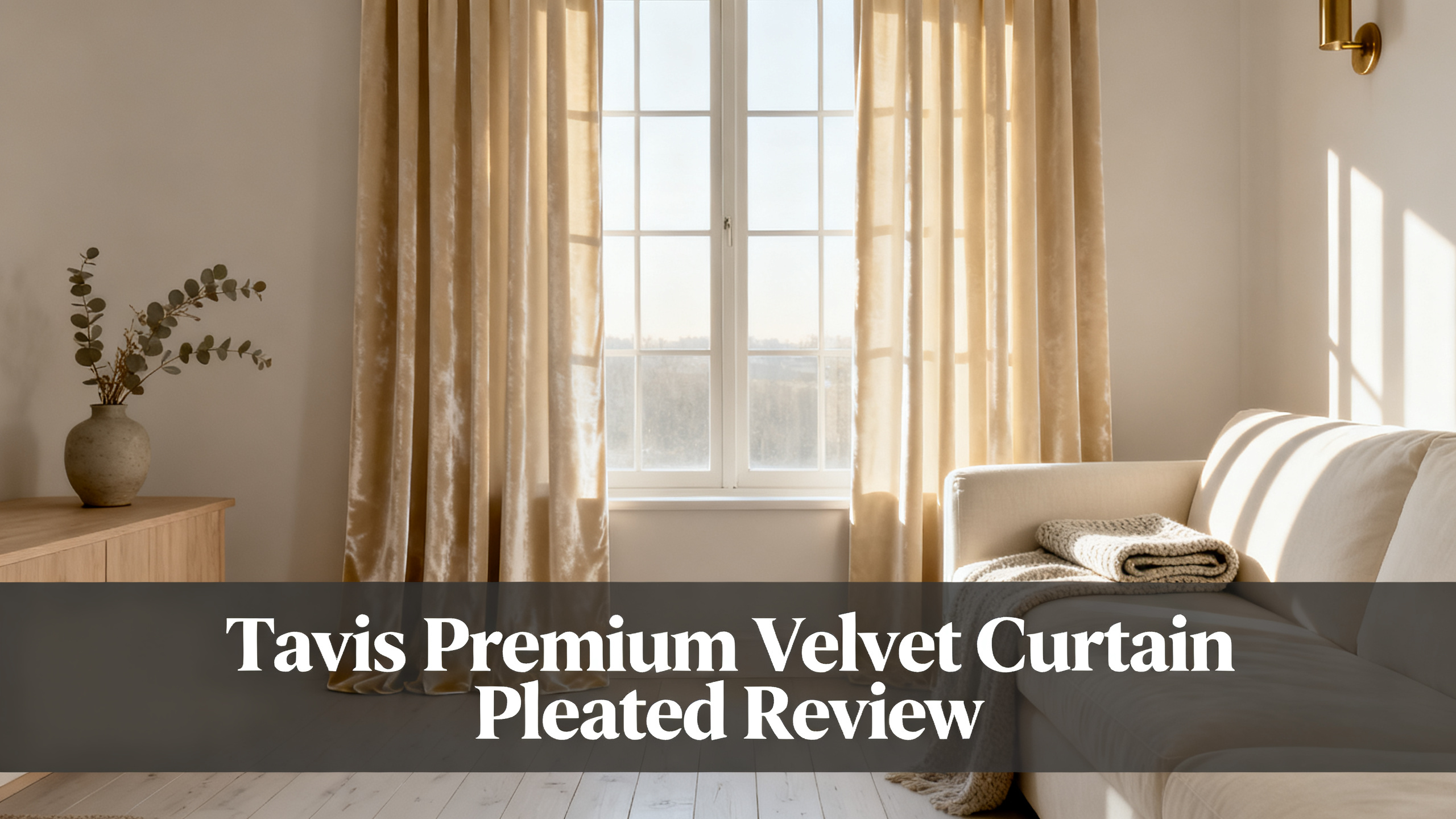
Here is the tension in one line. Tavis is the heaviest pleated velvet in the Two Pages catalog at 445 gsm, dense enough to read near-blackout unlined, and the recurring Trustpilot note on the saturated jewel tones is that the panel arrives 1 to 2 shades deeper than the swatch booklet under warm interior light. Both statements are correct. This review walks the trade-off without smoothing either edge.
That is the corner of the Two Pages range where Tavis lives. For the wider velvet landscape across weights, headers and lining options beyond Tavis, our velvet curtains complete guide maps the full Two Pages velvet range. The brief here is narrower: how the 445 gsm polyester velvet body falls, what the configurator actually returns at three real window sizes, and whether the dye lot variance is the deal-breaker some buyers fear or a footnote handled by a $1 swatch order.

Review Subject
Tavis Premium Velvet Curtain, Pinch Pleat
from $109/panel (final price depends on size & lining)
- 445 gsm heavyweight body, 100% polyester velvet with muted matte finish
- Pinch Pleat 3-finger header with hooks included at base price
- 16 colorways: Beige, Off White, Hazelnut, Grass Green, Navy Blue, Burgundy, Black and more
Code JULY for 20% off · Free shipping over $300
Quick Verdict
Cutting to it: Tavis earns 4.4 out of 5 as a heavyweight pleated velvet. It scores high on drape density, on near-blackout behavior without a liner, and on the matte finish that does not catch overhead light like cheaper polyester velvets. It loses ground on color accuracy when the order lands on a saturated jewel tone, and on the polyester-only material story for buyers shopping pure natural fiber.
Quick Verdict (Tavis · 445 gsm · Pinch Pleat)
4.4 / 5
The densest pleated velvet in the Two Pages catalog. Holds back from a higher score on natural fiber appeal (100% polyester vs the pure-cotton velour Veda alternative) and on dye lot color consistency (jewel tones occasionally read 1 to 2 shades deeper than the swatch).
Drape
4.7
Light Block
4.6
Build Quality
4.5
Value
4.3
Color Accuracy
3.9
Two honest caveats. The dye lot variance is real but addressed by ordering the $1 swatch booklet first, which arrives in the same batch logic as the panels. And the polyester signature is intentional engineering for wear resistance, not a corner cut. Rest of the review walks how that plays out in the room.
Drape & Finish: How 445 gsm Polyester Velvet Actually Falls
The first thing the 445 gsm body does is settle. Two Pages catalog data lists Tavis at the top of their velvet weight ladder, ahead of Birkin (300 gsm) and ahead of the cotton-velour Veda Luster (280 gsm). In practice, that density translates to a flat vertical fall on a standard 96 inch drop, with the 3-finger pinch pleat folds holding their geometry from the rod down through the bottom hem.

The matte finish is the second thing buyers notice. Tavis is described in the catalog as a high-density velvet with a muted matte finish and cloud-like softness. That matters because the cheap end of polyester velvet usually has a glossy sheen that catches overhead halogen and reads as plastic. Owner-shared photos demonstrate that Tavis does not. The pile reflects light diffusely, which is closer to silk velvet behavior than to mass-market polyester drape.
Birkin Velvet Pleated: The 300 gsm Lighter Sibling
Our parallel review of the Two Pages Birkin Velvet covers the lighter 300 gsm midweight pleated version with a softer drape and 37 colorways for buyers who find Tavis too dense.
The third thing is the color range. Two Pages classifies Tavis under 16 colorways in the HY2028 series, organized into three groups: warm neutrals (Beige, Off White, Hazelnut, Light Khaki, Chocolate, Taupe), cool neutrals (Neutral Gray, Dark Grey, Wolf Gray), and saturated jewel tones (Sunset Yellow, Grass Green, Sky Blue, Indigo, Navy Blue, Burgundy, Black). The jewel tones are where the dye lot variance shows up most.
🎨 Tavis Color Palette (selection)
8 anchors across the 16-color lineup
Beige
HY2028-1 · default
Off White
HY2028-28 · brightest
Hazelnut
HY2028-3 · warm mid
Grass Green
HY2028-8 · jewel
Neutral Gray
HY2028-40 · cool mid
Navy Blue
HY2028-63 · deep
Burgundy
HY2028-72 · wine
Black
HY2028-74 · deepest
Velvet dye lots vary by 1 to 2 shades batch-to-batch. Saturated jewel tones (Burgundy, Indigo, Grass Green) most often read 1 shade deeper than the booklet under warm interior light. Ordering the swatch booklet first matches the panels to your actual wall paint and floor tone.


Pricing by Configuration
Worth being honest about what the from $109/panel headline really means. That base figure is the entry price for the smallest custom panel before width, drop and lining choices feed into the configurator. The Pinch Pleat header is included at the base, not an upcharge, and the curtain hooks ship in the box. The rod and rings are not included, which is standard Two Pages catalog policy across pleated panels.
📐 Pricing by Configuration
Real configurator outputs · Tavis 445 gsm, Pinch Pleat, Unlined
Bedroom window (small)
42″ W × 84″ L · Unlined
~$149
Entry config for a single bedroom window with near-blackout from the velvet body.
Standard window
52″ W × 96″ L · Unlined
~$229
Most-ordered Tavis config sitewide.
Living room patio doors
75″ W × 108″ L · Unlined
~$315
Full drape across a sliding glass door bay, sturdy rod recommended for the 445 gsm body.
Code JULY applies 20% off sitewide. Free shipping unlocks at $300 cart value, which corresponds to a two-panel order at the standard window tier and above.
The configurator returns approximately $229 for a 52 by 96 inch panel unlined, which is the most-ordered Tavis size sitewide. A small bedroom config at 42 by 84 inches lands around $149, and a patio door panel at 75 by 108 inches lands around $315. With the JULY code, a two-panel standard window order lands above the $300 free-shipping threshold even after the 20% discount, which is the practical reason most Tavis carts qualify for free delivery.


Build your Tavis configuration before the JULY window closes
The Two Pages configurator returns the exact panel price once width, drop, color and lining are set. Tavis ships in 10 to 12 days, made-to-order.
Code JULY · Made-to-order (final sale)
One disclosure before the specs section. Tavis is made-to-order and final sale once production starts. That is why the swatch step matters more here than on a ready-made panel: the cost of guessing wrong on color is the cost of a re-order, not a return.
Specs Deep-Dive: 445 gsm and 100% Polyester Velvet
The composition reads simply. Tavis is 100% polyester, woven into a high-density velvet construction at 445 gsm (about 13.1 oz per square yard). There is no natural-fiber blend, no cotton backing layer, no rayon contribution. The polyester is engineered for wear resistance and color stability, and the velvet pile is what carries the visual signature. Two Pages catalog confirms the fabric meets the OEKO-TEX STANDARD 100 framework for textile safety on the dye and finishing chemistry.
Veda Luster Cotton Velour: The Natural-Fiber Alternative
If you want the velvet aesthetic in a natural fiber, our Veda Luster review covers the 280 gsm cotton velour pleated alternative with a softer sheen and a more breathable hand.
On weight tier, the 445 gsm figure puts Tavis above the typical 300 to 350 gsm range where most premium polyester velvets sit. The practical consequence is the near-blackout light behavior: the dense pile absorbs the bulk of direct sunlight, and the matte finish does not redirect what does pass through into a halo. For broader polyester market context, the Textile Exchange polyester market report covers the fiber sustainability picture at industry scale.
On sizing, Tavis ships at 112 inch fabric width, custom cut to the configurator inputs. Lead time is 10 to 12 business days for any of the 16 colorways, which are all standard inventory. The bottom hem is 1.5 inches with puddle length recommended for added light-blocking at the floor seal. Care instructions emphasize that lengths can vary by up to 1 inch due to handcraft tolerance, and dye lot color is batch-dependent.
Use Case Fit: 3 Rooms Where Tavis Wins
The first room where Tavis lands cleanly is the bedroom that needs near-blackout. South-facing bedrooms hit by 6am sun, east-facing bedrooms with the morning glare problem, and shared bedrooms where one sleeper wakes earlier than the other all benefit from the 445 gsm velvet body absorbing most of the direct light without a separate liner upcharge. Owner-shared photos in Trustpilot and on the Two Pages product page confirm the unlined panel is enough for most rooms.
👤 Who Tavis Fits
Three buyer profiles where Tavis is the right call
🌙
Bedrooms wanting near-blackout
South and east-facing bedrooms where the 445 gsm velvet body blocks most direct sunlight unlined and softens early-morning glare without a dedicated blackout liner.
🎬
Media rooms and home theaters
Dedicated viewing spaces where the velvet density dampens sound reflections, the matte finish kills screen glare, and the deep colorways (Navy, Indigo, Burgundy, Black) absorb stray light.
🎨
Saturated jewel-tone interiors
Dining rooms, libraries and formal living rooms where a Burgundy, Indigo or Grass Green velvet panel is the statement piece around brass hardware and dark wood.
The second room is the media room or home theater. The combination of velvet pile (sound-dampening), matte finish (no screen glare bounce), and deep colorways (light absorption) is what makes Tavis the standard pick for dedicated viewing spaces. Black HY2028-74 and Indigo HY2028-60 are the two most-ordered colorways for this use case according to Two Pages catalog data, with Navy Blue HY2028-63 as the soft alternative when full black reads too heavy.
📏 Pro tip before configuring Tavis
Multiply finished window width by 2.0 to 2.25 for full pinch pleat fullness on Tavis. At 445 gsm the body carries its own weight, so a fullness multiplier slightly lower than the lighter Birkin (300 gsm) still reads dense and architectural. For drop, measure from the rod to either 0.5 inch above the floor (kiss length) or 1.5 inches puddled: the puddle adds light-blocking at the floor seal and the velvet body holds the fold without sagging.
The third room is the jewel-tone interior built around brass hardware, dark stained wood, and rich wall paint. Burgundy HY2028-72, Grass Green HY2028-8 and Indigo HY2028-60 are the statement picks here. Where Tavis stops being the right call: open-plan loft windows that need light, kid rooms that need washable cotton, and any space where the polyester signature would clash with a pure natural-fiber design brief.
Pros & Cons
The balance is straightforward. Tavis wins on weight, on light behavior, on color range, and on the matte finish that elevates it above the cheap end of polyester velvet. It loses on natural-fiber appeal, on dye lot consistency for the jewel tones, and on the made-to-order policy that locks in the order once production starts. Here is the side-by-side.
✅ Pros
- 445 gsm heavyweight velvet body, the densest in the Two Pages pleated line
- Near-blackout unlined: the velvet density blocks most direct sunlight without a separate lining upcharge
- 16 colorways from soft neutrals to saturated jewel tones (Burgundy, Indigo, Grass Green)
- Pinch Pleat included at base price (no header upcharge, hooks included)
- Wear-resistant matte finish: muted sheen that does not catch light like cheaper polyester velvets
⚠️ Cons
- 100% polyester: synthetic fiber only, no natural fiber alternative within the Tavis line
- Dye lot variance: jewel tones occasionally read 1 to 2 shades deeper than the swatch booklet
- From $109/panel: above Birkin Velvet entry for a heavier weight that not every room needs
- Made-to-order, final sale once produced, no returns post-production
- Heavy fall: the 445 gsm body needs a sturdy rod and proper bracket spacing on wide spans
What Buyers Actually Say
Two Pages sits at Trustpilot 4.5/5 across 5,000+ owner reviews at the brand level. On Tavis specifically, the recurring praise themes are the dense vertical fall at the 445 gsm weight, the matte finish that owners describe as reading closer to silk velvet than polyester, and the jewel-tone saturation on Burgundy, Indigo and Grass Green when the colorway lands on tone.
Photo-shared reviews on the product page consistently show Tavis in dining rooms and bedrooms with brass hardware and dark wood floors. The structured pinch pleat geometry holds across owner photos taken months after delivery, which lines up with the catalog claim on wear resistance. Two Pages classifies Tavis as their heaviest pleated velvet because the 445 gsm body is what delivers that long-term fold stability.
🎁 Order the Tavis swatch booklet before you commit
Compare the Tavis velvet colorways side-by-side in your own room light. Booklet size 4 by 6 inches, fabric front and back same density and finish as the full panels, $1.00 plus shipping, refundable separately from the made-to-order curtains.
The recurring criticism is short. The jewel tones occasionally arrive 1 to 2 shades deeper than the booklet under warm interior light. A minority of reviewers note the polyester-only composition was not what they expected when comparing to silk or cotton velvet at a higher price tier. And the made-to-order final-sale policy frustrates buyers who skipped the swatch step and then could not return after delivery.
FAQ
Is Tavis actually velvet, or is it polyester pretending?
Two Pages lists the Tavis composition as 100% polyester woven into a high-density velvet construction. The fabric is engineered polyester velvet, not natural-fiber cotton velour or silk velvet. The trade-off is intentional: the polyester base is what makes Tavis wear-resistant, easier to maintain, and consistent in color durability over time, while the 445 gsm density and the muted matte finish are what deliver the visual signature of premium velvet without the natural-fiber upcharge.
How heavy is Tavis compared to the rest of the Two Pages velvet lineup?
Tavis sits at 445 gsm which makes it the heaviest velvet in the Two Pages catalog. It is significantly heavier than Birkin Velvet (300 gsm, the midweight standard) and Veda Luster Cotton Velour (280 gsm cotton-based velour). The 445 gsm tier translates to a dense vertical fall, a structured pinch pleat hold, and a fabric body that approaches blackout performance without needing a separate lining at typical 84 to 108 inch drops.
How much does a standard Tavis Pinch Pleat panel cost?
Base price is $109/panel for the smallest config. A typical 52 by 96 inch Tavis Pinch Pleat panel returns around $229, a 42 by 84 inch bedroom config around $149, and a 75 by 108 inch patio door panel around $315. Code JULY applies 20% off sitewide. Free shipping unlocks above $300 cart value.
Does Tavis really block light without a separate liner?
For most rooms, yes. The 445 gsm polyester velvet body approaches blackout performance unlined, blocking the bulk of direct sunlight and softening early-morning glare in bedrooms. Two Pages catalog notes that a puddle length bottom hem of 1.5 inches improves the floor seal further. For true cinema-grade blackout in a media room, a custom blackout liner via the configurator adds a final 1 to 3 percent of stray light control, but most owners report the unlined panel is enough.
What’s the lead time on a custom Tavis order and can I return it?
10 to 12 business days from order confirmation, before shipping. All 16 Tavis colorways are standard inventory, so color choice does not extend the lead time. The order is made-to-order and final sale once produced. The recommended workflow is to order the Tavis swatch booklet first (variant of Choose Any Fabric Booklets, $1.00 plus shipping) to verify color and fabric density in your own room light before committing to the full panels.
Final Verdict

Here is the call. Tavis is the right pick if you want a heavyweight pleated velvet that lands near-blackout unlined, holds its pinch pleat geometry over years, and offers a 16-color range that covers both soft neutrals and saturated jewel tones at a from $109/panel entry. Order the $1 swatch booklet first to verify the colorway under your own room light, especially if the order is on Burgundy, Indigo, Grass Green or any of the other saturated tones where the recurring 1-to-2-shade dye lot variance shows up. Skip Tavis if the brief is pure natural fiber (the Callout to Veda Luster covers the cotton-velour alternative), if a lighter 300 gsm drape would suit the room better (Birkin sibling Callout above), or if the made-to-order final-sale policy is a deal-breaker for the project. For the buyers it fits, it is the densest, most architectural pleated velvet in the catalog and the score reflects that.
Final Verdict
Tavis Premium Velvet Curtain · Pinch Pleat
from $109/panel
The heaviest pleated velvet in the Two Pages catalog. Calibrated for owners who want a dense, near-blackout 445 gsm fall in a saturated jewel-tone palette, not a light, drapey Birkin sheen.
Configure Tavis on Two Pages →
Code JULY for 20% off · 10 to 12 day lead time · Free shipping over $300 · Made-to-order (final sale)
