
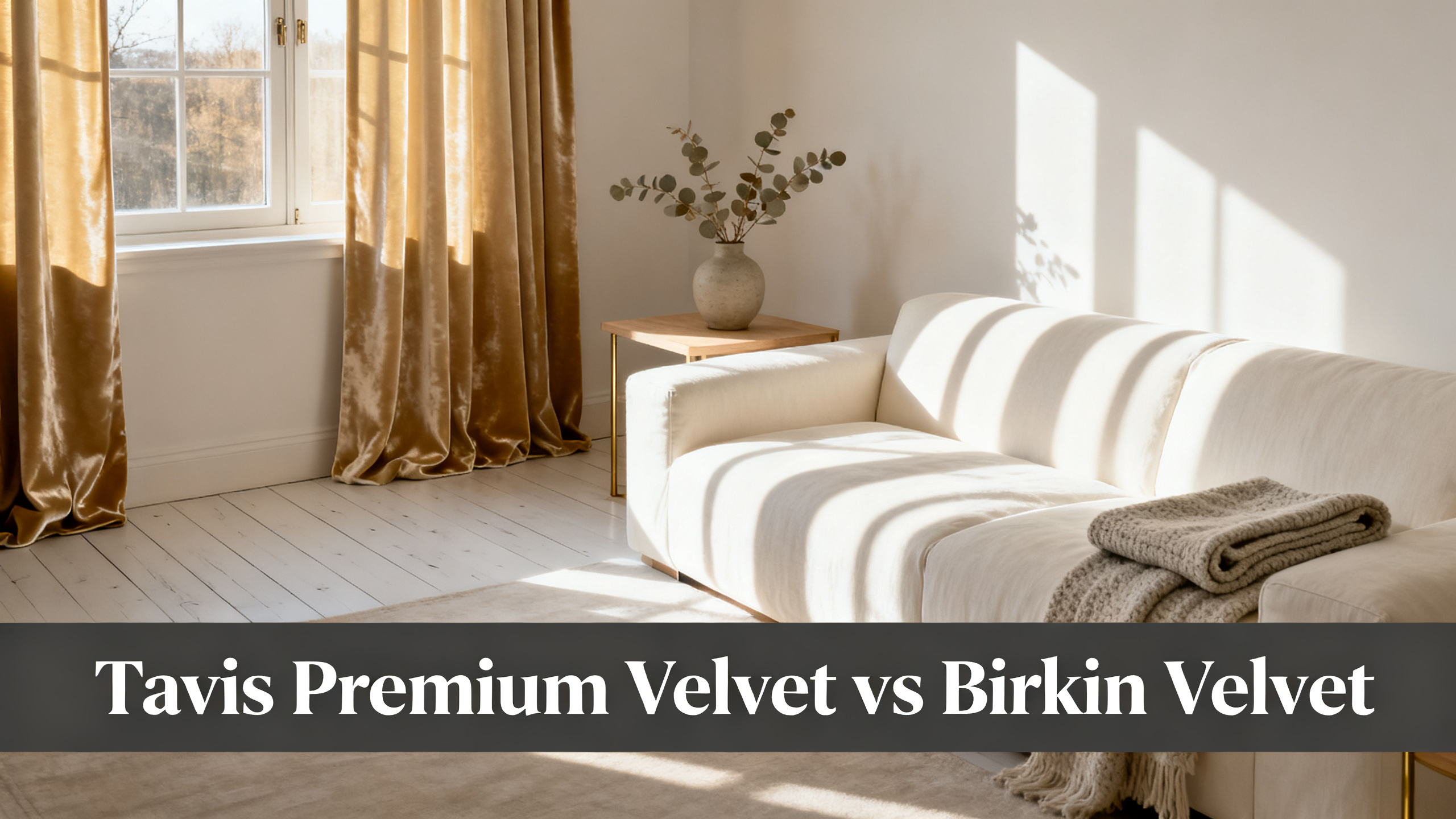
Cut to it: if you want the heavier, near-blackout, jewel-tone drape, choose Tavis Premium Velvet at 445 gsm. If you want the lighter, softer, warmer-neutral everyday velvet, choose Birkin at 300 gsm. That is the whole answer in two lines. The rest of this page exists for the buyers who want the why on every dimension before they commit a configurator order.
Both panels route through the same Two Pages line, share pinch pleat as the default header, draw from the same four lining grades, and ship in the same 10 to 12 business day lead window. The fork is the body fabric. Tavis is 445 gsm 100% polyester velvet at $109 base. Birkin is 300 gsm 100% polyester velvet at $89 base, OEKO-TEX Standard 100 certified. Everything below works that 145 gsm and $20 gap into a room-by-room verdict.
🪟 Quick Verdict
Tavis 445 gsm or Birkin 300 gsm. The room decides.
Tavis wins on weight, near-blackout behavior unlined, jewel-tone color depth, theater-room fit. Birkin wins on price ($20/panel cheaper), softer drape sway, warmer neutral palette, certified-fabric story (OEKO-TEX 100), everyday living-room match. Both ship in 30-plus colorways, both take the same four linings, both clear the 10 to 12 day production line.

PICK A · HEAVYWEIGHT 445 GSM
Tavis Premium Velvet Curtain, Pinch Pleat
The heavier Two Pages velvet, 445 gsm polyester, near-blackout unlined, jewel-tone color depth. Best for theater rooms, north-facing bedrooms, formal dining. from $109/panel. Final price depends on size and lining.

PICK B · MIDWEIGHT 300 GSM
Birkin Velvet Curtain, Pinch Pleat
The lighter Two Pages velvet, 300 gsm OEKO-TEX polyester, softer drape, warmer neutral palette. Best for living rooms, dining, master bedrooms with double-pane glass. from $89/panel.
Material & Weight
Here is what 145 gsm actually buys you. Tavis sits at 445 gsm, which puts it at the top of the Two Pages velvet weight ladder and roughly 48% heavier per square meter than Birkin’s 300 gsm body. Both are 100% polyester velvet, both finish in a matte short pile, both are catalog-described as “heavyweight”. The fiber story is identical. The density story is not.
For the deeper teardown on dye-lot variance and the configurator price at three real window sizes for the heavier panel, see the full Tavis review. The relevant point for this comparison is that the extra grammage on Tavis lands almost entirely in pile density, not pile height. The panel feels denser in the hand without looking visibly different from across the room until you watch it move.
⚖️ Weight Visualizer · Two Pages Velvet Ladder
LIGHTWEIGHT
220 gsm
Kyla, Veda Luster cotton velour. Soft sway, daylight-friendly.
MIDWEIGHT
300 gsm
Birkin. The everyday velvet, the living-room default.
HEAVYWEIGHT
445 gsm
Tavis. Top of ladder, near-blackout unlined, theater-grade fall.
What changes at the window: the heavier Tavis body settles in a flat vertical line with the 3-finger pinch pleat folds holding their geometry from rod to hem. Birkin still drapes cleanly but sways more under HVAC drift, which some buyers actually prefer for a softer living-room read. Neither is wrong. They are tuned for different rooms.
📋 Comparative Specs Table
| Spec | Tavis Premium Velvet | Birkin Velvet |
|---|---|---|
| Composition | 100% Polyester Velvet | 100% Polyester Velvet |
| Fabric weight | 445 gsm (heavyweight) | 300 gsm (heavyweight) |
| Fabric width | 112″ | 110″ |
| Header default | Pinch Pleat | Pinch Pleat |
| Alt headers | Limited (pinch focus) | Soft Top, Grommet |
| Lining options | 4 (None, Cotton, Thermal, Blackout) | 4 (None, Cotton, Thermal, Blackout) |
| Color range | 30-plus, jewel-tone strong | 30-plus, warm neutrals strong |
| Light control unlined | ~95% (near-blackout) | ~88-90% |
| Certification | Not surfaced on PDP | OEKO-TEX Standard 100 |
| Lead time | 10 to 12 business days | 10 to 12 business days |
| Base price | from $109/panel | from $89/panel |
The honest note on the material story: both are 100% polyester. Buyers shopping for natural-fiber velvet (cotton velvet, mohair, silk velvet) will not find their answer in either. The trade-off is the polyester base costs less, resists fading better, and tolerates household cleaning better than a cotton velvet of the same gsm. If natural fiber is the dealbreaker, the cotton-velour Veda Luster is the Two Pages alternative, not Tavis or Birkin.
Color Range & Aesthetic
Same polyester base, very different color logic. Tavis pushes hard into saturated jewel tones: burgundy, grass green, navy blue, indigo, sunset yellow, sky blue. The 445 gsm body holds those pigments with more depth, less polyester sheen, because the denser pile traps light instead of bouncing it. The catalog reads this way intentionally. Tavis is sold for formal and statement-room use cases.
Birkin leans warmer neutrals: ivory, gray beige, taupe, chocolate, sable, snow white, brown. The 300 gsm body reads slightly softer under daylight, which suits living rooms and master bedrooms where the panel is meant to recede rather than dominate. Both palettes overlap on the safe neutrals (ivory, beige, gray, chocolate, black), so a buyer who wants neutral can pick either and decide on weight and price alone.
Birkin Velvet Pleated: The Full Review
Deep-dive on the 300 gsm body, the 30-plus colorway shortlist, what Trustpilot owners report after one winter, and the pile-direction flag.
🎨 Color Swatch Matrix · 8 Real Catalog Variants
Tavis
Burgundy
Tavis
Grass Green
Tavis
Navy Blue
Tavis
Black
Birkin
Ivory
Birkin
Gray Beige
Birkin
Chocolate
Birkin
Brown
The dye-lot caveat is shared by both. Both panels are produced in batches and both carry the catalog warning that color reads on dye lots. The practical impact: order every panel for the same room on a single order. If you split a 4-panel job across two orders six weeks apart, you can land a 1 to 2 shade delta that reads under warm interior light. Free swatches address the front-end risk, not this one.
Headers & Drape Behavior
Both default to pinch pleat. That is the only header you should compare them on, because it is the configuration both collections were built for. The fall does not match across the two, even at the same drop. Tavis at 445 gsm holds a tighter, more architectural pleat geometry. Birkin at 300 gsm reads slightly softer, with the pleat folds opening a touch more under air movement.
🪟 Side-by-Side Product Cards

TAVIS
Premium Velvet Pleated
445 gsm · 100% polyester velvet · 112″ width
Architectural pleat, flat vertical fall, jewel-tone depth.
from $109/panel

BIRKIN
Velvet Pleated
300 gsm · 100% polyester velvet · 110″ width · OEKO-TEX 100
Softer pleat sway, warmer neutrals, everyday velvet.
from $89/panel
The taller the window, the more the weight gap matters. On a 96 inch drop, both look comparable from across the room. On a 120 inch drop, the Tavis vertical line stays cleaner because the heavier body resists wind eddies from HVAC supply registers. Buyers fitting ceiling-track installs at 11 to 13 foot ceilings should default to Tavis for that reason alone.
Header flexibility tilts the other way. Birkin is also offered in Soft Top and Grommet configurations beyond pinch pleat, which makes it the friendlier collection for renters and for buyers who want the same velvet body across multiple rooms with different header preferences. Tavis is more focused on the pinch pleat configuration in the live catalog.
Lining & Light Control
The near-blackout claim on Tavis is mostly true. Mostly. The 445 gsm body unlined blocks roughly 95% of visible light, which reads near-blackout in a bedroom with no other ambient source. For absolute blackout (no hairline halo around the panel edges, no rim-light bleed) you still want the dedicated blackout lining add-on, ceiling-mounted with side returns. That last 5% matters in a true media room. The DOE window coverings guidance covers the thermal-mounting logic that applies equally to both panels.
Birkin needs the lining add-on to do the same job. The 300 gsm body unlined sits at roughly 88 to 90% light blocking, which is good for most living rooms and most bedrooms with light-pollution street exposure, but is not near-blackout. Adding the cotton lining gets Birkin closer to Tavis-unlined. Adding the thermal lining gets it past Tavis-unlined on R-value, though not on body weight.
Theater Room? See the Birkin Blackout Build
If the goal is a home theater, the Birkin Blackout build with sewn-in lining is the right config to compare against the 445 gsm Tavis near-blackout.
Sound dampening tracks the weight ladder. Tavis at 445 gsm absorbs midrange echo and street noise better than Birkin at 300 gsm, no surprise. The catalog does not publish an STC delta because no curtain brand reliably does, but owner reports on theater builds consistently single out the heavier velvet as the audibly quieter option for the same lining choice.
🧵 Lining Comparison · Shared Across Tavis & Birkin
NO LINING
Tavis ~95% · Birkin ~88-90% light block. Lightest hand.
COTTON LINING
+5-8% light block on either panel. Softer back, modest weight gain.
THERMAL LINING
2-pass coated. R-value gain on either panel. Cooler glass-side temps.
BLACKOUT LINING
~99% absolute blackout on Tavis. Pushes Birkin to near-blackout.
When to upgrade lining versus upgrade body fabric: if your window faces a streetlight and your goal is sleep, the cheaper move is Birkin plus blackout lining ($89 + lining add-on), not Tavis unlined. If your goal is a formal-room aesthetic where the panel is the centerpiece, the body weight matters more than the lining, and Tavis is worth the $20 base bump.
Want Birkin Drape with Tavis Insulation? Add the Thermal Lining
The Birkin Pinch Pleat Thermal config closes part of the weight gap with Tavis through lining, not body fabric. Useful if 445 gsm feels too heavy for the room.
Pricing & Configuration
Let us run the numbers on a real window. Base prices are Tavis from $109/panel, Birkin from $89/panel, a $20 delta on the body fabric alone. Lining add-ons price identically on both panels: cotton lining is the cheapest add, thermal mid, blackout the most expensive. The lead time, the panel header price, the custom width pricing tier all match.
💰 Pricing by Configuration · 3 Real Window Sizes
SMALL · 50″W × 84″L
Tavis: from $109
Birkin: from $89
STANDARD · 60″W × 96″L
Tavis: ~$135 unlined
Birkin: ~$115 unlined
TALL · 80″W × 120″L
Tavis: ~$195 unlined
Birkin: ~$165 unlined
Configurator-derived estimates. Final price depends on size, header, lining. Use promo codes at checkout.
On a standard 60″W × 96″L window unlined, the configurator returns roughly $135 for Tavis and $115 for Birkin. Add blackout lining and Birkin lands closer to $155, Tavis closer to $175. A 4-panel job at that size, blackout lined, is roughly $700 in Tavis and $620 in Birkin. That $80 spread across the room is the real-world cost-of-decision.
JEWEL-TONE CASE · BURGUNDY HY2028-72
Tavis Burgundy for Formal Rooms
Where Tavis pulls clear ahead of Birkin: deep jewel tones at 445 gsm read with more pigment density and less polyester sheen. The Burgundy variant is the catalog case study. from $109/panel.
Promo split: VIP22 (22% off) applies to the luxury tier and is the right code for a Tavis order. JULY (20% off sitewide) is the safer default for a Birkin order, and works on Tavis too if VIP22 is unavailable at your basket. Both stack with the free swatch program. Free shipping clears at $300, which most multi-panel jobs cross either way.
How to Choose Between Them
If your gut already picked one, your gut probably was not wrong. The buyer profiles cluster cleanly. Tavis buyers are usually building a theater room, a formal dining, or a north-facing primary bedroom where weight, near-blackout, and color depth matter more than the $20 price bump. Birkin buyers are usually equipping a living room, dining, or guest bedroom where the softer drape and warmer neutral palette do more work than raw gsm.
👤 Who Is It For?
TAVIS BUYER
Theater room, formal dining, north-facing bedroom, ceiling-track install at 11-13 ft, statement jewel-tone, near-blackout-without-lining priority.
Budget tolerant of $20/panel premium. Cares about weight first, color second, price third.
BIRKIN BUYER
Living room, master bedroom, dining, guest room, standard 96″ drop, warm neutral palette, OEKO-TEX certified fabric needed, softer drape sway preferred.
Wants the $89 base, alt headers (Soft Top, Grommet), the everyday velvet that does not over-formalize the room.
The cost-of-mistake framing: if you pick wrong, the lining add-on can rescue you on one axis (light block, R-value) but not on the others (color depth, drape weight, room formality). The lining is reversible at order time, not after delivery. Order the swatches before locking the body fabric, full stop.
🪟 Order Free Tavis + Birkin Swatches Before You Commit
The 145 gsm gap between Tavis and Birkin is the kind of difference you read with your hand, not your screen. Two Pages ships fabric booklets that include both Tavis and Birkin in the 39-collection set. Compare them under your actual room light before locking the order.
Frequently Asked Questions
Is Tavis really near-blackout without a lining?
The 445 gsm polyester velvet body of Tavis blocks roughly 95% of visible light unlined, which reads as near-blackout in a bedroom with no other ambient source. For absolute blackout (no hairline halo around the panel edges) the dedicated blackout lining is still the right add-on. Birkin at 300 gsm blocks closer to 88 to 90% unlined and benefits more from a cotton or thermal lining for the same use case.
Why does Tavis cost about $20 more per panel than Birkin?
The base price gap (from $109/panel for Tavis vs from $89/panel for Birkin) reflects the 145 gsm denser body fabric, which costs more in raw material per panel and weighs more to ship. Both share the same Two Pages production line, same lead time, same custom width cap. Lining add-ons, headers, and panel size pricing are identical above the base.
Are both available in the same color range?
Both ship in 30-plus colorways. The palettes overlap on neutrals (ivory, beige, gray, chocolate, black). Tavis pushes further into saturated jewel tones (burgundy, grass green, navy, indigo, sky blue) where the 445 gsm body holds the pigment with more depth. Birkin leans warmer earth tones (sable, taupe, snow white, brown). The booklet is the only reliable way to read both under your room light.
Can both take the same lining options?
Yes. Both Tavis and Birkin take the same four Two Pages lining grades (no lining, cotton lining, thermal lining, blackout lining). The shading rates and lining cost add-ons are identical across both panels. The lining choice changes the back of the panel and the R-value, not the face fabric.
Which one drapes better on a tall window?
For drops over 108 inches, the 445 gsm Tavis body holds a flatter vertical line because the heavier fabric resists wind eddies and HVAC drift better. The 300 gsm Birkin sways more under the same conditions, which some buyers prefer for living rooms where the panel reads softer. Tavis is the choice for ceiling-track installs at 11 to 13 foot ceilings.
Is the OEKO-TEX certification on both?
Birkin is explicitly certified to OEKO-TEX Standard 100 (the fabric tested free of a defined list of harmful chemicals). The Tavis catalog page does not surface the OEKO-TEX badge in the same way, though both fabrics come from the same Two Pages production network. Buyers who need a certified panel for a nursery or sensitive sleeper should default to Birkin or order swatches with a direct certification ask through Two Pages support.
Final Verdict
Two pinch pleat velvets, one configurator, one $20 decision. Tavis earns the heavyweight slot for theater rooms, formal dining, north-facing bedrooms, jewel-tone statement walls, and any window over 108 inches where weight matters. Birkin earns the everyday slot for living rooms, master bedrooms, guest rooms, warm-neutral palettes, OEKO-TEX certified fabric needs, and the buyer who wants alt headers (Soft Top, Grommet) on the same velvet body. The lining add-on logic is identical on both, the lead time is identical, the configurator is identical. Read both swatches under your actual room light, then pick by weight and color, not by spec sheet alone. The room decides.
PICK YOUR TWO PAGES VELVET
445 gsm or 300 gsm. The Room Decides.
Two pinch-pleat velvets, one configurator. Tavis from $109/panel, Birkin from $89/panel. Free swatches on either side.
