
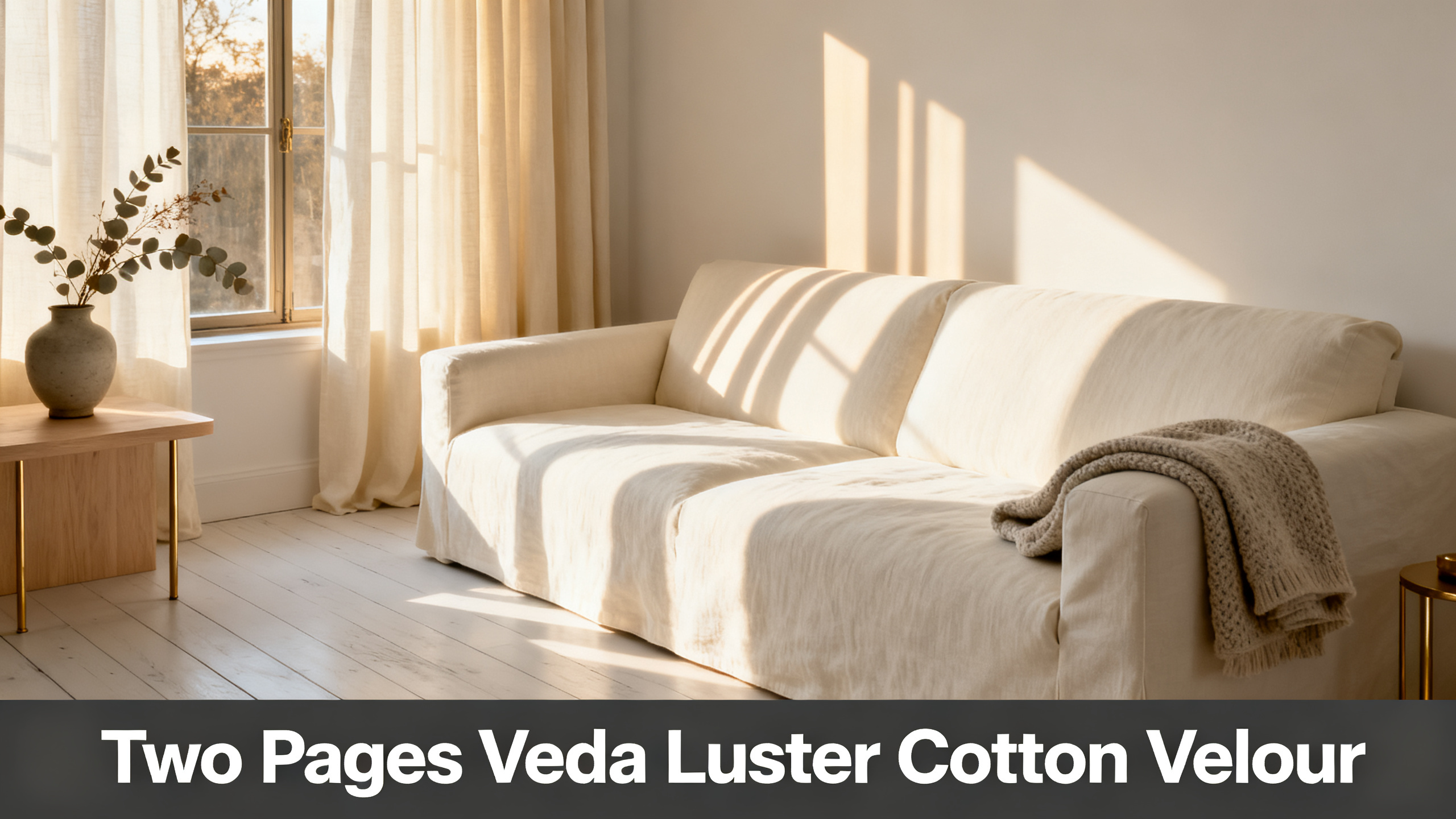
Quick context before we dig in: most velvet curtain panels sold at the $98 mark are polyester velvet finished to look like the heavier stuff. Two Pages Veda Luster is the opposite case. The collection is 100% cotton velour, woven at 280 gsm, hand-dyed across 12 colorways, certified to OEKO-TEX Standard 100, and sold from $98 per panel.
That fiber choice changes how the drape falls, how the light catches, how you clean it, and how the dye lots behave from one production batch to the next. This Veda Luster cotton velour review walks through every one of those, plus the pricing reality once size and lining enter the configurator.
TWO PAGES VEDA LUSTER COTTON VELOUR PLEATED · OVERALL
4.5 / 5 · in-depth review
DRAPE
4.6
LIGHT CONTROL
4.4
BUILD
4.6
VALUE
4.5
SERVICE
4.3
Verdict (TL;DR)
Veda Luster Cotton Velour Pleated is one of the few genuinely all-cotton velour drapes in the under-$100 entry tier, with a structured heavyweight hand, a soft luster finish, and a curated 12-shade range built around warm neutrals, jewel tones, and accent foundations. The fiber, certification, and pleated header carry the value at the entry price.
The honest caveat is that hand-dyed cotton drifts slightly between dye lots, which matters at reorder time. If you want the full velvet curtains landscape before committing to a fiber and a header, the hub maps every Two Pages velvet collection side by side.

EDITOR’S PICK · COTTON VELOUR PLEATED
Two Pages Veda Luster Cotton Velour Pleated
100% cotton velour, 280 gsm, OEKO-TEX, 12 colorways. from $98/panel. Final price depends on size and lining.
Configure Veda Luster · Code VIP22 (22% off) →
Free shipping over $300 · 30-day returns on ready-mades.
Drape and Finish: What Cotton Velour Actually Looks Like
Cotton velour belongs to the velveteen family of short-pile cut-pile fabrics. The pile is anchored to a woven cotton base, then sheared flat and brushed to a soft luster. The luster on Veda is the result of the finish on a 100% cotton ground, not a polyester sheen, which is the visual difference most buyers notice first in person against a polyester velvet sample.
Two-hundred-eighty grams per square meter is the second number that does the work. On a 100% cotton ground, that weight produces folds that settle into themselves softer than a same-gsm polyester, and a hand-feel that reads as plush rather than slick.
The fabric holds a pleat across the full 55-inch panel width without sagging at the rod, which is what the pleated header is designed for. Polyester velvet at a similar weight tends to glide and shimmer; cotton velour at 280 gsm catches and holds.

PICK FOR WARM LIVING ROOMS
Veda Luster Pleated · Mocha 9518-104
The deepest brown in the 12-shade range. Pairs with oak floors, brass hardware, and warm linen-painted walls. from $98/panel.
The luster in the catalog photos reads slightly differently in the room. North-facing daylight pulls the warmer undertone forward on the neutrals (Simple Taupe, Camel, Mocha, Golden Oak).
Warm LED bulbs in the 2700K range push the jewel tones (Peacock, Ocean, Midnight) deeper. Cool LED above 3500K flattens the luster across every shade. Picture the moment you draw the curtain in the evening and the wall lamps come on: that is when cotton velour earns its name.
Pricing by Configuration: What $98 Per Panel Actually Buys
The $98 displayed on the Veda landing page is the smallest ready-made: 52 inches wide by 84 inches drop, unlined, standard pleat. The number that matters more is the panel width itself. Veda’s fabric is cut to 55 inches per panel, which means a standard American living-room window between 80 and 100 inches takes two panels for a proper full pleated drape, not one. Plan the cart total on two panels per window, not on the headline figure.
🧮 PRICING BY CONFIGURATION · VEDA LUSTER PLEATED
Base $98 per panel. Final ticket scales with size and lining choice.
READY-MADE 52″ × 84″
$98
No lining, standard pleat
READY-MADE 52″ × 108″
$129
Floor-puddle drop
CUSTOM 80″ × 96″ + COTTON LINING
$189
Most common living-room config
CUSTOM 100″ × 108″ + BLACKOUT
$259
Master-bedroom config
Indicative price ladder from cart simulation on the Two Pages configurator (June 2026). Apply code VIP22 for 22% off the final total.
Reading that ladder, the sweet spot for most living rooms is the custom 80-by-96 with cotton lining at around $189 per panel. Two panels per window puts the unpromoted total around $378, or roughly $295 after the VIP22 22% off. The master-bedroom configuration with blackout lining lands near $259 per panel and is the call when you actually need 99% light block, not just shading.
Two promo codes apply at checkout. VIP22 takes 22% off and is the better deal on almost any custom configuration above the $100 line. JULY takes 20% off sitewide and is the safer default for ready-made orders or carts that mix collections. Free shipping kicks in above $300, which a two-panel custom order clears on its own.
Where Veda Cotton Velour Actually Works
Cotton velour is a fabric for rooms where you want the texture to register. Three scenarios are the right call. A warm living room where the drape is meant to be touched and looked at, not just block sun.
A bedroom that does not need true blackout, where the unlined or cotton-lined Veda earns its keep on hand-feel alone. A nursery or kids-room project where a 100% cotton, OEKO-TEX certified fabric is a parental requirement, not a nice-to-have.
🎨 COLOR SWATCH MATRIX · ALL 12 VEDA LUSTER COLORWAYS
Ivory White
Simple Taupe
Platinum
Slate
Dusty Blush
Wasabi
Camel
Golden Oak
Mocha
Peacock
Ocean
Midnight
Swatches above are approximate digital renderings. Cotton velour reads warmer in north light and cooler under LED above 3500K. Free swatches before commit, every time.
The 12-color range clusters into four useful buckets. The foundation neutrals (Ivory White, Simple Taupe, Platinum, Slate) sit quietly in a mixed-material room. The warm earth tones (Camel, Golden Oak, Mocha) anchor a living room around oak floors and brass hardware.
The jewel tones (Peacock, Ocean, Midnight) deliver depth that synthetic velvets struggle to match honestly. The accent shades (Dusty Blush, Wasabi) are the picks for nurseries, reading nooks, and rooms where the drape itself is meant to be a statement.


Now, where Veda falls short. Kitchen windows are a no: cotton velour holds onto cooking aerosols and odors more readily than polyester pile, and steam alone does not release them once they settle in.
Bathroom windows are a no for the same reason plus the humidity that cotton retains. South-facing exposures for the long term are a soft no: cotton velour fades faster than polyester velvet under direct UV, so a south-facing living room that sees five-plus hours of unblocked sun will show shift on the warm tones first within three to four years.
What the Specs Actually Mean
Two-hundred-eighty grams per square meter places Veda in the heavyweight cotton range. For context: cotton voile sits around 80 gsm, cotton velour like Veda lands at 280 gsm, polyester velvet at a similar price-point typically hits 300 gsm, and heavy upholstery velvet starts at 400 gsm and up.
The 20-gram gap with polyester sounds small on paper. In practice, the cotton fiber drapes softer at the same weight because it lacks the spring polyester has under tension.
🧵 HEADER STYLE VISUALIZER · VEDA LUSTER
Two Pages offers Veda in two standard headers. This review covers the Pleated version.
REVIEWED HERE
Pleated (Pinch Pleat)
Sewn-in pleats hold the fold across the 55-inch panel width. The right pairing for 280 gsm cotton velour because the pleats anchor the weight at the rod and prevent the soft cotton from sagging across years of daily draw.
ALSO AVAILABLE
Soft Top (Rod Pocket)
Casual gather, slides directly over the rod. Reads softer and more relaxed than the pleated. Loses some of the structured fold the cotton-velour weight is designed to hold.
The pleated header is the right pairing for cotton velour at this weight. The pleats are sewn in at the factory, which means they distribute panel weight across every fold instead of loading it onto a single rod-pocket gather.
Cotton fiber, unlike polyester, does not have a built-in shape memory: the pleated header is what keeps Veda’s silhouette steady over time. The Soft Top is the right call when you want the fabric itself to feel casual, in a reading corner or a guest room.
The OEKO-TEX Standard 100 certification on the Veda product page is a testing certification, not a sourcing claim. It confirms the finished cotton tests free of a defined list of chemical residues at the levels set by the standard, which covers what most indoor-air-quality buyers and nursery purchasers want to verify.
On a 100% cotton ground that has been hand-dyed, this certification is more load-bearing than on a polyester. Cotton retains more of what touches it during processing, so the OEKO-TEX is the difference between knowing what you bought and guessing.
Reading curtain material labels the honest way: Two Pages Liz Linen is 10% linen.
Veda is the opposite case, 100% cotton labelled as such. Worth the side-by-side before you generalize a brand’s labelling pattern.
One more spec worth reading carefully: the vertical seam rule. Veda’s fabric is 55 inches wide per panel, and any finished width above 23 inches (for pinch, tailor, inverted box, or goblet pleat headers) or above 18 inches (for triple pleat) requires a vertical seam to maintain pleat geometry across the panel face. The seam falls on the back of a pleat fold and is invisible from the front, but it is worth knowing the construction reality before the panel arrives.
The Cotton-Velour Reality: Dye Lots and Memory
Honestly? This is the section that decides whether Veda is the right call for your project. Cotton hand-dyeing is a batch process.
The feed entry itself acknowledges it in three words: “Color counts on Dye Lots.” That phrasing matters. It means each production run carries a small color drift versus the previous one, and Two Pages is naming the reality rather than glossing it.
UNLINED
Native cotton velour only
Shading around 55% from the 280 gsm fabric alone. Lightest drape, breathable in summer.
COTTON LINING
Plus cotton backer
Shading around 80%. Heavier fold, full all-cotton stack, doubles panel weight.
THERMAL LINING
Plus insulated layer
Shading around 90%. Cuts radiant heat loss, stiffer hand, best for single-pane windows.
BLACKOUT LINING
Plus 100% opaque backer
Shading 99% or more. Heaviest. Required combo for master bedrooms and nurseries.
In practice, panels ordered in a single transaction ship from one dye lot and arrive matching. Panels reordered three months later, even on the same SKU and same color code, can land on a different lot and read as a subtle tone shift under raking sidelight from a single window. The workaround is simple: order every panel you might want at the same time, and request free swatches from the current lot before you commit. If it were my room, I would oversize by one panel and use the spare elsewhere rather than risk a six-month-later reorder.
The handcraft tolerance is the second cotton reality. Two Pages states up front that lengths vary by 1 inch due to handcraft, which on a 108-inch puddle drop reads as essentially zero, and on a 96-inch trouser-break drop reads as the difference between brushing the floor and clearing it. Order the longer of the two if you are between sizes. Cotton velour also reprises its fold faster than polyester after steaming, which means the transport creases steam out within a day or two without the memory-training upcharge polyester pile sometimes asks for.
How Veda Compares to Polyester Velvet Drapes
The closest cross-shopped fabric is polyester velvet at the same entry price-point. The differences fall along five axes. Fiber: cotton versus polyester, with cotton breathing and polyester repelling.
Drape: cotton softer, polyester crisper. Care: both dry clean only in pleated configuration, cotton more forgiving to home steaming.
Durability: polyester wins on UV and humidity, cotton wins on hand-feel longevity once broken in. Honest labelling: cotton velour is what it says, polyester velvet is sometimes labelled simply “velvet” without the fiber tell.
Same drape silhouette, opposite fiber: Two Pages Birkin Velvet Pleated is 100% polyester at 300 gsm.
Useful contrast for buyers choosing between cotton velour warmth and polyester durability at a similar price-point.
Outside the Two Pages catalog, the comparison set is Pottery Barn (Emery Velvet, Velvet Channel) and West Elm cotton velvet, which run $129 to $199 per panel at the standard 50-by-96 ready-made. Both PB and West Elm offer cotton velvet that drapes similarly to Veda, but neither publishes an OEKO-TEX certification on the line, neither offers custom panel widths approaching 55 inches as standard, and both price the entry tier 30 to 100% above Veda’s $98 starting point. Where Veda pulls clear is on certification, custom-sizing access, and entry price.
The right Veda buyer is someone who wants a genuine all-cotton velour drape at the entry tier, values OEKO-TEX backing for a nursery or bedroom, and accepts the dye-lot order-all-at-once pattern as a fair trade for hand-dyed cotton. The buyer for whom Veda is not the right call is the one who needs maximum UV resistance for a south-facing wall of glass, or who prefers polyester’s shape-memory crispness over cotton’s softer settle.
Final Verdict
✓ STRENGTHS
- 100% cotton velour, not polyester
- 280 gsm heavyweight hand and structured fold
- OEKO-TEX Standard 100 certified ground
- 12 hand-dyed colorways across neutrals, jewels, accents
- From $98 per panel, fair entry for genuine cotton
✗ TRADE-OFFS
- Dye lots drift between batches
- Lengths handcrafted within a 1-inch tolerance
- Dry clean only, not machine washable
- 55-inch panel width plus seam rule above 23 inches
- Custom configurations not returnable
Cotton velour shifts by dye lot. Order swatches first.
Two Pages ships free fabric swatches. Veda is hand-dyed cotton, so the 12 colorways drift slightly between batches. Pick 3 to 5 close shades from the current lot before committing to panel size.
Veda Luster Cotton Velour Pleated earns its $98 entry price by delivering what most velvet drapes at that line cannot honestly claim: a 100% cotton ground, 280 gsm heavyweight hand, OEKO-TEX certified, in 12 hand-dyed shades that span what cotton velour does best. The dye-lot drift and the 1-inch handcraft tolerance are not flaws, they are the cost of buying genuine hand-dyed cotton, and they are addressed simply by ordering every panel you need in a single transaction with free swatches confirmed against the current lot. For a warm living room, a non-blackout bedroom, or a nursery where OEKO-TEX is non-negotiable, Veda is one of the strongest entry points to real cotton velour drapery on the US market right now.
THE PICK
Two Pages Veda Luster Cotton Velour Pleated
280 gsm 100% cotton velour, OEKO-TEX 100, pleated header, 12 colorways, from $98 per panel, custom sizing, free swatches.
Configure Your Veda · Code JULY (20% off) →
Free shipping over $300 · Lead time 2 to 3 weeks custom · 30-day returns on ready-mades.
Frequently Asked Questions
Are Two Pages Veda Luster curtains real cotton velvet?
Yes. Veda Luster is 100% cotton velour, a short-pile cut-pile fabric in the velveteen family, finished with a soft luster. The weave is hand-dyed cotton at 280 gsm, certified to OEKO-TEX Standard 100. Most velvet curtains sold at the $98 price-point are polyester velvet, so the fiber distinction matters at purchase.
What does 280 gsm mean for the drape on Veda?
280 gsm sits in the heavyweight cotton range. Cotton voile is around 80 gsm. Cotton velour like Veda lands at 280 gsm.
Polyester velvet like Two Pages Birkin sits at 300 gsm. Heavy upholstery velvet goes 400 gsm and up.
At 280 gsm, Veda hangs in soft structured folds, holds a pleat across the 55-inch panel width, and provides moderate sound absorption without needing a heavy lining.
Why does Two Pages mention dye lots for Veda Luster?
Veda is hand-dyed cotton, which means each production batch carries a small color drift versus the previous one. The feed entry notes “Color counts on Dye Lots.”
In practice, panels ordered in one purchase ship from the same lot. Panels reordered later, even on the same SKU and variant, can show a slight tone shift under raking light.
Ordering all needed panels in one order is the practical workaround. Free swatches let you confirm the current lot before committing.
Are Veda cotton velour curtains light-blocking?
Unlined Veda blocks roughly 55 percent of light from the fabric weight alone. Adding a cotton lining pushes shading near 80 percent.
The thermal lining option reaches roughly 90 percent. Only the blackout lining hits 99 percent or above.
For a master bedroom or a nursery requiring blackout, add the blackout lining at order time.
Can Veda cotton velour be machine washed?
Two Pages recommends dry cleaning for the pleated configuration. Machine washing risks pile crushing and shrinkage on a 100% cotton fabric, particularly on the pleated header which is sewn in and not removable. Steam from below using a handheld steamer is the safe between-cleanings option and revives the fold after long settled periods.
Why is there a vertical seam on wider Veda panels?
Veda fabric width is 55 inches per panel. The factory rule states that any finished width above 23 inches (for pinch, tailor, inverted box, or goblet pleat headers) or above 18 inches (for triple pleat) requires a vertical seam to maintain pleat geometry across the panel face. This is a construction reality of pleated heavyweight cotton, not a defect. The seam falls on the back of the pleat fold and is invisible from the front.
