
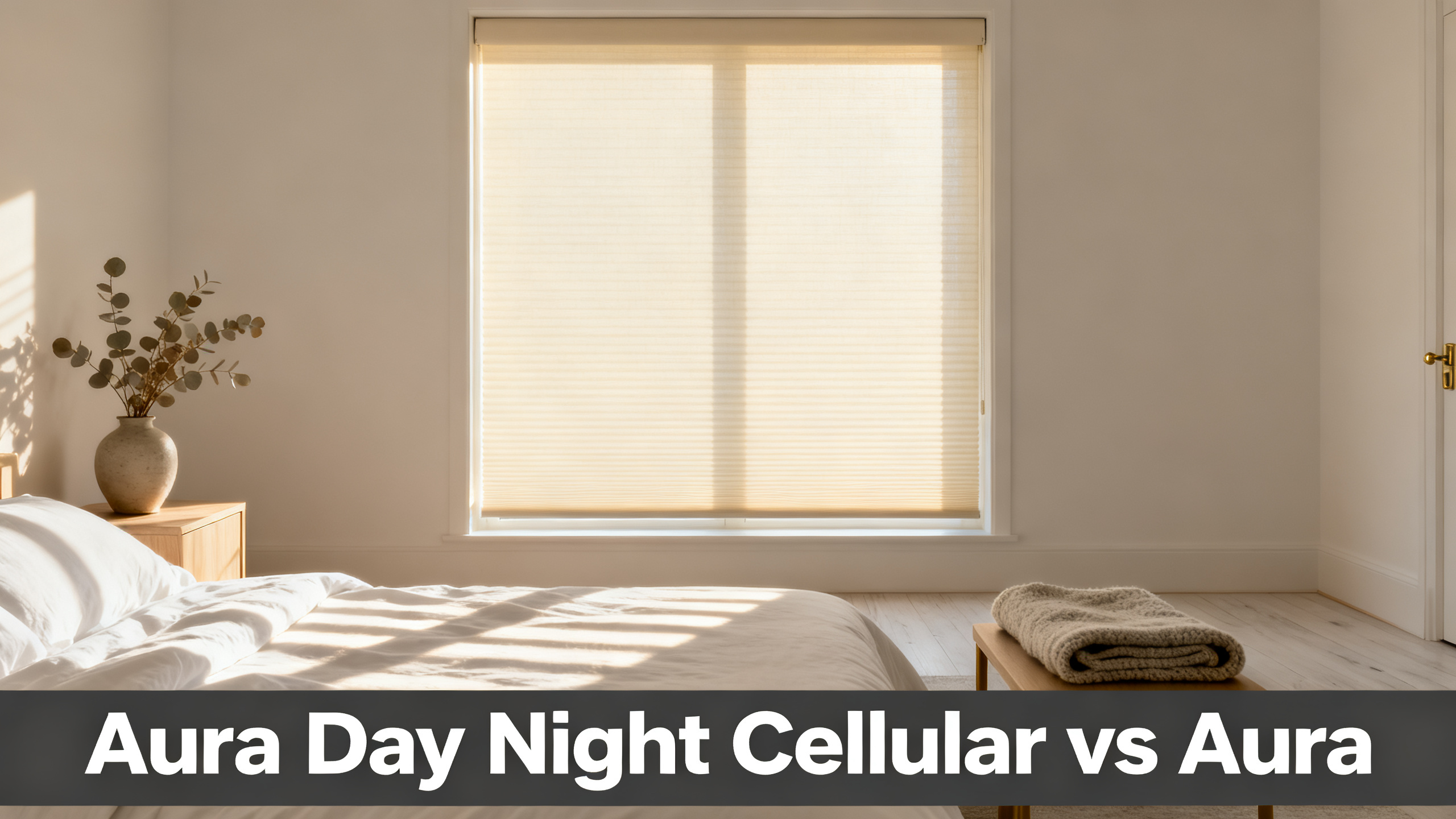
Same 225 gsm polyester honeycomb. Same seven HCB colorways. Same cordless lift. Same aluminum headrail at 2 3/16″ D × 1 3/8″ H. Then the configurator returns +$16/panel for the Day Night version and two completely different ways of thinking about how light enters your room.
That’s the tension this comparison untangles. The Aura collection at Two Pages built two cellular shades that look almost identical on the spec sheet, then solved two different problems with the engineering above the fabric. Aura Day Night Blackout Cellular Shades Cordless stacks a sheer layer behind the blackout layer on a single rail, so one pull gives you filtered daylight and another gives you full darkness. Aura Top Down Bottom Up Blackout Cellular Window Shades Cordless keeps one blackout fabric but splits the rail in two, so the top and bottom move independently and you can keep the bottom up for privacy while daylight enters from the top. Knowing which logic fits your room is the whole decision.

Two Pages · Aura Collection
Aura Day Night Blackout Cellular Shades Cordless
Dual-layer: sheer plus blackout on a single cordless rail. Switch from filtered daylight to full blackout in one motion.
from $118.99/panel · 225 gsm honeycomb · 7 colorways
Configure Day Night → Code JULY (20% off)
Final price depends on size & mount. Free shipping over $300.

Two Pages · Aura Collection
Aura Top Down Bottom Up Blackout Cellular Shades Cordless
Dual-rail: top and bottom move independently. Privacy from the bottom while daylight enters from the top.
from $102.99/panel · 225 gsm honeycomb · 7 colorways
Configure Top Down Bottom Up → Code JULY (20% off)
Final price depends on size & mount. Free shipping over $300.


Construction & Layer Logic: What Each Aura Actually Is
The Aura Day Night is built around two fabric panels stacked on the same cordless mechanism. The front layer is a sheer cellular fabric that filters daylight without giving up on privacy at a casual distance. The back layer is a high-density blackout honeycomb with an aluminum-coated interior that closes the room down to true darkness. Both are 225 gsm polyester, both share the same 1″ honeycomb pleat, and both ride on a single aluminum headrail. The user-facing trade-off is that you carry the weight of two fabrics on one lift, so the operating force is slightly higher than the single-fabric sibling.
The Aura Top Down Bottom Up is the single-fabric version of the same blackout honeycomb, mounted on a more sophisticated rail system. One rail sits at the top of the window, anchored to the headrail, and a second rail sits at the bottom of the shade itself. Both rails are cordless and move independently. You can lower the top while the bottom stays raised, which gives you daylight through the top half of the window with full privacy through the bottom half. According to the U.S. Department of Energy cellular shade insulation guidance, the honeycomb pleat traps an insulating air pocket whether you run one fabric or two, so the thermal performance per square inch covered is comparable.
Same fabric, same rail housing, same brackets. Not the same shade. If you are still mapping the broader category before picking an Aura variant, our complete cellular shades buying guide covers cell counts, R-values, and lift systems across the whole pillar. For this comparison, here is how the deltas score against each other.
Comparison Grid · 6 criteria
Light flexibility
Day Night ●●●●● · Top-Bottom ●●●○○
Edge: Day Night
Privacy with view
Day Night ●●○○○ · Top-Bottom ●●●●●
Edge: Top Down Bottom Up
Blackout depth
Day Night ●●●●● · Top-Bottom ●●●●●
Edge: Tie
Mechanism simplicity
Day Night ●●●●○ · Top-Bottom ●●●○○
Edge: Day Night
Price (lower is better)
Day Night $118.99 · Top-Bottom $102.99
Edge: Top Down Bottom Up
Child safety (cordless)
Day Night ●●●●● · Top-Bottom ●●●●●
Edge: Tie
Light Control Modes: Filtered Daylight vs View-With-Privacy
How Day Night’s Stacked Sheer-and-Blackout Works
The Day Night gives you three usable states. With both layers raised, the window is open. With the sheer layer pulled down and the blackout layer raised, you get diffuse daylight plus visual privacy from anyone closer than the sidewalk. With both layers fully down, you get true blackout, the kind of darkness that lets a 6am sun fail to reach the bed. The motion between states is one continuous pull on a single rail, so the daily handling is intuitive even half-awake.
What the Day Night does not give you is a view out. The sheer layer softens the light but obscures the outside; the blackout layer obviously closes it. If your priority is to look at the garden while keeping the lower half of the window private from the street, the Day Night is the wrong tool.
Day Night · Stacked Layer Diagram
Sheer down
Filtered daylight + privacy. Blackout layer stays raised.
Blackout down
100% darkness for sleep, naps, screens.
Both up
Open view, neither layer engaged.
How Top Down Bottom Up’s Two Independent Rails Work
The Top Down Bottom Up gives you a different three states. Bottom raised, top engaged at the top: you get daylight pouring in from the top half and full privacy from the street through the bottom half. Bottom lowered to the sill, top raised: you have a fully covered window. Top rail lowered halfway and bottom rail raised halfway: the shade frames a horizontal band of view across the middle of the window with everything else covered.
What this shade cannot do is filter the daylight. When the window is open above the rail, the light is unmediated; when the rail is closed against it, the light is gone. There is no in-between mood. It’s a coverage tool, not a diffusion tool.
Top Down Bottom Up · Dual-Rail Diagram
Top rail lowered
Daylight from the top, privacy from the bottom.
Bottom rail raised
View out + privacy from the upper window.
Rails meet
Full coverage, full blackout, normal cellular behavior.
Same Honeycomb, Different Logic
Both shades use the same 225 gsm blackout honeycomb at the moment of full coverage, which is why blackout depth scored as a tie on the comparison grid above. The differentiator is in what you can do short of full coverage. Day Night gives you a light quality option; Top Down Bottom Up gives you a window geometry option. Same problem class (you want flexibility before you reach for full closure), different answer.
Aura Day Night Blackout Cellular Shades, the full review
Want the standalone deep-dive on the dual-layer mechanism, owner-feedback patterns, and configurator pricing scenarios for Day Night before you decide?
Compare configurations side-by-side
Aura Day Night, configure your size
Dual-layer for filtered daylight plus blackout in one pull. from $118.99/panel.
Compare configurations side-by-side
Aura Top Down Bottom Up, configure your size
Dual-rail for privacy with view, plus full blackout when needed. from $102.99/panel.
Pricing by Configuration: Where the $16/Panel Delta Lands
Base Prices and What Drives Cost
The Aura Day Night opens at $118.99/panel and the Aura Top Down Bottom Up opens at $102.99/panel, both before promo code JULY (20% off sitewide). The $16/panel delta is the cost of the extra sheer fabric layer and the slightly more complex stacked lift. Configured size is the bigger price driver on either shade: width above 48″ and length above 60″ push both prices up by similar percentages, so the delta stays roughly proportional as the window grows.
Pricing by configuration · 3 window scenarios
Small bedroom (24″ W × 36″ L)
Day Night base $118.99 · projected $118-128
Top-Bottom base $102.99 · projected $102-112
Delta: ~$16
Standard bedroom (36″ W × 60″ L)
Day Night base · projected $145-160
Top-Bottom base · projected $128-142
Delta: ~$17-18
Picture window (60″ W × 60″ L)
Day Night base · projected $185-210
Top-Bottom base · projected $165-185
Delta: ~$20-25
Projected ranges, before promo. Configurator returns final price. Both products ship free above $300.
Three Window Scenarios With Configured Totals
For a single primary-bedroom window, the $16 delta is small enough that whichever logic you prefer is what you should buy. For a three-window bedroom suite, the gap becomes $48-54, which is real money but still landing on a single-room project, easily absorbed if the Day Night fits the room’s daily use pattern. For a six-window living and dining sweep, the gap stretches to roughly $100-150 against the same promo discount, and the question becomes whether you’ll actually use the sheer layer in every window or whether some of them would do just as well with a simpler shade. If neither dual-layer nor dual-rail logic moves you and you only need straight blackout for a single bedroom window, the entry-level Aura Blackout Cordless starts at from $88.99/panel with the same 225 gsm honeycomb fabric.
The price gap reads as small until you scale it to a 6-window project. Either way, the configurator returns the binding number, and code JULY compounds against both products equally.
Use Case Fit by Room: Bedroom, Bathroom, Nursery, Kitchen
Bedroom: Sleep Darkness Priority
Bedrooms reward simplicity. If the dominant question is “can I sleep until the alarm without 6am light through the gap above the rod,” the answer is the same shade either way at the moment you pull it all the way down. The Day Night’s sheer layer is an asset only if you spend daytime hours in the bedroom and want filtered light during reading or weekend mornings. For pure sleep-room duty, the Top Down Bottom Up does the job for $16 less per panel.
Aura Top Down Bottom Up Cellular, the full review
Bathroom, kitchen-over-sink, and street-facing-living scenarios pull this one ahead. The standalone review covers dual-rail mechanics and color drift across HCB-1 to HCB-7.
Bathroom and Kitchen-Over-Sink: Privacy With Daylight
This is the Top Down Bottom Up’s home turf. A street-facing bathroom needs privacy at sightline height and benefits from daylight above. The dual-rail lets you keep the bottom 36 inches covered and the top open to a tree canopy or skylight gradient. The same logic applies to a kitchen window over a sink that faces a neighbor’s driveway. The Day Night cannot do this; lowering its blackout layer covers the whole window, and the sheer layer obscures the view even when engaged. Bedroom-only buyers don’t need dual-layer flexibility. They need darkness. Bathroom buyers don’t need flexibility either, but the kind they need is geometric, not optical.
Nursery and Living Room: Mode Flexibility
Nurseries pull the Day Night ahead. A nap-time room needs darkness for the baby to settle, then filtered daylight for floor-time and bottle-time without forcing the parent to raise the shade entirely and lose the privacy from the street. The Day Night gives that with one cord-free pull. Living rooms with a similar dual mood profile (movie nights plus afternoon reading) also reward the dual-layer logic, especially in westerly exposures where the late-afternoon sun is too harsh for full openness but cutting it entirely kills the room. If small children share the room, this stops being a feature decision and becomes a hard requirement: both shades are cordless to meet the safety standard, and Day Night offers more daily flexibility without adding cord risk.
Use case fit matrix · 4 rooms
| Room | Day Night fit | Top-Bottom fit | Edge |
|---|---|---|---|
| Primary bedroom | Strong | Strong | Top-Bottom (price) |
| Bathroom street-facing | Weak | Strong | Top-Bottom |
| Nursery | Strong | Moderate | Day Night |
| Kitchen over sink | Weak | Strong | Top-Bottom |
| Living room (mixed use) | Strong | Moderate | Day Night |
Decision flowchart · Which Aura for your room?
1. Sleep darkness vs daytime mood?
Sleep only → continue to Q2. Both → Day Night likely wins, continue to Q3.
2. Need view-with-privacy at sightline?
Yes → Top Down Bottom Up. No → consider entry-level Aura Blackout Cordless instead.
3. Daytime use frequency in this room?
Daily (nursery, living) → Day Night. Occasional → reconsider Top-Bottom for budget.
4. How many windows in this project?
1-2 → pick by logic. 6+ → run the $16 × 6 math against your sheer-layer usage forecast.
Install, Lift Mechanism & Child Safety
Cordless Lift and the WCSC Standard
Both Aura variants are cordless, meeting the Window Covering Safety Council cordless lift standards for child safety recommendation against accessible operating cords. Functionally they’re equivalent on this dimension. The Day Night’s stacked-fabric lift carries slightly more fabric weight per pull but the cordless mechanism handles it without operator strain in standard window sizes. The Top Down Bottom Up has two rails to grasp, which young children may reach more readily once they can stand at the window. Neither presents a corded loop risk.
Mount Depth, Headrail, Bracket Compatibility
Mount depth is identical at a 2″ inside-mount minimum and 2 1/4″ minimum flush inside-mount. Headrail dimensions are 2 3/16″ D × 1 3/8″ H on both, aluminum alloy on both, with brackets 1″ H × 2 3/8″ D in matching housings. If you’re replacing one Aura variant with the other in the same window, the existing brackets carry across. Outside-mount install is available on both for windows with shallow frames or where you want light overlap at the sides.
Best Top Down Bottom Up Shades, the wider roundup
Want to benchmark Aura Top Down Bottom Up against roman and natural-fiber alternatives with the same dual-rail logic?
Daily Handling Notes
Daily operation differs. The Day Night runs in three discrete states, each reached by lifting or lowering one of two stacked fabrics on the single rail. Once you learn the muscle memory, the move is fast. The Top Down Bottom Up runs in continuous adjustments along two axes, which gives more granular control but more decisions per day. Households that want one habitual setting per time of day will gravitate toward Day Night; households that adjust window coverage as the sun moves will find the Top Down Bottom Up more satisfying.
Cordless child-safety comparison
Aura Day Night Cordless
Single cordless rail, no accessible loops. WCSC-compliant lift.
Aura Top Down Bottom Up Cordless
Two cordless rails, no accessible loops. WCSC-compliant lift.
Both products meet the Window Covering Safety Council cordless lift recommendation for homes with children and pets.
Lead Time, Returns, Care & Service
Production and Shipping Window
Both shades are made-to-order. Standard production and shipping runs 2 to 3 weeks from order confirmation, and free shipping kicks in above $300. Returns and exchanges follow the Two Pages custom-order policy: changes to size or color are accepted within the published window, but custom-cut fabric isn’t restocked, so swatch-first is the right move on any project larger than two windows.
Aura color range · 7 HCB colorways, identical on both
White
HCB-1
Light Blue
HCB-2
Light Gray
HCB-3
Slate Blue
HCB-4
Black
HCB-5
Light Taupe
HCB-6
Dark Brown
HCB-7
Color Matching Across the 7 HCB Range
The seven Aura colorways are identical between the two variants, with the suffix -DN on Day Night and -TB on Top Down Bottom Up. Color is not a differentiator in this decision. Light Taupe and Slate Blue read very differently between morning daylight and evening lamplight, so the swatch program is worth the small lead time, especially if the room mixes warm wood tones with cool wall paint.
Order Aura swatches
See the 7 Aura HCB colorways in your light before you commit
Light Taupe and Slate Blue read very differently between morning daylight and evening lamplight. Free swatch shipping on Aura cellular orders.
Frequently Asked Questions
What’s the actual difference between Aura Day Night and Top Down Bottom Up?
Day Night uses two stacked fabric layers (one sheer, one blackout) sliding on a single cordless rail, so you choose between filtered daylight or full blackout in one motion. Top Down Bottom Up uses one blackout fabric on two independent rails, so you can lower the top while keeping the bottom raised, or vice versa. Same 225 gsm honeycomb, same 7 colorways. Different light logics.
Is the Day Night worth the extra $16 per panel?
It depends on whether you’ll use the sheer layer routinely. Buyers who want filtered daylight in a living room or nursery during the day and full darkness for naps or movie nights get clear value. Bedroom-only buyers who pull the shade fully down at night and fully up in the morning rarely touch the sheer layer, and the $16 stops earning its keep at scale (six windows = $96 added for an unused mode).
Can either shade be installed in shallow window frames?
Both share the same minimum inside-mount depth of 2″. For shallower frames, both also support outside mount, which adds light overlap on the sides but requires drilling into the wall or trim above the window. Headrail dimensions are identical across both (2 3/16″ D × 1 3/8″ H), so bracket footprint won’t differ between them.
Which is safer for homes with children and pets?
Both are cordless and meet the Window Covering Safety Council’s recommendation against accessible operating cords. Functionally they’re equivalent on child safety. The only difference is mechanical: Top Down Bottom Up has two rails to handle, which children may reach more easily once they can stand and grab.
Do both shades come in all 7 Aura colorways?
Yes. White HCB-1, Light Blue HCB-2, Light Gray HCB-3, Slate Blue HCB-4, Black HCB-5, Light Taupe HCB-6, and Dark Brown HCB-7 are available on both Day Night (suffix -DN) and Top Down Bottom Up (suffix -TB). Color is not a differentiator; order swatches to compare in your specific light before committing.
How long does each take to ship?
Both are made-to-order custom cellular shades. Production and shipping window is the same across the Aura collection. Standard lead time is roughly 2 to 3 weeks from order confirmation. Promo code JULY (20% off sitewide) and free shipping above $300 apply to both products.
Final Verdict: Which Aura Wins for You
Neither shade is better. They answer different questions about how you want to live with the window. Pick Aura Day Night if your room asks for filtered daylight by day and full darkness by night, if you spend daytime hours in the room, or if the nursery or living-room mood deserves the dual-layer flexibility the $16/panel premium buys. Pick Aura Top Down Bottom Up if your room needs view-with-privacy at sightline (bathroom, kitchen over sink, street-facing living), if pure bedroom blackout is the brief, or if the project scales to six windows and the simpler-shade math wins. Same honeycomb, same colors, same lead time. Different answer.
Buy Day Night if · Daytime mood matters
Aura Day Night Blackout Cellular Cordless
from $118.99/panel · sheer + blackout dual-layer · code JULY (20% off) · free shipping over $300
Buy Top Down Bottom Up if · View-with-privacy matters
Aura Top Down Bottom Up Blackout Cellular Cordless
from $102.99/panel · dual-rail single-fabric · code JULY (20% off) · free shipping over $300
