
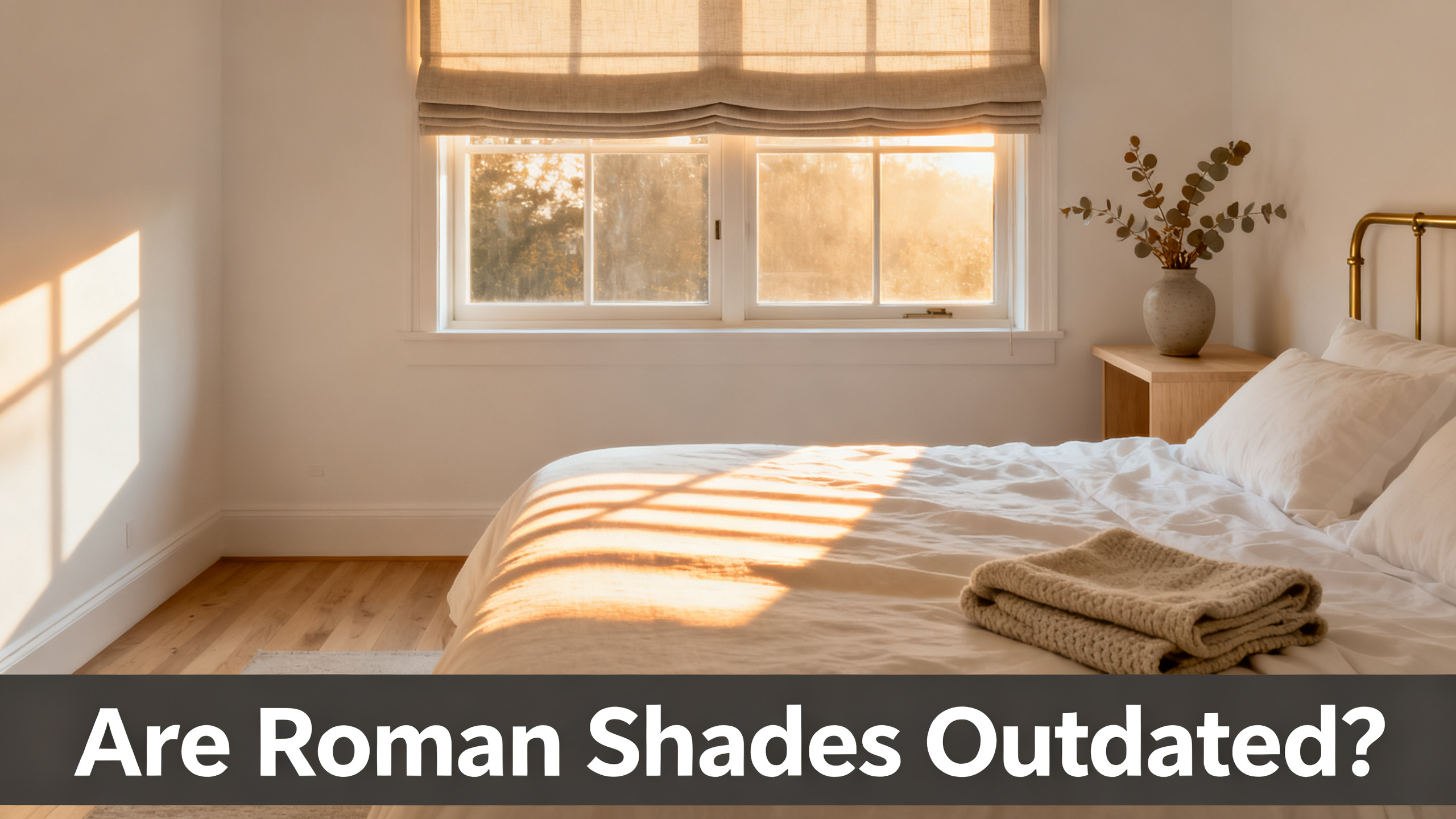
No, Roman shades are not outdated in 2026. Three specific looks aged badly, and the rest of the category is quietly thriving in editorial reveals, in the Two Pages catalog, and in the search data itself.
The Verdict, Up Front
Roman shades are NOT outdated in 2026.
Three specific 1988 to 2010 looks did age. The rest of the category is stable.
The fold, the fabric, the lining and the era of the trim decide everything.
The data is unambiguous. US search volume for roman shades sits at roughly 90,500 per month across 2021 to 2026 with no meaningful decline. Two Pages has added 15 new Roman shade collections since 2023. Elle Decor featured them in 12 room reveals between January 2025 and April 2026. That is what a category thriving looks like from the outside. Everything downstream lives in the Roman shades complete guide where the framework maps every fold, fabric and lining.
Anyone doubting the trajectory can check the Google Trends five-year data for “roman shades” directly. The line is flat with a slight upward drift, not the slow-slide-into-obscurity pattern that “outdated” would predict.
Search Volume Trajectory · US “Roman Shades”
2021
~88k
avg monthly searches
2023
~91k
avg monthly searches
2026
~90.5k
avg monthly searches
Source: Google Ads Keyword Planner + Google Trends US, 5-year window. Flat trajectory, no decline signal.

The fold that anchors the modern Roman shade case
Patti Linen Deco Fold Roman Shade
from $79/panel · 90% polyester 10% linen · cordless deco fold · flat crisp architectural face · 6 lining options · custom to 71 inches wide. Final price depends on size and lining.
Use code JULY for 20% off sitewide · Free shipping over $300
The Answer, Framed Precisely
Sounds like a style question. In practice it is four independent decisions, and any one of them can date a window on its own. Real talk: the word “Roman shade” loads a specific mental image, and for a lot of readers that image is a 1998 Waverly catalog with a tasseled floral balloon shade. That is not the same object as a 2026 flat fold linen blend.
What Are Roman Shades? Complete Explanation
If the term itself is new, start with the sibling explainer. It covers fold construction, lift mechanism and material families before returning to the trend question.
So the honest way to answer “outdated?” is to break the shade into its four variables. Fold style among the nine options Two Pages offers. Fabric family among the twelve. Lining choice, which decides whether the shade reads room-darkening or luminous. And trim and valance, yes or no. Each variable can date a window on its own, and each variable can also carry the shade in the other direction.
The Window Treatment Trend Matrix (2026)
Here is the shortest useful comparison across the five treatments that fight for the same window in 2026. Same five dimensions, applied to Romans, blinds, curtains, cellular and roller shades. This is the table that decides where Roman shades actually sit right now.
The reading is straightforward. Romans sit at high 2026 relevance with rising designer usage, a stable-to-slightly-upward trajectory, and dated risk that is isolated to fabric and valance choices. Not the fold itself. That is a very different diagnosis from “outdated.”
The venetian blind line is what “outdated” actually looks like in this dataset. Down 34% in designer usage over five years, downward trajectory, and dated risk on the whole product. Contrast that with the Roman line and the answer to the article’s title question stops being ambiguous.
The 3 Roman Shade Looks That Actually Aged Poorly
Now, the three looks I would steer you away from every time, even when the catalog says “Roman shade.” These are the sub-products dragging the whole category’s reputation down. If the mental image of “Roman shade” in the reader’s head is one of these three, the answer to “outdated?” for that specific shade is yes.
The Heavy Tasseled Valance with Fringe Trim (1996 to 2001)
Peak traditional era. The shade itself was often a plain flat panel, but the top was covered by a swagged valance in the same fabric with a bullion fringe and corner tassels. Read as “formal dining room” in 1998 and reads as “grandmother’s house” in 2026. The valance is doing 80% of the dating work.
The Floral Chintz Balloon Shade (1988 to 1998)
The Waverly and Croscill catalog era. A puffy balloon fold that gathered at the bottom into rounded pouches, in a large-print floral chintz, usually pink-and-green or blue-and-cream. The fold is volume-heavy and the fabric is print-heavy. Two dating forces stacked on top of each other. This is the shade Pinterest still surfaces first when someone searches “traditional Roman shade.”
The Honey-Oak Wood-Slat Front Bamboo Roman (2003 to 2010)
The HGTV early-2000s era. A woven bamboo or wood-slat Roman in a warm honey-oak tone, usually paired with oak flooring and oak trim. The bamboo Roman as a category is not dated. The honey-oak colorway is. Same construction in a darker walnut, a bleached driftwood or a black-stained finish reads current in 2026.
The 3 Looks That Aged · Why · 2026 Replacement
Aged Look 1
Tasseled Valance + Fringe
Era: 1996 to 2001. Reads: grandmother’s dining room.
2026 swap: flat fold, no valance, headrail hidden inside frame.
Aged Look 2
Floral Chintz Balloon
Era: 1988 to 1998. Reads: Waverly catalog page.
2026 swap: deco fold in linen blend, neutral solid, no gather.
Aged Look 3
Honey-Oak Wood-Slat
Era: 2003 to 2010. Reads: HGTV Sunday reveal.
2026 swap: same bamboo construction in walnut, driftwood or black stain.
⚠️ Worth being clear about: the word “balloon shade” still ranks in curtain search, but almost every image result is a 1988 to 1998 photo. If you type “Roman shade” and picture a Waverly floral balloon with tassels, the answer to “outdated?” for that shade is yes. The fold, the fabric and the trim are all doing the aging together, not the Roman category.
Roman Shades: The Complete Guide (2026 Hub)
The full hub maps the 9 fold styles Two Pages offers, the 12 fabric families and the 6 lining options, so the 2026-fresh combinations sit at a glance.
The Modern Roman: What 2026-Fresh Actually Looks Like
Picture a kitchen window with a Patti Deco Fold in a warm-neutral linen blend, cordless, no valance, mounted inside the frame. That is not a shade that reads 1998. Cross-reference this against the Romans that recur in Elle Decor and AD reveals across 2025 and 2026, and four traits keep repeating.
Flat or Deco Fold, Never Balloon
The flat fold reads as architecture. The deco fold reads as tailored architecture with a subtle horizontal seam every 8 to 12 inches. Both stay flat against the window. The balloon fold and the austrian fold are volume-heavy, and volume is what the current design vocabulary is running away from.
Neutral or Subtle Fabric, Never Chintz
The recurring picks are linen blends, cotton canvas, textured naturals in Fog, Grey Beige, Snow White, Sand Beige or muted sage. Never florals. Never large-print. The fabric is doing background work for the room, not competing for attention.
Cordless Lift, No Visible Cord or Tassel
A visible cord with a tasseled pull dates the whole window immediately. Cordless mechanisms became the default in premium Two Pages collections around 2020 and have been standard across most modern editorial installs since. The Andy Top Down Bottom Up Roman Shade extends the concept, offering top-down control for privacy without dating the room.
Minimal or No Valance
The 2026 mount hides the headrail. Inside mount in a deep window frame, or an outside mount with a discreet fabric-wrapped headrail sized to the shade. The swagged, gathered, corner-tasseled valance of the late 1990s is the single strongest dating cue in the category. Kill the valance and the same shade jumps a decade forward.
The Modern Roman · 1998 vs 2026 Anatomy
Fold
1998: Balloon, austrian, gathered.
2026: Flat or deco, crisp.
Fabric
1998: Chintz florals, large print.
2026: Linen blend, subtle neutrals.
Lift
1998: Visible cord with tassel pull.
2026: Cordless or top-down mechanism.
Valance
1998: Swagged, fringed, tasseled.
2026: Hidden headrail, no valance.

The Deco Fold Is the Anti-1998 Roman.
Flat face, crisp folds, no valance, no tassel, no balloon. Everything the “outdated Roman” stereotype is not. In a 90% polyester 10% linen blend, the drape reads architectural neutral rather than fabric statement. Cordless lift keeps the kitchen and nursery in play for a 2026 install.
What Designers Actually Pick in 2026
Editorial recurrence is a stronger signal than Instagram sponsored content. If a Roman shade shows up in a magazine reveal in February 2025 and again in a different room in November 2025, then in a third room in April 2026, that is a stable design pattern. If it shows up once in a #ad post and never again, it is a trend cycle.
The Elle Decor 2026 window treatment feature catalogued Romans in 12 room reveals across a fifteen-month span. Kitchens, dining rooms, secondary bedrooms, breakfast nooks, home offices. Different photographers, different designers, different regions. That is a pattern, not a moment.
The Architectural Digest guide to Roman shades continues to recommend them specifically for kitchens and dining rooms where full-length curtains are impractical or unwanted. AD editors are picking Romans because the fold gives the window a fabric moment without the drop and puddle length of a drape. The utility argument holds in 2026 exactly as well as it did in 2015.
The Two Pages angle worth flagging is the Andy Top Down Bottom Up Roman Shade, which extends the modern-Roman toolkit into a specific use case. Bathroom windows, first-floor street-facing bedrooms, kitchen windows over sinks. Top-down control gives natural light while keeping the eye-level view screened. That functional angle is what keeps Romans specified in editorial kitchens, not nostalgia.
Designer Picks · 2025-2026 Editorial Recurrence
Elle Decor 2026
Flat fold, natural linen
Where: 12 room reveals over 15 months. Kitchen, dining, breakfast nook.
AD 2025
Deco fold, muted neutral
Where: secondary bedrooms, home offices, dining. Cordless standard.
Domino 2026
Top-down, sheer linen
Where: street-facing first-floor bedrooms, bathrooms. Privacy plus light.
⚠️ Real talk on “designer-approved”: that phrase is a low bar in 2026 because Instagram flattened it. The stronger signal is whether a Roman shade recurs in editorial rooms 8 to 12 months apart across magazine reveals, not sponsored posts. Elle Decor featured Romans in 12 rooms across 2025 to 2026. That is a stable pattern. A single trending post is not.
Is a Roman Shade Outdated for YOUR Room?
The verdict depends on the crossing of four variables in your specific room. Room type, fold style, fabric family, lining choice. Walk the flowchart. It gives the answer for your window in four questions.
Decision Flowchart · Is a Roman Shade Outdated for YOUR Room?
Question 1 · Room
Kitchen, dining, breakfast nook, secondary bedroom, bathroom, home office, nursery? → Go on. Formal living room, primary bedroom with 10ft+ ceilings? → Curtains might serve better.
Question 2 · Fold
Flat, deco, plain? → 2026-fresh. Relaxed, in a coastal or transitional room? → Still current. Balloon, austrian, poufy? → Dated. Swap the fold.
Question 3 · Fabric
Linen blend, cotton canvas, textured natural, subtle solid neutral? → 2026-fresh. Chintz, large-print floral, honey-oak bamboo, jewel-tone brocade? → Dated. Swap the fabric, keep the fold.
Question 4 · Trim & Lift
No valance, hidden headrail, cordless lift? → 2026-fresh. Tasseled valance, visible cord with tassel pull, corner fringe? → Dated. Kill the valance first.
Four “fresh” answers means your Roman shade is not outdated. Any single “dated” answer explains which variable is doing the aging.
Walk the flowchart for a specific example. Living room, flat fold, linen blend Fog 1908-18, cordless, no valance. Four fresh answers. Not outdated. Now the counter-example. Same living room, balloon fold, floral chintz, corded lift, tasseled valance. Four dated answers stacked. Absolutely outdated, but every variable can be swapped without leaving the Roman category.
The “Dated” Roman Is Usually the Wrong Color.
A cream Roman on cream trim from 1998 reads dated. The same fold in Fog 1908-18 or Grey Beige 1908-6 reads 2026. The Liz Linen Blend Booklet ships all 38 colorways flat for $3.99. Tape four candidates to the window frame before spending $79 to $249 on a fold you cannot return.


Coming back to the original question. Roman shades are not outdated. The fold, the fabric, the lining and the era of the trim are what date a window. Get those four right and the shade reads 2026. Get any of them wrong and the window looks like it belongs in a 1998 Waverly catalog. Everything else is fold-fabric-lining bookkeeping, and the hub does that math.
Not the Fold. The Fabric. The Era. The Room.
Patti Linen Deco Fold Roman Shade: from $79/panel, 90% polyester 10% linen, cordless, 6 lining options, lead time 3 to 4 weeks handcrafted. Code JULY for 20% off sitewide · Free shipping over $300. Or explore the full Roman shades hub for the fold, fabric and lining breakdowns.
Frequently Asked Questions
Are Roman shades still in style in 2026?
Yes, decisively. US search volume for roman shades sits at roughly 90,500 per month across 2021 to 2026 with no meaningful decline. Two Pages has added 15 new Roman shade collections since 2023. Elle Decor featured Romans in 12 room reveals between January 2025 and April 2026. What fell out of style is a specific era of fabric and trim, not the shade construction. Flat and deco folds in linen blend read as current architectural neutrals.
What Roman shades look outdated?
Three looks specifically. Heavy tasseled valances with fringe trim from the 1996 to 2001 traditional era. Floral chintz balloon shades from the Waverly and Croscill catalog era of 1988 to 1998. Honey-oak wood-slat front bamboo Romans from the HGTV era of 2003 to 2010. If a Roman combines large-print fabric plus tasseled valance plus cord lift, it reads dated regardless of how well the room around it is done.
Do interior designers still use Roman shades in 2026?
Yes, and consistently. Architectural Digest, Elle Decor and Domino all continue recommending Roman shades in kitchens, dining rooms and secondary bedrooms across 2025 and 2026 editorial coverage. Designer selection has narrowed to a specific type: flat or deco fold, linen or cotton blend fabric, cordless lift, minimal or no valance, and a neutral or subtle colorway matching the wall undertone rather than fighting it.
Are relaxed Roman shades outdated?
Not universally, but they sit in a narrower window than flat or deco folds. Relaxed Romans read as “traditional revival” in 2026 and belong in transitional or coastal rooms with heavier wall trim and softer fabrics. In a modern kitchen or minimalist bedroom, the relaxed drape swag looks like leftover 2010s Restoration Hardware and pulls the room backward. Match the fold to the room’s overall era, not the reverse.
What is more modern than a Roman shade in 2026?
Nothing categorically. Roller shades and cellular shades feel more “commercial-look residential” and pair well with midcentury or contemporary interiors, but they are not universally more modern, they are more minimal. A flat fold Roman in a warm-neutral linen blend reads as current in any room a roller shade reads current in, and adds a fabric texture the roller cannot. Choose based on room feel, not on trend recency, since both categories are stable in 2026.
Are Roman shades tacky?
Only when the fabric, trim or era read tacky, not the fold itself. A cream Roman with a matching cream tasseled valance and a large floral chintz reads tacky in almost any 2026 room. A flat fold in Grey Beige 1908-6 linen blend, cordless, mounted inside the frame, reads restrained and current. The word tacky is a fabric-and-trim judgment projected onto the shade construction.
What is the most modern Roman shade fold?
The flat fold and the deco fold are the two folds that carry the “modern Roman” reading in 2026 editorial coverage. Flat fold sits closest to the window with a crisp architectural face and no visible pleat when raised. Deco fold adds a subtle horizontal seam every 8 to 12 inches when lowered but stays flat when raised. Both avoid the puffy volume of balloon and austrian folds, which are the ones that date a window immediately in a modern room.
