
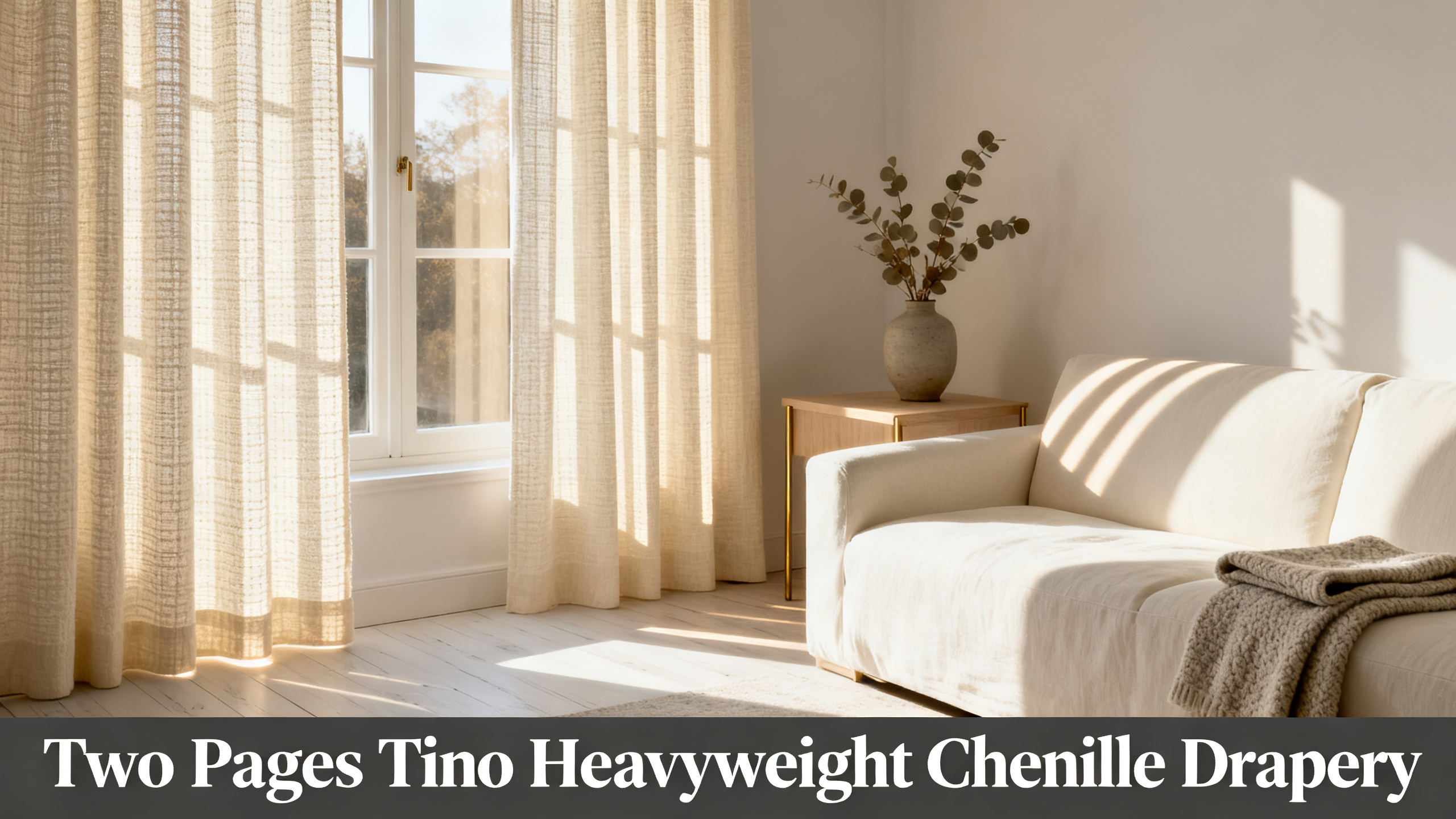
Every meaningful judgment on the Tino Soft Top traces back to the spec sheet. The fabric weighs 430 gsm, putting it firmly in the heavyweight band, and the composition reads 97% Polyester with 3% Viscose Chenille. That ratio is the entire reason this fabric drapes the way it does.
Polyester at this density gives dimensional stability across long drops and resists creasing through the rod-pocket gather. The viscose chenille component adds the pile surface that catches light differently than a flat poly, which is why owners consistently describe the finish as velvety rather than synthetic. The Soft Top header (Two Pages’ name for a 4-in-1 rod-pocket channel) is what changes between this product page and the Pleated version of the same fabric.
This review breaks down the specs, the way the rod-pocket header reads at the window, the 18 available colors, every realistic price point from the configurator, and how this Soft Top compares with the Pleated header on the identical chenille base. Tino sits inside the broader cotton drapery collections at Two Pages, though its chenille construction puts it in a slightly different lane than the woven cotton families.
Two Pages Tino Heavyweight Chenille: Soft Top
From $109/panel. 18 colors, 6 sizes, made to order in 10-12 business days. Use code JULY for 20% off sitewide. Final price depends on size and lining.
Quick Verdict
The Tino Soft Top is the casual sibling of the Pleated version. Same 430 gsm chenille, same 97% Polyester / 3% Viscose composition, and the same 18 colorways, but mounted through a rod-pocket header that gathers softer at the top rather than holding a structured pinch pleat.
Where it wins: rooms styled with visible decorative rods, renters who do not want hook-and-ring hardware, and any buyer who prefers the way a soft gather reads at the top of the window. Where it asks for caution: buyers who need true blackout still need to upgrade the lining at checkout, and ceiling-mount tracks or tab-top hardware will not pair with a rod-pocket channel.
Quick Verdict : Tino Heavyweight Chenille Soft Top
Quality
Weight
Control
Range
for Price
Overall: 4.4 / 5. Soft blackout chenille in a casual rod-pocket header. Add lining for full light control.
Material and Weight Specs
The 430 gsm Chenille Composition
The Tino fabric is built around 97% Polyester and 3% Viscose Chenille. The polyester base does the structural work, holding the panel flat across long drops and resisting the kind of creasing that shows up on lighter blends after a season on the rod. The viscose chenille is what your eye reads first.
At 430 gsm, Tino sits in the upper band of the Two Pages weight catalog. For reference, anything below 200 gsm behaves as a sheer or semi-sheer, the 300 to 380 gsm range covers the standard heavyweights, and Tino’s 430 gsm band is where gravity alone keeps the fabric falling in vertical columns rather than ripples.
The chenille pile adds a second performance layer. Because pile scatters incoming light rather than reflecting it like a glazed weave, the unlined panel already delivers a visible glare reduction without darkening the room completely. No surface coating is listed on the spec sheet, which is consistent with the soft blackout positioning.
Fabric Width and Soft Top Geometry
The Tino fabric is woven at 109 inches wide before the header is sewn. That generous bolt width means the Soft Top channel can gather generously without the panel reading thin, even at the wider 100 inch finished width.
The Soft Top header itself is what Two Pages calls a 4-in-1 multi-style channel. In practice it functions as a rod pocket: the channel slides directly onto a curtain rod up to roughly 2 inches in diameter, with no hooks, rings, or clips required. The bottom hem is finished at 1.5 inches, and Two Pages quotes a tolerance of about 1 inch on the finished length given the handcraft cutting and sewing process.
Two finished-width options are listed in the configurator: 52 inches for a standard single panel and 100 inches for a wide single panel. The 100-inch width is the one to pick when you want a single panel sweeping a sliding door rather than a stacked pair on a narrower rod.
📏 Pro Tip: The 4-in-1 Soft Top channel accepts rods up to roughly 2 inches in diameter. If your existing decorative rod is thicker, or if you are mounting to a ceiling track, the Pleated header version of the same Tino fabric is the safer call.
Same Fabric, Different Header
Tino Heavyweight Chenille Drapery Pleated Review
Considering the structured pinch pleat version instead of the rod pocket? The Pleated review covers identical specs in a hook-and-ring header that reads more formal at the window.
Drape, Light, and Texture
How the Soft Top Header Reads at the Window
A rod-pocket gather is a fundamentally different shape than a fixed pinch pleat. The fabric crowds onto the rod and forms soft, irregular vertical folds that move when the rod is touched. With a 430 gsm fabric, that movement is calm and weighted rather than fluttery, which is the whole appeal of running a heavyweight chenille in this header style.
Owner-shared photos consistently show the Soft Top reading more relaxed than the Pleated, especially in casual living rooms and bedrooms. The gather depth is not adjustable after manufacture, so the visual rhythm is set by the finished width you select rather than tuned at install.
One real consequence of the rod-pocket geometry: the panel does not glide on rings. Daily open-and-close pulls the fabric across the rod itself, so a smooth rod finish matters more than it would with a hook-and-ring system. Wooden rods with a clear coat or powder-coated metal both work well in the user feedback.
Lining Options and Real Blackout
The fabric alone is a soft blackout. That is the spec, that is the marketing, and the owner reports confirm it: dense chenille kills glare and dramatically reduces incoming light, but it does not produce a media-room dark in direct sun.
For full room-darkening the only reliable path is the Premium Blackout 99% lining added at checkout. Reviewers using this lining on the Tino consistently describe the result as fully effective for nurseries and bedrooms. The Blackout 85% sits between, blocking enough for most sleep purposes while keeping the panel slightly more breathable.
One quiet detail: lining a rod-pocket panel adds bulk in the gather. With Tino at 430 gsm plus a blackout lining, the channel becomes notably thicker than the unlined version, so check that your decorative rod still threads cleanly before committing the size.
Lining Options for Tino Soft Top
Unlined
Soft blackout from the chenille pile alone. Lets some light through edges in direct sun.
Best for: Living rooms, dining, casual spaces.
Privacy
Adds silhouette opacity without significant light-block upgrade.
Best for: Street-facing windows, ground floor.
Thermal
Insulating layer that helps with drafty windows and reduces summer heat gain.
Best for: Older homes, single-pane glass.
Blackout 85%
Strong light reduction without the full blackout weight penalty.
Best for: Bedrooms with east windows.
Premium Blackout 99%
The full media-room option. Adds bulk in the rod pocket.
Best for: Nurseries, master bedrooms.
Interlined
Adds an inner flannel layer for the most luxurious drape and weight.
Best for: High-end residential, hotel-grade install.
Color Range and Mounting Options
Tino Soft Top is offered in 18 colorways, one more than the Pleated catalog (the additional Silver Birch 2034-35 appears in the Soft Top configurator only). The palette spans neutrals through saturated jewel tones, with the warm whites and the cream registering strong on owner shots, and the deeper Evergreen and Espresso reading dramatic in north-facing rooms.
Color counts on dye lots, which Two Pages flags directly on the product page. The practical implication: if you are ordering panels for multiple windows that need to match exactly, place the order as a single transaction so the entire run is cut from one bolt. Splitting orders weeks apart risks a visible shift in saturation.
Color Selection : Tino Soft Top (6 of 18 shown)


Order a swatch before committing to confirm how each shade reads in your specific light.
On the hardware side, the Soft Top header is the casual rod-pocket finish. If you want to mount to a ceiling track, run S-fold tape, or use ripplefold hardware, this header will not adapt. Those installations require the Pleated header variant of the same Tino fabric instead.
430 gsm chenille in a rod-pocket header, 18 colors, made to your dimensions. Tino Soft Top ships in 10-12 business days.
Pricing by Configuration
Pricing on the Tino Soft Top tracks the standard Two Pages configurator: a base price per panel that scales up with width, drop, and lining choice. Cart simulation gives a clear ladder. The smallest standard configuration starts at from $109 per panel for the 52 inches wide by 84 inches drop unlined Soft Top.
Adding length pushes the price up gradually. The same 52 inch width at 96 inches drop moves to from $125/panel, and the 108 inch drop reaches from $145/panel. These are still the narrower standalone panels, suitable for typical bedroom or den windows that take a stacked pair.
Doubling the finished width is the bigger price jump. The 100 inch wide unlined panel at the standard 96 inch drop runs from $225/panel, which is the configuration most owners select when covering sliding doors with a single panel per side.
Tino Soft Top : Pricing by Configuration
52″W x 84″L unlined
from $109
Smallest standard config. Bedroom side window.
52″W x 96″L unlined
from $125
Standard living room single panel.
52″W x 108″L unlined
from $145
Tall ceilings, full-length drop.
100″W x 84″L unlined
from $195
Wide single panel for sliders, short drop.
100″W x 96″L unlined
from $225
Most-ordered Soft Top configuration.
100″W x 96″L + blackout 99%
from $275
Full media-room dark. Bulkier rod pocket.
All prices from the live configurator. Apply code JULY for 20% off sitewide.
The lining decision is the single biggest swing on a same-size panel. Adding the Premium Blackout 99% to the 100 inch wide by 96 inch drop pushes pricing from $225 to $275 per panel, a $50 jump that buys the full media-room performance. Cart simulation confirms the lining surcharge is consistent across widths.
Pros and Cons
Stepping back from the spec sheet, the Tino Soft Top has a clear personality. Here is how the strengths and limitations stack up based on owner feedback and configurator data.
✓ Strengths
- 430 gsm heavyweight drape with no flutter, even on tall windows.
- Velvety chenille pile reads warm in natural light.
- 18 colors, the broadest in the Tino family.
- Soft blackout from the fabric alone, no coating required.
- Casual rod-pocket header pairs cleanly with decorative rods.
- Made to order with a fair 10-12 day lead time.
⚠ Trade-offs
- Not a true blackout without the lining upgrade at checkout.
- Rod-pocket channel caps rod diameter at roughly 2 inches.
- Daily pulling drags fabric across the rod, so smooth rod finish matters.
- Dye lot variation means matched orders must ship together.
- Polyester-dominant chenille is dry-clean recommended.
- Made-to-order panels are non-returnable once produced.
Same Header, Woven Cotton
Isabella Heavyweight Cotton Drapery Soft Top Review
Want a structured cotton-blend weave at a similar heavyweight tier with the same casual rod-pocket header? The Isabella Soft Top is the direct alternative when texture is the deciding factor.
Is the Tino Soft Top Right for Your Room?
The Tino Soft Top is the right call when three things line up. You want a casual, rod-pocket gather rather than a structured pleat. You want the tactile pile of chenille rather than the flat finish of a woven blend. And you are willing to commit the lining upgrade to get full blackout where the room demands it.
The room types where this fabric and header combination performs best: casual living rooms with visible decorative rods, bedrooms styled around natural materials, and rental units where hook-and-ring hardware is impractical. The deeper colors (Evergreen, Forest Green, Espresso, Chocolate) work particularly well in north-facing rooms where the chenille texture helps the depth read warmer.
Where to skip Tino Soft Top: media rooms requiring 100% blackout from the fabric alone, ceiling-mount installations that need hooks or S-fold tape, and any space where you want a crisply tailored, formal look at the top of the panel. For those, the Pleated header variant or a different fabric family will fit better.
Frequently Asked Questions
What does Soft Top mean on the Tino Heavyweight Chenille?
Soft Top is the Two Pages name for a rod-pocket header style. The top of the panel forms a 4-in-1 multi-style channel that slides directly onto a curtain rod with no hooks, rings, or clips required. It pairs well with decorative rods and reads as more casual than a pinch pleat.
Is the Soft Top Tino a true blackout curtain?
No. At 430 gsm, the chenille weave delivers what Two Pages calls soft blackout. The dense pile reduces incoming light significantly but does not eliminate it. Owner feedback consistently recommends adding the Premium Blackout 99% lining for full room-darkening.
How does the Soft Top differ from the Pleated version of Tino?
Same fabric, same 430 gsm, same colorways at the chenille base. The Soft Top uses a rod-pocket header and gives a softer, more casual gather. The Pleated version uses a fixed pinch pleat geometry with a hook-and-ring mounting and reads more formal and tailored at the window.
What rod diameter does the Soft Top channel fit?
Two Pages Soft Top channels are sized to accept standard decorative curtain rods up to approximately 2 inches in diameter. For thicker rods or for ceiling-mount tracks with hooks, the Pleated header is the recommended alternative.
Can I add thermal or blackout lining to the Tino Soft Top?
Yes. The standard Two Pages lining menu applies: Unlined, Privacy, Thermal, Blackout 85%, Premium Blackout 99%, and Interlined. Cart simulation shows the 100 inch wide by 96 inch drop Soft Top with Premium Blackout 99% lining prices from $275 per panel.
How should I care for the chenille pile on Soft Top panels?
Specs confirm the fabric is 97% Polyester, 3% Viscose Chenille. Dry-clean is the safer route for polyester-dominant chenille, since machine agitation can flatten the pile. Spot cleaning with a damp microfiber cloth handles routine dust and surface marks without disturbing texture.
Not sure how Silver Birch or Evergreen will read in your specific light? Order a fabric swatch before committing to full panels.
Which Version to Buy
This fabric is sold in 2 versions built on the same base cloth. What separates them is how the top is finished and how the panel operates.
The weave is constant here. What separates the options is the way each one hangs and how you open it.
| Heading | Owners | Best for |
|---|---|---|
| Soft top (this page) | n/a | The cheapest way into this fabric |
| Pleated | 4.4 / 5 (1) | A tailored fall that keeps its folds |
Owner ratings are the brand product page aggregates at the time of writing.
Final Verdict
Across material, drape, color depth, and configurator pricing, the Tino Heavyweight Chenille Drapery Soft Top is the casual-rod-pocket counterpart to a fabric that already delivers above its price band. The 430 gsm chenille gives the panel its quiet, weighted fall, the rod-pocket header adapts it to a wider range of decorative hardware, and the 18-color palette covers neutrals through deep saturated tones. The fabric is a soft blackout, not a true one, so the lining decision at checkout is the single most important call you make, and once that is committed the panels consistently meet owner expectations at the $109 to $275 per panel range.
Two Pages Tino : Heavyweight Chenille Soft Top
From $109/panel. Apply code JULY at checkout for 20% off your entire order. Free shipping over $300.
