
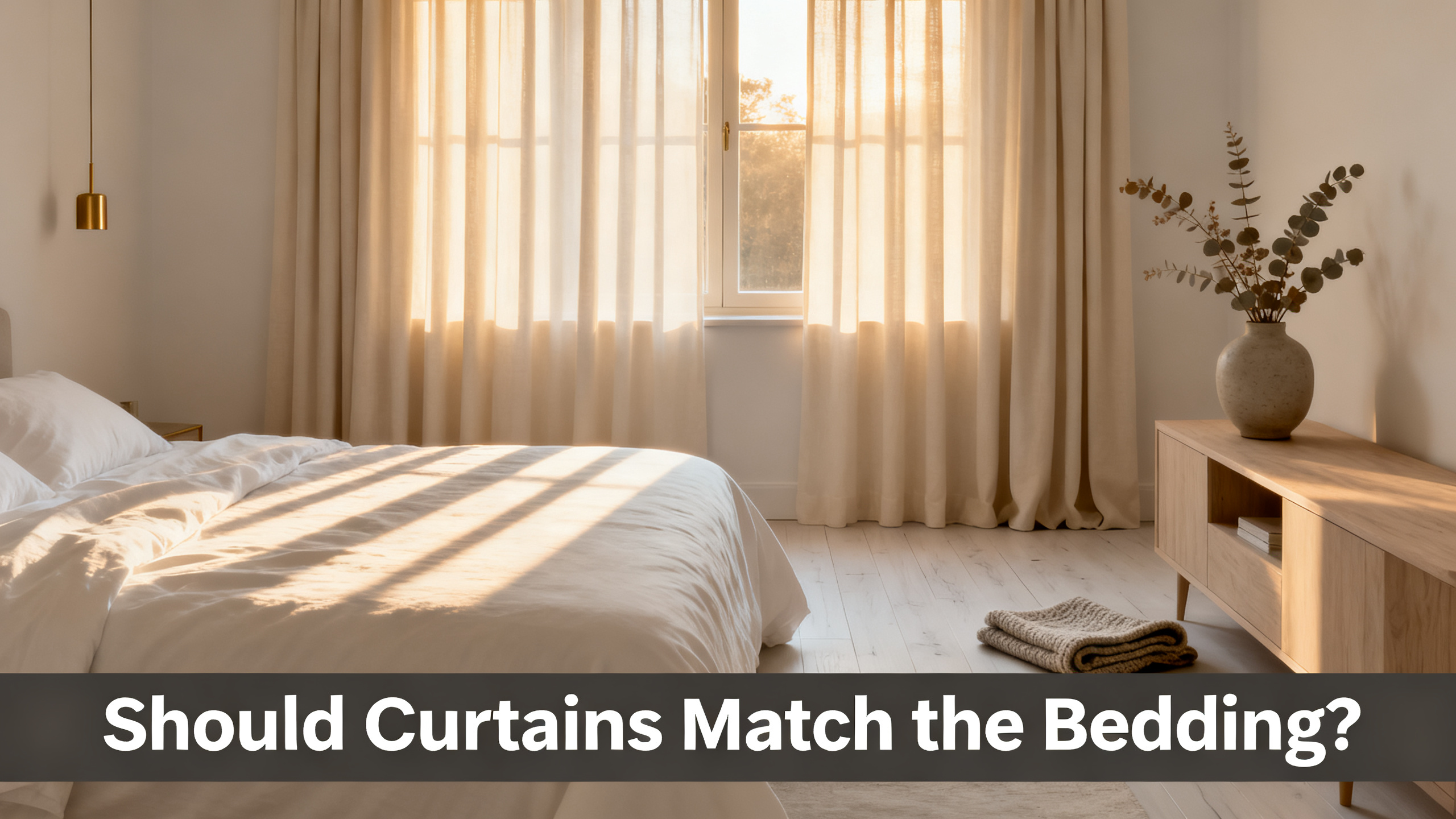
The Whole Answer, in Three Lanes
Lane 1
🎯 Match
Curtain = same color as the duvet cover.
When it works: monochromatic percale white on Snow White 1908-0 curtains, nothing else reliably.
Lane 2
🪟 Coordinate
Curtain = same undertone family, one to two values lighter.
When it works: 8 bedrooms out of 10. The safe designer default.
Lane 3
🔥 Contrast
Curtain = complementary or saturated statement.
When it works: designer rooms with velvet, a canopy, or a bold headboard already anchoring.
That triad above is the whole answer to the question in the title. Curtains do not have to match the bedding, and in most bedrooms the literal match is the mistake that reads brittle under bedside lamplight. Coordinate is the answer 8 times out of 10. Which of the three lanes you land in depends on 10 sub-questions this guide walks in order.
The framing that resolves the whole thing early is this: in a bedroom, the bed is the visual anchor, the walls are the backdrop, and the curtains are the frame. Match the frame to the anchor. Let the backdrop breathe. Everything downstream, from duvet undertone to bedside light temperature, lives inside the full curtain color pairing hub where the same framework scales to walls, couches and carpets.

The panel this bedding-coordination guide is built around
Liz Linen Drape Pleated
from $59/panel · 350 gsm linen blend · 38 colorways, 8 read cleanly against any bedding scheme · 9 header styles · 6 lining options. Final price depends on size and lining.
Use code JULY for 20% off sitewide · Free shipping over $300
The 10 Questions That Answer This in One Sitting
Ten sub-questions, each closed in one or two paragraphs. Pick the answer that maps your bedroom, skip the ones that do not. The flowchart below telescopes all ten into four decision axes.
Decision Flowchart · Match, Coordinate or Contrast?
Axis 1
🛏️ Bedding Pattern
Solid duvet: any lane open. Print or floral: curtain must be solid in the least dominant hue. Textured neutral: coordinate.
Axis 2
📐 Bedroom Size
Under 140 sq ft: coordinate, not contrast. Contrast shrinks the room. Over 200 sq ft: contrast tolerated.
Axis 3
☀️ Light Exposure
North-facing: push cool, coordinate with cool neutrals. South-facing: push warm. East-west: swatch both moments.
Axis 4
👤 Persona
Renter: coordinate, panels follow 2 moves. Owner: coordinate + flannel lining. Designer: contrast play.
Read the axes together. Three or more pushing toward the same lane = your answer. Split verdicts = swatch before you commit.
Is the duvet cover a solid or a print?
A solid duvet leaves all three lanes open, and the flowchart routes on the other three axes. A printed or floral duvet closes two lanes almost automatically: the curtain has to be a solid, and the solid has to be the least dominant hue in the print, never the loudest one. The Interior Design Society guidance on primary and secondary color use inside a room lands the same rule from a different angle: the pattern already carries the visual load, the curtain should recede.
Bedding Pattern · Curtain Response
Solid Duvet
Curtain: any of the 3 lanes. Coordinate is the default.
Striped Duvet
Curtain: solid in the dominant stripe color, one value lighter.
Floral or Print
Curtain: solid in the background hue, never the flower color.
Textured Neutral
Curtain: solid in the echoed undertone, matching fiber weight.
How do I match the undertone of a printed duvet cover?
Ignore the loudest hue in the print. Pick the background wash instead, the field the pattern sits on. That field is what the eye reads at 8 feet from the bed, and the curtain has to echo that, not the flowers themselves.
The Munsell hue, value and chroma notation gives the language for this. Reading the background wash of a floral duvet often lands around N7 to N8 in value with a slight warm or cool chroma bias. The curtain colorway has to sit inside that same undertone bracket. Sand Beige 1908-3 fits a warm-wash floral. Fog 1908-18 fits a cool-wash floral. Snow White 1908-0 fits a true-neutral floral.
Undertone Match · Bedding Read → Curtain Answer
Warm Bedding
Cream, ivory, linen. Curtain: Sand Beige, Beige White, Burlywood Birch.
Cool Bedding
Grey, percale white, blue-white. Curtain: Fog, Snow White, Grey Beige.
Neutral Bedding
True white cotton, unbleached linen. Curtain: any of the 8, pick by wall.
Mixed Print
Floral, geometric, ikat. Curtain: solid in the background hue only.
Should the curtains echo the duvet or the throw pillows?
The duvet cover, every time. Throw pillows rotate every 6 months because they are the cheapest change lever in the room. The duvet stays 4 to 6 years. Curtains stay 6 to 10 years. Curtains coordinate with the surface whose lifespan matches theirs, which is the duvet, not the seasonal pillow set.
📏 Pillows change, curtains don’t. Matching curtains to a rotating pillow set means re-doing the curtain scheme twice as often as needed and eating a 3-week custom lead time each time. Anchor to the duvet, style with the pillows.
Do the walls take priority over the bedding?
No, and this is the reversal most guides get wrong. In a bedroom the eye lands on the bed first because the bedding covers the largest single horizontal surface at eye level from the door. Walls provide the ambient field. Curtains frame the aperture. The hierarchy is bedding anchor, then walls backdrop, then curtains frame. Curtains coordinate with the anchor, not the backdrop.
The exception is a saturated accent wall behind the bed, where the wall takes over the anchor role and the bedding becomes secondary. In that case the framework flips and the curtain coordinates with the wall. That configuration is under 10% of bedrooms, so treat it as the exception.
📏 Hierarchy order. Bedding is the anchor. Walls are the backdrop. Curtains are the frame. Match up from anchor outward. Reverse only when a saturated accent wall claims the anchor role.
Should Curtains Match Wall Color?
The sister FAQ on the wall side of the same decision. Same 3-tier match / coordinate / contrast framework, applied to the vertical surface behind the bed.
Can the curtains be the exact same color as the duvet?
Technically yes, practically brittle. Same-color curtain and duvet from two different dye lots, two different fibers, and two different weaves will read as two mismatched near-matches under bedside lamplight. Studio photos hide this because studio lighting is 5000K flat. Your bedroom at 8pm on a warm 2700K bulb tells a different story.
The literal match is the most Pinterest-friendly lane and the first one to fail once the sun sets. Coordinate one to two values lighter is the same look with none of the fragility.
⚠️ Real talk on the literal match. Two fabrics of the same color from two different dye lots and two different fibers do not photograph the same. Under a 2700K bedside bulb they read as two near-neutrals fighting each other. It is the most brittle lane and the first one to fail.
Does bedroom size change the answer?
Yes. Under 140 square feet, contrast shrinks the room visually because the eye reads the frame separately from the field. Coordinate is the answer for small bedrooms, full stop. Over 200 square feet, contrast becomes tolerated and a deep Sepia Ebony 1908-14 or Navy Blue 1908-36 curtain against white bedding can hold the anchor tension. Between 140 and 200, it depends on ceiling height.
Does light exposure change the answer?
Yes, and it changes the undertone side of the decision more than the lane. North-facing bedrooms push everything cool by 200 to 400 K in perceived temperature, so cool bedding wants a cool coordinated curtain (Fog, Grey Beige) to avoid a clinical drift. South-facing bedrooms push warm, so warm bedding wants a warm coordinated curtain (Sand Beige, Beige White) and a cool curtain against warm bedding will read greenish at noon. East-facing and west-facing rooms shift by hour, which is exactly the case for the swatch protocol below.
What about a canopy bed or upholstered headboard?
An upholstered headboard doubles the bedding anchor because it adds another textile surface at eye level in the same visual zone. The curtain has to coordinate with the headboard fabric first, the duvet second. A canopy bed adds a second frame layer, which means the curtain becomes tertiary and any contrast has to route through the canopy rather than the curtain. In both cases, drop the curtain into the coordinate lane and skip contrast plays.
Renter, owner or designer, does it change the answer?
Yes, and this is where the persona axis of the flowchart earns its place. A renter picking curtains that follow across two leases wants a neutral colorway that reads clean against a wide range of bedding schemes: Fog 1908-18 is the default. An owner with a locked-in bedding aesthetic and an 8-year horizon wants coordinated depth: Sand Beige 1908-3 with cotton flannel lining or Grey Beige 1908-6 for greige-leaning rooms. A designer with a saturated headboard, a velvet upholstered bench, and a percale white bedding scheme is running the contrast lane on purpose and reaches for a Birkin Velvet Curtain Pleated in Emerald or deep Rust.
Persona · Bedding Coordination Pick
Renter
🔑 Fog 1908-18
Coordinate lane. No lining upgrade. Reads clean against grey, white, cream, or linen bedding across 2 moves.
Owner
🏠 Sand Beige 1908-3
Coordinate lane, cotton flannel lining. Warm depth against linen and cream bedding, 8-year horizon.
Designer
🎨 Birkin Velvet Emerald
Contrast lane. 108″ drop, blackout lining, sheer layer over percale white bedding.
What if I want to refresh the bedding but keep the curtains?
Pick curtains in a bedding-agnostic colorway. Fog 1908-18, Sand Beige 1908-3, Beige White 1908-1, and Snow White 1908-0 all survive 3 bedding refreshes over 8 years without needing to re-order panels. Bold curtains commit you to a bedding palette. Neutral curtains let the bedding evolve underneath them, which is the practical case for anyone who redecorates by season or budget.
The Bedroom Visual Hierarchy Rule
Sounds like a color question. In practice it is a hierarchy question, and hierarchies rank surfaces by anchor first. Once the hierarchy is settled, the color choice becomes almost automatic.
Bedding takes about 45% of the visual weight from the doorway sightline in a standard 12×14 bedroom. Walls carry roughly 35% as ambient field. Curtains occupy about 15% as the framed aperture. The remaining 5% is furniture and hardware. Match the frame to the anchor. Let the backdrop breathe. Curtains that coordinate with the wall and ignore the bedding invert the hierarchy and read as if someone else picked them for a different room.
The Bedroom Visual Hierarchy · Anchor → Backdrop → Frame
Bedding = Anchor
Dominance 45%. First surface the eye reads from the doorway. Sets the color palette for the room.
Walls = Backdrop
Dominance 35%. Ambient field. Stays neutral so the anchor holds. Reverse only for accent walls.
Curtains = Frame
Dominance 15%. Frames the aperture. Coordinates with the anchor, echoes the undertone, sits one value lighter.
Bedroom Curtains & Window Ideas: The Complete Hub
Once the bedding coordination is settled, the bedroom hub covers rod height, layering, lining choice and 30+ real bedroom looks with Two Pages panels.
The 8 Curtain Colors That Fit Any Bedding
Eight Liz Linen Drape Pleated colorways survive the cross-bedding test. Each one coordinates with at least three bedding schemes without a literal match, so a bedding refresh does not force a curtain re-order.
The 8 Liz Colorways That Fit Any Bedding
Snow White 1908-0
Percale white bedding, monochromatic luxury.
Beige White 1908-1
Cream, blush, or warm ivory bedding.
Sand Beige 1908-3
Linen and cream bedding, natural echo.
Burlywood Birch 1908-5
Warm mid tone for natural linen bedding.
Grey Beige 1908-6
Greige bedding, cool neutral coordination.
Fog 1908-18
Grey and percale bedding, cool restraint.
Navy Blue 1908-36
Contrast against white cotton bedding.
Sepia Ebony 1908-14
Deep warm contrast for light bedding.
Once the color voie is decided, the panels themselves matter. The top 5 bedroom curtain picks ranked shows the collections that hold up against layered bedding across natural and blackout linings. Fog and Sand Beige alone cover roughly 70% of bedding schemes in North American bedrooms. Snow White anchors any percale-white monochromatic look. Grey Beige handles greige-leaning bedding when the duvet already carries a slight brown pull. Navy is the reliable contrast lane pick against a white bedding scheme.
If it were my own bedroom, the pick would be Fog 1908-18 for anything grey to greige, Sand Beige 1908-3 for anything linen to cream, Snow White 1908-0 for a full percale monochromatic. Those three colorways alone answer roughly 85% of the bedding coordination question without a swatch. The remaining 15% is where the $3.99 booklet earns its place.

Fog 1908-18 for Grey. Sand Beige 1908-3 for Linen.
from $59/panel · Two Liz colorways handle 70% of bedding coordinations. Fog reads slightly lighter than a mid-grey duvet, staying in the same value family without a literal match. Sand Beige echoes natural linen bedding one value warmer. Swatch both against your duvet before committing.
How to Swatch Against Your Bedding
Picture the swatch draped across the foot of your made-up bed at 8pm with just the bedside lamp on. That is the moment you actually live in the room. Studio photos of a duvet cover cannot tell you what the same fabric reads at 2700K against a coordinated curtain because studio color is 5000K flat. The swatch protocol below is the only reliable way to lock the pairing.
How to Choose Curtain Color: The 5-Criterion Framework
The parent framework this FAQ inherits from. Five criteria, three persona picks, one framework that scales beyond the bedroom.
Four steps, 90 seconds of active decision time, spread across 24 hours of observation. The room does the reading, you just watch. The single most common bedding coordination regret is a curtain that looked right in a Pinterest pin and reads peach against a linen duvet under a warm bedside bulb.
Swatch Testing Protocol · Bedside 24 Hours
Step 1
Order the booklet
All 38 colorways, ships in 3-5 days for $3.99.
Step 2
Drape 4 candidates
Across the foot of the made-up bed, bedding visible.
Step 3
Observe 3 moments
8am, noon, 8pm bedside lamp on.
Step 4
Decide 24h later
Ranks the survivors, not the loudest first-look pick.
Your Duvet Undertone Cannot Be Judged Against a Studio Photo.
The Liz Linen Blend Booklet ships all 38 colorways flat for $3.99. Drape 4 candidates directly across the foot of the bed, observe at 8am, noon and 8pm bedside-lamp on. Decide 24 hours later. That $3.99 rules out the mismatch that turns a linen duvet peach against a cool grey curtain.
Renter, Owner, Designer: The One-Liner Pick
Now, the one-liner for people who came here for the answer, not the framework. The 10 sub-questions collapse into three sentences, one per persona.
Renter default: Fog 1908-18, no lining upgrade. Coordinates with grey, white, cream or linen bedding, follows across two moves without paying for a new set. from $59/panel.
Owner default: Sand Beige 1908-3 or Grey Beige 1908-6 with cotton flannel lining. Warm depth for linen bedding, cool depth for greige bedding, 8-year horizon without color regret.
Designer default: Birkin Velvet Curtain in Emerald or deep Rust, 108″ drop, blackout lining, sheer layer over percale white bedding. Contrast lane on purpose, anchored by a saturated headboard or upholstered bench in the same tonal family.
Three Personas · Three One-Liner Picks
Renter
🔑 Fog 1908-18
Coordinate. No lining. 2 moves. from $59/panel.
Owner
🏠 Sand Beige 1908-3
Coordinate + cotton flannel. 8-year horizon.
Designer
🎨 Birkin Emerald
Contrast. 108″ drop, blackout lining, sheer layer.
Coordinate is the answer 8 times out of 10. Match is the answer for monochromatic percale white plus Snow White 1908-0 curtains and nothing else reliably. Contrast is the answer when a designer, a velvet, or a bold anchored headboard already lives in the room. Ten sub-questions decide the rest, and the swatch booklet resolves the last 15%. If the wall side of the same decision matters more, the same question on the living-room side sits one click away.
Coordinate, Do Not Duplicate. Your Bedding Is the Anchor.
Liz Linen Drape Pleated: from $59/panel, 350 gsm linen blend, 38 colorways, 9 header styles, 6 lining options. Code JULY for 20% off sitewide · Free shipping over $300 · lead time 3 to 4 weeks handcrafted. Or explore the full curtain color pairing hub for the wall, couch, carpet and cross-room breakdowns.
FAQ
Do curtains have to match the bedding?
No. In most bedrooms, coordinated is more polished than matched. Coordinate means the curtain shares the same undertone family as the duvet cover but sits one to two values lighter or darker. A literal same-color match reads brittle under bedside lamplight because dye lots and fiber differences (linen vs cotton, percale vs sateen) shift color visibly. Fog 1908-18 coordinates with a mid-grey duvet more reliably than a grey-labeled curtain from the same swatch card.
Should curtains be lighter or darker than the bedding?
Lighter, in the same undertone family, is the safest lane for 70% of bedrooms. Curtains one to two values lighter than the duvet cover extend the wall and let the bed remain the anchor. Snow White 1908-0 against a linen bedding, Fog 1908-18 against a mid-grey duvet, Sand Beige 1908-3 against a warm cream coverlet. Darker curtains work in ceilings above 10 feet and rooms with saturated headboards.
Should curtains match the duvet or the walls?
Neither. Curtains should coordinate with the bedding first because bedding is the visual anchor in a bedroom. Walls are the backdrop, curtains are the frame. Match the frame to the anchor, then let the backdrop breathe. If the walls are painted a saturated accent color, the framework flips only when the walls become the anchor, which is under 10% of bedrooms.
What color curtains go with white bedding?
Snow White 1908-0 for monochromatic luxury, Beige White 1908-1 for a soft warm frame, Fog 1908-18 for cool restraint, Sand Beige 1908-3 for a natural linen echo. All four coordinate with white cotton, white linen or white percale bedding without competing. Bold saturated curtains against white bedding read as a designer contrast play, not a coordination fail.
Do curtains and bedding have to be the same fabric?
No, and mixing fabrics is what separates polished from cheap. Linen curtains against cotton percale bedding, velvet curtains against linen bedding, or cotton curtains against a linen duvet all work. Two Pages Liz Linen Blend at 140 gsm reads as textured drapery, not sheeting, and mixes well with cotton, percale, sateen and matelassé bedding. Matching fabric is only mandatory when going for a bespoke same-family monochromatic look.
Should the curtains match the throw pillows or the duvet?
The duvet cover. Throw pillows rotate every 6 months, the duvet stays 4 to 6 years, curtains stay 6 to 10 years. Curtains coordinate with the surface whose lifespan matches theirs. Matching curtains to a rotating pillow set means re-doing the curtain scheme twice as often as needed and eating a 3-week custom lead time each time.
What curtain color goes with grey bedding?
Fog 1908-18 (cool light neutral, coordinates without a literal match), Snow White 1908-0 (crisp cool contrast), Grey Beige 1908-6 (warm neutral shift for greige-leaning grey), or Navy Blue 1908-36 (deep complementary contrast). Avoid a curtain in the exact same grey as the duvet from a different dye lot, it reads as two mismatched greys under bedside lamplight.
How long does Two Pages take to deliver bedroom curtains?
Two Pages lead time is 3 to 4 weeks handcrafted per panel, once the color is confirmed. The 38-color Liz swatch booklet ships in 3 to 5 days for $3.99. That booklet is the highest-leverage risk reduction on bedding-coordination: drape 4 candidates across the foot of the bed, observe at 8am, noon and 8pm with the bedside lamp on, and rule out the mismatches before spending $59 to $199 per panel that arrives 3 weeks later.
