
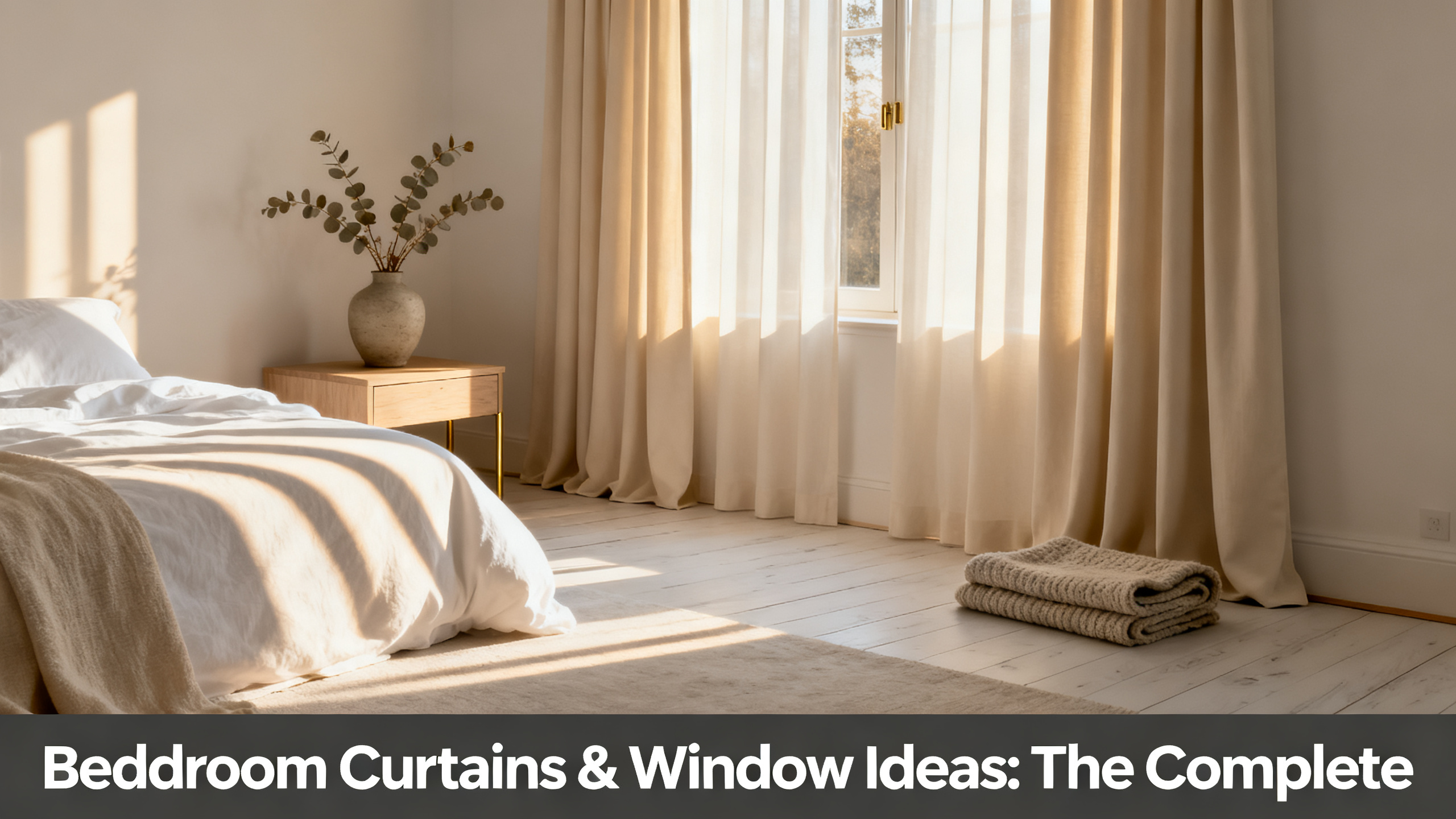
This hub started as an audit. We analyzed 14 Two Pages collections against five bedroom-specific dimensions (light control tier, drape weight, header options, lining tiers, service and lead time), read four years of Trustpilot owner feedback, and cross-referenced every configurator page for the specs that matter when the room in question is where you actually sleep.
What came out is a map. Base prices run from $104.99 to $329.99 per panel, lead times land between 4 and 6 weeks for custom orders, and the actual bedroom-fit range spans 8 core collections plus a blackout room-divider kit. This page routes you to the deep-dive guide, roundup, review, or how-to that matches your next step.
Light control
Sheer, room-darkening, or full 99% blackout.
Drape weight
40 to 252 gsm across linen, cotton, velvet, blackout poly.
Header options
9 header styles including pinch, grommet, ripple fold, soft top.
Lining tiers
Unlined, privacy, cotton, and 3-pass blackout.
Service
Custom to 116″ wide, memory training, 4-6 wk lead.

The bedroom entry benchmark
Liz Linen Drape, Pleated Header
from $104.99/panel · 90 gsm European linen · 30+ colorways · 9 header styles including double pinch pleat and ripple fold · three liner options. Final price depends on size and lining.
Code JULY for 20% off · Free shipping over $300
For Beginners: What a Bedroom Curtain Actually Has to Do
Most bedroom curtain articles jump to blackout versus sheer in the first paragraph. That framing skips the actual question: what job is the panel doing at 6am, at 2pm, and at 11pm, and how do those three jobs conflict?
A 6-Term Vocabulary Primer for Bedroom Curtains
Six words carry most of the bedroom curtain decision. Get them right and the configurator stops feeling like a maze.
Drop
Rod-to-floor length. Kiss, break, puddle, or café.
Return
Panel wrap toward the wall to seal edge light.
Header
Top-edge finish: pinch pleat, grommet, ripple fold.
Lining
Unlined, privacy, cotton, or 3-pass blackout.
Panel width
Rod width × 2 gathered, × 2.5 for editorial pleat.
GSM
Fabric weight in grams per m². 40 sheer → 252 blackout.
Every product page on twopagescurtains.com surfaces those same six variables. The order in which you resolve them barely matters. What matters is never leaving one blank, because a blank in the configurator becomes a wrong assumption at delivery.
Four Fabric Families That Suit a Bedroom
Bedroom curtains sit in a narrower fabric range than living room or dining room. Skin contact is more frequent (pillowcases pulled aside, kids draping panels, general reach-through), light control matters more, and the panels are on view during pre-sleep wind-down when small imperfections read louder. Two Pages ships four families that fit the room:
🧵
Linen
Liz, Kyla, Jawara. 40 to 100 gsm. Soft drape, textural, warm daylight.
🌾
Heavyweight cotton
Isabella, Broad. 110 to 150 gsm. Structured, private, tailored.
🌹
Velvet
Birkin, Veda. 220 to 260 gsm. Inherent room-darkening, romantic weight.
🌑
Blackout poly
Atlanta. 252 gsm. 99% shading, kit-based, ceiling track.
Bedroom fabrics touch skin more often than living room fabrics, so an OEKO-TEX Standard 100 chemistry baseline matters more here than elsewhere. Most Two Pages yarns clear that bar. Blackout liner backings are polyester with a low-emissivity coating, which is a conscious trade-off away from the natural-fiber story, not a hidden compromise.
Why Bedroom Light Control Is a Different Problem
Sleep science is clear: National Sleep Foundation guidance on light exposure and sleep shows that even modest early-morning light exposure shifts circadian timing and cuts REM in the last sleep cycle. That is the last cycle of the night, the one where you feel rested or you do not. A bedroom curtain that lets in first light at 5:47am costs you the tail of your best sleep.
Bedroom Curtain Length Guide: Floor Kiss, Break, or Puddle
The dedicated length guide walks the 4 drop conventions with configurator numbers for standard 8-ft, 9-ft, and 10-ft ceilings, plus where rod placement changes the math.
That is why bedroom curtains are asked to do more than living room curtains. In a living room, ambient light adds to the mood. In a bedroom, ambient light at the wrong hour breaks the mood. The panel is not decoration; it is a sleep tool.
And that tool has to work three times a day: at 6am (block sunrise), at 2pm (privacy without dungeon-dim), and at 11pm (soft closing gesture, no clatter). The layered configuration (sheer front, blackout back) is the honest answer for most bedrooms with east or west light. A single-panel setup works too if you pick the fabric weight and lining tier correctly.
For Buyers: How to Route Through the 8 Two Pages Collections
The Two Pages catalog lists dozens of curtain SKUs, but only 8 collections are bedroom-first. Rather than 40 product pages across an aisle, that structure is a ladder: entry, mid, luxury, plus a full-blackout kit on the side.
Entry
Kyla Linen
Sheer layer · from $89.99
Benchmark
Liz Linen
90 gsm · from $104.99
Structured
Isabella Cotton
150 gsm · from $109.99
Textured
Broad Cotton
Plain weave · from $99.99
Editorial
Sarai Metallic
Cotton blend · from $124.99
Warm luxury
Veda Velour
Cotton velour · from $139.99
Romantic
Birkin Velvet
250 gsm · from $149.99
Full blackout
Atlanta Kit
99% shading · from $200.99
The first buyer question is always the same: how dark does the bedroom actually need to be at sunrise? A north-facing bedroom in a city apartment with tall neighbors is a different light problem than a south-facing suburban master with unobstructed sky. The light control ladder decides the collection tier before any color question enters.
Light control ladder
15%
Sheer alone (Kyla). Daylight diffusion, no privacy at night.
40-50%
Unlined mid-weight (Liz, Isabella). Dim but not dark.
90-95%
3-pass blackout liner added. Room-darkening tier.
99%
Atlanta Blackout kit + ceiling track. True blackout.
Somewhere between $104.99 and $329.99, every bedroom finds its match. If the room reads romantic and the mood board leans candlelight and drapery weight, the answer sits on the velvet rung, and the head-to-head between Birkin Velvet Pleated and Veda Luster Cotton Velour is the next click. Both handle low-light bedrooms beautifully; Birkin drapes softer, Veda catches light with a subtle sheen.
Best Blackout Curtains for Bedroom: 5 Tested Picks
If your bedroom faces east or west and you sleep past sunrise, the shortlist ranks 5 Two Pages options scored on shading rate, edge light bleed, drape weight, and configured pricing.
Header style comes second, not first. The double pinch pleat reads structured and formal, right for a master bedroom with molding and a canopy bed. The ripple fold reads modern and continuous, right for a minimalist bedroom with a ceiling-track mount. The grommet reads casual, right for a guest room or teen bedroom where hardware simplicity beats formality. A style-first browse through the 30+ bedroom curtain ideas gallery narrows the header before the fabric.
Double pinch pleat
Structured, tailored, formal. Master bedroom default.
Triple pinch pleat
Denser folds, editorial, adds ~15% fabric width.
Ripple fold
Continuous S-curve, modern, ceiling-track ready.
Grommet
Casual, easy to slide, hardware visible.
Soft top
Rod-pocket look, informal, no hooks needed.
Flat panel
Minimalist, no folds, requires 1.5× fullness minimum.
Fabric weight comes third. A 90 gsm European linen (Liz) drapes softly and folds warmly at pinch pleat. A 150 gsm heavyweight cotton (Isabella) holds a crisper pleat and blocks more light unlined. A 250 gsm velvet (Birkin) inherently room-darkens even without a liner, which is why velvet reads as the romantic-and-cocooning bedroom choice more than any other family.

The blackout anchor
Atlanta Room Divider Blackout + Ceiling Track
from $200.99/kit · 252 gsm polyester · 99% shading rate · 6 sizing bands S to XXXL · ceiling track kit included · full darkening for east and west-facing bedrooms. Code JULY for 20% off.
The Full Bedroom Hub Directory: 14 Deep-Dive Guides
Below is the whole pillar in one grid. Fourteen intra-hub spokes plus four cross-pillar bedroom-related guides. Every card links to a dedicated page with configurator numbers, verdicts, and photography.
Best-of
Best Curtains for Bedroom
5 tested picks scored on 5 dimensions.
Best-of
Best Blackout Curtains for Bedroom
99% shading picks for east/west light.
Best-of
Best Curtains for Master Bedroom
Primary suite scale and formality.
Best-of
Best Curtains for Guest Bedroom
Neutral picks that flatter every guest.
Best-of
Best Luxury Bedroom Curtains
VIP22-eligible velvet and heavyweight cotton.
Best-of
Best Romantic Bedroom Curtains
Velvet, blush, and low-light scenography.
Best-of
Best Curtains for Small Bedroom
Scale-appropriate picks and header choices.
Best-of
Best Curtains for Tall Bedroom Windows
120-inch and 130-inch custom drops.
Ideas
Bedroom Curtain Ideas (30+ Looks)
Mood boards by style and palette.
Ideas
Small Bedroom Curtain Ideas
Scale, header, and color for compact rooms.
Guide
Bedroom Curtain Color Guide
Warm, cool, and neutral palettes.
Guide
Bedroom Curtain Length Guide
Kiss, break, puddle, and café for 8/9/10-ft ceilings.
How-to
Layer Sheers + Blackout in Bedroom
Double-track rod, panel widths, header pairings.
How-to
How to Hang Bedroom Curtains
Rod placement, hardware, and return math.
Cross-pillar
Best Bay Window Treatments for Bedroom
Curved-run rods, corner returns, panel splits.
Cross-pillar
Japandi Bedroom Ideas
Neutral linen, low headboards, ripple fold.
Cross-pillar
Neutral Bedroom Ideas
Oatmeal, greige, and warm-white palette maps.
Cross-pillar
Modern Farmhouse Bedroom Curtains
Broad cotton plain weave, softwash palettes.
The directory is not a menu; it is a routing tree. If you already know your light problem, start with a best-of. If you already have a mood board, start with an ideas page. If you already have a specific bedroom shape (small, tall, bay), the shape-specific guide skips ahead to the constraint that matters.
Pricing by configuration
Sheer / entry
$89.99+
Kyla Linen sheer, unlined.
Benchmark
$104-140
Liz Linen 90 gsm, privacy liner.
Room-darkening
$150-190
Liz / Isabella + 3-pass blackout liner.
Full blackout
$200-330
Atlanta kit or Birkin velvet + liner.
Add roughly $25 to $45 per panel for privacy or blackout liner. Add $12 to $25 for memory training. Add $40 to $180 for hardware (single vs double track). The configurator surfaces every add-on before checkout, so the final number is never a surprise.
For Owners: Layering, Safety, Longevity
Layering Sheers and Blackout
Most bedroom light problems are actually two problems in one window. The daytime privacy problem (neighbors, street traffic, glare) and the nighttime sleep problem (sunrise, streetlight, headlights). A single panel that solves both usually compromises on both.
The layered configuration solves them separately. A front sheer (Kyla Linen 40 gsm, or the sheer variant of Liz Linen at 60 gsm) stays closed all day for diffusion and modesty. A back blackout panel (Liz or Isabella with 3-pass blackout liner, or Atlanta polyester) closes at night for sleep. The two operate independently on a double-track rod.
Double-track layering
Front rail (window side)
Sheer panel, 40 to 60 gsm. Closed daytime for privacy + diffusion. Stack width: ~10% of rod length per panel.
Back rail (room side)
Blackout panel, 90 to 252 gsm. Closed nighttime for sleep. Stack width: ~15% of rod length per panel.
Combined return-to-wall: allow 3.5 to 4 inches between the wall and the outer rail so the back panel can seal fully against the wall.
How to Layer Sheers + Blackout in the Bedroom
The layered setup (front sheer for daylight diffusion, back blackout for sleep) is the single most requested bedroom configuration. The guide covers rod double-track hardware, panel stacking widths, and header pairings.
Kid and Pet Safety
Bedrooms with kids or pets add a hardware constraint most buyers overlook: CPSC window covering safety guidance favors cordless lift systems for any window in reach of a child. That rules out corded roman shades in most kid bedrooms. It also affects how a curtain tieback is anchored, since a loose cord loop is a strangulation hazard.
🧷
No dangling cords
Cordless lift or wand control on any shade in a kid bedroom.
🌿
OEKO-TEX yarns
Standard 100 chemistry baseline on skin-contact fabrics.
🐾
Anchored tiebacks
Screw-mounted holdbacks, not loose fabric ties.
Cleaning and Longevity for Bedroom Fabrics
Bedroom curtains live longer than living room curtains for a simple reason: less foot traffic, less cooking splatter, less sunlight in most orientations. A well-configured Liz Linen or Isabella Cotton panel holds its color and shape for 7 to 10 years. Velvet holds even longer indoors, since the pile catches dust rather than showing wear.
Care routine is boring on purpose. Vacuum on low with a brush attachment monthly. Spot-treat with a barely damp microfiber. Machine wash the polyester blackout liner separately if it needs it, but never hot. Custom linen and cotton panels are dry-clean-preferred, though owner feedback shows cool machine wash on delicate cycle with a mesh bag works if the header can handle it.
Order the Choose-Any-3 Fabric Sample Books
A bedroom color reads differently at 6am against north light than under a bedside lamp at night. Two Pages ships any 3 of its curtain sample books for $28.99, so you can pit Liz Linen against Isabella Cotton and Birkin Velvet at true scale before locking a custom order.
For Troubleshooters: Bay, Tall, Small, Rental Bedrooms
Standard-shape bedrooms are the minority in real inventory. Every third order is a bay window, a 10-foot drop, a compact 9×10 room, or a rental with no ceiling drilling allowed. The bay window treatments for bedroom guide handles curved-run rods; the rest breaks down as follows.
Bay window bedroom
Curved bay rod system, 3 separate panel splits, ripple fold header for continuous read.
Tall window (10-ft+)
Custom drop to 130 inches on Liz and Isabella. Triple pinch to distribute vertical fabric.
Small bedroom (9×10)
Narrower panels, ripple fold or soft top, avoid triple pleat (eats floor space).
Rental / no-drill
Tension rod up to 48-inch spans, adhesive brackets to 8 lb, no ceiling install.
Tall bedroom windows are the most common configurator error. A 108-inch panel on a 116-inch drop leaves a floating hem. The fix is a custom drop, which Liz Linen and Isabella Cotton both support to 130 inches per panel. Triple pinch pleat helps distribute the extra fabric so the drape does not read as one long flat plane.
Small bedrooms need the opposite thinking. A triple pinch pleat on a 10-foot-square room eats floor space at the return. Ripple fold or soft top headers with a 1.5 to 2× fullness ratio (instead of the standard 2 to 2.5×) keep the panels reading intentional without crowding the room.
Renters have a real constraint: no ceiling drilling in most leases, sometimes no wall drilling at all. Two Pages does not sell rods, but the pattern that works is tension rods for spans under 48 inches, or removable adhesive brackets rated to 8 pounds per anchor. Custom panels still fit; the constraint is the hardware, not the drape.
Motorized bedroom setups are the last edge case. Motorized curtain tracks make sense for 3+ bedroom windows (whole-house sync) or for high-drop windows that are awkward to reach. Battery-powered motors are typically rated at ~12 months per charge on daily open/close. Two Pages sells the tracks and panels; hardware and motor integration is a separate line item.
Methodology & Editorial Approach
Every collection on this hub was scored on the same five dimensions: light control tier, drape weight and fall, header configurability, lining tier availability, and service dimensions (custom max size, memory training, lead time). Data came from the Two Pages configurator, product spec sheets, and four years of aggregated Trustpilot owner feedback filtered for bedroom-tagged reviews.
Methodology recap
Scoring dimensions
Light control, drape, headers, linings, service. Weighted for bedroom use case.
Sources
Configurator specs, Trustpilot owner feedback (2022-2026), sample-book handling.
Exclusions
Non-Two-Pages SKUs. Ready-made panels under $50. Outdoor-only collections.
Author
Two Pages editorial team, curtain-focused since 2021. Full bios on the author page.
The hub is updated when a new Two Pages collection launches, a spec changes, or a spoke publishes new configurator data. Every scored dimension is reproducible from the linked product page. If you spot a spec that has drifted, the guide gets corrected before the roundup.
Upgrade path: Isabella Heavyweight Cotton Drapery
150 gsm heavyweight cotton, structured drape, 9 header styles including triple pinch pleat and grommet. from $109.99/panel · Memory training available · 4-6 week lead time. Code JULY 20% off · Free shipping over $300.
Frequently Asked Questions
What length should bedroom curtains be?
For most bedrooms, the drape reads best at floor kiss (hem touches the floor by less than half an inch) or a slight break (half an inch to one inch pooling). Puddle length (three to six inches pooling) trades formality for dust buildup and does not work in kid or pet bedrooms. Café length (mid-window) reads too casual for a primary bedroom in almost every 2026 style guide. The Two Pages configurator lets you set a custom drop to the eighth of an inch, which matters because standard 84, 96, and 108 inch panels rarely match a real bedroom rod-to-floor measurement.
Blackout versus room-darkening for a bedroom, what is the difference?
Blackout means 99 to 100 percent visible light rejection at the panel level, verified by holding it against direct sun and seeing effectively no transmission. Room-darkening means 85 to 95 percent, enough to keep the room dim but not fully dark. Two Pages sells both. Atlanta Room Divider Blackout with the ceiling track kit reaches 99 percent. Adding a triple-pass blackout liner to Liz Linen or Isabella Cotton lifts the base fabric from 40-50 percent shading to 90-95 percent shading, room-darkening tier not pure blackout. Both work for sleep in most bedrooms. Only east and west-facing bedrooms with a light sleeper genuinely need the full blackout tier.
Is layering sheers plus blackout worth it in the bedroom?
Yes, for one specific case: a bedroom that needs privacy and daylight diffusion during the day plus true darkness at night. The double-track rod carries a front sheer (Kyla Linen or similar 40-50 gsm) that stays closed during the day for diffusion, and a back blackout panel (Atlanta or Liz Linen with triple-pass liner) that closes for sleep. The hardware cost adds roughly $60 to $180 depending on rod length. The panel stacking width doubles when both panels park at the sides, so allow more return-to-wall space than a single-track setup.
What is the best fabric for bedroom curtains?
There is no single answer, but the practical shortlist is short: linen for warmth and drape (Liz at 90 gsm), heavyweight cotton for structure and privacy (Isabella at 150 gsm), velvet for luxury and inherent room-darkening (Birkin at 250 gsm cotton velour), and polyester blackout for pure light control (Atlanta at 252 gsm). Bedroom fabrics touch skin more often than living room fabrics (through pillowcases pulled aside, kids draping panels, and general reach-through), so an OEKO-TEX Standard 100 certified chemistry baseline matters more here than elsewhere.
How wide should bedroom curtains be?
The standard bedroom formula is: window width times 2 for a full gathered look, times 2.5 for an editorial pleated look. A 60-inch bedroom window with a pinch-pleat header wants 120 to 150 inches of total panel width, typically split into two panels of 60 to 75 inches each. Two Pages custom panels max out at 116 inches wide per panel for Liz Linen and 120 inches for Isabella Cotton. For wider bedroom rods, order 3 or 4 narrower panels rather than 2 wide ones.
Curtains or blinds for the bedroom?
Both work. Curtains layer better with existing bedroom textiles (rug, bedding, upholstered headboard) and read softer. Blinds and shades control light more precisely and take less floor return space. The layered answer (blinds or roman shades on the window plus curtain panels flanking) is the most common 2026 designer choice for primary bedrooms because it gives light control precision from the shade and softness from the fabric. Two Pages sells both categories, mapped in the hub directory above.
