
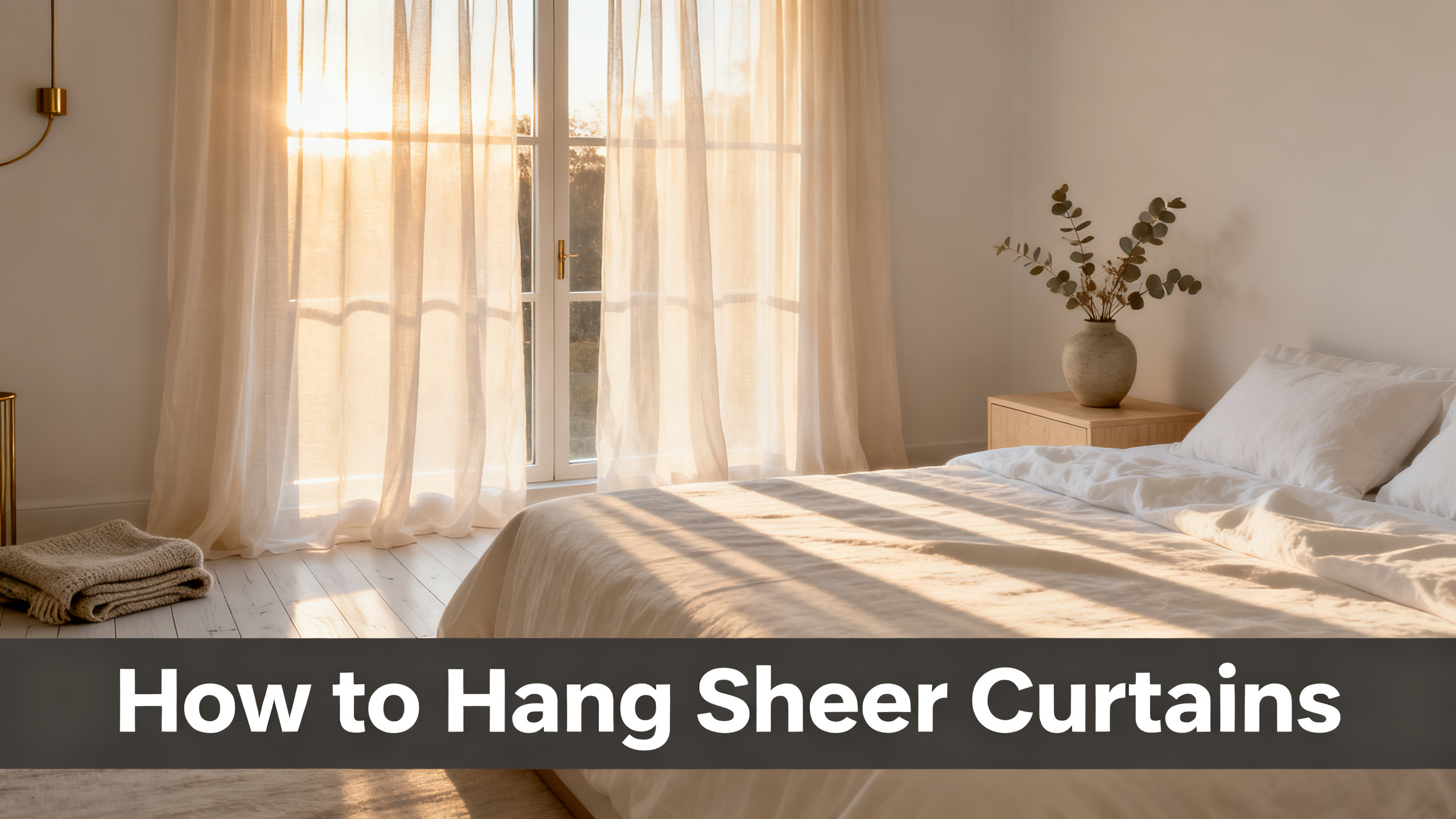
Sheer curtains fail about 80% of the time not because of the fabric, but because the installer copies the drape playbook. A 140 gsm linen drape falls in a stack. A 50 gsm voile floats. The rod, the fullness, the hem, the header, and the layering rules all shift once the panel weight drops below 1 pound.
The design authority literature backs this. Sources from the The Spruce sheer curtain overview to interior editorial features treat sheer install as a separate discipline, with its own math and its own failure modes.
This guide walks through the 6 step framework Two Pages designers use when sizing voile for a live cart configuration. Full pole placement and cross ceiling context sits in the full curtain install hub.
🧰 Tools & prep checklist
Measure
Tape measure, laser level, pencil, step ladder
Mount
Stud finder, drywall anchors, cordless drill, 1/8 inch bit
Time
35 minutes per window once panels are on hand
📐 Quick answer
Hang sheer curtains from a rod mounted 4 to 6 inches above the window frame and 4 to 8 inches wider on each side. Aim for 2.5x fullness between rod width and total panel width, and let the hem float 1/2 inch above the floor.
Never puddle a 50 gsm voile. Use a lightweight rod (under 1 lb capacity works for most single window installs) and pinch pleat or rod pocket for header.

Built for daylight diffusion
Scandina Solid Voile Sheer Curtain
from $28.99/panel · 100% polyester · 50 gsm true voile · pinch pleat that holds shape on a 1/2 lb panel · custom width to 110 inches · 2 colors (White HN906-5, Beige HN906-4). Final price depends on size and header style.
Use code JULY for 20% off · Free shipping over $300
Why Sheer Install Rules Differ From Drape Install Rules
A four panel voile set for a standard living room window weighs about 2 pounds total. A four panel linen drape set at 140 gsm weighs closer to 12 pounds. That six fold difference in load is why bracket ratings, center support requirements, and even tension rod viability all reset for sheers.
Transparency changes the visual layer count. On a drape install, you see the panel. On a sheer install, you see the panel plus the rod behind it, plus the wall color behind that, plus (if layered) the drape lining. Every install layer becomes visible.
The fullness math is the third shift. Below 2x fullness, a voile reads flat and cheap, like a bedsheet stretched across a rod. A drape at 1.8x fullness still looks intentional because the fabric weight creates natural folds. Voile has no such recovery.
The 6 Step Framework at a Glance
Before diving into any single step, it helps to see the arc. The six steps below are ordered by decision dependency: each step feeds numbers into the next, so skipping ahead usually means going back.
🪟 The 6 steps
1
Choose the right rod (single vs double, weight rating)
2
Measure rod height and panel drop for a floating hem
3
Pick a header style that holds shape at 50 gsm
4
Fullness ratio (target 2.5x, this is where most fail)
5
Panel count math from rod width and fullness
6
Layer with drapes on a double rod (optional)
Step 1: Choose the Right Rod
Single Rod for Sheer Only Rooms
For a sunroom, a nursery, or any room where the voile is the only window treatment, a 1/2 inch or 3/4 inch curtain rod is the workhorse choice. A tension rod also works, provided the total panel load stays under 2 pounds.
Decorative wooden rods read better than metal on sheer installs. The reason is optical: a voile shows the shadow of whatever is behind it, and a matte wood rod casts a softer shadow than a chrome or brass pole. If it were my sunroom, I would default to a walnut or oak rod every time and skip the metal argument entirely.
Double Rod for Layering
Layered installs (sheer plus drape on the same window) call for a double rod bracket with two rods stacked at different projections. Standard geometry is a 5 inch front rod for the drape and a 2 inch back rod for the sheer, giving a 3 inch clearance gap between the two.
Sheer goes on the back rod, drape on the front rod. The reverse (sheer in front) reads like a mistake because the drape then blocks the diffusion and the voile has no daylight to soften. Rod install itself follows the same steps as any other bracket mount; the full rod install walkthrough covers stud finding, anchor selection, and level checks.
Bracket weight rating still matters on double rod installs even though the sheer is featherlight. The drape on the front rod is heavy, and the bracket carries both loads. Read the bracket spec sheet for the combined weight, not the sheer weight.
Step 2: Measure Rod Height and Panel Drop
The universal 4 to 6 inches above the window frame rule holds for sheers, and so does the 4 to 8 inches wider per side rule for stack back. What changes is where the hem lands.
A voile hem should float 1/2 inch above the floor, not touch, not puddle. Puddling works on 240 gsm velvet where fabric weight anchors the pool of fabric to the ground. On a 50 gsm voile the pooled fabric flutters with any air movement, and it turns into a magnet for dust, cat hair, and floor dirt within a week.
How to Measure for Curtains: The Complete Guide
Width, drop, and rod projection math from a single Two Pages designer worksheet, plus the 1.5 inch ring drop offset every custom order needs to account for.
Real talk on the floor-clearance question: a lot of buyers order voile at the same drop as their linen drapes and then wonder why the sheer catches on the vacuum. It is not a defect. It is that the 1/2 inch clearance rule is specific to lightweight fabrics that never should pool.
Drop math for a standard install: rod at 90 inches minus 1/2 inch hem clearance minus 1 inch of ring drop equals a panel drop of 88.5 inches. Off the shelf 84 inch panels leave 5.5 inches of daylight below the hem. Off the shelf 96 inch panels puddle 6 inches on the floor. Neither reads finished.
How High to Hang Curtains: The Universal Rules
The universal 4 to 6 inch rule, why designers cheat higher, and the per ceiling height variations for 8, 9, and 10 foot rooms.
Step 3: Pick a Header Style That Doesn’t Collapse the Voile
Rod pocket is the traditional default for voile because it hides the rod behind a gathered top hem. It reads casual and coastal, and it works down to about 84 inches drop. Past 90 inches, rod pocket voile starts to sag at the top because the fabric has no structural support along its width.
Pinch pleat holds shape memory even at 50 gsm, but only if the manufacturer trains the pleat during finishing. Untrained pinch pleat voile collapses to a flat sheet the first time it is drawn. Grommet gives a clean bounce and works down to about 100 inches drop, above which the eyelet weight starts stretching the top hem of the panel over months of use.
🧵 Header style for sheers
Pinch Pleat
Formal, best structure. Needs trained memory at 50 gsm. Two Pages memory trains during finishing.
Rod Pocket
Casual traditional. Hides rod. Sags past 90 inch drop.
Grommet
Modern. Clean bounce. Stretches past 100 inch drop.
Tab Top / Ripple
Too casual for most sheers. Skip for formal rooms.

A Voile That Holds Its Pleat at 50 gsm (Most Don’t)
Most 50 gsm voiles collapse into a flat sheet the second you skip the fullness math. Scandina is memory trained during finishing so the pinch pleat reads clean even at 2.5x fullness. That is the ratio between rod width and total panel width, and it is the single knob that decides whether a sheer looks intentional or looks like a dropcloth. from $28.99/panel.
Step 4: Get the Fullness Ratio Right (This Is The One Most People Miss)
Fullness ratio is the total panel width divided by the rod width. On a 60 inch rod, a 2.5x fullness install calls for 150 inches of total panel width, which is either 4 panels at 40 inches each or 3 wide panels at 50 inches each. That is the single knob most people get wrong.
Picture the moment the west sun hits a 1.5x fullness voile at 4pm. The panel reads flat and washed out, with the folds pulled taut against gravity. Now picture the same window at 2.5x fullness: soft vertical folds catch the light in bands, and the diffusion reads intentional. That is not a subtle difference. It is the entire visual difference between “looks like a bedsheet” and “looks like an interior magazine spread”.
📐 Fullness ratio visualizer
1.5x
Flat, cheap, looks like a bedsheet
2.0x
Soft gather, acceptable for casual rooms
Sweet spot
2.5x
Ideal soft folds, reads intentional
3.0x
Luxe, hoards budget without visible gain
Worked example on a real window: a bedroom with a 60 inch rod. At 2.5x fullness the total panel width sits at 150 inches. Options: 4 panels at 40 inches each (readable folds, best drape) or 3 wide panels at 50 inches (slightly less fold density but faster to draw and cheaper). Either works.
Step 5: Order the Right Number of Panels
The panel count formula is: rod width divided by 30 inches per single panel width for a 2.5x fullness install. A 36 to 48 inch window needs 2 panels. A 60 to 72 inch window needs 3. A sliding glass door at 96 inches wide needs 4 or more.
Two Pages wide panels custom cut to 55 inches for pinch pleat (or 106 inches for grommet and soft top) let you drop to 3 panels on wider rods, which saves both fabric and stack back space at the edges. The Scandina Solid Voile Sheer product page configurator surfaces the width options once you enter your rod length. The Scandina Solid Voile Sheer Curtain Pleated panel is the primary Two Pages pick because it holds trained pleat memory at 50 gsm, which almost no other voile in this price band does.
Real talk on the color range: Scandina ships in 2 colorways only (White HN906-5 and Beige HN906-4). If the room calls for a colored sheer (blush, sage, dusty blue), Two Pages does not have that in the sheer line. Order the booklet before committing to a full window set.
Step 6: Layer With Drapes on a Double Rod
Double rod layering (sheer plus drape on the same window) is the most versatile install because it splits daylight control from privacy control. Sheers filter light during the day. Drapes block light and provide privacy at night. Editorial guides like the Architectural Digest layered treatments guide treat the double rod install as the default for formal rooms.
How to Hang Sheer Curtains With Drapes: The Layering Guide
Double rod projection, sheer in front vs sheer behind decisions, and the 3 inch clearance rule that stops the two layers from friction sticking each time you draw them.
☀️ Single vs double rod geometry
Single rod
3 inch projection, sheer only, tension rod viable under 2 lb panel load
Double rod
5 inch front rod for drape, 2 inch back rod for sheer, 3 inch gap prevents friction stick
The 3 inch clearance rule is the number to hold onto. Front rod projects 5 inches from the wall for the drape. Back rod projects 2 inches for the sheer. That leaves a 3 inch gap between the two panels so they never touch when drawn simultaneously. Below 3 inches of clearance the two layers grab each other on every draw, and the mechanism reads janky within a month.
Pro Tips: What Sheer Installers Get Wrong
Three failure modes come up over and over in Two Pages customer service tickets. Fixing them at install saves the panel from looking wrong for its full lifespan.
Order the Scandina Sheer Booklet Before Committing
White voile and beige voile read completely different under morning east light versus afternoon west light. The booklet ships flat for $1.99 so you can tape both colorways to the actual window and check the daylight cast across a full day before ordering a $120 four panel set.
Now You’ve Planned. Here’s the Panel to Order.
You have the geometry. Rod height 4 to 6 inches above the frame, 4 to 8 inches wider each side. Panel drop that floats 1/2 inch above the floor. 2.5x fullness, 30 inches per single panel width, header style matched to the room formality. Single rod for sheer only, double rod with 3 inch clearance for layered.
The last variable is which voile behaves at 50 gsm without collapsing the fullness math you just settled. That is a shortlist of one product at Two Pages: Scandina Solid Voile Sheer, memory trained during finishing so the pinch pleat holds even on a featherweight panel.
You Have the Rod Height, the Fullness Ratio, the Header. Now Order a Voile That Behaves.
Scandina Solid Voile Sheer is custom cut to your rod width up to 110 inches, drop up to 106 inches for grommet or 55 inches for pinch pleat over 102 inch drop, at a true 50 gsm so daylight reads soft not washed. from $28.99/panel. Code JULY (20% off) · Free shipping over $300 · lead time 10 to 12 days.
Frequently Asked Questions
How high should sheer curtains be hung above the window?
Hang the rod 4 to 6 inches above the window frame and 4 to 8 inches wider on each side, exactly like a drape. What changes for sheers is where the hem lands, not where the rod goes. On an 84 inch frame with a rod at 90 inches, the hem should float 1/2 inch above the floor. Never puddle a 50 gsm voile because the pool traps dust in a week.
What is the ideal fullness ratio for sheer curtains?
2.5x fullness is the sheer sweet spot. That means total panel width should equal 2.5 times the rod width. A 60 inch rod calls for 150 inches of total voile, which is either 4 panels at 40 inches each or 3 wide panels at 50 inches each. Below 2x the voile reads flat and cheap. Above 3x the fabric hoards budget without visible gain.
How many sheer panels do I need per window?
Divide rod width by 30 inches per single panel width for 2.5x fullness. A 36 to 48 inch window needs 2 panels. A 60 to 72 inch window needs 3. A sliding glass door at 96 inches wide needs 4. Wider Two Pages Scandina panels custom cut to 55 inches for pinch pleat let you drop to 3 panels on wider rods.
Can I hang sheer curtains on a tension rod?
Yes for panels under 2 pounds total weight, which covers most single window voile installs with 2 to 4 panels of Scandina 50 gsm. Tension rods rely on friction, and a heavier panel plus wind drift can pop the rod off the frame overnight. For layered sheer plus drape installs on the same rod, tension rods are unsafe. Use a bracketed decorative rod.
Should sheer curtains touch the floor?
Sheer curtains should float 1/2 inch above the floor, not touch. Puddling works on 240 gsm velvet where the fabric weight anchors the pool. On a 50 gsm voile, the pooled fabric flutters with any air movement and collects dust and pet hair. Kiss the floor at half inch clearance for a clean modern read.
What is the best header style for sheer curtains?
Pinch pleat for formal rooms because it holds shape memory even at 50 gsm when the manufacturer trains the pleat during finishing. Rod pocket for traditional casual rooms because it hides the rod behind a gathered top hem. Grommet for modern minimalist rooms up to 100 inch drop, above which the eyelets stretch. Tab top and ripple fold read too casual for most sheers.
Do sheer curtains provide any privacy?
Sheers provide daylight privacy from 6 to 8 feet away when installed at 2.5x fullness with 50 gsm voile like Scandina. Silhouettes still show at 3 feet. At night with interior lights on, sheers become essentially transparent from outside. For evening privacy, layer with a drape on a double rod (sheer on back rod, drape on front rod).
