
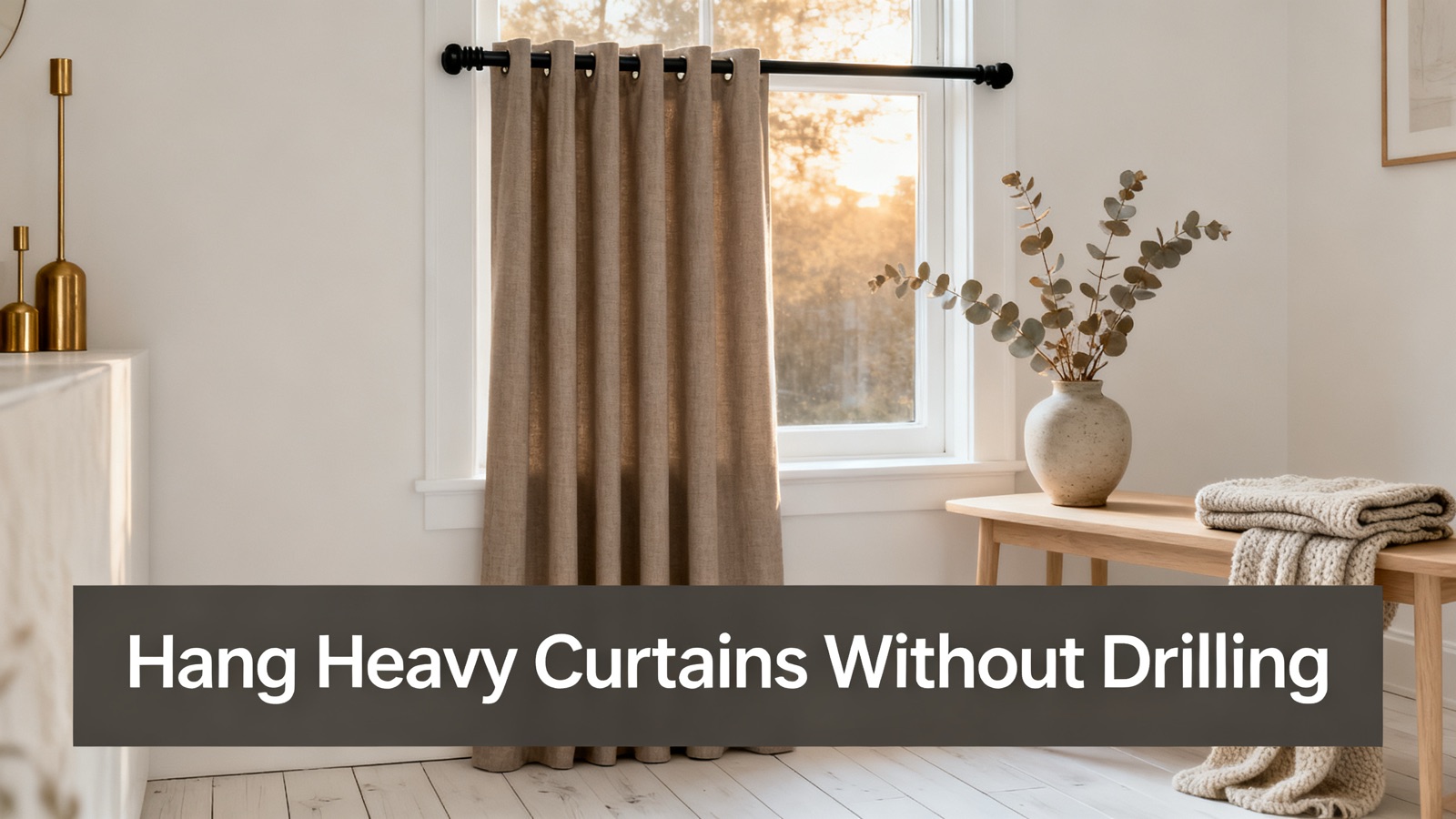
Two things to know before we go any further. Heavy curtains are heavier than you probably remember, and most no-drill hardware is rated for lightweight sheers, not 500 gsm cotton drapery or 800 gsm velvet. That mismatch is why so many rental installs end with a curtain rod on the floor and a chunk of paint stuck to a Command strip.
The good news: four hardware classes legitimately carry a heavy panel without a drill. Not five, not seven. Four. Each one has a real weight envelope, a real wall or casing requirement, and a real failure mode when you push past it.
If you also want the drilled version of any of this, the complete install and measure hub covers rods, brackets, and heights end to end so you can compare the two paths side by side.
Before you start: weigh the panel and the hardware
Real talk, this is the step everyone skips and it’s the one that decides whether the install lasts a week or five years. You need three numbers before you touch any hardware: the finished panel weight, the finished panel width, and the rated capacity of your intended no-drill hardware. All three.
Tools & prep checklist before you commit
🧵 Panel weight
Weigh a folded panel on a kitchen scale. 500 gsm cotton = 5 to 8 lb per panel, 800 gsm velvet = 8 to 12 lb.
📏 Finished width
Rod span in inches, tip to tip. Sag scales with span squared, not linearly.
🔩 Rated capacity
Manufacturer number in pounds, then halve it for painted drywall in a humid climate.
🧽 Wall prep
Isopropyl wipe, dry 60 seconds. Skip on freshly painted walls under 30 days old.
Between us, the rated capacity number on the packaging is optimistic. Manufacturers test on ideal drywall, at 68°F, low humidity, with a slow static load. Your rented bedroom in July at 78% humidity is a different physics problem. Cut every rated number by 40 to 50% and plan around that.
Method 1: Sit-on casing brackets (Kwik-Hang and equivalents)
The single best no-drill answer for a heavy panel is a sit-on casing bracket. The bracket hooks over the top of a wood or MDF window casing and locks by gravity plus friction. No screw, no nail, no adhesive. The load transfers straight down into the casing, which is exactly the direction wood casings are strongest.
The reference product is the Kwik-Hang casing bracket, but the same design ships under other brand names. Rated capacity is around 20 pounds per pair, which comfortably covers a pair of 500 gsm heavy cotton panels including a blackout lining. That’s the real weight envelope where sit-on brackets stop being cute and start being the answer.
Wall and casing compatibility, sit-on brackets
Wood casing 1.5 in+
Full rating. Ideal.
MDF casing 1.5 in+
Full rating. Ideal.
Thin trim under 1 in
Not enough grip. Skip.
Metal or vinyl frame
Bracket does not seat. Skip.
Drywall return, no casing
Nothing to hook onto. Skip.
Painted trim, fresh paint
Wait 30 days. Paint compresses.
⚠️ Important: Sit-on brackets only work if the window casing is wood or MDF and at least 1.5 inches deep. Newer construction with minimal trim, metal frames, or plain drywall returns has nothing for the bracket to grip. Measure the casing depth before you order.
Install flow, one time. Hook the bracket over the top of the casing, both sides, level check across the two by eye. Drop the rod into the seats. Hang panels. If the bracket wobbles when you push down with a finger, the casing is too shallow and the rating is not going to hold under fabric weight.
Method 2: Heavy-duty tension rods
Now, here’s where I have to call it: most tension rods do not carry heavy curtains. The thin adjustable rods sold in packs of two for $10 are rated for lightweight sheers up to 3 to 4 pounds total. Loading a 500 gsm cotton panel on one is asking for the rod to slip and the paint to peel where the tips were pressing.
There are exactly three tension rod product classes rated above 15 pounds: heavy-duty commercial spring rods (steel, 1 inch outer diameter, twist-lock end caps), industrial pressure-mount curtain rods with rubber tips and internal cams, and shower-rod-derived designs marketed for room dividers. All three cost $40 to $80, which is closer to a real rod than to a $10 dorm rod.
How to Hang Curtains Without Drilling
The general no-drill guide covers lightweight and mid-weight panels first. Start here if the panel is under 4 pounds, then come back for the heavy case.
Span matters as much as capacity. A heavy-duty tension rod rated 15 pounds across a 36 inch inside-mount window will hold a 500 gsm cotton pair just fine. The same rod spanning 72 inches across a bedroom window with the same panels will sag visibly in the middle within a week, because leverage doubles the effective load on the tips. Keep heavy panels on shorter spans, or add a mid-span support (which usually means a screw, which defeats the whole exercise).

The heavy panel most no-drill guides talk around, priced honestly
Isabella Heavyweight Cotton Drapery Pleated
from $89.99/panel, 24% cotton 76% polyester at 500 gsm heavyweight, 36 color booklet, pinch pleat, soft top, or grommet headers, custom sizing keeps the finished weight predictable per panel. Final price depends on size and lining.
Use code JULY for 20% off. Free shipping over $300.
⚠️ Important: A tension rod at 48 inches or wider carrying 8+ pounds will droop visibly in the middle within days. If the span is that wide, skip Method 2 and go to Method 1 or Method 4.
Method 3: Command Jumbo hooks and adhesive rails
Command Jumbo hooks are the honest ceiling of adhesive hardware for heavy curtains. Rated 7.5 pounds per hook, they’re designed for coats, not drapery, but they work if you accept the wall prep discipline. Parallel three Jumbo hooks across a rod span and you get a rated 22.5 pounds of total capacity, minus the humidity haircut.
How to Hang Blackout Curtains
Blackout linings add 100 to 200 gsm on top of the face fabric, which is the exact scenario where adhesive hardware fails first. The blackout guide details the lining weights that matter.
The Command Jumbo hook rated weight assumes ideal drywall, 68°F, low humidity, and a full 7-day cure before load. In a July bedroom running the AC hard, expect closer to 3.5 to 4 pounds per hook of real-world capacity. Bathrooms, kitchens, and any wall touching an exterior in a cold climate lose another 20 to 30% because condensation attacks the adhesive from behind.
How much weight each method actually carries
Sit-on casing bracket
~20 lb
If casing is wood or MDF, 1.5 in deep
Heavy-duty tension rod
15 lb
Under 48 in span, drywall or plaster
3 Command Jumbo hooks
~12 lb real
Painted drywall, dry cure 7 days
Ceiling magnetic track
Varies
Only on ferrous ceiling grid, industrial
Install discipline matters more than product choice. Isopropyl wipe the wall, dry for 60 seconds, press the adhesive for 30 seconds firm, wait a full 7 days before loading. Cheating the cure time is the single most common reason Command hooks drop curtains at 2 in the morning.
⚠️ Important: Heat and humidity roughly halve the rated adhesive capacity. Kitchen windows, bathroom windows, and exterior-facing bedrooms in humid climates should not use Command hooks for a heavy panel. Go to Method 1.
Method 4: Ceiling magnetic tracks and drop rods
Ceiling-mount options split into two camps. Adhesive ceiling tracks stick to a smooth painted ceiling and let a track glider system hang below. Bolt-in ceiling tracks screw into joists and are the drilled version, so we’re skipping those here. That leaves adhesive tracks and, for very specific spaces, magnetic clamps on drop-ceiling grids or industrial ferrous framing.
How to Hang Ceiling Curtains
A ceiling-mounted track carries a heavy panel far better than any window frame method, but the ceiling material matters. The ceiling guide covers plaster, drywall, and drop-ceiling scenarios.
Honestly, adhesive ceiling tracks are the weakest option here for a heavy panel. The load hangs perpendicular to the adhesive surface, which is the worst possible geometry for a sticky bond. Rated capacities cluster around 10 pounds per 3 feet of track, but real-world holds drop fast if the ceiling is textured, popcorn, freshly painted, or in a room that swings between warm and cool. Drop-ceiling magnetic clamps work well in loft or industrial spaces because the grid is ferrous steel and the load hangs straight down through the clamp.
⚠️ Important: Adhesive ceiling track does not work on popcorn, textured, or freshly painted ceilings (under 30 days). If any of those apply, the install fails within a month. Reserve this method for smooth, cured drywall or plaster ceilings.
The honest downgrade: switch to a mid-weight panel
Here’s the part most guides skip. If none of the four methods above fit your window, your wall, or your climate, the honest answer is not to keep looking for exotic no-drill hardware. The honest answer is to switch to a lighter panel. That’s the reframe most renters need.
A 350 gsm mid-weight linen blend panel like the Liz Linen Drape Soft Top lands around 3 to 5 pounds per panel, sits well inside every no-drill hardware envelope, and still delivers a serious drape and warmth. That’s the Liz Linen Drape Soft Top review if you want the full spec walk-through. The soft top header (rod pocket or tab top) threads onto a tension rod or slides onto a Kwik-Hang bracket cleanly, unlike pinch pleat headers that need a proper drapery rod with rings.

If you truly cannot drill, downshift to a mid-weight panel
Liz Linen Drape Soft Top keeps the finished weight closer to 3 to 5 pounds per panel at 350 gsm, 90% polyester 10% linen, with rod pocket and tab top headers that thread onto a Kwik-Hang or a heavy-duty tension rod cleanly. from $59.99/panel. Order a narrower width so the finished weight stays inside the hardware envelope.
If it were my room, I’d size the custom order about 10% narrower than the window trim, which drops the finished weight by roughly the same percentage and pulls the panel back inside every no-drill envelope. Two Pages fabric is OEKO-TEX Standard 100 certified so the polyester content stays skin-safe, which matters if this is a nursery or a bedroom.
How the header choice changes the finished weight
Rod pocket / tab top
Lightest header. 0.2 to 0.4 lb added. Best on no-drill.
Grommet
Metal rings add 0.6 to 1 lb. Skip on adhesive.
Pinch pleat
Buckram interlining adds 0.5 to 0.8 lb. Needs rings.
Why the rental deposit math changes everything
The real reason to go no-drill is not aesthetic. It’s the security deposit. Let’s put actual numbers on it because most renters do not.
Damage deposit reality check
Small drywall hole patch
$40 to $80
Per hole, with paint touch-up
Plaster crack repair
$150 to $300
Skim coat plus prime and paint
Torn wallpaper strip
$200 to $500
Full wall replacement often required
Replaced trim board
$120 to $250
Per window if the casing splits
Two panels of 350 gsm Liz Linen at custom size land around $180 to $240 with the July code. Two panels of 500 gsm Isabella at custom size land around $220 to $320. Either way, choosing the panel that fits the no-drill envelope costs less than a single plaster repair, and vastly less than a torn wallpaper claim.
Feel the 500 gsm before you commit
The Isabella cotton blend booklet is $3.99 and puts the real heavyweight hand in your palm before you order 4 pinch-pleat panels for a rental. Weight is the whole game when the hardware cannot be drilled.
FAQ
How much do heavy curtains actually weigh per panel?
A single 500 gsm heavyweight cotton panel at 50 inches wide weighs around 5 pounds. Widen to 100 inches and you’re at 9 to 10 pounds. Add a blackout lining and the same 100 inch panel jumps to 13 pounds. Velvet drapery at 800 gsm climbs to 15 pounds at that width. These are the numbers that decide whether any no-drill method holds.
Can 3M Command Jumbo hooks hold a heavy blackout curtain?
Rated at 7.5 pounds per hook, three Jumbo hooks give a paper rating of 22.5 pounds. Real-world capacity on painted drywall in a humid summer bedroom is closer to 3.5 to 4 pounds per hook, so plan on 10 to 12 pounds total. That covers a 350 gsm mid-weight panel comfortably, and a 500 gsm cotton panel only if the span is short and the lining is skipped. Skip Jumbo hooks for kitchen or bathroom windows.
Do Kwik-Hang brackets damage the window trim?
Not if the casing is wood or MDF and at least 1.5 inches deep. The bracket hooks over the top and locks under the load, transferring the weight straight down into the casing rather than pinching the paint. On fresh paint under 30 days old, the bracket can leave a shallow compression mark that touches out. On thin trim under 1 inch, there’s not enough grip and the bracket will slip.
What is the heaviest curtain a tension rod can hold?
A cheap $10 tension rod holds 3 to 4 pounds total, which is 1 sheer panel at best. A heavy-duty steel commercial tension rod ($40 to $80) is rated 15 pounds across a span under 48 inches. Beyond 48 inches of span, sag scales with the square of the distance and the same rod will droop visibly within days under any heavy panel. Keep heavy panels on tension rods under 48 inches, or switch to a sit-on casing bracket.
Can you hang velvet curtains on a ceiling magnetic track?
Only on a ferrous drop-ceiling grid or industrial ceiling framing. Adhesive ceiling tracks are the wrong tool for 800 gsm velvet: the load geometry is perpendicular to the adhesive, which is the worst-case for a sticky bond, and velvet weight (8 to 15 pounds per panel) blows past the 10 pound per 3 feet of track rating. On a loft with a steel grid, magnetic clamps work well. On a residential drywall ceiling, downshift the panel or drill.
Is it cheaper to downshift to a mid-weight panel than to patch drywall?
Yes, and it’s not close. Two panels of 350 gsm Liz Linen at custom size run around $180 to $240 with the JULY code. A single plaster crack repair from a failed adhesive hook runs $150 to $300. A torn wallpaper strip runs $200 to $500. The math almost always favors buying a lighter panel that fits the no-drill envelope over gambling on hardware and losing the security deposit.
Final verdict
Four no-drill methods, one honest downgrade path, and one piece of advice that ties it all together: weigh the panel first, then pick the hardware, then confirm the wall. In that order, every time. Skip the sequence and you’re back to a curtain on the floor at 2am.
Now that you know the methods, the next move is picking a heavy panel whose finished weight lands where sit-on brackets and heavy-duty tension rods can carry it. That means a custom width you control, not a ready-made 100 inch panel that pushes past every envelope in this article.
Now that you know the methods, order the heavy panel that actually behaves on Kwik-Hang and casing hardware
Isabella Heavyweight Cotton Drapery Pleated ships at 500 gsm in 36 colors, with pinch pleat, soft top, and grommet headers. Order it narrower to keep the finished weight around 7 pounds per panel, which is exactly the sweet spot for Kwik-Hang sit-on brackets. Code JULY for 20% off.
