
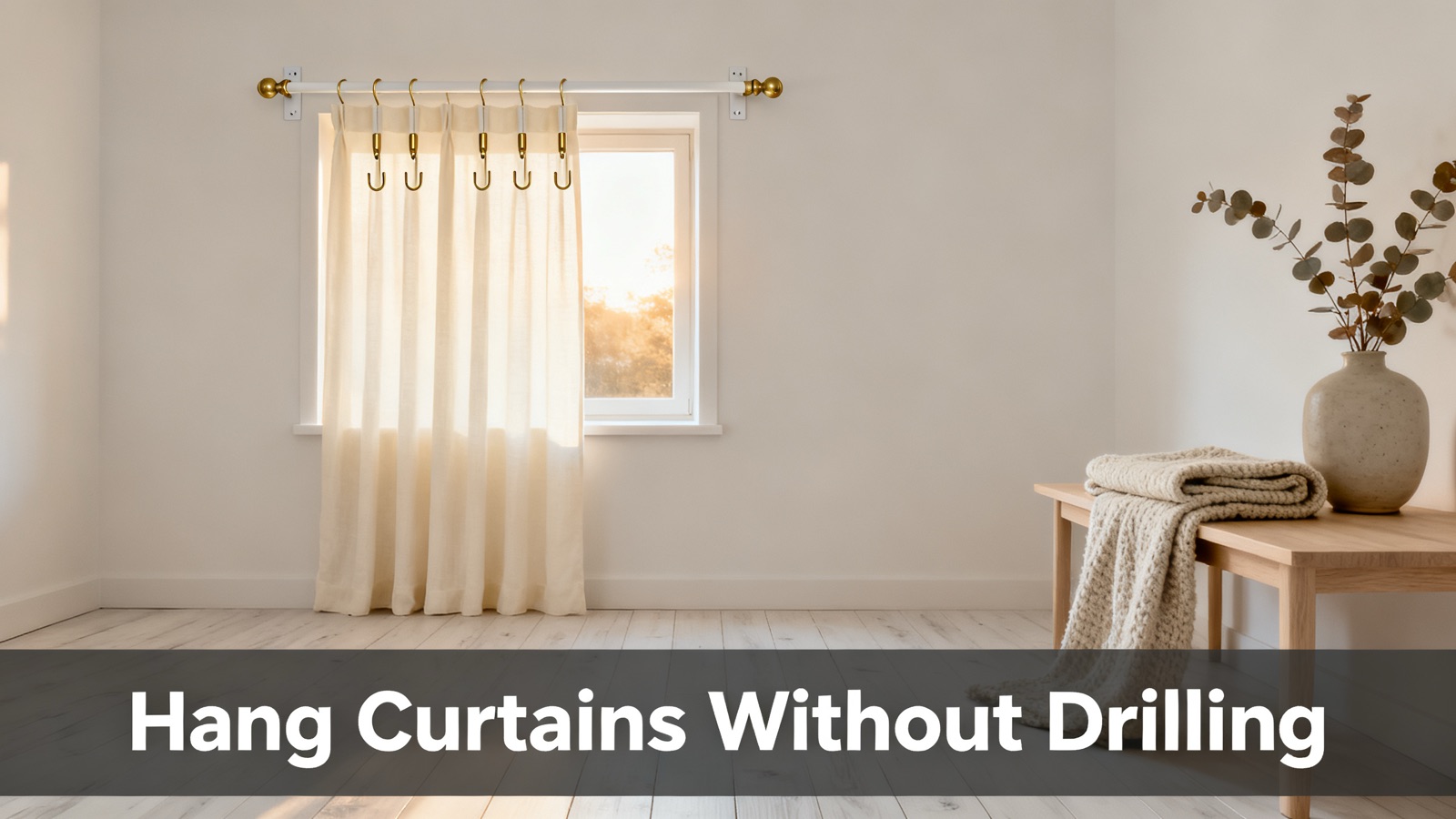
Two numbers before you buy a single hook: your panel weight per side, and your rod-length span. Every no-drill method lives or dies on those two numbers, and the five paths below split cleanly by weight tier and by wall surface.
The methods run from sheer-only (tension wire, magnetic clamps) through mid-load (adhesive hooks, cup hooks) up to full blackout territory (heavy-duty tension rods). If you want the full pilier of install content covering measurement, ceiling tracks, drilled rods, and bay windows, the full curtain install hub maps every variation. Otherwise, keep reading.
Tools & Materials Checklist
🔧 Bathroom scale
Weigh each folded panel on a home scale. This is the make-or-break number.
🪟 Tape measure
Jamb-to-jamb inner span for tension rods, wall-to-wall for hooks.
📏 Isopropyl alcohol wipe
Adhesive fails on dust. A single wipe doubles hook lifespan.
🔩 Rod or hook per method
Tension rod ($5-$30), Command hooks ($4-$12), cup hooks ($3), or clamp brackets ($15).
🧵 Rod-pocket panel
The one header style that threads on any tension rod without rings.
🎨 Bubble level
$4 tool that separates a straight install from a tilted one.

The panel that fits any tension rod
Liz Linen Drape Soft Top
from $59.99/panel · 90% polyester / 10% linen · 350 gsm heavyweight · rod pocket header (slides on any straight rod, tension or fixed) · 38 colors. Final price depends on size and lining.
Use code JULY for 20% off · Free shipping over $300
Before You Start: Weigh the Panel and Measure the Span
Panel weight is the make-or-break variable. A ready-made polyester sheer usually lands around 1 to 2 pounds per side. A mid-weight linen blend at 140 gsm sits at 2 to 4 pounds. A blackout or heavyweight linen at 300 to 350 gsm at a full 100 inch by 84 inch panel is 4 to 6 pounds per side, sometimes more with a thermal lining. If you skip this weigh-in step, you will pick a method rated for less than half your actual load.
Span is the second number. Tension rods work off the jamb-to-jamb inner distance. Command hooks work off wall-to-wall placement and need a rod that spans between them. Both math out cleanly if you measure once with a real tape (not a phone AR tool). Round up to the nearest half inch, then add 2 inches of tension-rod jaw travel or 4 inches of hook offset per side.
Own the Wall? The Drilled Install Guide
If a landlord approval or a permanent install is on the table, the six-step drilled process holds heavier panels and lasts a decade.
Surface is the third check. Painted drywall is friendly to almost every no-drill method. Plaster on lath (common in pre-1950 buildings) rejects most adhesive hooks after 2 to 3 weeks because the finish coat has micro-vibration under pressure. Brick and tile block adhesion entirely and need mortar clips or tension-rod-in-jamb setups. The card below covers what actually holds where.
Wall Surface Compatibility
Drywall
All 5 methods work. Prep with an alcohol wipe for adhesive.
Plaster (pre-1950)
Tension rods only. Adhesive fails in 2 to 3 weeks.
Brick / mortar
Mortar clips (Krok-Lok) or tension rods in a wood jamb.
Tile / glass
Suction hooks (light sheers only) or tension rods.
Method 1: Tension Rod (The 90% Fix)
A tension rod is a two-piece telescoping cylinder that presses against the window jamb via internal spring or twist-lock. There is no drilling, no anchor, and no visible mount when the rod is set. The The Spruce tension rod comparison ranks the three main classes: spring, friction, and heavy-duty ratchet-lock.
Sounds thin. Here is the actual math: a spring tension rod (the $6 shower-caddy style) holds 3 to 8 pounds across a 48 inch span. A friction rod with a twist mechanism holds 8 to 12 pounds. Heavy-duty ratchet-lock rods (Umbra, Kenney, Amazon Basics premium) hold 15 to 20 pounds across spans up to 90 inches. Match your total panel weight (both sides combined) to the rated class, then step up one tier for safety margin.
Length math: the inner jamb-to-jamb span sets the minimum rod compression. If your window inner span is 40 inches, buy a rod rated 28 to 48 inches, sit at the top of the range for maximum grip. If you need help translating a window opening into rod length and drop, the sibling piece on how to measure for curtains walks the math step by step.
The panel that mounts easiest on any tension rod is a rod-pocket header: sewn tube along the top edge, rod threads through, no rings, no clips, no grommets. The Liz Linen Drape Soft Top product page lists rod pocket as one of five header options at Two Pages Liz Linen Drape Soft Top. Weight sits at 350 gsm heavyweight, which on a 100 inch by 84 inch panel puts you at roughly 4.5 pounds per side. That is comfortable for a heavy-duty tension rod, borderline for a friction rod, and too much for a spring rod.
Best Curtains for Renters (2026)
The five panels that survive rental-tension-rod loads without sagging, plus the header styles that thread cleanly on any $12 rod.
| Tension Rod Class | Weight Rating | Max Span | Typical Price | Panel Fit |
|---|---|---|---|---|
| Spring (basic) | 3 to 8 lb | 48 inches | $5 to $10 | Sheers only |
| Friction (twist-lock) | 8 to 12 lb | 72 inches | $12 to $20 | Mid-weight linen |
| Heavy-duty (ratchet) | 15 to 20 lb | 90 inches | $22 to $35 | Blackout and heavyweight |
| Extra-long (spliced) | 10 to 15 lb | 120 inches | $30 to $50 | Sliding doors, sheers |
🧵 Tip: The paper-towel test for tension jaws
Before you set the rod, wet-then-dry a paper towel and rub the jaw contact points on the jamb. If the towel pulls up flakes of paint or old varnish, the tension jaw will slip within a week. Wipe with alcohol, let dry, then set the rod. Grip doubles.
Method 2: Adhesive Hooks (Command, 3M, Damage-Free)
Adhesive hooks are the second-most-used no-drill path, and the first path when the window has no usable jamb depth (bay windows, arched-top windows, deep casement openings). The workhorse product is the 3M Command line: Small (0.5 lb), Medium (3 lb), Large (5 lb), Jumbo (7.5 lb), and Utility Wire (5 lb). Two hooks per rod, one at each end, gives a combined capacity of up to 15 pounds for a Jumbo pair.
Real talk on Command hooks in humid bathrooms: the 3M Command adhesion weight ratings assume a dry indoor wall at prep temperature between 60 and 100 F, a wall wiped with 90% isopropyl alcohol, and a full 7-day cure before you hang anything. Skip any of those steps and the failure rate jumps from under 1% to roughly 30% in the first week. Humid rooms (bathroom, laundry, subtropical climates) drop rated capacity by about 20% even with correct prep.
Multi-hook spacing math: for a 60 inch rod, place two hooks at the outer 4 inch mark on each side, leaving 52 inches of unsupported rod between them. That works fine for panels under 4 pounds total. For rods 72 inches or wider, add a third center hook, which requires a compatible rod (a rod that accepts a center-hook cradle, not just an end-hook). Kwik-Hang and Command sell rod-plus-hook kits designed to click together.
Command Hook Adhesion Chart
Surface
Painted drywall
100% rated capacity. Best surface for Command adhesion.
Prep temp
60 to 100 F
Below 50 F, adhesive stays gummy. Above 105 F, it pre-cures.
Cure time
7 days
Full bond strength. Loading earlier cuts capacity 40 to 60%.
Method 3: Ceiling Hooks and Cup Hooks (Screw-In vs Adhesive)
Ceiling hooks split into two categories: screw-in cup hooks that thread into a bradawl pilot (technically no drill, since a $3 bradawl opens the pilot manually), and adhesive ceiling hooks rated 3 to 5 pounds each. Cup hooks are the sturdier path (load-bearing, reusable) but leave a pinhole. Adhesive is fully reversible.
Cup hooks into a ceiling joist hold 25 to 40 pounds each, more than enough for any drape configuration. Cup hooks into hollow drywall hold 3 to 5 pounds unless you use a hollow-drywall anchor sized for the cup thread, which then holds 10 to 15 pounds. Popcorn ceilings block adhesive contact entirely because the texture prevents the pad from seating. Smooth painted ceilings hold adhesive well after alcohol wipe and 7-day cure.
The S-hook plus rod combination is where full ceiling mount reads as intentional design rather than fix-it: two cup hooks in the ceiling, two S-hooks or carabiners hanging off them, a rod threaded through the S-hooks. The rod floats 2 to 4 inches below the ceiling and reads like a professional track install. Weight capacity depends on the cup hook and the ceiling substrate.

Rod Pocket Is Built for No-Drill Setups
Rings and grommets fight tension rods. The rod pocket on Liz Linen Drape Soft Top slides straight on, weighs the panel evenly across the span, and hides the rod entirely. from $59.99/panel, sized to your window in 10 to 12 days.
Method 4: Tension Wire (Steel Cable + Turnbuckle)
A wire-and-clip system uses a steel cable stretched between two wall-mounted anchors (or between two tension-pressure end caps that press against opposite walls). The classic reference is the discontinued IKEA Dignitet line, and current spiritual descendants come from Kvartal, Umbra, and generic Amazon kits. Weight capacity is the lowest of any rod-style method: 4 to 8 pounds combined for the whole span.
Clip fatigue is the failure mode that catches most first-timers. The panel hangs off small alligator or ring clips that pinch the top edge of the fabric. After 6 to 12 months of daily open-and-close cycles, the clips loosen and drop the panel corners. Ring-and-clip fatigue on a standard rod is the same failure mode, just slower because rings distribute the pinch across more surface area.
When wire beats a rod: sliding glass doors (wire spans wider than most rods and does not project into the doorway), pure sheer setups where the fabric is under 3 pounds total, and split-view windows where the top half stays clear. Wire loses to a rod anywhere the panel is over 5 pounds combined or where the fabric is opaque enough that the clip line becomes visible from the room side.
Header Style x No-Drill Method Matrix
Rod pocket
Best fit for tension rod, cup hook, and wire. Universal.
Grommet
Slides on any rod but fights tension jaws. Avoid for no-drill.
Soft top / 4-in-1
Works with rings, tension rod, and cup hook. Most flexible.
Tab top
Slides on any straight rod. Great for wire and tension rod.
Pinch pleat
Needs rings and pin hooks. Skip for no-drill unless using cup hooks.
Method 5: Magnetic Rods and Clamp-On Brackets (For Steel Doors and Blinds)
Magnetic curtain rods work only on ferrous steel surfaces: steel entry doors, steel-frame casement windows, some steel-clad exterior doors. The magnet grips the frame or door face and holds a slim rod for a lightweight panel. Weight limit is the lowest of the five methods: typically 2 to 4 pounds combined, which restricts the fabric choice to sheers or single-layer lightweight linen.
Clamp-on brackets are the sibling method, and they solve one very specific problem: hanging a decorative curtain over existing horizontal blinds without adding a single hole. Kwik-Hang and NoNo Brackets grip the metal blind head rail from above, projecting the rod 4 to 6 inches out and 3 inches above the blinds. The blind head rail must be metal (plastic cracks under the leverage), and the horizontal slats must clear the fabric drop.
Weight limits sit at 3 to 5 pounds per bracket. Two brackets give up to 10 pounds combined capacity, enough for a mid-weight linen but not a full blackout at 100 inch drop. Where a magnetic rod loses to a tension rod every time: any window without a steel surface, any panel over 4 pounds, and any install where the tension jamb depth is even minimally usable.
Blackout Without Drilling? Yes, With the Right Panel
Blackout panels weigh 2 to 3 times a sheer. The linen-blackout picks that stay under the tension rod ceiling of 12 pounds per rod.
All 5 Methods Compared (The Grid That Decides)
Read the grid left to right: match your panel weight per side to your wall surface, then pick the leftmost method whose weight ceiling covers double your load. Doubling the panel weight is the safety margin that separates a install lasting one week from one lasting three years.
5 Methods Compared
Tension rod
20 lb
Any jamb, drywall or plaster. Fully reversible.
Adhesive hooks
15 lb
Drywall best. Fails on plaster and brick. 7-day cure.
Cup hooks
40 lb
Load-bearing, needs bradawl pilot. Leaves a pinhole.
Tension wire
8 lb
Sheer-only. Clip fatigue after 12 months.
Magnetic / clamp
10 lb
Steel doors or metal blind head rails only.
If it were my rental, I would tension-rod every window and skip the wire entirely. Tension rods cover 90% of setups, install in under 5 minutes, and leave zero marks on move-out. Cup hooks come in second only where a full ceiling-mount look matters more than a pinhole. The other three methods are situational: adhesive when the jamb is unusable, wire for sheer-only rooms, magnetic or clamp when the frame is metal.
Header Style Is Half the Battle: Which Panel Header Works With Each Method
Panel header choice determines whether the install reads clean or DIY. Rod pocket wins for tension rods and wire because the sewn tube lets the fabric drape uniformly across the whole span, and hides the rod entirely. Grommets fight tension jaws because the metal ring catches on the twist-lock or spring end cap, then twists the rod out of level.
Soft top and tab top swap freely between methods without any hardware change. Both accept rings, hooks, or a straight tension rod slipped through the header opening. Pinch pleat and back tab need rings, which need clearance from the rod, which is fine on a fixed rod with brackets but awkward on a tension rod where the end caps take up the last 2 inches of length.
Why pinch pleat and back tab need rings, and rings need clearance: the pleat spacing (typically 4 inches on-center) requires a ring spaced to match. Rings slide along the rod, but they need at least 1/2 inch of clearance above the pleat to hang correctly. On a tension rod, that clearance is the first thing to disappear because tension jaws sit at the very ends of the rod.
Weight Budget Calculator
Step 1
Panel weight
Weigh one panel on a home scale. Multiply by number of panels.
Step 2
Add rod
Standard rod adds 1 to 2 lb. Wire adds 0.5 lb. Include it.
Step 3
Double it
Multiply total by 2. That is the method rating you need.
5 Renter Mistakes That Ruin a No-Drill Install
Picture the moment the panel drops and the whole rod tilts three degrees to one side. Nine times out of ten, one of these five mistakes is why.
5 Renter Mistakes to Avoid
1. Skipping the weigh-in
Guessing panel weight puts you 30 to 50% off the real load.
2. No alcohol wipe
Dust cuts adhesive strength by 30% immediately.
3. Loading before cure
Hanging before the 7-day cure drops capacity by 60%.
4. Wrong header
Grommet on a tension rod jams and twists the rod off-level.
5. Underrated rod class
Spring rod for a 4 lb blackout slips in one week.
Pro Tips Before You Buy
Three moves make the difference between a no-drill install that reads as intentional design and one that reads as temporary fix. The stack below covers all three.
📏 Tip 1: Level twice, load once
Set the rod, walk away for 5 minutes, come back with a bubble level. Tension rods and adhesive hooks both settle after initial placement. The second check catches the drift before the panel goes on.
🧵 Tip 2: Pre-cure adhesive at the wall, not the counter
Attach the Command strip to the wall (not the hook yet), press for the full 30 seconds, then walk away for one hour. Attach the hook second. This doubles the initial bond and reduces the failure rate on textured or matte-finish paint.
🎨 Tip 3: Match the panel drop to the method, not the window
Adhesive hooks let you hang the rod 4 to 8 inches above the window frame, which makes the ceiling look taller. Tension rods force you to sit inside the jamb, which limits the design cheat. Pick the method for the aesthetic effect, not just the surface.
Order the 38-Color Liz Linen Booklet
Rental walls are usually beige, cream, or greige, three tones that read completely differently under warm bulbs vs afternoon daylight. The booklet ships flat for $3.99 and lets you sample the exact colorway against your wall before committing to a full panel order.
Now the Method Is Chosen, the Panel Is the Last Variable
The whole trick to a clean no-drill install is: right method for the surface + weight, plus a rod-pocket header on a panel weight-matched to the rod class. Everything else follows. Liz Linen Drape Soft Top ships with rod pocket as one of five header options at from $59.99/panel, custom-sized to your window, and lands at 350 gsm heavyweight for a warm drape that reads intentional against rental beige walls.
Sizing note: order the drop to touch the floor (or float 1/2 inch above for a cleaner sweep), and add 4 inches to the width per panel for gather at the rod pocket. Two Pages lead time is 10 to 12 days for made-to-order sizing. Code JULY takes 20% off through the season, and free shipping kicks in over $300.
You Picked Your No-Drill Method. Now Pick the Panel.
Liz Linen Drape Soft Top ships in a rod pocket header, the only style that lets you thread a tension rod without pinch pleat hooks or grommets fighting you. from $59.99/panel, 38 colors, custom to your exact drop. Code JULY (20% off) · Free shipping over $300 · lead time 10 to 12 days.
FAQ
Can Command hooks hold a curtain rod?
Yes, if you match the hook rating to the panel weight and prep the wall correctly. 3M Command’s technical guide lists Jumbo hooks at 7.5 pounds and Utility Wire hooks at 5 pounds. For a standard rental window, that means two hooks per rod, one at each end, for panels under 3 pounds per side. Prep temperature must sit between 60 and 100 F, and the adhesive needs a 7-day cure before you hang anything heavier than a sheer. Skip the cure, and the strip peels off drywall paint in the first week.
Will tension rods damage the walls?
Not in most cases. Spring and friction tension rods press against the window jamb, not the drywall face, and the rubber tips distribute the load across roughly 1 square inch. On painted trim in good condition, that leaves no visible mark. On flat matte paint or fresh drywall, the rubber can leave a faint dark ring that wipes off with a damp cloth. The exception is heavy-duty tension rods over 12 pounds: the higher spring pressure can dent soft drywall or crack thin plaster if the jaw is off-center.
How do you hang blackout curtains without drilling?
Blackout panels weigh 2 to 3 times a sheer, so tension rods alone rarely hold them without slipping. The reliable no-drill path is a heavy-duty tension rod rated 15 pounds or more, paired with a rod pocket header (grommets add friction against the jaws). Alternatively, mount two 3M Command Jumbo hooks per window (15 pounds combined capacity) and a lightweight rod across them. Panel weight math: a 100 inch by 84 inch blackout panel in 300 gsm fabric weighs roughly 4 to 5 pounds per side, so two Jumbo hooks handle it with margin.
How to hang curtains from the ceiling without drilling?
The three reversible ceiling paths are: screw-in cup hooks into a 1/16 inch pilot (technically no drill needed, a bradawl works), adhesive ceiling hooks rated 3 to 5 pounds, and tension wire kits that clamp between two walls. Popcorn ceilings are the hardest surface because the texture prevents adhesive contact. Smooth painted ceilings hold adhesive well after wiping with alcohol and letting cure 7 days. For panels over 5 pounds, cup hooks into ceiling joists are the only path that lasts.
What is the best no-drill method for renters?
Tension rods for 90% of setups. They are cheap ($5 to $30), fit any window between 16 and 96 inches, hold up to 20 pounds in the heavy-duty rating, and leave zero marks on the trim or wall. Match a rod-pocket header panel to the rod, and the install takes under 5 minutes per window. Command hooks come second, useful when the window has no jamb depth (bay window, arched top) or when the tension rod would sit inside the frame and block the view.
Can you hang curtains over horizontal blinds without drilling?
Yes, with clamp-on brackets that grip over the top rail of the blind. Kwik-Hang and similar brands make brackets that hook onto the metal head rail and hold a decorative rod 4 to 6 inches above and 3 inches in front of the blinds. Weight limit is 5 to 7 pounds per bracket, enough for a standard linen panel. The blind head rail must be metal (plastic head rails crack under the leverage), and the horizontal slats must clear the fabric drop.
How much weight can a tension rod hold?
It varies by class. Standard spring tension rods hold 3 to 8 pounds across a 48 inch span. Friction tension rods hold 8 to 12 pounds. Heavy-duty tension rods (twist-lock, ratchet-lock) hold 15 to 20 pounds across spans up to 90 inches. Multiply your panel weight per side by 2 for safety margin and match to the next tier up. A 100 inch by 84 inch blackout panel at 4.5 pounds per side needs a 12 pound tension rod at minimum, ideally the heavy-duty 20 pound class.
Do no-drill methods work on rental brick walls?
Adhesive hooks fail on brick and concrete because the surface texture prevents contact adhesion. Tension rods work if the window has a wooden or metal jamb inside the brick opening (most do). If the brick is exposed to the frame, use brick clip hangers that slot into mortar joints, or the Krok-Lok mortar hook line that grips the mortar edge. These leave no marks and hold up to 25 pounds per hook, more than enough for a decorative rod and heavy panels.
