
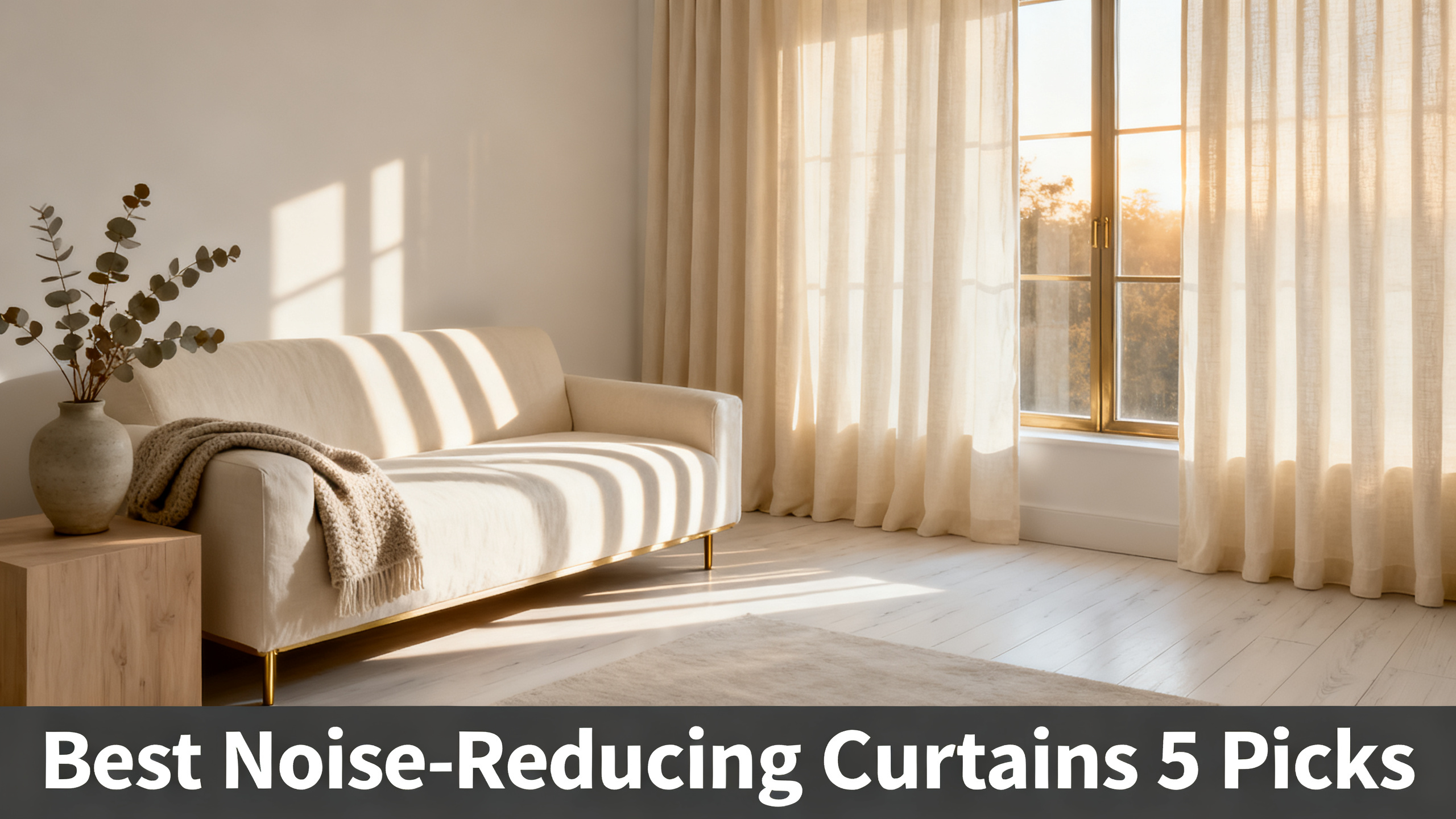
Most “noise-reducing curtains” you’ll see in a Google image grid are thin polyester panels at 140 to 180 gsm, marketed with words like “soundproof” that no fabric on Earth can deliver. The pick that wins this 2026 roundup is Birkin Velvet Curtain Pleated from Two Pages, and it wins on the only acoustic variable that actually matters: mass. Velvet pile is the densest fabric the catalogue ships, the pinch pleat header stacks that mass at the rod, and the 37 colourways mean you’re picking a living-room design pick that quiets the room as a side effect, not a backstage acoustic blanket.
Below, you’ll find four alternatives scored against four other scenarios: bedroom (where sleep depth and a snoring partner change the math), home office (where Zoom calls and on-camera glare matter as much as outside noise), studio (where you’re sealing a whole zone, not just a window), and rental (where reversible install protects the deposit). If the goal extends beyond noise into full light control and thermal performance, the blackout and heavyweight curtain hub maps every Two Pages dense-fabric collection in one place.

Quick Verdict
The five-pick shortlist below covers five distinct acoustic scenarios. Skim the comparison grid for the dB drop you can realistically expect, then jump to the pick that matches your room.
| Pick | Best for | Fabric & Mass | Est. dB drop | From / Panel |
|---|---|---|---|---|
| Birkin Velvet | Living rooms (street noise, editor’s pick) | Velvet pile, heaviest in line | 5 to 7 dB | $89 |
| Veda Cotton Velour | Bedrooms (sleep, snoring partner) | Cotton velour pile, ~290 gsm | 4 to 6 dB | $98 |
| Isabella Cotton + Interlining | Home offices (Zoom, WFH) | 3-layer mass-air-mass stack | 4 to 6 dB + reflected mid kill | $89.99 |
| Atlanta Room Divider | Studios / media rooms (isolation) | 252 gsm wall-to-wall + ceiling seal | 6 to 8 dB (wall use) | $200.99/kit |
| Liz Linen Blackout | Renters (apartment neighbour noise) | 350 gsm + blackout layer | 3 to 5 dB | $59.99 |
Editor’s Pick · Best for Living Rooms
Birkin Velvet Curtain Pleated
from $89/panel (final price depends on size & lining)
- Densest fabric in the catalogue, velvet pile is the highest-impact lever on mid-high frequency absorption
- Pinch pleat header doubles fabric volume at the rod, stacking more mass at the window plane
- 37 colourways, the noise pick that also reads as a living-room design statement
Configure Birkin on Two Pages →
Code JULY for 20% off · Free shipping over $300 · Up to 5 free fabric swatches
Read on for the four alternatives, scored by room, with the honest dB ranges and the configurator math each pick implies.
Do Curtains Actually Block Sound
Both, with caveats. Per CDC noise exposure guidance, conversational street noise sits around 60 to 70 dB, and the human perception of “halved loudness” lands at roughly a 10 dB drop. The realistic delivery on a heavyweight curtain hung with proper edge seal is 3 to 8 dB across mid to high frequencies. That’s enough to flip the perception from “intrusive” to “ambient” on speech and traffic, and exactly not enough on bass-heavy noise, HVAC drone, or close-range barking.
Best Soundproof Curtains, the Sister Roundup
If the use case sits closer to “isolate a recording corner” than “soften living-room traffic”, the soundproof roundup leads with track-mounted full-wall systems instead of window panels.
The reason the range tops out near 8 dB and not 20 is physics. Fabric absorbs sound through mass-induced reflection and viscous loss in the pile; doubling the GSM at the window plane buys you roughly 3 dB on the band the fabric is dense enough to engage. Stacking layers (face + lining + interlining) widens that band downward, but the bass end belongs to walls and glazing, not textiles.
“Soundproof” Is a Marketing Word, Not a Spec
No curtain on the market is “soundproof”. The honest spec is sound dampening, measured in dB attenuation across a frequency band. The realistic delivery on a heavyweight curtain hung with proper edge seal is 3 to 8 dB across mid to high frequencies, which is enough to make street voices feel muffled and to drop a noisy 65 dB hallway to a livable 58 dB room. It is not enough to block bass-heavy noise (a subwoofer next door), low-frequency mechanical noise (HVAC), or a barking dog at close range. If those are the use case, the answer is not a curtain, it is wall treatment or replacement glazing.
The takeaway is calibration. A curtain is the right tool for street voices, traffic, hallway noise, partner sounds, video-call echo, and most apartment neighbour noise above the kick-drum register. It is the wrong tool for bass response, mechanical hum, or aircraft overhead.
What “Acoustic Curtain” Actually Means
The spec to look at is fabric weight per panel. GSM (grams per square metre) directly proxies mass, and mass is the dominant acoustic variable on textiles. A 280 gsm velvet single layer outperforms a 180 gsm “triple weave” panel by a margin you can hear, because the weight class delta swamps the layer-count advantage. The industry standard for measured attenuation, ASTM E90 sound transmission loss method, runs on full assemblies, not loose panels, which is why honest manufacturer claims always cite a band and a hanging configuration, not a single dramatic number.
The second variable is the air gap. Inserting a flannel interlining between the face fabric and the lining creates two trapped air gaps and produces the classic mass + air + mass stack, the same principle behind double-glazed windows. Every 1 inch of trapped air at the panel adds usable attenuation on the mid band. This is why Isabella with the +$28 interlining sits at the top of the Sound Dampening column despite weighing less in raw GSM than Birkin.
Header Style Acoustic Implication (Fabric Volume at the Rod)
Pinch Pleat
2.0× to 2.5× fabric · best mass at rod
Goblet Pleat
2.0× fabric · formal, dense
Ripple Fold
1.8× fabric · steady waves
Grommet
1.5× fabric · open at top
Rod Pocket
1.5× fabric · gathered
Tab Top
1.3× fabric · worst for acoustics
Noise vs Light Coupling
The reason four of the five picks below also publish 99 to 100% shading is structural, not coincidental. Anything that adds mass at the window to attenuate sound also tends to block light by the same mechanism: dense fabric, dark backings, full edge overlap. The relationship is not symmetric (a thin coated blackout can hit 100% shading while delivering only 2 to 3 dB), but on heavyweight constructions the two metrics travel together.
Best Blackout Curtains, the Light-First Sibling
Four of the five picks below also publish 99 to 100% shading; the blackout roundup orders the same catalogue around light control instead of acoustics, useful when sleep depth is the primary buyer goal.
For the buyer, the practical consequence is leverage. A bedroom that needs both quiet sleep and 100% darkening can satisfy both goals with one panel choice, usually Veda or Lila-tier blackout. A home office that wants the curtain pulled open most of the day gets less acoustic benefit (the fabric is bunched, not deployed), which is why on-camera Zoom audio quality depends as much on absorbing in-room reflection as on blocking outside ingress.
How to Build a Noise-Reducing Window Setup
Lining and Interlining
Adding an interlining is the single largest acoustic upgrade you can make on a panel that already has mass; the six Two Pages lining options are documented with their shading, thermal and weight add-on values per panel. The interlining specifically (a layer of flannel cotton sandwiched between the face fabric and the standard lining) raises the panel from a 2-layer mass system to a 3-layer mass-air-mass system, which is where the math jumps non-linearly.
Two Pages Lining Options, Read for Acoustic Mass + Air Gap
Unlined
Single layer only · +$0
Cotton Lining
+1 layer mass · +$15/panel
Privacy Lining
+1 dense layer · +$20/panel
Blackout Lining
+1 heavy coated layer · +$25/panel
Thermal Blackout
Heavy + air gap · +$35/panel
Interlining (flannel)
Mass + 2 air gaps · +$28/panel · the acoustic upgrade
Edge Seal
The panel only delivers its rated mass attenuation where the fabric is. A 4 inch gap at the top of an over-rod install, a 2 inch side gap at the wall, a 1 inch lift off the floor: each is a high-pass acoustic path that bypasses the curtain entirely.
Edge Seal Tip: Sound Leaks Where Light Leaks
Acoustically, the panel only delivers its rated mass attenuation where the fabric is. A 4 inch gap at the top of an over-rod install, a 2 inch side gap at the wall, a 1 inch lift off the floor: each is a high-pass path that bypasses the curtain entirely. Mount the rod 4 to 6 inches above the frame, extend 6 to 12 inches past each side, run the drop to the floor or 1 inch onto it for the puddle effect. The Atlanta Room Divider gets its top score on this dimension because the ceiling track removes the largest gap by design.
Fabric & Certifications
The Two Pages catalogue runs to OEKO-TEX equivalent fabrication across the picks below; the OEKO-TEX Standard 100 certification means the fabric is tested for harmful substances and safe for prolonged indoor contact. For a panel hanging in a bedroom or a home office where you spend hours next to the fabric, it’s the verification worth checking before any acoustic claim.
Criteria Matrix: Each Pick Scored 1-5 Across Five Acoustic-Buyer Priorities
| Pick | Sound Dampening | Drape Weight | Edge Seal | Price | Install Flex |
|---|---|---|---|---|---|
| Birkin Velvet | 5 | 5 | 4 | 4 | 4 |
| Veda Cotton Velour | 4 | 5 | 4 | 3 | 4 |
| Isabella + Interlining | 5 | 4 | 4 | 3 | 4 |
| Atlanta Room Divider | 5 | 4 | 5 | 2 | 5 |
| Liz Linen Blackout | 3 | 3 | 4 | 5 | 5 |
Still weighing five picks? Living-room buyers end here.
Birkin Velvet, the densest fabric on the list
Velvet pile carries the mass that traffic and voice frequencies need; pinch pleats stack the mass at the rod; 37 colourways means the choice is design-first, performance-implicit.
Pick #1 (Editor’s Pick, Best for Living Rooms): Birkin Velvet Curtain Pleated
Drape
Velvet pile is the densest fabric Two Pages ships, and density is the single highest-impact lever on the speech and traffic absorption band (500 to 2000 Hz). The pinch pleat header stacks 2.0× to 2.5× the rod width in fabric, which physics-wise doubles the front-face fabric volume at the window plane. The drape reads drawing room, not backstage blanket, which is the difference between a curtain you keep up year-round and one you replace as soon as the design phase shifts. Buyers focused on the design tier of velvet rather than its acoustic side benefit from the dedicated best velvet curtains roundup, which orders five velvet picks on colour depth and pile finish instead of dB attenuation.
Light
Birkin in dark and saturated colourways (deep navy, forest, charcoal, brick) delivers effectively full shading at full drop with side overlap; ivory and oat run lighter, around 90 to 95% on the lux meter, useful in a living room where you want quiet but not full bedroom darkness. The shading number is a side benefit; the picks here are scored on mass first.
Price
Birkin Velvet Pleated configures from $89/panel on a 52″ × 96″ single-window setup, scaling predictably with width and drop. A standard 75″ × 108″ double window with privacy lining returns roughly $288 for two panels; a wide street-facing wall at 100″ × 108″ lands at ~$408. Apply code JULY for 20% off at checkout.
Real Pricing: Birkin Velvet for Common Living-Room Configurations
🪟
Single 36″ living-room window (52″W × 96″L, 2 panels)
~$198
unlined velvet pile
🏠
Standard double window (75″W × 108″L, 2 panels)
~$288
pinch pleat + privacy lining
🏛️
Wide street-facing wall (100″W × 108″L, 2 panels)
~$408
full wall-to-wall
Configured from Two Pages cart simulation. Apply code JULY for 20% off.
Verdict
Birkin Velvet is the most cross-applicable pick on the list. It wins the 5 to 7 dB acoustic test, the design transferability test (37 colourways), and the install flexibility test (it runs on any rated rod, no ceiling track needed). The trade-off is the velvet pile, which is finicky on day one (you flatten the rake direction with steam, not a press) and pile-rated for two to three years of heavy direct sunlight before any subtle fade shows on the brightest colourways. For a living room facing a busy street or a hallway pulling noise from the rest of the house, this is the default answer.
✅ Pros (Birkin Velvet)
- Densest fabric in the Two Pages catalogue, the single largest acoustic lever
- Pinch pleat header stacks fabric volume at the rod, multiplying effective mass at the window plane
- 37 colourways, performance pick that also reads as a design pick
- OEKO-TEX equivalent fabrication, in stock, lead time 2 to 3 weeks
⚠️ Cons
- Velvet shows pile direction shifts under raking light, finicky to flatten on day one
- Heavier panel weight requires a rated rod or ceiling track for spans over 75 inches
- From $89/panel base, scales to ~$200 on a wide street-facing window
Birkin Velvet Curtain Pleated Review (Honest Verdict)
The full deep-dive on Birkin: side-by-side drape against IKEA velvet imitations, colour accuracy on the 37 colourways, and the configurator math from $89 entry up to wide-window setups.
Editor’s Pick · Best for Living Rooms
Birkin Velvet Curtain Pleated
from $89/panel
Velvet pile, the densest fabric Two Pages ships; 37 colourways; pinch pleats stack mass at the rod.
Pick #2 (Best for Bedrooms): Veda Luster Cotton Velour Drapery Pleated
Drape
Cotton velour combines pile depth with the natural fibre softening that pure synthetic velvet does not deliver. The luster surface absorbs harsh consonants in voices coming through walls, and the cotton hand reads soft cocoon against a headboard. ~290 gsm of fabric weight pulls the drape into a clean falling line; the pinch pleat header stacks 2.0× the rod width in mass at the window plane.
Light
Veda delivers 98 to 100% light shading at full drop, which puts it inside the blackout-grade tier even without an added blackout lining. For a bedroom where the goal is sleep continuity, this is the convenient overlap: the same mass that quiets the room also flattens dawn light without any configuration upcharge.
Price
Veda configures from $98/panel, the highest entry on this list and the gap is in the cotton velour pile itself (a more expensive base than synthetic velvet by yardage). A pair of pinch pleat panels on a standard 75″ × 96″ bedroom window returns ~$298 configured, before swatch lining add-ons. Code JULY applies 20% off at checkout.

Verdict
Veda is the bedroom answer when the buyer wants cotton-fibre warmth without giving up acoustic mass. It absorbs 4 to 6 dB on the mid band, delivers 98 to 100% shading by side-effect, and reads as a soft architectural choice instead of a stage curtain. The constraint is the 3 week lead time and the $98 floor: this is not a budget pick. For a primary bedroom where the buyer also wants the drape to soften a snoring partner’s mid-frequency profile, the cost is justified.
Best for Bedrooms
Veda Luster Cotton Velour Drapery Pleated
from $98/panel
Cotton velour pile, dense and natural-fibre; 98 to 100% light shading; soft cocoon read against a headboard.
Pick #3 (Best for Home Offices, Zoom Calls): Isabella Heavyweight Cotton with Interlining
Drape
Isabella’s face fabric is 100% cotton at heavyweight gsm, with a matte finish that reads executive office and (critically) kills the on-camera ring-light glare velvet creates under direct illumination. The base drape is good; the interlining option is what unlocks the acoustic tier. Adding the +$28/panel flannel interlining at configuration time inserts a third fabric layer between the face and the standard lining, creating two trapped air gaps.
Light
Isabella with interlining + privacy lining lands around 95 to 98% shading, sufficient for a home office where the buyer rarely wants full pitch-black. The matte finish also stops the curtain itself from acting as a secondary light source on Zoom, which is the failure mode of velvet picks on camera.
Price
Isabella Heavyweight Cotton configures from $89.99/panel; the interlining adds +$28/panel; cotton lining adds another +$15/panel. A pair of panels on a 60″ × 96″ home office window with full interlining and privacy lining returns roughly $295 configured. The math reads more like an investment than a furniture purchase, but for a buyer on daily client calls, the call-quality delta is measurable.
Verdict
Isabella + Interlining is the WFH-call answer because the mass-air-mass stack absorbs reflected mid-frequency sound inside the room, which is the band that makes “cavernous Zoom voice” land badly with whoever is on the other side. It’s 4 to 6 dB on external noise, plus an additional 1 to 2 dB on internal reflection that doesn’t show up in window-only specs. The matte cotton finish handles the camera side. For a home office in an apartment or a converted spare bedroom, this is the surgical pick.


Best for Home Offices · Zoom
Isabella Heavyweight Cotton (with Interlining)
from $89.99/panel (+$28 interlining)
Three-layer fabric sandwich with two trapped air gaps, the classic mass-air-mass acoustic stack; matte cotton kills ring-light glare on camera.
Pick #4 (Best for Studios / Media Rooms): Atlanta Room Divider with Ceiling Track
Drape
Atlanta is the only pick on this list that seals the room rather than the window. Hung ceiling-to-floor on a pre-drilled aluminum track and run wall-to-wall, it builds a floating fabric wall around a recording corner, a podcast booth, a piano practice zone, or a separated work-from-home area in an open-plan apartment. The 252 gsm heavyweight polyester carries measured mass; the flush ceiling mount eliminates the top gap that wrecks most over-rod blackout setups acoustically.
Light
Atlanta publishes 99% shading, which is the high blackout band; the same flush ceiling mount that improves the acoustic edge seal also improves the light edge seal. For a media room buildout where the goal is both dark and acoustically dampened, the kit format delivers both in one install.
Price
Atlanta ships as a complete kit (curtain + aluminum track + end caps + end hooks + screws + roller hooks + a saw to trim the track to fit). The base Small A series (3′ to 4’6″ wide × 8.5′ tall) starts at $200.99/kit; the kit math scales to $334.99 for the XXX-Large A series (14′ to 18′ wide × 8.5′ tall). It is the most expensive entry on this list and also the only one that delivers vendor-claimed sound dampening on the product page.
Verdict
Atlanta is the studio/media-room answer because it’s the only pick that closes the largest acoustic leak (the top gap) by design. The 6 to 8 dB delivery on wall use is the highest sustained attenuation on the list, and the install flexibility (pre-drilled track, no permanent construction) is the highest install-flex score. The trade-off is the price floor: this is a $200+ commitment, not a $89 single-window pick. For a buyer building a permanent recording corner or converting a basement zone, the math works; for a single living-room window, Birkin is the right answer.
Best for Studios / Media Rooms
Atlanta Room Divider Blackout with Ceiling Track Kit
from $200.99/kit
252 gsm polyester wall-to-wall, ceiling-flush mount eliminates the top gap; the only Two Pages SKU with vendor-claimed sound dampening.
Pick #5 (Best Budget for Renters): Liz Linen Blackout Pleated
Drape
Liz Linen Blackout is a polyester-linen blend at 350 gsm, the lightest fabric weight on this list but the only entry under $80. The face reads as a chiné linen panel, which means the renter gets the high-end-look magazine bedrooms charge $200+/panel for, while the integrated blackout layer doubles as an extra layer of acoustic mass.
Light
Liz publishes 100% shading on the spec sheet; the integrated blackout coating delivers full light block in eight neutral colourways (ivory white through to sand beige and taupe). For an apartment bedroom where the buyer wants noise + light addressed in one panel and one rod setup, the overlap is the value.
Price
Liz Linen Blackout configures from $59.99/panel, the lowest entry on the list. A pair on a standard 60″ × 84″ apartment window runs ~$140 configured; code JULY drops that to ~$112 at checkout. The install is rod-and-hook reversible, which means the apartment tenant gets meaningful acoustic and light upgrade without losing a damage deposit on drill holes.
Verdict
Liz is the renter answer because it’s the only entry where the math works on a single-window apartment lease. The 3 to 5 dB delivery is the lowest on the list and that’s honest: 350 gsm doesn’t carry the mass of 290 gsm cotton velour, no matter how the marketing reads. For an apartment buyer facing neighbour noise through a shared wall window, it’s enough to flip the perception from intrusive to background, in a panel that ships in stock and installs the same week.

Best Budget for Renters
Liz Linen Blackout Curtains Pleated Drapery
from $59.99/panel
350 gsm polyester linen with integrated blackout layer; reversible rod-and-hook install protects deposit; chiné linen look.
Pricing & Promo at Two Pages
Every pick on this list is made-to-measure, configured at checkout against the exact window dimensions and lining selection. The configurator quotes from $X/panel as the base, then scales linearly with width and drop; lining options add a per-panel upcharge that ranges from +$15 (cotton) to +$35 (thermal blackout), with the interlining at +$28 sitting in the middle and delivering the largest acoustic upgrade. Code JULY applies 20% off sitewide; trade buyers can use VIP22 for 22% off. Free shipping kicks in above $300.
| Spec | Birkin | Veda | Isabella+IL | Atlanta | Liz |
|---|---|---|---|---|---|
| Material | Velvet poly | Cotton velour | 100% cotton + flannel IL | Poly heavyweight | Poly linen blend |
| Weight / Build | Heavy pile | ~290 gsm pile | Heavy + 2 air gaps | 252 gsm | 350 gsm + blackout |
| Est. dB drop | 5 to 7 | 4 to 6 | 4 to 6 + reflected | 6 to 8 | 3 to 5 |
| Headers | Pinch pleat | Pinch pleat | Pinch pleat | Grommet 1.6″ | Pinch pleat |
| Max custom | 112″W | 112″W | 112″W | 18’W (XXX-Large) | 112″W |
| Lead time | 2 to 3 wks | 3 wks | 3 to 4 wks | In stock | In stock |
| Cert. | OEKO-TEX eq. | OEKO-TEX eq. | OEKO-TEX eq. | OEKO-TEX eq. | OEKO-TEX eq. |
🎁 Order the Birkin Velvet Sample Book (37 colours) for $3.99
Tape two swatches over a hard wall behind a speaker for one afternoon. The dB drop at conversational volume is the closest at-home preview of what mass-driven attenuation feels like. Ships in 3 to 5 days.
Who Each Pick Is For
The decision collapses to five mutually exclusive room-and-budget buckets. The Criteria Matrix above scored each pick on five axes; the matrix below converts those scores into the room they map to. Skim, pick, configure.
Who Is Each Pick Actually For?
🛋️
Living room facing street traffic
→ Birkin Velvet, densest pile, design tier.
🛏️
Bedroom, light sleeper, partner sounds
→ Veda Cotton Velour, soft pile + 98 to 100% shading.
💼
Home office on daily video calls
→ Isabella + Interlining, mass-air-mass, matte cotton on camera.
🎙️
Studio / podcast / piano corner
→ Atlanta Room Divider, ceiling-flush wall-to-wall.
🏘️
Renter, no-drill, apartment neighbour
→ Liz Linen Blackout, from $59.99, reversible install.
FAQ
Do curtains actually block sound or is that marketing?
Both. No curtain is “soundproof”, that word is marketing. What dense curtains do, reliably, is dampen mid and high frequency sound through fabric mass and air-gap interception. Independent acoustic testing on heavyweight velvet and lined cotton drapes shows 3 to 8 dB attenuation in the 500 to 2000 Hz speech and traffic band when hung with full edge seal. That is enough to make a 65 dB street feel like a 58 dB room, which is the difference between “intrusive” and “ambient”. It is not enough for bass, HVAC drone, or a barking dog at close range.
How many dB can a noise-reducing curtain realistically drop?
3 to 8 dB on conversational and traffic frequencies is the honest range. Birkin Velvet (heaviest fabric in this list) lands at the top, 5 to 7 dB; Liz Linen Blackout at entry mass lands at the bottom, 3 to 5 dB. The Atlanta Room Divider used wall-to-wall reaches 6 to 8 dB because it eliminates the top gap most window installs leak through. Anyone marketing “20 dB” or “30 dB” from a fabric curtain alone is overpromising. The honest expectation: a perceived halving of loudness in the dampened frequency band.
Are curtains better than acoustic foam panels?
Different jobs. Curtains target sound at the window plane and absorb reflected mid frequencies inside the room. Foam panels target reverberant decay across the whole room, mounted on hard walls. A studio mixing the two outperforms either alone. If the goal is keeping street noise out of the bedroom, curtains win on placement and aesthetics. If the goal is killing a Zoom call’s echo, Isabella with interlining + 2 small foam panels is the surgical move.
Does the “triple weave” claim matter for noise?
Marginally. “Triple weave” usually means three layers of polyester woven together to a higher GSM, and the higher GSM helps. But a single-layer 290 gsm velvet still outperforms a 200 gsm “triple weave” panel on mass-driven absorption, because mass is the dominant variable, not layer count. Verify GSM and total fabric weight per panel, not the marketing label. Birkin, Veda and Isabella all publish their weight tier on the spec sheet.
Do blackout curtains automatically reduce noise?
Often, yes, but not always to the degree the buyer expects. Blackout panels use either a coated backing or a heavy lining to reach 100% shading. That added mass also raises acoustic performance vs an unlined sheer. But a blackout panel optimised purely for light (thin coating, modest gsm) attenuates less than an unlined heavyweight velvet. Mass first, then light coverage, not the reverse. Liz Linen Blackout and Atlanta both hit the cross-over zone, that is why they appear on both this list and the blackout roundup.
How does interlining change the math?
Interlining is the largest single upgrade you can make to a panel that already has mass. Inserting a flannel cotton layer between the face fabric and the lining creates two trapped air gaps, and the classic acoustic principle is mass + air + mass = more attenuation than mass × 2. Isabella Heavyweight Cotton with the +$28 interlining option drops measurable mid-frequency reflected sound by an additional 1 to 2 dB over the same panel unlined. That is why it sits at the top of the Sound Dampening column for home offices.
Are noise-reducing curtains washable?
Spot clean and professional dry clean recommended for the velvet, velour and interlined cotton picks. Birkin and Veda lose pile loft after machine wash, which kills their acoustic edge as much as their visual one. Liz Linen and Atlanta polyester tolerate gentle cold machine wash with hang dry, but Two Pages care notes still preference dry clean to preserve pleat memory. For any cellular shade, dust-only with a vacuum brush.
Can a curtain block a snoring partner?
Partially. Snoring is broadband, with a strong mid-frequency component the curtain absorbs and a low-frequency component the curtain mostly does not. A heavyweight pile drape near the bed (not just at the window) can knock the perceived loudness back by 4 to 6 dB, which is enough to make the difference between “wakes me up” and “background hum I sleep through”. The honest pairing is Veda Cotton Velour around the bed alcove + a white noise generator as the low-frequency mask. The curtain alone is a half-solution.
Final Verdict
Birkin Velvet Curtain Pleated wins this 2026 roundup on the combined strength of the densest fabric in the Two Pages line, a pinch pleat header that stacks fabric volume at the rod, 37 colourways that hold across a wide design range, and a configured entry of from $89/panel. For a living room facing street traffic, a hallway pulling noise from the rest of the house, or a bedroom where the buyer wants both acoustic mass and design transferability in one pick, it is the most cross-applicable answer on the list.
The four alternatives each top their scenario. Veda Cotton Velour (5.0 bedroom drape) for sleep continuity with snoring profile attenuation; Isabella with Interlining (5.0 reflected sound kill) for daily Zoom calls; Atlanta Room Divider (5.0 edge seal, 5.0 install flex) for studio and media room isolation; Liz Linen Blackout (5.0 budget, 5.0 install flex) for apartment renters. Pick by room first, then by budget; the math holds.
Final Editor Verdict, Best Noise-Reducing Curtains 2026
4.6/5
★★★★★
Birkin Velvet Curtain Pleated wins the round on the combined strength of the densest fabric in the line, pinch pleat header that stacks mass at the rod, 37 colourways, and a $89 entry that holds across living rooms and bedrooms.
Veda Velour (5.0 bedroom drape), Isabella + Interlining (5.0 reflected sound kill), Atlanta (5.0 edge seal + isolation), Liz Linen (5.0 budget + renter flex) each top their scenario; Birkin remains the most cross-applicable default.
Birkin Velvet Curtain Pleated
from $89/panel
The most cross-applicable noise-reducing pick: densest fabric in the line, pinch pleat header that stacks fabric volume at the rod, 37 colourways from ivory to deep forest. Living-room first, but it survives a transfer to a bedroom or a Zoom-call backdrop.
Configure & Order on Two Pages →
Code JULY for 20% off · Free shipping over $300 · Made-to-measure
