
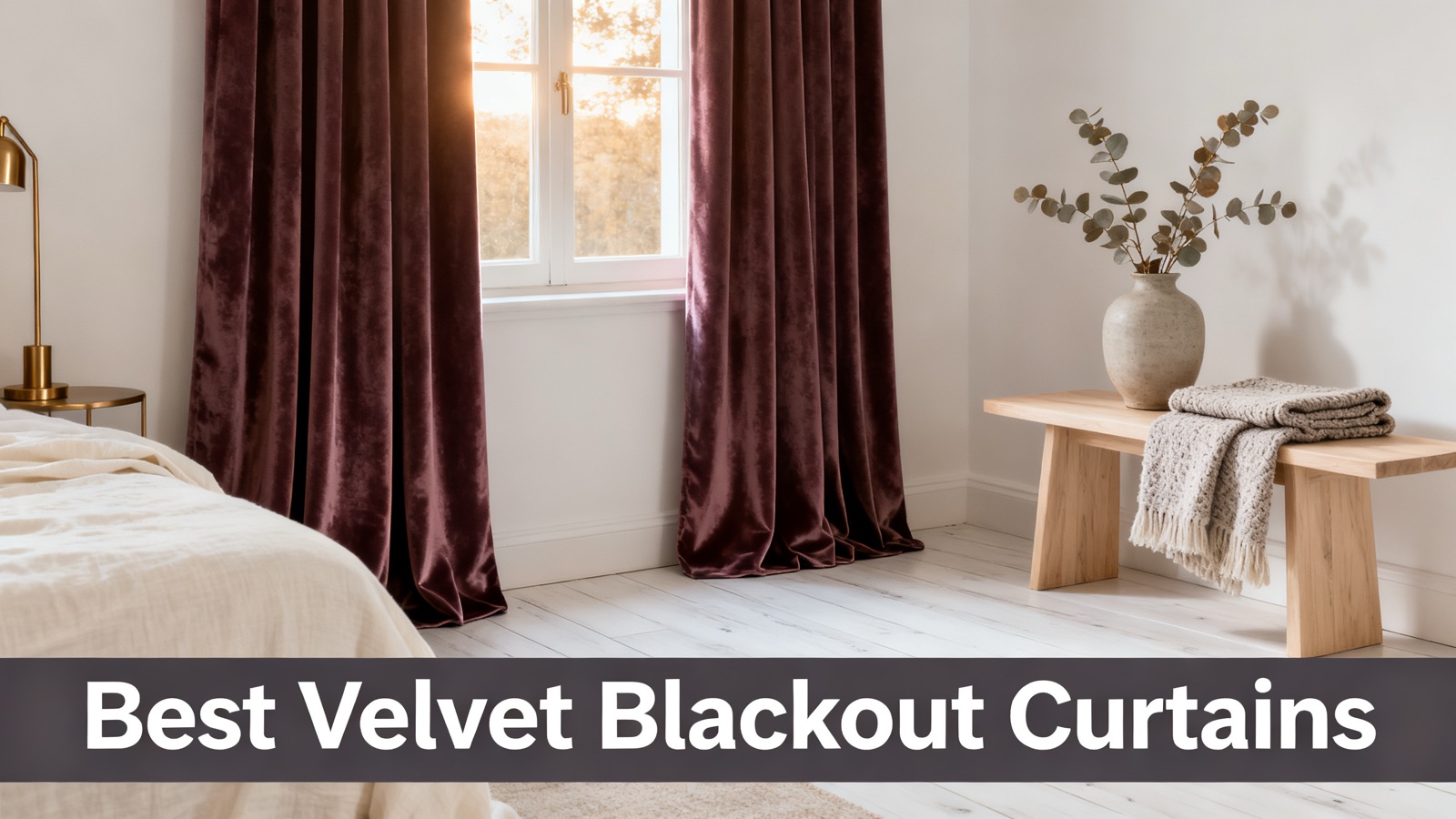
How We Screened the Velvet Blackout Lineup (Methodology)
Let me start with the number that matters. Out of the entire Two Pages velvet and velour lineup, 5 configurations survived a blackout-first screen. The Editor’s Overall Pick is the Birkin Velvet Pinch Pleat Thermal, the only velvet SKU at Two Pages explicitly packaged as thermal drapes with a pinch header tuned to seal the rod gap.
Every Two Pages collection sold under a “Velvet” or “Velour” label was pulled and filtered against a blackout-first criteria set. The screen required 300 gsm or heavier, or compatibility with the 100% blackout liner, plus OEKO-TEX Standard 100 certification, 6+ lining options at checkout, and a base panel under $150.
Variations of the same fabric identity got collapsed into one entry per pile-and-weight body, so you are looking at 5 distinct textile decisions, not 5 near-duplicates. Two Birkin variants that share the 300 gsm body but differ on header packaging and loom width still count separately here because the blackout tradeoffs shift meaningfully between them.
🧮 Our blackout-first screening method
We pulled every Two Pages collection sold under a “Velvet” or “Velour” label and filtered against a blackout-first criteria set: 300 gsm or heavier OR compatible with the 100% blackout liner, OEKO-TEX Standard 100 certified, 6+ lining options at checkout, and a base panel under $150. Variations of the same fabric identity were collapsed into one entry per pile-and-weight body.
Each survivor was then scored on 6 blackout-focused axes: light block unlined, light block with the 100% blackout liner, weight and stack-back bulk, color range, wide-window fit, and value per panel at the configurator. 5 picks came out of the screen, ordered Editor’s Overall first, then by descending use-case relevance.
For the broader picture across polyester, linen, and cotton blackout options beyond velvet, see our blackout curtains hub.

Editor’s Overall Pick
Birkin Velvet Pinch Pleat Thermal
from $89/panel (final price depends on size & lining)
- 300 gsm velvet, blocks 90 to 95% of light unlined
- Pairs with 100% blackout liner for true bedroom blackout
- 37 colors, OEKO-TEX Standard 100, 10-12 day lead time
Code JULY for 20% off · Free shipping over $300 · Up to 5 free fabric swatches
Why Velvet Reads as Blackout Even Before the Liner
Here is the physics behind the pile. Velvet at 300 gsm is not just heavy fabric, it is a directional pile that catches and diffuses incoming light instead of transmitting it.
The short cut pile on the Birkin body sits perpendicular to the weave. Light hitting the room-side face gets scattered by thousands of vertical fiber tips before it can pass through the base weave. The result is a fabric that filters 90 to 95% of room-side light before you add anything to the back.
That is a heavier optical signature than most polyester panels sold with a “blackout” label at big-box stores, which typically run 150 to 220 gsm and rely entirely on the coating. Backing this out with the DOE data on heavy-drape thermal performance, the same pile that blocks light also traps a boundary air layer at the window, which is why the Birkin thermal packaging exists in the first place.
Velvet behavior across weight, drape, and color context is documented in the velvet curtains hub, with the pile-and-weight math that anchors this roundup.
The takeaway for shopping is straightforward. Pile density and grams-per-square-meter correlate directly with unlined light block. Birkin at 300 gsm reads as 90 to 95% unlined. Tavis at 117 gsm drops to roughly 60% unlined, a spec-honest number that reframes what “premium velvet” means when the room actually needs blackout. Veda cotton velour sits in between at around 70% unlined, with a natural-fiber hand that changes how the pile catches morning light.
One nuance owners flag on Trustpilot: color matters more than most buyers expect on the unlined blackout number. Deep saturated colors (Midnight Blue MJ11-108, Warm Black MJ11-111, Brown MJ11-18) filter closer to the top of the 90 to 95% range because the dyed pile absorbs the light instead of reflecting it forward. Pale colors (Ivory MJ11-57, Cashmere MJ11-2) sit at the lower end of the range. If your window faces east and you want the darkest room possible without the 100% blackout liner, the color choice itself is a lever you can pull for a few points.
Big Comparison Grid, 5 Picks × 6 Blackout Criteria
Two things to know before we dig in. First, every survivor of the screen carries OEKO-TEX Standard 100 certification, so we did not need to weight fiber safety separately. Second, all 5 accept the 100% blackout liner at checkout, so the interesting spread is really about how the fabric behaves before the liner and how the full stack-back feels once you add it.
Top-line takeaways from the grid. The three Birkin bodies sweep the top of the blackout scorecard because they share the same 300 gsm pile: the pinch thermal wins the sealed-header slot, the pleated wins the widest header choice, the extra wide wins the seamless 100-inch coverage a doorwall needs.
Tavis takes the value-versus-bulk tradeoff: 117 gsm costs about a third of the stack-back of Birkin at the wall, which matters more than you would think in a 10-by-10 office. Veda is the only natural-fiber survivor, the pick when the room brief is a nursery and the material argument is breathability.
The broader Two Pages velvet lineup, ranked by room
If blackout is not the top priority, the same 5 velvet collections compared without the blackout weighting.

Top of the blackout scorecard
Birkin Pinch Pleat Thermal sweeps Blackout with Liner and Weight.
If you want the only Two Pages velvet SKU packaged as thermal and a header tuned to seal the rod gap, this is the pick to configure first.
How the 100% Blackout Liner Changes Every Pick
Real talk: on velvet, blackout lives or dies at the liner interface. The 6 Two Pages linings do not all move the needle equally, and picking the wrong one is how buyers end up disappointed at 6 am.
Unlined on 300 gsm Birkin already sits at 90 to 95% block, which is enough for a living room but not for a bedroom facing east. Sheer lining barely moves the number, mostly a hand upgrade.
Cotton lining adds roughly 5 to 8 points, which pushes Birkin into low-to-mid-90s territory but never true dark. Room darkening gets you to about 98%, close enough for guest rooms. Only the 100% blackout liner is the true dark option, and it works on every velvet in this roundup.
🧵 The 6 Two Pages linings, ranked by light block on velvet
Unlined
On 300 gsm velvet the pile alone filters 90 to 95% of room-side light. On 117 gsm Tavis, closer to 60%. On cotton velour, roughly 70%.
Sheer lining
Minimal added light block, mostly a hand and pleat-fall upgrade. Not the blackout choice.
Cotton lining
Adds weight, deepens saturation, boosts unlined behavior by roughly 5 to 8 points. Best general-purpose choice on Birkin.
Thermal lining
Adds insulation value on the room side. Light block reads similar to cotton lining, roughly 93 to 98% paired with 300 gsm velvet.
Room darkening liner
Pushes to roughly 98% block on 300 gsm velvet. Almost blackout, not quite. Fine for guest rooms.
100% blackout liner
The only lining that hits true blackout. Required for bedroom, home theater, or kid-room deep-nap conditions. Works on every velvet in this roundup.
For the full mechanics of foam-back versus 3-pass coated versus bonded blackout, see our guide on how to choose a blackout liner, which applies verbatim to every Two Pages velvet in this roundup.
The short version: the 100% blackout construction is a bonded 3-pass coating that blocks essentially all visible-light transmission. The reason it is priced as a premium add-on is that the coating is heavier than the cotton lining option. Expect the liner to add $80 to $120 per panel depending on size.
One field-tested detail worth knowing before you configure. The blackout liner adds stiffness to the pleat fall on Birkin, which some owners like (the pleats hold their sculpted shape longer between steamings) and some do not (the drape reads slightly less fluid than the cotton-lined version). On Tavis at 117 gsm, the blackout liner takes over the visual body of the panel because the face fabric is lighter than the liner itself. That is a legitimate tradeoff to weigh at the swatch stage.
All Two Pages blackout curtains beyond velvet
Linen, cotton, and polyester blackout collections compared. Useful when velvet does not fit the room brief.
The 5 Picks
1. Bedroom & Home Theater: Birkin Velvet Pinch Pleat Thermal (Editor’s Overall)
This is the pick I would put in my own bedroom, and the reason is narrow but decisive. Two Pages sells the Birkin body in three configurations, and only this one is packaged with the pinch pleat header tuned to seal the rod gap.
That matters because on a bedroom window the top-edge light leak is what wakes you up at 6 am even when the panel itself is at 100% blackout. The deep sculpted pinch folds pull the top of the panel tight against the rod, which closes that gap in a way a rod pocket or grommet never quite manages.
Underneath the header, the fabric is the same 300 gsm dense polyester velvet as picks #2 and #3. That means 90 to 95% light block before you add anything, and true blackout once you specify the 100% blackout liner at checkout. Spec-side, this is OEKO-TEX Standard 100, 110-inch fabric width, 37 colors, base panel from $89.
Cart simulation returns roughly ~$200 for a 50 by 84 cotton-lined bedroom pair in Warm Black MJ11-111, and roughly ~$390 for a 100 by 96 pair with the 100% blackout liner in Midnight Blue. That is the configuration a home theater brief lands on.
✅ Birkin Pinch Thermal wins on…
- 90 to 95% light block unlined at 300 gsm, before you add anything
- True 100% blackout with the 100% blackout liner add-on
- Pinch pleat header tuned to seal the rod gap
- 37 colors, OEKO-TEX Standard 100, from $89/panel
❌ Skip Birkin Pinch Thermal if…
- You want a lightweight velvet that does not crowd a tight room
- You need a natural fiber, cotton velour or linen
- You prefer a non-pinch header (grommet, rod pocket)
Full Birkin Pinch Pleat Thermal review, configurator walkthrough
Liner choice, pleat seal at the rod gap, and the cart simulation for a true bedroom blackout setup.
Editor’s Overall Pick
Birkin Pinch Pleat Thermal · from $89/panel
The only Two Pages velvet packaged as thermal drapes. 300 gsm body, sealed pinch header, 37 colors, blackout-liner compatible.
2. Living Room Statement + Blackout: Birkin Velvet Curtain Pleated
Picture the room where the curtain has to read as decor first and blackout second. This is the Birkin for that brief. Same 300 gsm dense polyester velvet body as the thermal pick, same 37 colors, same 110-inch loom, same OEKO-TEX Standard 100 certification.
What changes is the packaging: 9 header styles instead of pinch-only, no thermal marketing, so the drape reads as living-room sculpture. Owners on Trustpilot consistently describe the look as “hotel lobby” or “classic drawing room”. The reason is the pile catches afternoon light in structured folds instead of the flatter face of a lighter velvet.
Blackout comes on demand. When the living room doubles as an evening TV space, add the 100% blackout liner and you land at true dark. When the daytime brief is decor plus 90 to 95% ambient block, stay with cotton lining and the fabric handles the rest.
Cart simulation returns roughly ~$190 for a 50 by 84 unlined pair in Ivory MJ11-57, and roughly ~$355 for a 100 by 96 cotton-lined pair in Midnight Blue MJ11-108. Base panel from $89.


✅ Birkin Pleated wins on…
- The widest velvet palette at Two Pages: 37 colors
- Same 300 gsm dense body, blackout-compatible with the liner
- 9 header styles versus pinch-only on Pick #1
- Reads as living-room decor first, blackout second
❌ Skip Birkin Pleated if…
- You want the header packaged for thermal + blackout out of the box (see Pick #1)
- You need to span 100 inches without a seam (see Pick #3)
- Your room brief is tight square footage, 300 gsm is too much bulk
Best for Living Room Statement + Blackout
Birkin Velvet Pleated · from $89/panel
Same 300 gsm Birkin body, decor-first packaging. Add the 100% blackout liner when the living room doubles as an evening TV space.
3. Sliding Glass Door & Wide Window: Birkin Velvet Extra Wide
Anyone who has tried to cover a 120-inch doorwall with stitched velvet panels knows the failure mode. The stitch line down the middle of the panel becomes a visible sag once the fabric relaxes. The pile direction on either side of the seam catches light differently, which reads as a bright vertical stripe from the room side.
The Extra Wide loom on this Birkin body engineers the problem out by pushing single-panel finished width up to 100 inches without a horizontal seam. Same 300 gsm polyester velvet as picks #1 and #2, same 37 colors, same OEKO-TEX Standard 100 certification.
Owner photos on Trustpilot confirm the pile direction stays consistent across the full opening, no bright stripe. For a 120-inch doorwall you still use two Extra Wide panels, but each one covers 60 inches finished at a comfortable fullness, so the center meet is a normal center meet, not a stitched seam.
Cart simulation returns roughly ~$240 for an 80 by 96 unlined panel in Cashmere MJ11-2, and roughly ~$440 for a 100 by 108 cotton-lined panel in Sapphire Blue. Base from $89.
🧵 Which headers seal the rod gap on velvet blackout
Pinch Pleat
The default on Birkin Thermal. Deep sculpted folds reduce the top rod gap that leaks morning light. Best blackout seal.
Goblet Pleat
Softer top fold, slightly more rod-gap leak than pinch. Good compromise for formal living rooms.
Rod Pocket
Tightest top seal in principle, but the rod itself becomes the leak. Add a valance for bedroom blackout.
Grommet
Visible rod, wide top gap. Skip for blackout use. Fine for living-room decor.
✅ Birkin Extra Wide wins on…
- Single panels up to 100 inches wide, no horizontal seam
- Consistent pile direction across the full opening
- Same 300 gsm Birkin body, blackout-compatible with the liner
- The right call for 120-inch doorwalls and bay window setups
❌ Skip Birkin Extra Wide if…
- Your window is under 72 inches wide, the standard Birkin fits
- You want the thermal packaging out of the box (see Pick #1)
- You need a lightweight velvet for a compact space
Best for Sliding Glass Doors
Birkin Extra Wide Velvet · from $89/panel
Same 300 gsm Birkin body, extra-wide loom. Single panels up to 100 inches wide without horizontal seam. Pairs with the 100% blackout liner for true patio-door blackout.
4. Home Office & Dining: Tavis Premium Velvet
Cards on the table about Tavis. At 117 gsm, the fabric alone is not blackout. That is not a criticism, it is the point of the SKU.
The lightweight body is roughly a third of Birkin’s density, which means the stack-back at the wall when the panel is open is roughly a third of the bulk. In a tight home office where a 300 gsm Birkin would crowd the wall and eat into the desk space, Tavis gives you the same pile aesthetic without the heavy footprint.
Paired with the 100% blackout liner at checkout, the combined stack still delivers true blackout and remains lighter and less bulky than a Birkin with cotton lining. That is the tradeoff that makes Tavis the right call for offices and dining nooks where the room brief is compact luxury plus dark-on-demand.
Palette is 16 designer colors anchored on Hazelnut, Wolf Gray, Neutral Gray, Indigo, Navy Blue, Burgundy, Grass Green. OEKO-TEX Standard 100 like the rest of the roundup.
Cart simulation returns roughly ~$225 for a 50 by 84 unlined pair in Hazelnut HY2028-3, and roughly ~$410 for a 100 by 96 pair with the 100% blackout liner in Navy Blue. Base from $109.

✅ Tavis wins on…
- Roughly a third the stack-back bulk of Birkin at the wall
- Full blackout with the 100% blackout liner add-on
- 16 designer colors, less commercial than the Birkin palette
- The right call for tight home offices and dining nooks
❌ Skip Tavis if…
- You want the unlined panel to hit 90%+ light block on its own (see Birkin)
- Your room needs a heavier, more dramatic drape
- You want a base panel under $100 (Tavis starts at $109)
Best Lightweight Blackout Option
Tavis Premium Velvet · from $109/panel
117 gsm alone is not blackout. Paired with the 100% blackout liner it delivers full blackout with far less bulk than Birkin, the right call for tight home offices and dining nooks.
5. Nursery & Kids Room: Veda Luster Cotton Velour
If it were my kid’s nursery, this is where I would land. Veda is the only 100% cotton velour in the Two Pages catalog, and the natural-fiber argument matters more in a room where a two-year-old is breathing 12 hours a day at low altitude.
Cotton velour runs lower static than polyester velvet, which parents on Trustpilot consistently flag as the deciding factor once the panel is in the room. Breathability is the other half of that argument: the natural fiber body handles humidity and temperature swings in ways synthetic pile does not.
On the blackout side, cotton velour alone blocks roughly 70% of room-side light unlined, which is not deep-nap conditions. The pairing with the 100% blackout liner is the whole point of this pick for kid rooms that need morning-nap-through-noon coverage.
Palette runs 12 muted colors anchored in Dusty Blush, Simple Taupe, Golden Oak, Ivory White, Slate, Midnight, Wasabi, Camel, Peacock, Mocha, Ocean, Platinum. OEKO-TEX Standard 100 certified.
Cart simulation returns roughly ~$210 for a 50 by 84 unlined pair in Dusty Blush, roughly ~$385 with cotton lining in Ocean, and roughly ~$430 with the 100% blackout liner. Base from $98.

✅ Veda wins on…
- 100% cotton velour, the only natural-fiber velvet in the catalog
- Lower static and better breathability than polyester pile
- 12 muted colors tuned for nursery and kid-room palettes
- Full blackout with the 100% blackout liner add-on
❌ Skip Veda if…
- Your room needs 90%+ block unlined before the liner
- You want the widest color palette in the roundup
- You need thermal packaging out of the box (see Pick #1)
Best Natural-Fiber Blackout for Nursery
Veda Luster Cotton Velour · from $98/panel
The only 100% cotton velour at Two Pages. Breathable, lower static than polyester velvet. Pair with the 100% blackout liner for kid-room blackout without the polyester pile.
Pricing by Configuration & Header Choice
Boring number, real impact: base panel prices ($89, $98, $109) tell you almost nothing about what the panel will cost in your specific room. Cart simulation on the Two Pages configurator returns a range that scales with size, header, and liner.
A bedroom pair at 50 by 84 with cotton lining lands around ~$200. A home theater pair at 100 by 96 with the 100% blackout liner pushes to ~$390. A sliding door pair at 120 by 96 with Extra Wide plus blackout liner reaches ~$440.
All three scenarios below use the Birkin Pinch Pleat Thermal as the reference point. If you switch to Tavis or Veda, expect the configured totals to shift by roughly $20 to $40 per panel at similar sizes, mostly driven by the base panel delta.
Pricing by configuration: Birkin Pinch Pleat Thermal
🛏️
Bedroom, cotton lined
(50″W × 84″L, 2 panels)
~$200
Warm Black MJ11-111
🎬
Home theater, 100% blackout
(100″W × 96″L, 2 panels)
~$390
Midnight Blue MJ11-108
🚪
Sliding door, blackout
(120″W × 96″L, 2 wide panels)
~$440
Extra Wide + 100% blackout
Pricing simulated in the Two Pages configurator. Apply code JULY for 20% off.
On the header side, the choice is not purely aesthetic when blackout is the goal. Pinch pleat is the strongest rod-gap seal, which is why the thermal packaging defaults to it.
Goblet is close behind, with a softer top fold that leaks marginally more morning light. Rod pocket looks tight but the rod itself becomes the leak, so bedroom setups usually need a valance over the top. Grommet is a hard skip for blackout use because the visible rod and the top gap between grommets both bleed light.
If the blackout goal is true dark at 6 am, order the pinch header on Birkin or Tavis and specify the 100% blackout liner.
📏 Tip: return brackets make or break the blackout seal
Even the 300 gsm Birkin body will leak light around the sides if the panel hangs flat against the wall. A 3 to 4 inch return bracket pulls the panel back to the wall on both sides, closing the vertical light leak. On sliding doors, extend the rod at least 6 to 8 inches past the frame on each side so the panel can fully clear the glass when open and fully cover when closed.
Two Pages recommends measuring rod-to-floor for the drop rather than window-to-floor. The rod-side measurement is what the panel actually needs to span for the blackout seal.
| Collection | Composition | Weight (gsm) | Liner Options | Colors | Base Price |
|---|---|---|---|---|---|
| Birkin Pinch Pleat Thermal | 100% Polyester Velvet | 300 | 6 (incl. 100% blackout) | 37 | from $89 |
| Birkin Velvet Pleated | 100% Polyester Velvet | 300 | 6 (incl. 100% blackout) | 37 | from $89 |
| Birkin Extra Wide | 100% Polyester Velvet | 300 | 6 (incl. 100% blackout) | 37 | from $89 |
| Tavis Premium Velvet | 100% Polyester Velvet | 117 | 6 (incl. 100% blackout) | 16 | from $109 |
| Veda Cotton Velour | 100% Cotton Velour | heavyweight (cotton) | 6 (incl. 100% blackout) | 12 | from $98 |
Two Pages Pricing, Lead Time & Promo
Quick context before the swatch pitch. Two Pages runs a made-to-order model, which means every panel gets cut, sewn, and lined to your exact configuration rather than pulled off a shelf. That is why the pricing is transparent to the last inch and why the lead time is real. If you have ever ordered from a ready-made retailer and gotten “8 feet” that measured 91 inches, this is the opposite of that.
Two Pages quotes 10 to 12 business days for made-to-order production plus 3 to 5 days shipping, so plan on about 17 days door-to-door for the continental US. The lead time is consistent across all 5 picks whether or not you add the 100% blackout liner.
Free shipping kicks in above $300, which every configured pair in this roundup crosses. Code JULY applies 20% off at checkout, stackable on top of the swatch program.
On the trust side, Trustpilot 4.5/5 across 5,000+ Two Pages reviews consistently flag color accuracy and blackout performance on the Birkin body as the two most-praised attributes. Lead time occasionally runs a day or two over quoted for larger custom sizes, particularly in November and December when the pre-holiday queue is longest. Order early if the project has a hard deadline.
🎁 Blackout on velvet lives or dies at the liner interface. Touch the swatches before you configure.
Up to 5 free fabric swatches per order. $8.99 shipping, 3-5 day delivery. Compare the 300 gsm Birkin pile against the 117 gsm Tavis hand and the cotton velour Veda side-by-side.
Which Velvet Blackout Curtain Should You Buy?
Between us, the 5 picks split cleanly by room brief. If you had asked me a decade ago how to shop velvet blackout, I would have told you to buy the heaviest fabric you could find and stop there. The real answer is more interesting: the fabric is only half the equation, the header and the liner do the rest. Here is where I would land depending on what your project actually looks like.
Coming back to the original question. If the room is a bedroom or home theater and you want the shortest path to true dark at 6 am, the Birkin Pinch Pleat Thermal with the 100% blackout liner is the pick, roughly ~$390 configured for a 100 by 96 pair.
If the brief is a living-room statement where blackout is on-demand, take the Birkin Pleated in your color and add the liner when the room doubles as TV space. For a sliding doorwall past 96 inches, the Birkin Extra Wide is the only pick that spans the opening without a seam.
For a compact office or dining nook, Tavis plus the liner keeps the stack-back small. For a nursery where breathability is non-negotiable, Veda cotton velour plus the liner is the natural-fiber answer.
One last piece of advice worth spending money on: the swatch program. On dark blues and burgundies the difference between the swatch under your kitchen light and the finished panel in your bedroom at dusk can read like two different colors. Five free swatches at $8.99 shipping is the cheapest insurance you will buy on a $400 panel decision. Configure after you touch the fabric, not before. Buyers who skip this step are the ones flagging color mismatch in the returns forum, and there are no returns on made-to-order.
Birkin Velvet Pinch Pleat Thermal
from $89/panel
300 gsm, 37 colors, OEKO-TEX. The only velvet SKU at Two Pages packaged as thermal + blackout-ready.
Code JULY for 20% off · Free shipping over $300 · 10-12 day lead time
FAQ
Do velvet curtains block light on their own?
At 300 gsm the Birkin polyester velvet body filters roughly 90 to 95% of room-side light unlined, which is heavier than most polyester panels marketed as “blackout” without a liner. That is not the same as true blackout. For a bedroom where you want the room fully dark at 6 am, add the 100% blackout liner. Lightweight velvet at 117 gsm (Tavis) blocks closer to 60% unlined and needs the liner to reach blackout.
How much does the 100% blackout liner add to a velvet panel price?
In the Two Pages configurator, the 100% blackout liner adds roughly $80 to $120 per panel depending on size and header, on top of the base panel price. On a 100 by 96 Birkin Pinch Pleat Thermal in Midnight Blue, the cart returns around $390 with the blackout liner versus around $200 with cotton lining. The uplift is consistent across Birkin, Tavis, and Veda.
Are polyester velvet or cotton velour better for a blackout bedroom?
Polyester velvet at 300 gsm has denser pile and deeper light filtering than cotton velour before any liner is added. Cotton velour has lower static and better breathability, which parents flag as the key argument for nurseries. For a light-controlled adult bedroom, 300 gsm polyester velvet paired with the 100% blackout liner is the strongest performer. For a kid room where breathability matters, cotton velour plus the same liner is the better call.
Do velvet blackout curtains help with soundproofing?
The dense pile at 300 gsm absorbs mid and high frequencies more than equivalent-weight cotton or linen, which translates to a perceptible reduction in echo and street noise at real windows. It does not stop low-frequency bass. Owner reviews on Trustpilot consistently flag the noise reduction effect on the Birkin Pinch Pleat Thermal at street-facing bedroom windows.
How wide is one Birkin velvet panel for a sliding door?
The standard Birkin Pleated tops out at roughly 60 to 65 inches of finished panel width per panel before a horizontal seam is required. The Birkin Extra Wide loom pushes single-panel width up to 100 inches without a seam. For a 120-inch sliding-glass doorwall you would still use two Extra Wide panels, but you avoid the visible center sag that stitched velvet panels develop across wide openings.
What is the lead time on custom velvet blackout curtains?
Two Pages quotes 10 to 12 business days for made-to-order panels plus 3 to 5 days shipping. That window is consistent across Birkin Pinch Pleat Thermal, Birkin Pleated, Birkin Extra Wide, Tavis Premium, and Veda Cotton Velour, whether or not you add the 100% blackout liner. Trustpilot reviewers report most orders arriving inside 14 days door-to-door for the continental US.
Can I return velvet blackout curtains if the color does not match?
Two Pages custom-made panels are final sale, so returns for color mismatch are not accepted. That is why the free fabric swatch program matters, up to 5 free swatches per order at $8.99 shipping. Compare the swatch in the actual room light before you configure the panel, particularly for dark blues and burgundies that read very differently under north versus south exposure.
Do I need thermal-blackout or is 300 gsm velvet enough alone?
For living-room decor where you want deep folds and 90 to 95% light block at night, 300 gsm velvet alone is enough and looks better without the added stiffness. For a bedroom where morning light matters or a home theater where you need a fully dark room mid-day, the 100% blackout liner is the required add-on. Thermal lining is a middle option that adds insulation value without full blackout, useful in cold-winter bedrooms.
