
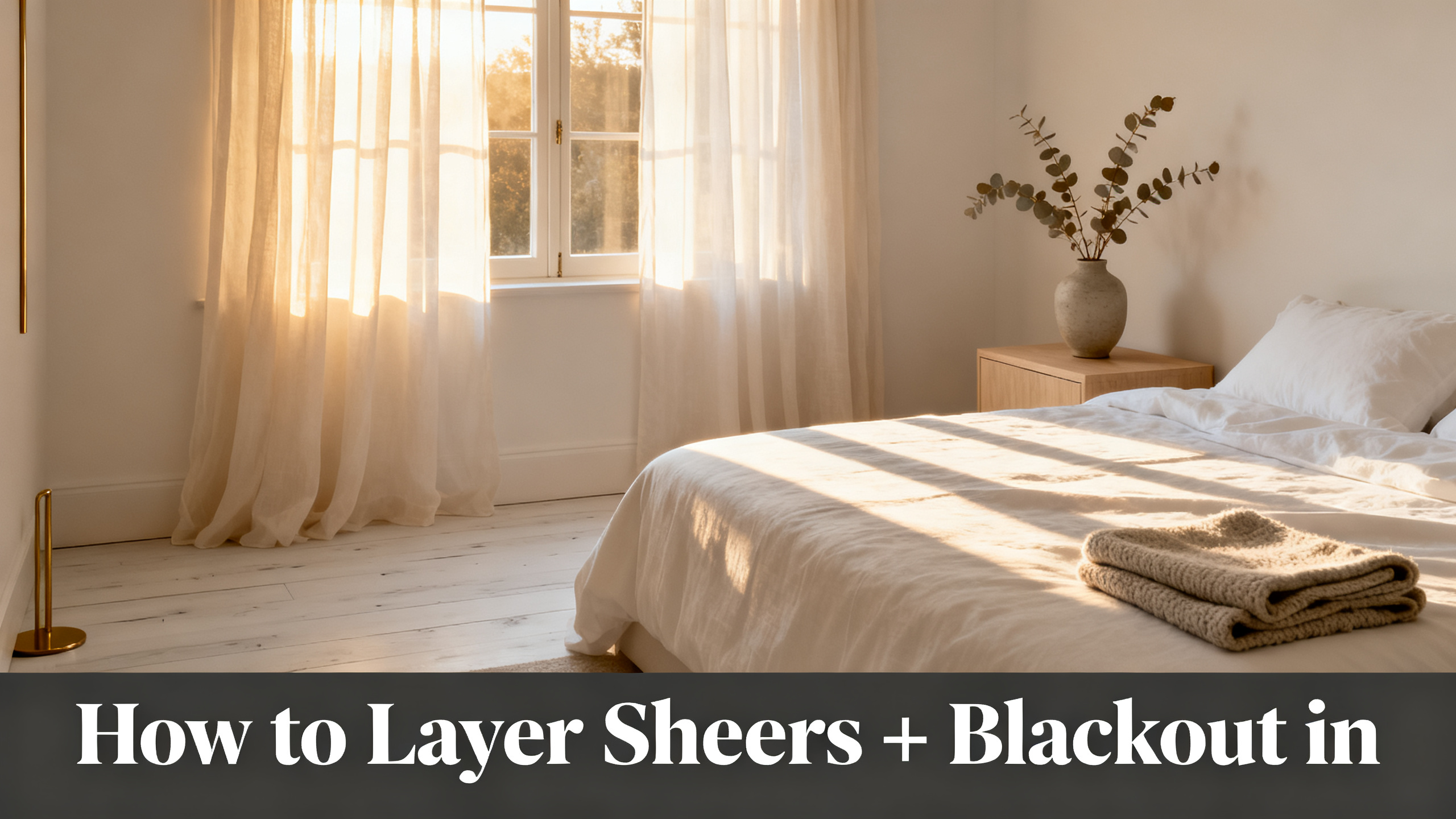
Most first-time bedroom layerers stack a 200 gsm sheer behind a 252 gsm blackout and call it layered. That is not layering. That is laundry piled on a rod.
Real bedroom layering starts with a 90 gsm sheer in front and a 252 gsm blackout behind, at a 1:3 GSM ratio, with the sheer doing 8 daily light-changes and the blackout locked shut from 9pm to 6am. This guide walks through the 7 bedroom-specific decisions that separate a hotel-dark sleep setup from a nursery-Pinterest board that leaks dawn light. If you want the wider context, the full bedroom curtains hub covers everything else on the room. According to Sleep Foundation data on light and sleep, even low-intensity ambient light delays melatonin release and cuts deep-sleep percentage, which is exactly why the return-depth seal matters at 5am.
The 3 Bedroom Layering Mistakes That Wake You Up At 5am
⚠️
Matched GSM stack
200 gsm sheer behind 252 gsm blackout reads as two identical panels. Fix: front sheer 90 gsm, back blackout 252 gsm, ratio 1:3.
⚠️
Sheer behind blackout
Order reversed. The sheer moves 8 times a day, blackout twice. Front-back position follows workload, not intuition.
⚠️
Single rod for both
252 gsm blackout drags a 90 gsm sheer out of alignment on every slide. Double rod is not optional in a bedroom.
The bedroom method fixes all three in 7 decisions.

The 252 gsm back layer that carries the dark-sleep half of the combo
Atlanta 100% Blackout Curtain Pleated
from $79/panel · 100% polyester · 252 gsm heavyweight · 100% shading rate · pinch pleat header · body memory shaping supported · 9 colorways. Final price depends on size and lining.
Use code JULY for 20% off · Free shipping over $300 · Curtain hooks included
The 7 Bedroom Layering Decisions At A Glance
Sounds like a lot of rules for two pieces of fabric. It is. The good news: the 7 decisions collapse into 4 numbers on your shopping list once you know them. Front-back order, return depth, GSM ratio, header type. Get those four right and the other three follow.
Bedroom layering differs from living-room layering on three pivots. The GSM ratio tightens to 1:3 instead of 1:4, because the back layer is a functional 100% blackout, not a decorative drape. The return depth goes to 4 inches minimum, not 2.5, because 5am dawn light leaks around any narrower panel edge. And the choreography adds a third state, the 5am dawn scenario, where the blackout is still shut and the sheer has not yet moved.
The 7 Bedroom Layering Decisions
🌙 1. Front-back order
Sheer front, blackout back, always.
📐 2. Return depth
4 inches minimum. Standard 2.5 leaks.
📏 3. Rod configuration
Double rod default. Never single.
🌗 4. GSM ratio
1:3 bedroom. 1:4 is living-room.
🧵 5. Header match
Same header both panels. No mixing.
⏰ 6. Choreography
Sheer 8 opens/day. Blackout 2.
🌅 7. Width and fullness
2x per layer, not shared. Plus 4-inch return per panel. Both matter for the sunrise seal.
Decision #1: Order And Why Blackout Always Goes Back
The rule: sheer in front, blackout behind, in about 97% of bedroom setups. This is the opposite of what most nursery Pinterest boards show, and it is why those setups leak light around the panel edges at 5am.
The mechanical reason is workload. The sheer moves 6 to 8 times a day for daily light control, which is the panel that needs to be reachable without pulling the whole system out of alignment. The blackout closes once at 9pm and opens once at 6am, so it can sit at the back doing the night-lock job. Front position always follows daily workload. If you would rather see the living-room variant where the back layer is a decorative drape at 350 gsm instead of a 252 gsm functional blackout, order the Atlanta 100% Blackout via the Two Pages configurator, then check the drape-only guide for the layering math that changes.
How to Layer Sheers and Drapes Like a Designer
The living room variant where the back layer is a decorative drape at 350 gsm rather than a 252 gsm blackout, with GSM ratio 1:4 instead of 1:3 and the sheer front doing all the daily labor.
The aesthetic reason is that the bedroom window reads as two faces. Day face is the sheer, the layer you actually see from 7am to 8pm. Night face is the blackout, the layer that takes over after bedtime. Reverse the order and the day face disappears behind a wall of dark 252 gsm, which is why the reversed setup always reads as a rental blackout retrofit, no matter the fabric budget.
The 3% exception: renters with pre-installed roller-blackout shades on the window itself. In that case, the roller shade does the night-lock and you add a single sheer curtain in front as a decorative day-face layer. That is a different problem and not what this guide is calibrated for.
Decision #2: Return Depth And The Sunrise Leak Nobody Photographs
Return depth is the distance the rod wraps back toward the wall at the end of the panel. Bedroom setups need 4 inches minimum, sometimes 6 on east-facing summer windows, so 5am dawn light cannot leak around the blackout edge. This is the single most-skipped bedroom-specific spec.
Living-room panels get away with 2.5-inch returns because the light angle at midday hits the window face-on and the sides do not leak. Bedroom windows deal with dawn and dusk, both at shallow angles, both hitting the panel edge rather than the panel face. A 2.5-inch return leaves a 6-inch strip of dawn light bleeding onto the ceiling above the headboard.
Sheer Front, Blackout Back: The Side View
🌅
Dawn 5am
Blackout closed, sheer closed. 4-inch return seals the panel edge, no ceiling leak above headboard.
☀️
Midday
Blackout open, sheer closed. Diffuse light through 90 gsm, glare cut, view softened.
🌙
Bedtime 9pm
Blackout closed, sheer closed. 100% shading rate confirmed on Atlanta spec, dark-sleep locked.
Front rod projects 6 to 8 inches from wall. Back rod projects 3 to 4. Gap 3 to 4 inches so the two layers never touch.
Real talk on the standard-rod trap: most big-box double rods ship with a 2.5-inch return default and cannot seal a bedroom blackout. The fix is either an extended-return double rod (usually sold separately) or a pair of wraparound end brackets you swap onto the rod ends. Neither is expensive, both are invisible in the showroom, and both are the difference between a real dark-sleep bedroom and a nice-looking daytime-only setup.
Decision #3: Single Wide Rod, Double Rod, Or The Wraparound Cheat (Bedroom Edition)
Three configurations exist. Purpose-built double rod with extended return brackets, two independent single rods stacked with wraparound end brackets, or single wide rod with a wraparound cheat. Each has a cost and effort trade-off.
The bedroom version disqualifies one of them immediately. A 252 gsm blackout is too heavy to share a rail with a 90 gsm sheer. The blackout weight drags the sheer out of alignment on every slide, the two hooks foul on each other, and the sheer starts to hang crooked within a month. Single wide rod with wraparound bracket is a living-room trick, not a bedroom one.
How to Hang Bedroom Curtains (Complete Guide)
The height, projection, and side-return math for a bedroom setup, with the double-rod bracket depth that a 252 gsm blackout back layer plus a 90 gsm sheer front layer specifically demand.
⚠️ Important: Single rod for bedroom blackout, never. A 252 gsm blackout on the same rail as a 90 gsm sheer will pull the sheer crooked within four weeks and foul the hooks on every slide. Use a purpose-built double rod with extended return brackets, or two stacked single rods for renters.
Purpose-built double rod is the default for owners. Two stacked single rods with wraparound end brackets is the renter-friendly workaround, since some rental agreements limit the number of anchor holes per wall. Either config supports the front-back projection math: back rod 3 to 4 inches from wall, front rod 6 to 8 inches from wall, gap of 3 to 4 inches between so the layers never touch during a slide.
Decision #4: The GSM Ratio Bedroom Layering Actually Wants (1:3, Not 1:4)
The bedroom ratio: front sheer at 60 to 100 gsm, back blackout at 220 to 300 gsm, so the ratio sits between 1:2.5 and 1:3.5. Flynn Airy at 90 gsm paired with Atlanta Blackout at 252 gsm hits 1:2.8, essentially 1:3. This is tighter than the living-room 1:4 designer window and it exists for one reason.
The bedroom back layer is functional blackout, not decorative drape. The eye reads a functional back layer as “one working system” better when the two panels are closer in weight. A living-room 1:4 with 90 gsm sheer plus 350 gsm drape reads as designed. Try that same 1:4 in a bedroom with 60 gsm sheer plus 240 gsm blackout and the sheer disappears against the blackout mass. The bedroom eye wants contrast, not disappearance.
Blackout Curtains: The Complete Guide
Everything the back-layer choice depends on: shading rate math, coating vs woven blackout, thermal side-effect, and the return-depth spec that decides whether sunrise light leaks around the panel.
Flynn Airy Sheer is polyester and OEKO-TEX Standard 100 certification confirms fabric safety in nursery-adjacent contexts, which matters if the bedroom shares an infant sleep zone. Atlanta Blackout runs the same polyester family, so both panels sit in the same safety register when the setup migrates from master bedroom to nursery.
Bedroom GSM Ratio 1:3 (Not Living-Room 1:4)
Front layer
90 gsm
Flynn Airy Sheer
Back layer
252 gsm
Atlanta 100% Blackout
Ratio
1:2.8
Bedroom window
Living-room is 1:4 (Liz Linen 350 gsm)
⚠️ Important: A 200 gsm sheer behind a 252 gsm blackout is not layering. That is two panels of similar weight in the same visual register. The eye reads “no design intent” and the room reads “hotel-2001”. Keep the ratio at 1:3, minimum 1:2.5.

The Front-Layer Sheer That Reads 1:3 Against Atlanta Blackout
Flynn Airy Lightweight Sheer Pleated ships at 90 gsm in the same pinch pleat header family as Atlanta Blackout. The GSM ratio (1:2.8 against 252 gsm blackout, essentially 1:3) is the bedroom-specific window that lets the sheer do daily light control while the blackout stays crisp for night lock. from $49/panel, 4 core colorways, 10 to 14 day lead.
Decision #5: Header Match (Bedroom Duo Reads As One System Or Not At All)
Matching headers is stricter in bedroom than in living-room. If both panels are pinch pleat, both are grommet, or both are rod pocket, the duo reads as a pre-matched bedroom system. Mismatched headers, say pinch pleat sheer with grommet blackout, read as an improv that spoils the hotel-darkness mood before the fabrics get a chance to matter.
The Two Pages advantage on this: both Flynn Sheer and Atlanta Blackout ship in the same pinch pleat header family with hooks included. Same header language, same hook geometry, same rod compatibility. Front-back panels align without pre-purchase gymnastics.
Header Style Match: Bedroom Duo Read-Test
✅ Matched
Pinch pleat + pinch pleat
Default Two Pages bedroom duo. Same hook geometry. Reads as one system.
✅ Matched
Rod pocket + rod pocket
Flat layered look, works if both panels stay static on side of window.
❌ Mismatched
Pinch pleat + grommet
Hooks foul on 6am slide. Wakes the partner. Reads hardware-store improv.
Hook clearance is a bedroom-specific side-effect. A mismatched header means the sheer hooks catch on the blackout hooks when both panels slide, adding a clunk at 6am that wakes a sleeping partner. In a living-room, that clunk is invisible because the panels rarely slide simultaneously. In a bedroom, it happens every day.
Body memory shaping supported on the Atlanta Blackout is worth noting here. Two Pages’ spec sheet describes it as a heat-shaping process that trains the pleats to hold their fold across the panel lifetime, so the blackout keeps its crisp column shape night after night instead of collapsing into wave-like drapes over 12 months. Bedroom blackout wants that crispness for the seal at the return corner.
Decision #6: The Bedroom Opening Choreography (5am Reality Added)
Picture the bedroom at 5am in June. The blackout is still down, the sheer has not yet moved, and the only thing between your partner and a wake-up flash of dawn is the 4-inch return at each panel edge. This is why the return depth spec from Decision #2 matters most here.
The bedroom rule: sheer moves 6 to 8 times a day for glare, view, and privacy. Blackout closes at 9pm and opens at 6am, so 2 opens per day. The choreography adds a third state that living-room layering does not have: the pre-dawn stretch when both layers stay closed and the return corners do all the sealing work.
Bedroom Layering Choreography Across A Summer Day
🌅
5am dawn
Both closed. Return depth 4 inches does the sealing work.
☀️
7am wake
Blackout opens. Sheer stays for diffuse light.
🌤️
Midday
Sheer only. 90 gsm cuts glare, keeps view.
🌙
9pm sleep
Both closed. 100% shading confirmed on Atlanta.
Partner-sleep offset adds a real edge case. If one partner wakes at 5am and the other at 8am, the blackout stays down until the earlier riser leaves the room, and the sheer opens later. The 5am partner navigates by the ambient light around the return corners, which is exactly why the return depth stays at 4 inches minimum. Any shallower and the earlier riser trips on the way out.
Decision #7: Width, Fullness, And The 2x Rule Per Bedroom Layer
Each panel needs 2x window width for proper fullness, and this does NOT get shared across layers. A 60-inch bedroom window needs 120 inches of sheer width AND 120 inches of blackout width. Bedroom layering does not shortcut this for the blackout.
Less fullness on the bedroom blackout leaves flat panels that show every wrinkle and read like a hotel room from 1998, not a boutique bedroom from 2026. A 1.5x fullness reads fine on a solo living-room drape but reads visibly flat under a layered sheer, because the sheer above catches sidelight and reveals every drape irregularity behind it.
Side-return math adds one more line to the shopping list. Order width equal to 2x window width + 4 inches of return per panel. A 60-inch window with 120 inches of fullness becomes 128 inches of finished panel width once the return is included. Miss this and the seal at the return corner leaks 5am light around the panel edge no matter how deep the return depth is set.
Order The 39 Collections Booklet Before You Pick Your Bedroom Layer Tones
Layering a Natural sheer against a Beige blackout in your bedroom means matching two tones under 5am dawn, midday sun, and 8pm bedside lamp. The 39 Collections Fabric Booklets ship flat, cover every Two Pages line (Atlanta Blackout and Flynn Sheer included), and are the only way to test how a Natural sheer reads against a Wheat blackout before the 10-day lead time starts.
The 4 Bedroom Layering Mistakes That Ruin Otherwise Good Fabrics
Cards on the table: 3 of the 4 mistakes are invisible in the showroom and show up at 5am on a summer sunrise. That is the failure mode nobody photographs, because photography happens at 11am when the panels look fine.
The 4 Mistakes That Ruin Bedroom Layering
⚠️ Blackout in front
Order reversed. Day face disappears. Room reads rental retrofit.
⚠️ Return under 4 inches
Standard 2.5-inch return leaks dawn light around the panel edge onto the ceiling above the headboard.
⚠️ GSM 1:1 matched
200 gsm sheer + 252 gsm blackout = zero visual contrast. Reads as two panels of the same weight.
⚠️ Header mismatch
Pinch pleat + grommet hooks foul each other on the 6am slide. Clunk wakes the partner.
The pattern is worth naming. All 4 are cheap to fix before the order goes in, and expensive to fix after the panels arrive. The blackout in front means new panels. Return under 4 inches means new rod. Matched GSM means new sheer. Header mismatch means new one of whichever panel is the odd one out. This is why the 7 decisions matter at the shopping list, not at the install.


The Duo That Ships Pre-Matched: Atlanta 100% Blackout + Flynn Airy Sheer
You’ve mapped the 7 bedroom decisions. If the shopping list still feels open, the Two Pages combination that ships all 7 pre-solved is Flynn Airy Lightweight Sheer Pleated in front, Atlanta 100% Blackout Curtain Pleated behind, both in matching pinch pleat header, GSM ratio locked at 1:3. Both panels ship in 10 to 14 days made-to-order with hooks included.
The practical case: same lead time, same header language, shared color-tuning through the 39 Collections booklet, body memory shaping on the blackout for the crisp night-lock. If you are still comparing the back-layer alternative before committing to the Atlanta, our our best bedroom curtains roundup maps the other Two Pages options that qualify as back-layer partners for a Flynn sheer. Direct configuration remains the fastest path, through the Atlanta 100% Blackout product page.
Atlanta Blackout + Flynn Sheer: The Bedroom Duo Config
Fabric weight
Flynn 90 gsm
Atlanta 252 gsm
Header
Pinch pleat
Matched both panels
Colorways
4 + 9
Flynn 4 core, Atlanta 9
Base price
from $49 + $79
Duo from $128/pair
Lead time
10 to 14 days
Both, aligned


Order The Bedroom Duo That Ships All 7 Decisions Pre-Solved
Atlanta 100% Blackout Curtain Pleated (252 gsm, 9 colorways, pinch pleat, body memory shaping) plus Flynn Airy Lightweight Sheer Pleated (90 gsm, pinch pleat) is the pre-matched bedroom combo. Both ship 10 to 14 days, headers aligned, GSM ratio locked at 1:3. Code JULY (20% off) · Free shipping over $300.
FAQ
Should sheers go in front or behind blackout curtains in a bedroom?
Sheers go in front, blackout behind, in about 97% of bedroom setups. The blackout does the night-lock at 9pm and stays shut until 6am, so back position lets it seal against the window. The sheer does daily light control with 6 to 8 opens per day, so front position lets it move without disturbing the blackout. The 3% exception is renters with pre-installed roller-blackout shades who add a sheer in front as a second decorative layer.
Can you put sheer curtains over blackout curtains?
Yes, and it is the recommended bedroom configuration: sheer as the front layer, blackout as the back layer, on a double rod. The sheer moves during the day for glare and view, the blackout closes only at night for full darkness. The two layers must NOT share a rod because the 252 gsm blackout weight would drag the 90 gsm sheer panel out of alignment on every slide.
What GSM ratio should sheer and blackout have in a bedroom?
Aim for a 1:3 GSM ratio between the front sheer and back blackout, tighter than the 1:4 ratio recommended for sheer plus drape living-room combos. Flynn Airy Sheer at 90 gsm paired with Atlanta 100% Blackout at 252 gsm hits 1:2.8, essentially 1:3, the bedroom window. Matched-GSM setups (200 gsm sheer + 252 gsm blackout) read as two similar panels with no visual contrast and no design intent.
How far apart should a double rod for sheer and blackout be?
Front rod projects 6 to 8 inches from the wall, back rod projects 3 to 4 inches, giving a front-to-back gap of about 3 to 4 inches. Bedroom setups add a specific requirement: side-return depth 4 inches minimum on both rods at the wall, so 5am dawn light cannot leak around the panel edges. Standard big-box rods often ship at 2.5-inch return, insufficient for real blackout sealing.
Do I need a double rod for sheer and blackout curtains?
Yes for any real bedroom layered setup with a 100% blackout back layer. Single-rod wraparound tricks work for two light-weight decorative panels but not for the 252 gsm blackout plus 90 gsm sheer bedroom combo, because the blackout weight would fight the sheer on every slide and the two panels would hook each other. Renters with drilling limits can stack two independent single rods with wraparound end brackets as a workaround.
What kind of sheer works best with blackout curtains?
A lightweight pinch pleat sheer at 60 to 100 gsm in the same header family as the blackout, to lock the GSM ratio at 1:3 and let both panels read as one bedroom system. Flynn Airy Lightweight Sheer Pleated at 90 gsm is designed to pair with Atlanta 100% Blackout Curtain Pleated at 252 gsm: same pinch pleat header, hooks included on both, matching lead time of 10 to 14 days, and shared color-tuning through the 39 Collections booklet.
What is the fastest way to get a bedroom layered blackout + sheer setup that reads designer?
The fastest path is a pre-matched duo where the sheer and blackout ship from the same brand in the same header family with a locked GSM ratio. Flynn Airy Lightweight Sheer Pleated (90 gsm) plus Atlanta 100% Blackout Curtain Pleated (252 gsm) from Two Pages ships both panels in matching pinch pleat headers at a 1:3 GSM ratio, both in 10 to 14 days made-to-order, with hooks and body memory shaping included. Base combined price from about $128 for the two-panel duo before size and lining upgrades, before the JULY 20% code.
