
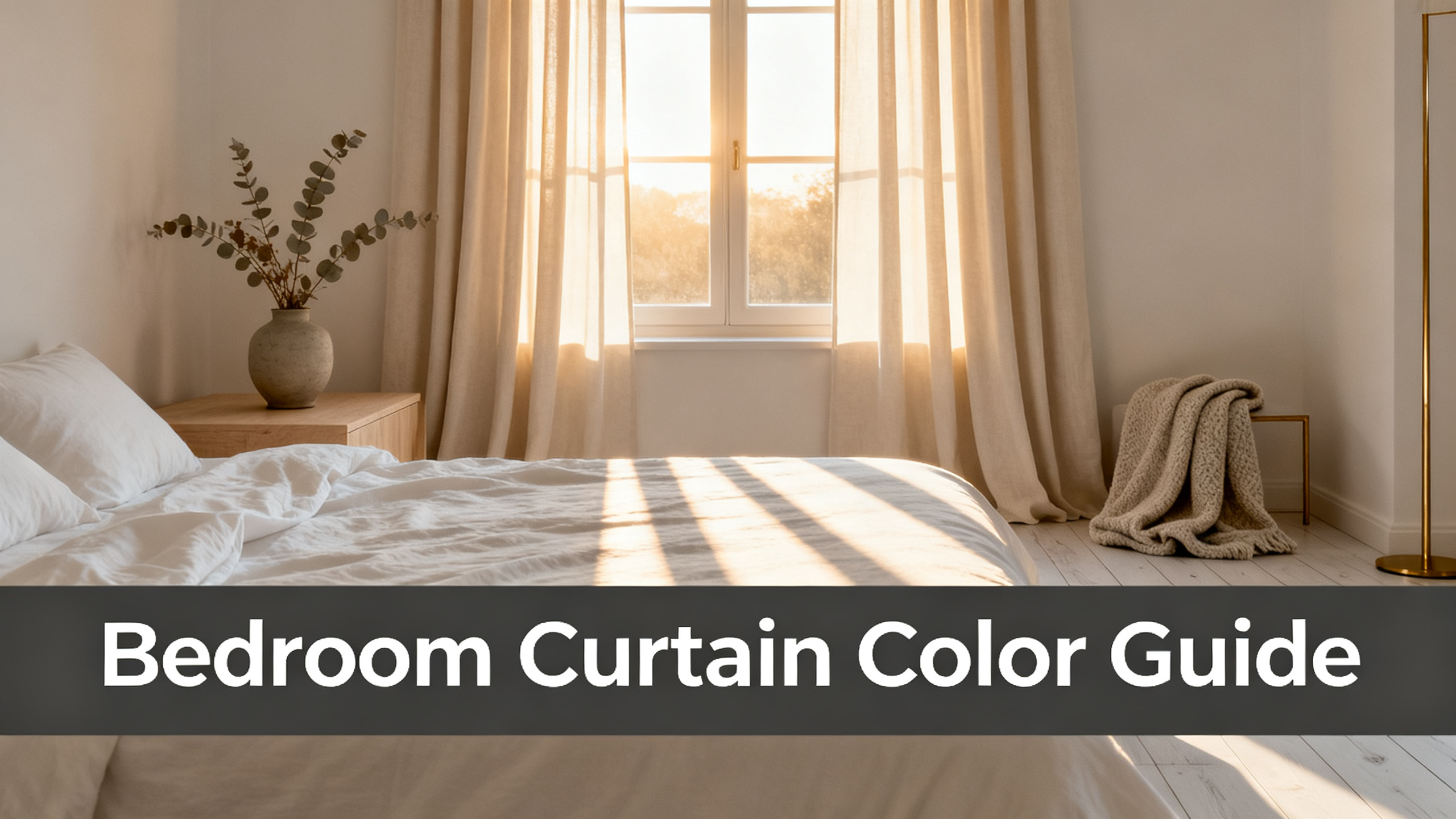
Six words decide a bedroom curtain color. Undertone. LRV. Blackout backer bleed. Sleep saturation cap. LED color shift. Dye lot drift. Skip any one of them and the panel that looked perfect in the configurator reads wrong at 9pm above your headboard.
Here is the bedroom-locked framework: 4 decisions (wall tone, light exposure, blackout backer, bedroom type), a 12-colorway shortlist from the Liz Linen Blend line that covers 80% of bedrooms, and a 3-step “what to do next” plan at the end. Everything room-by-room lives in the full bedroom curtains hub.
Vocabulary Primer · 6 Terms Every Bedroom Color Decision Rests On
🎨
Undertone
Warm or cool bias hiding under every named color. Two beiges rarely share one.
💡
LRV
Light Reflectance Value 0-100. Drops 1-2 values under blackout backer.
🖤
Blackout backer bleed
Dense backer prevents rear light, shifts the front colorway darker on light shades.
😴
Sleep saturation cap
Saturation ceiling set by hours-in-room per night. Master < guest < occasional.
🔆
LED color shift
Same fabric reads warmer under 2700K bedside lamp, cooler under 4000K overhead.
🌀
Dye lot drift
Handcrafted runs vary 1-2% per dye lot. Order all panels together, never separately.

The bedroom panel this color guide is built around
Liz Linen Blend Drapery Pleated
from $59/panel · 140 gsm linen blend · 38 colorways from Snow White to Dark Grey · 9 header styles · 6 lining options including cotton flannel and blackout. Final price depends on size and lining.
Use code JULY for 20% off sitewide · Free shipping over $300
Six Terms Every Bedroom Color Decision Rests On (Vocabulary Primer)
Undertone (Munsell hue direction)
Every color carries a warm or cool bias underneath its named hue, even the ones that look neutral. Beige can lean yellow (warm) or grey (cool). White can lean cream (warm) or blue (cool). The Munsell color notation for hue, value and chroma is the industry standard that formalizes this warm-to-cool axis inside every color family.
Real talk: “greige” does not stay stable in a bedroom. It drifts warm under a 2700K bedside lamp, cool under morning north light, and neutral only for the two hours around noon. Bedroom color decisions have to survive all three lighting states.
LRV (Light Reflectance Value)
LRV is a 0-100 measure of how much light a surface reflects back into the room. Snow White 1908-0 sits near LRV 85. Sand Beige 1908-3 near LRV 55. Sepia Ebony 1908-14 near LRV 12. Bedrooms trade on LRV differently than living rooms because ambient light after sundown is 90% reflected LED, not direct source.
Blackout backer bleed
A blackout lining does more than stop rear light. It rewrites the front colorway by removing the translucent glow that gives light linens their airy read. A Snow White panel with plain lining reads bright. The same panel with a dense blackout backer reads dove grey by day and slate by 9pm.
How to Choose Curtain Color: The 5-Criterion Framework
The parent framework covers every room. This guide narrows the same rules to what matters in a bedroom: sleep saturation cap, blackout backer bleed, cycle jour-nuit.
Decision Flowchart · Which bedroom curtain color?
Decision 1
Wall tone
Warm white or warm neutral → Sand Beige, Burlywood Birch. Cool white or cool neutral → Fog, Grey Beige, Snow White.
Decision 2
Light exposure
North → warm colorway. South → cool colorway. East → warm blackout-friendly. West → UV-tolerant deep.
Decision 3
Blackout backer
Light colorways drift 1-2 LRV darker. Ask for the blackout-lined swatch, not the plain one.
Decision 4
Bedroom type
Master → Whisper-Soft saturation. Guest → Soft-Statement. Small → monochromatic. Luxury master → Birkin Velvet deep.
Sleep saturation cap
Saturation is the intensity of a hue, independent of light or dark. A dusty Sand Beige is low saturation. Rust Brown is mid. A pure emerald is high. Bedrooms cap saturation by hours-in-room per night, not by aesthetic preference. 8 hours nightly changes the math compared to a 40-nights-per-year guest room.
Cycle jour-nuit · Sand Beige 1908-3 at three hours
9am
Cool morning
Reads soft, slightly cool. LRV ~55. Warm undertone still legible.
Noon
Peak natural
Reads true. LRV ~55. The configurator studio shot matches this hour.
9pm
Bedside 2700K
Reads warm gold. LRV ~48. The hour you sleep next to. Test here first.
LED color shift
A 2700K bedside lamp pushes every fabric warmer. A 4000K overhead pulls every fabric cooler. Bedrooms typically use both. The panel has to hold undertone across the switch, which is why cool colorways in warm-lit master bedrooms need a warm accent somewhere in the room to avoid a clinical read.
Dye lot drift
Two Pages panels are handcrafted per order, dyed in small runs. Dye lot drift is 1-2% per run, which is invisible on a single panel and can become visible on a matched pair if ordered weeks apart. Order all bedroom panels in one purchase, always.
Decision 1: How to Choose by Wall Tone
Match the wall undertone, not the wall name. “Warm white” and “cool white” walls need opposite curtain temperatures even though the paint chip label reads similar.
The four wall archetypes that cover most bedrooms: warm white (Benjamin Moore Simply White, Farrow & Ball Pointing), cool white (Sherwin-Williams Alabaster, Extra White), warm neutral (Accessible Beige, Manchester Tan), cool neutral (Revere Pewter, Repose Gray).
Wall-Undertone Matrix · Which Liz colorway matches your bedroom wall
| Wall archetype | Best Liz colorway | Second pick | Avoid |
|---|---|---|---|
| Warm white Simply White, Pointing |
Sand Beige 1908-3 | Ivory Beige | Fog 1908-18 (reads blue) |
| Cool white Alabaster, Extra White |
Fog 1908-18 | Snow White 1908-0 | Burlywood Birch (reads orange) |
| Warm neutral Accessible Beige, Manchester Tan |
Burlywood Birch 1908-5 | Sand Beige 1908-3 | Grey 1908-11 (reads flat) |
| Cool neutral Revere Pewter, Repose Gray |
Grey Beige 1908-6 | Grey 1908-11 | Rust Brown (reads clashing) |
If it were my own master bedroom, the pick would be Sand Beige 1908-3 with cotton flannel lining for a warm-white wall. It handles warm bedside light without going yellow and holds a soft neutral at noon. Fog 1908-18 does the same neutralizing job on a cool-white wall.
Decision 2: How to Choose by Bedroom Light Exposure
Bedroom light behaves differently than living-room light. Most bedroom usage falls in two windows: 5am-9am and 8pm-11pm. That means the color decision is dominated by low-angle warm light in the morning and by LED bedside light at night, not by the noon overhead sun a living room sees.
The rebalance rule stays the same as the general framework, but the priority hour shifts. Pick for how the swatch reads at 9pm bedside, not noon window.
Bedroom Light Exposure · Rebalance rule per orientation
🧭
North-facing
Perpetual cool light. Warm curtain rebalance.
Pick: Sand Beige, Burlywood Birch. LRV target 40-55.
☀️
South-facing
Late-day warmth drift. Cool curtain rebalance.
Pick: Fog, Grey, Snow White. LRV target 50-75.
🌅
East-facing
Intense 6am wakeup light. Warm blackout-friendly.
Pick: Sand Beige, Grey Beige + blackout. LRV target 35-50.
🌇
West-facing
Evening warm intense. UV-tolerant deep.
Pick: Chocolate Tart, Sepia Ebony. LRV target 15-35.
The bedroom light hour that matters most is 9pm at bedside lamp, not noon at the window. Pick for how the swatch reads by lamplight, then cross-check that it still works at 9am morning wake.
Decision 3: How to Choose by Blackout Backer
The reason blackout backer is a color decision, not an aesthetic accessory: a dense backer prevents rear light transmission entirely, so the panel front reads only by reflected room light. That kills the airy glow that gives light linens their character and shifts the perceived colorway 1-2 LRV values darker.
The shift is invisible on mid and deep colorways (Sepia Ebony drifts less than 0.5 LRV). It is unmistakable on light colorways. Snow White with blackout reads dove grey by day and slate grey by 9pm.
Blackout Backer Bleed · LRV drift by colorway
Snow White 1908-0
Plain lining: LRV ~85
Blackout backed: LRV ~72
Drift +2 values darker. Visible.
Sand Beige 1908-3
Plain lining: LRV ~55
Blackout backed: LRV ~49
Drift +1 value darker. Noticeable.
Fog 1908-18
Plain lining: LRV ~48
Blackout backed: LRV ~46
Drift +0.5 value. Stable. Safest bet.
Sepia Ebony 1908-14
Plain lining: LRV ~12
Blackout backed: LRV ~12
Drift <0.2. Deep colorways absorb it.
⚠️ Bedroom color regret #1. The single most under-anticipated bedroom color mistake is a light colorway (Snow White, Ivory Beige, Sand Beige) losing 1 to 2 LRV values once the blackout backer is added. The panel reads dove grey at noon and slate grey by 9pm, and the buyer describes it later as “wrong”. Ask Two Pages to swatch the blackout-lined version, not the plain one.
Two Pages ships six lining options bedroom-relevant: unlined, cotton drill, cotton flannel (soft mid-density), thermal, blackout (maximum density), and interlined blackout. Cotton flannel is the default sleep-hygiene pick when full blackout is not required. Blackout is the correct pick if the bedroom is street-facing or east-facing, and it decides sleep quality more than the color itself does. The best blackout curtains for the bedroom roundup covers the pairing side.

Fog 1908-18 With Blackout Lining Is the Bedroom Safest Bet.
from $59/panel · Fog is the Liz colorway that reads warm-cool neutral in every bedroom light, then holds its true hue once the blackout backer is added. Most cool-neutral linens shift 1-2 values darker with blackout. Fog absorbs the bleed cleanly.
Decision 4: How to Choose by Bedroom Type
Bedroom type sets the saturation ceiling by hours-in-room per night. A master with 8+ hours nightly is not the same problem as a guest room with 40 nights per year of use. The Sleep Foundation on bedroom color and sleep quality notes that low-saturation warm neutrals correlate with faster sleep onset, which lines up with the master-bedroom rule below.
Sleep Saturation Cap Ladder · How bold can you sleep with?
Tier 1 · Whisper
Master bedroom, 8h nightly
Snow White, Ivory Beige, Sand Beige, Fog. Low saturation, high LRV. Signals wind-down.
Tier 2 · Soft
Guest bedroom, 40 nights/year
Grey Beige, Burlywood Birch, Grey. Mid saturation. Personality without fatigue.
Tier 3 · Statement
Occasional guest, reading nook
Chocolate Tart, Rust Brown. Mid-high saturation with warm-hue safety.
Tier 4 · Bold
Master with matte walls + blackout
Sepia Ebony, Dark Grey. Deep saturated. Requires matte walls and paired blackout.
Master bedroom picks are dominated by Whisper and Soft neutrals, warm or cool. A saturated master statement (Sepia Ebony, Rust Brown, Chocolate Tart) works only when three conditions hold: matte wall paint, paired blackout backer, and a bedroom-appropriate fabric weight. For those cases, Birkin Velvet Drapery Pleated handles saturated deep tones at 108-inch drop better than any linen blend will.
Best Luxury Bedroom Curtains (2026)
Once the color is locked, the fabric matters. The luxury bedroom roundup covers velvet, silk-blend and heavy cotton picks that hold saturated tones at 108-inch drop.
Guest bedroom picks default to neutrals because the room has to please 3 to 8 different guests per year. Personal taste caps at 30%. Sand Beige 1908-3, Fog 1908-18, and Grey Beige 1908-6 rotate through as safe defaults across the year.
Small bedroom picks follow a different rule: monochromatic with the wall, 1 or 2 LRV values lighter, hung floor to ceiling with the rod 4-6 inches wider than the frame. Small bedrooms fail on high contrast because the color fragments the wall and shrinks the room visually.
Small Bedroom Curtain Ideas
Small bedrooms reward monochromatic pairings and floor-to-ceiling drops. This companion gallery shows the 12 configurations that read as extended wall rather than window frame.
⚠️ Saturated master picks dusk drift. Saturated colorways (Sepia Ebony, Rust Brown, Chocolate Tart) look great in the configurator studio at noon and lose 10 to 15 percent of their punch by dusk when the bedroom reads warm and dim. Order at least one notch more saturated than the configurator suggests, especially with a warm off-white wall.
The bedroom type sets the saturation ceiling. The wall sets the undertone. The light sets the temperature. The backer sets the drift. Four locks, one colorway.
Bedroom Type Card · Verdict color rule by room
Master bedroom
Whisper neutral + cotton flannel
Pick: Sand Beige 1908-3 or Fog 1908-18. Line with cotton flannel or blackout if east-facing.
Guest bedroom
Soft neutral + cotton drill
Pick: Grey Beige 1908-6 or Burlywood Birch 1908-5. Cotton drill lining for privacy.
Small bedroom
Monochromatic + no lining
Pick: Snow White 1908-0 or Fog 1908-18. Floor to ceiling, no lining to preserve airiness.
The Bedroom Colorway Shortlist (12 Liz Picks That Work in 80% of Rooms)
The 4-decision framework filters most of the 38 Liz Linen Blend colorways down to a 12-pick shortlist, six warm and six cool, that covers 80% of bedroom situations across master, guest, and small rooms.
Liz Linen Blend · 12 bedroom-friendly colorways
Warm axis (6 picks)
Ivory Beige
Whisper master
Sand Beige 1908-3
Whisper flagship
Beige
Soft mid warm
Burlywood Birch 1908-5
Soft guest
Chocolate Tart
Statement
Rust Brown
Warm master bold
Cool axis (6 picks)
Snow White 1908-0
Whisper small
Fog 1908-18
Whisper safe bet
Grey Beige 1908-6
Soft guest
Grey 1908-11
Soft cool mid
Sepia Ebony 1908-14
Cool master statement
Dark Grey
Bold cool master
Warm-axis picks work best against warm-white and warm-neutral walls (Simply White, Accessible Beige). Sand Beige 1908-3 is the single most versatile bedroom warm colorway across master, guest, and small. Burlywood Birch adds mid-warmth for warm-neutral walls without going orange. Rust Brown and Chocolate Tart become statement master picks only with matte walls and blackout backer.
Cool-axis picks work best against cool-white and cool-neutral walls (Alabaster, Repose Gray). Fog 1908-18 is the single most versatile bedroom cool colorway because it holds LRV under blackout backer better than any other Liz colorway tested. Sepia Ebony 1908-14 is the cool master statement pick when the wall is deep matte grey.
Swatch Protocol for a Bedroom (Different From a Living Room)
The living-room swatch protocol tests at 9am, noon, and 4pm to catch morning, peak, and late-day. The bedroom protocol substitutes 4pm for 9pm bedside lamp, because the 9pm reading is the one you will live with for 8 hours a night.
Tape three candidate swatches next to the headboard at eye level, not on the window frame. Observe at 9am morning wake, noon peak natural, and 9pm with the bedside lamp on and the overhead off. If the bedroom is east or west facing, add a fourth reading at 6am (east) or 4pm (west) to catch the intense sun angle.
Order the 38-Color Booklet Before You Pick.
The Liz Linen Blend Booklet ships all 38 colorways flat for $3.99. Bedroom lighting shifts a colorway 1-2 values darker at 9pm than at noon. A physical swatch taped next to your headboard at both hours settles the pick in 90 seconds.
What to Do Next: 3 Steps in Order
Step 1. Order the 38-color Liz Linen Blend booklet for $3.99. It ships in 3 to 5 days and covers every warm and cool bedroom-relevant colorway in the line. The alternative, ordering a full panel and returning it if the color is wrong, costs $59 to $199 and 3 to 4 weeks of lead time.
Step 2. Tape 3 candidates next to your headboard at 9am, noon, and 9pm. Observe for 24 hours before ranking them. Cross-reference against the 4-decision framework: does the pick match the wall undertone, rebalance the light exposure, hold LRV under the planned lining, and stay under the saturation ceiling for the bedroom type? The 30-plus bedroom curtain looks gallery is useful cross-check inspiration at this step.
Step 3. Order the panel with matched lining. Cotton flannel is the master-bedroom default. Blackout is the correct pick for street-facing or east-facing bedrooms. Two Pages lead time is 3 to 4 weeks handcrafted, use code JULY for 20% off sitewide, free shipping over $300.
What to Do Next · 3 steps, in order
📖
Step 1
Order the booklet
$3.99, ships 3-5 days, 38 colorways flat.
🕘
Step 2
Tape 3 candidates by the headboard
9am, noon, 9pm. 24 hours minimum before ranking.
🧵
Step 3
Order with matched lining
Cotton flannel default. Blackout if east or street-facing.
One Panel, 38 Bedroom-Ready Colorways.
Liz Linen Blend Drapery Pleated: 140 gsm, 38 colorways from Snow White to Dark Grey, 9 header styles, 6 lining options (cotton flannel and blackout included). from $59/panel. Code JULY (20% off sitewide) · Free shipping over $300 · lead time 3-4 weeks handcrafted.
Bedroom Curtain Color FAQ
What is the best curtain color for a bedroom?
There is no single best color, there are four decisions that pick it. Match the curtain undertone to the wall undertone (warm-with-warm, cool-with-cool), rebalance for room light exposure (warm curtain in north-facing rooms, cool curtain in south-facing), account for blackout backer bleed if a blackout lining is planned, and cap saturation by hours spent in the room.
In 80% of bedrooms, Sand Beige 1908-3 (warm wall) or Fog 1908-18 (cool wall) is the safest single-shot pick from the Liz Linen Blend line.
What color curtains make a small bedroom look bigger?
Curtains one or two LRV values lighter than the wall, in the same undertone family, hung floor to ceiling with the rod 4 to 6 inches wider than the frame on each side. Snow White 1908-0 or Fog 1908-18 on a light wall, Sand Beige 1908-3 on a warm neutral wall are the safest picks. Bold or saturated colorways shrink a small bedroom by fragmenting the visual field between wall and curtain.
What is the best curtain color for sleep?
Warm neutrals in the Whisper or Soft saturation tier work best for master bedrooms with 8+ hours nightly use. Sand Beige 1908-3, Burlywood Birch 1908-5, and Grey Beige 1908-6 signal wind-down without stimulating the eye.
Saturated deep colorways (Sepia Ebony, Rust Brown, Chocolate Tart) also support sleep because they absorb ambient light and cue night, but they require a matching blackout or cotton flannel lining to avoid a heavy room feel by day.
Should bedroom curtains match walls or contrast?
Match undertone always, choose contrast level by bedroom type. Master bedrooms reward low-contrast monochromatic pairings for calm. Guest bedrooms tolerate mid-contrast to add character. Small bedrooms need monochromatic to read as extended wall. Kids-adjacent bedrooms often work with soft mid-contrast if the room is used for reading and homework as well as sleep.
Do blackout curtains change the color of the fabric?
Yes. A blackout backer prevents rear light transmission, so the panel front reads only by reflected room light. Light colorways (Snow White, Ivory Beige, Sand Beige) drop 1 to 2 LRV values with blackout added, effectively darkening 1 notch. Mid and deep colorways drift less than 0.5 LRV. Ask Two Pages to swatch the blackout-lined version, not the plain one, if a light bedroom color is planned with blackout.
What curtain color goes with grey bedroom walls?
Match the grey undertone. Cool grey walls (Repose Gray, Chelsea Gray) pair with Fog 1908-18 or Snow White 1908-0 for low contrast, or with Sepia Ebony for high-contrast statement. Warm grey walls (Agreeable Gray, Revere Pewter) pair with Sand Beige 1908-3 or Burlywood Birch 1908-5. Two Pages Grey 1908-11 is the safest match for a cool grey wall in the same value family (low-contrast monochromatic).
What curtain color is best for a north-facing bedroom?
North light is cool and blue-shifted year-round. Warm colorways (Sand Beige 1908-3, Burlywood Birch 1908-5, Grey Beige 1908-6) rebalance the room and prevent the flat-clinical feel that cool colorways produce in north light. If cool colorways are preferred for the wall palette, add warm accents (wood nightstand, brass sconce, oatmeal throw) elsewhere in the bedroom.
How long does it take to receive Two Pages bedroom curtains after choosing a color?
Two Pages lead time is 3 to 4 weeks handcrafted per panel, including the color-matched lining. The 38-color Liz Linen Blend booklet ships in 3 to 5 days for $3.99.
That booklet is the highest-leverage bedroom color risk reduction available: it lets you observe the colorway at 9am morning wake light, noon peak natural, and 9pm bedside lamp light before committing to a $59 to $199 panel with 3 to 4 weeks of lead time.
