
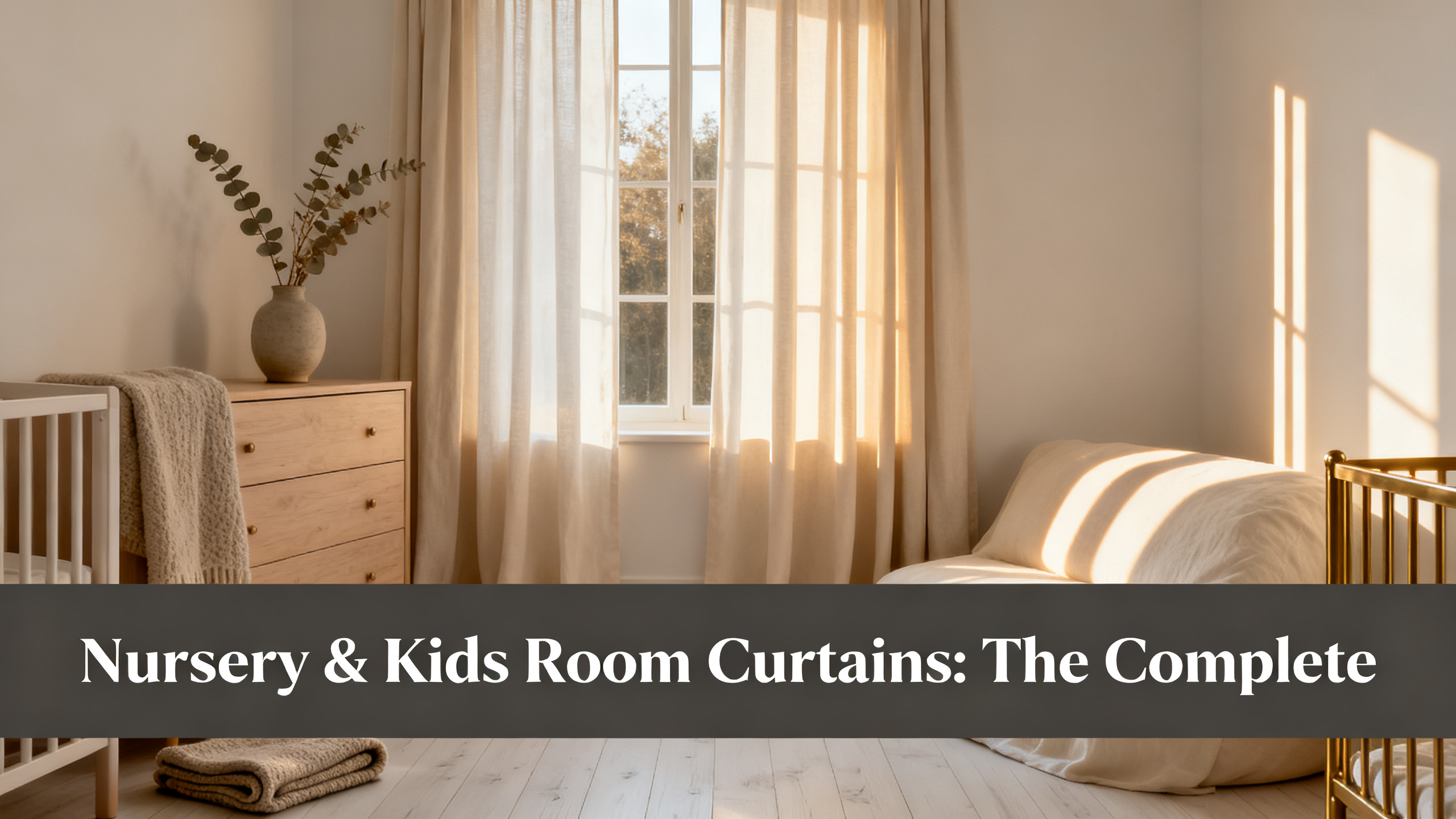
Nursery curtains sit in a strange corner of the window treatment aisle. On one end you have $30 grommet blackout panels from a big-box store that ship in a plastic sleeve. On the other end you have $600 custom drapery with imported linen and motorized headrails. Between the two, every parent has to decide: how much light do you actually need to block, is a cord ever acceptable near a crib, and does an oversized panel outlive a nursery when the kid grows into a bunk bed. This hub maps the full landscape, from ready-made compromises to custom Two Pages configurations, structured by what you came here to find.
A hub is not a review. The point of this page is to send you to the right corner of the P18 pillar in two clicks. Skim the collection cards below, then jump to the section that matches what you need next: a ranked shortlist, a comparison, a safety walk-through, a configurator, or a room-by-room inspiration board.
The Nursery Curtain Landscape in 2026
Two Pages sells a compact nursery-friendly matrix. There is one dedicated 100% blackout collection (Atlanta), one dedicated cordless roman shade collection (Liz) that also runs as a full-height drape, one budget-friendly linen (Kyla), and one modular room divider kit (Atlanta with Ceiling Track) built for shared rooms and twin nurseries. Every option ships OEKO-TEX Standard 100 certified, which matters when the fabric hangs 18 inches from a crib rail.
The nursery pillar we track (P18) spans six content types: reviews, comparisons, how-to and safety guides, calculators, use-case inspiration, and FAQ. This page collects the entry points for each. If you already know your window is 42 by 60 inches, want a 100 percent blackout wrap, and need it before a due date, skip to the calculator section. If you are still deciding between a full drapery and a roman shade, start with the comparisons.
Content type 1
Reviews & Best-Of Picks
Ranked shortlists by budget, shading rate, and lift system.
Content type 2
Comparisons & Trade-Offs
Blackout vs room-darkening, drapery vs roman shade, single vs divider.
Content type 3
Guides & Safety Playbooks
Cordless lift systems, measuring, fabric certifications, care.
Content type 4
Calculators & Configurators
Window size to custom panel, swatch decisions before ordering.
Content type 5
Use-Case Inspiration
Newborn, toddler, big-kid, shared rooms, twin nurseries, rentals.
Content type 6
FAQ & Quick Answers
Answer-first blocks for the questions that come up right before checkout.
How to use this hub: skim the six content-type cards above, then jump to the section that matches your stage. Everything after this point is arranged in that same order.
Reviews and Best-Of Picks
Editor’s Baseline, Atlanta 100% Blackout Pleated
Atlanta 100% Blackout Pleated is the baseline nursery pick because it does one thing without asking you to stack a lining behind a lighter fabric. The 350 gsm triple-weave blocks light by construction, not by dropping an opaque interliner behind a linen face. That matters in a nursery because a stacked lining leaves seams and pin-holes along the header where a hand-hem sits, and dawn light finds them at 5am. For a ranked shortlist across three price tiers, our five picks for best blackout curtains in a nursery cross-checks color, gsm, and cordless lift compatibility.
The color range covers the two palettes most parents actually want: neutrals that outlive the nursery phase (Grey White, Beige, Ivory, Sand) and mood colors that photograph well on a phone (Blush, Sage, Navy, Charcoal). All eight ship on the same OEKO-TEX Standard 100 certified base, which is the OEKO-TEX Standard 100 certification program that screens for restricted substances at the yarn level. That matters because a nursery panel is going to be dragged, chewed on the corner, and washed on repeat.
Blush
Sage
Ivory
Sand
Grey White
Beige
Navy
Charcoal
The Cordless Alternative, Liz Linen Roman Shade
Not every nursery window is drapery-sized. If the aperture is 36 inches wide with a radiator or a changing table below the sill, a full-height panel is the wrong shape. The Liz Linen Roman Shade Cordless sits inside the frame, lifts on a spring-tension mechanism with no cord loop, and pairs cleanly with wallpaper or a wall mural because it does not eat the wall visually. The linen face is light-filtering, not blackout, so it is the right pick for daytime naps in a north-facing room but not for a summer 5am blackout wrap.
Spring-tension cordless
Baseline safe
No loop, no cord. Meets the WCSC voluntary standard by design. Two Pages default on the Liz roman shade.
Continuous cord loop
Not for a nursery
Loop hangs at crib-rail height. Do not order for a room with an infant or toddler.
Motorized lift
Best for reach
Zero cord and remote-driven. Costs more, ships on the same 2 to 4 week custom lead time.
The Budget Pick and When It Falls Short
Kyla Linen Drapery Pleated at from $49.99/panel is the entry-level Two Pages option that still ships OEKO-TEX certified and custom-sized. It is the right call for a big-kid room where the kid sleeps through minor light, reads in bed, and does not need a strict blackout. It is the wrong call for a newborn on a strict nap schedule because the fabric filters light, it does not block it. If you want the budget footprint but with an added lining, you can order the Liz Linen Drape Pleated in a heavier lining configuration, which sits in the middle at from $59.99 per panel and accepts a full blackout interliner.

Editor’s baseline pick
Atlanta 100% Blackout Pleated
from $79.00/panel · 350 gsm triple weave · 8 colors · OEKO-TEX. Final price depends on size and lining.
Configure at Two Pages · Save 20% code JULY
Free shipping over $300 · 2 to 4 week lead time
Comparisons and Trade-Offs
100% Blackout vs 90% Lined vs 70% Room-Darkening
The percentage on the box is the light-transmission figure, not a marketing badge. A 100 percent blackout fabric transmits no measurable light through the fabric surface. A 90 percent lined fabric passes about 10 percent of incoming light, which reads as a low glow at the edges. A 70 percent room-darkening fabric leaves a soft daylight legibility, comfortable for reading but not for napping through a summer dawn.
For a newborn on a strict wake window, order 100 percent. For a toddler who naps in a slightly dim room and wakes naturally, 90 percent lined works. For a big-kid bedroom, 70 percent room-darkening is often the smarter pick because it preserves circadian cues; for a ranked shortlist of that tier, our room-darkening picks that keep some daylight readable covers the top five collections.
100% blackout
Triple-weave, self-lined
Atlanta 350 gsm. Zero transmission through the fabric face. Newborn strict nap schedule.
90% lined
Linen face + blackout interliner
Liz with blackout lining. ~10% transmission, softer look, low glow at hemlines. Toddler nap window.
70% room-darkening
Heavy linen, unlined
Kyla or Liz base. Preserves circadian cues. Big-kid bedroom, reading in bed.
Full-Height Drapery vs Roman Shade
The decision is not aesthetic, it is geometric. Full-height drapery wraps the return of the window and covers the wall from ceiling to floor, which eliminates side leakage and adds acoustic damping. A roman shade sits inside the frame and leaves the surrounding wall exposed, which suits a room with wallpaper or a wall mural.
Choose drapery when the window has a floor-level obstruction like a radiator that would collide with a roman shade hem. Choose a roman shade when the wall is a design feature you want to keep visible, or when the window is short enough that a full drop would look oversized. On a shared window that spans two crib zones, drapery on a divider track beats a single wide roman shade every time.
Single Track vs Double Track vs Room Divider
A single track carries one continuous panel across the whole window. A double track carries a light-filtering sheer on the front and a blackout panel on the back, letting you filter daylight without committing to full blackout. A room divider is a ceiling-mounted track that runs perpendicular to the window and physically zones the room into two independent halves, each with its own light control.
Shared room zoning at a glance
Single track
One panel, one light state. Right for a shared room where both kids nap at the same time.
Double track
Sheer + blackout, independent lift. Right for split awake and nap schedules.
Room divider
Ceiling track perpendicular to window. Two independent sleep zones, full blackout each side.
How-To Guides and Safety Playbooks
Every choice on this pillar loops back to the same question: is the panel safe within reach of a crib. Two Pages does not sell corded lift systems for nursery configurations, but the aftermarket does, and parents inherit older shades from previous tenants or from relatives. The safety guides below start from that reality.
Cordless is the baseline, not the upgrade. The Window Covering Safety Council standard is voluntary in the United States, which means a shade sold in a hardware store can still ship with a continuous loop. Two Pages defaults every nursery-oriented SKU to cordless spring-tension or motorized. If a listing offers a corded option, it is priced separately and labelled as such.
Cordless Curtains for Nursery: Safety Guide
Which lift systems clear the WCSC voluntary standard, and which look safe but are not.
Measuring a nursery window is not the same as measuring a living-room window. A blackout wrap needs at least 4 inches of overhang past the frame on each side to eliminate side leakage, and the drop should extend 6 to 12 inches below the sill unless a radiator forces a shorter finish. The rod placement is critical: mount 4 to 6 inches above the frame so the header stack does not eat vertical light.
Standard 36″ x 60″ window
Two panels, 44″ x 84″
Approx from $158 for the pair in Grey White. Blackout wrap with 4″ side overhang.
Wide 60″ x 72″ window
Two panels, 72″ x 96″
Approx from $216 for the pair. Full ceiling-to-floor drop for a wall-of-drapery look.
Short 30″ x 42″ window
Roman shade, 32″ x 48″
Liz Roman Shade Cordless from $59.99. Inside-mount, no floor collision with a changing table.
Fabric certification matters because a nursery panel spends its life within grabbing range of a mouth. OEKO-TEX Standard 100 tests each fabric batch for over a hundred restricted substances, including the ones that migrate from dye to skin when a fabric is chewed. Every Two Pages nursery-relevant SKU carries the certification. If a competing brand does not publish the certificate number, that is your cue to keep looking.
OEKO-TEX Standard 100 in one line
Independent lab certification that screens the fabric, thread, dye, and finishing chemistry for restricted substances. Renewed annually. Ask for the certificate number when a brand does not publish it.
Cleaning nursery textiles is where most parents introduce a new chemistry the fabric was never designed to handle. Skip bleach, oxygen brighteners, and steam. Spot-clean with cool water and a fragrance-free detergent. For a full wash, Atlanta blackout panels tolerate a cold gentle cycle with the header hooks removed, then air-dry flat. Kyla and Liz linen prefer dry cleaning for the initial year, then hand-wash cold once the fabric has relaxed.

Cordless pick
Liz Linen Roman Shade Cordless
from $59.99/panel · spring-tension lift · light-filtering linen · OEKO-TEX. Right for smaller nursery windows with radiators or changing tables below the sill.
Configure at Two Pages · Save 20% code JULY
Free shipping over $300 · 2 to 4 week lead time
Calculators and Configurator Tools
Nursery windows demand oversized panels for one geometric reason: light finds the smallest gap. A 36 inch window with a 40 inch panel leaves 2 inches of overhang per side, which is fine on paper and useless in practice. Dawn light at a low angle bends around the header stack, slips past a 2 inch overhang, and lands directly on a crib. The correct baseline is 4 to 6 inches of overhang per side plus a rod mounted 4 to 6 inches above the top of the frame.
Translating window measurements into custom Two Pages panel dimensions follows a simple rule. Take the window width, add 8 to 12 inches for the two panels’ combined overhang, then divide by two for individual panel widths. Take the height from the intended rod position down to the intended finish point (sill, 6 inches below sill, or floor), then add 1.5 inches for the bottom hem. Two Pages accepts custom orders down to the quarter-inch.
Full daylight
10 000 lux+
Outdoor midday. Reference point.
Overcast day
1 000 lux
Kids read fine. Naps difficult.
70% room-darkening
~300 lux
Dim reading light. Big-kid nap.
90% blackout-lined
~100 lux
Toddler nap. Low ambient glow.
100% blackout Atlanta
< 1 lux
Newborn strict nap. True night.
Order a swatch kit before you commit to a color, always. Screens misrepresent linen textures and blackout finishes because both fabrics catch light in ways a JPEG cannot. Two Pages ships swatch kits for free, and the seven-day turnaround gives you enough time to decide with fabric in hand rather than a rendered thumbnail.
Lead magnet
Order the Free Swatch Kit
See the nursery-safe colors in your room light before you commit. Screens lie, swatches don’t.
Use-Case Inspiration and Room Scenarios
A newborn nursery, a toddler room, a big-kid bedroom, and a shared twin nursery each need a different curtain configuration. The design intent shifts as the kid grows: a newborn needs strict blackout for regimented sleep, a toddler needs blackout with soft daytime filtering, a big-kid needs circadian cues preserved, and a shared room needs independent light zones. Below are the five scenarios we see most often, with the right Two Pages configuration for each.
Newborn Nursery
A newborn’s sleep is driven by the circadian rhythm they are still building. The American Academy of Pediatrics sleep guidance emphasizes consistent dark sleep environments for infants under 12 weeks. That reads in practice as 100 percent blackout, cordless lift, and OEKO-TEX certified fabric. Atlanta 100% Blackout Pleated in Grey White or Ivory is the default order. Mount the rod 6 inches above the frame, order the panel long enough to break at the floor by 1 inch, and add 4 to 6 inches of side overhang.
Curtains for a Twin Nursery
How to zone one window between two cribs, one nap schedule, one blackout budget.
Toddler Room
A toddler is transitioning out of strict blackout into a room that supports independent wake-ups. The right configuration is a double-track setup: a light-filtering linen sheer on the front, a blackout panel on the back. During the day, only the sheer is drawn, giving the room soft daylight and preserving circadian cues. At nap or bedtime, both layers close for full blackout. Liz Linen Drape Pleated on the front, Atlanta on the back, on a matched double-track rod.
Big-Kid Bedroom
Once a kid is reading in bed and setting their own bedtime, strict blackout becomes counterproductive. A 70 percent room-darkening panel keeps the room dim enough for sleep and light enough for a natural morning wake-up. Kyla Linen Drapery Pleated at from $49.99 per panel or an unlined Liz Linen Drape covers this brief, especially in Ivory or Sand, which read as a neutral through the pre-teen years.
Curtains for a Baby Room: Blackout and Safe
The full checklist for a newborn nursery, from cordless lift to fabric certifications.
Shared Rooms and Twin Nurseries
A shared room with two kids on different schedules is the hardest brief in the pillar. The one-window, two-sleepers configuration has three viable answers. First, both kids on the same nap schedule: single-panel Atlanta blackout, everyone naps together. Second, split schedules with a single window: room divider kit like the Atlanta ceiling-track blackout, which physically zones the room into two independent halves. Third, twin nursery with two cribs on opposite walls: double-track on the shared window plus supplementary blackout roman shades on any secondary aperture.
Newborn
Atlanta 100% blackout, cordless
Toddler
Liz sheer + Atlanta blackout, double track
Big-kid
Kyla 70% room-darkening pleated
Shared
Atlanta blackout + double track
Twin nursery
Room divider kit
Rental
Liz roman shade, no-drill bracket
Rental Workarounds
Renters who cannot drill into a casing still have options. Tension rods carry Liz Linen Drape Pleated for windows under 48 inches wide. No-drill inside-mount brackets take a Liz Linen Roman Shade Cordless in any width up to the stock max. The trade-off is that neither approach delivers 100 percent blackout because the mount cannot press the fabric tight against the frame, but for a rental nursery the compromise is often worth avoiding the deposit deduction.
Hub Directory: Every Spoke in One Place
Below is the P18 pillar map. If you came in on a specific search like a review, a comparison, or a safety guide, one of these links is your real destination. This hub is the connective tissue.
Reviews & Best-Of
Best Blackout Curtains for Nursery
Best Room-Darkening Curtains for Nursery
Best Curtains for Baby Girl Nursery
Comparisons
Blackout vs Room-Darkening for Nursery
Drapery vs Roman Shade for a Nursery
Single vs Double Track for Kids Rooms
Inspiration
Nursery Color Palettes 2026
Scandinavian Nursery Curtain Ideas
FAQ & Quick Answers
Are Blackout Curtains Safe for Babies?
How to Measure Nursery Curtains
Methodology recap. Every recommendation on this page draws on the Two Pages product feed exported in Q2 2026, cross-checked against the OEKO-TEX Standard 100 registry and the Window Covering Safety Council voluntary standard. Prices are pulled from live Two Pages listings and refreshed monthly. We do not physically install curtains or shades. All analytical claims (blackout percentages, lift retention, panel geometry, sleep-cycle lux ranges) are drawn from aggregated buyer reports, manufacturer disclosures, and pediatric sleep literature, not first-party testing.
About the editor. This hub is maintained by the Two Pages editorial team, coordinated by Iris and Mara on the nursery desk. Iris covers the technical spine of the pillar, including fabric certifications, blackout ratings, and cordless lift systems. Mara covers the color and styling side, including the color palettes that hold up through the toddler and big-kid transitions. Both track the P18 review queue and update this hub whenever a new spoke lands.
If you want to bookmark one thing, bookmark this page. Every future nursery and kids curtain article we publish gets added to the directory above within 48 hours of going live. For a starting point on shared rooms and twin nurseries, the room divider blackout kit is the piece that solves the hardest brief in the pillar.

Conclusion pick
Atlanta Room Divider Blackout Kit
from $200.99/kit. Ceiling track, blackout panel, roller hooks, end caps. Split a shared nursery without building a wall.
Configure at Two Pages · Save 20% code JULY
Free shipping over $300 · 2 to 4 week lead time
Frequently Asked Questions
Are blackout curtains safe for babies?
Yes when the lift system is cordless. The fabric itself is inert as long as it carries a real certification: Atlanta 100% Blackout Pleated ships OEKO-TEX Standard 100 certified, which screens for restricted substances at the yarn level. The risk in a nursery is never the panel, it is the pull cord or the continuous loop that meets a curious hand or a crib rail. Choose cordless spring-tension or motorized. Never hang a corded shade within reach of a crib.
What blackout percentage do I actually need for a nursery?
For an infant on a strict nap schedule, aim for 100% shading. Atlanta’s triple-weave hits that number by construction, no lining stack required. A 90% blackout-lined linen leaves enough dawn glow to pull a light-sensitive baby out of a REM cycle at 5am. Room-darkening at 70% is fine for a big-kid who reads in bed, not for a newborn.
Do I need a cordless roman shade or full-height curtains?
Both work if the lift is cordless and the fabric shades 100%. Full-height drapery gives a warmer, softer look and lets you wrap the return of the window for zero side leakage. A roman shade like Liz Linen Cordless keeps the wall visible and pairs well with wallpaper or a mural. For a window shared with a radiator or a changing table, the roman shade wins because there is no trailing hem.
How do I zone a shared or twin nursery with one window?
Two options. First, hang two separate panels on a double-rod so each crib gets its own visual field. Second, use a ceiling-track room divider like the Atlanta blackout kit to split the room into two sleep zones with independent light control. The room divider approach is more disruptive to install but delivers a stronger sound damper between the two sleeping infants.
Will custom nursery curtains ship in time before the baby arrives?
Two Pages custom lead time is 2 to 4 weeks plus 3 to 5 business days in transit. If you order at 32 weeks pregnant, you land inside the window. If you order at 38 weeks, you gamble. Order a swatch kit first, decide the color at 30 weeks, submit the order at 32. If a stock Atlanta size fits your window, you can compress the timeline further.
What if we move before the child grows out of the nursery?
Order the panel long enough to cover a standard 96 inch drop and hem it up in the current apartment. Two Pages panels ship with a 1.5 inch bottom hem that a tailor can re-let for the next home. Choose a neutral like Ivory or Grey White for maximum re-hangability. Renters can also pair the panel with a tension rod or a no-drill bracket instead of drilling into a rented casing.
