
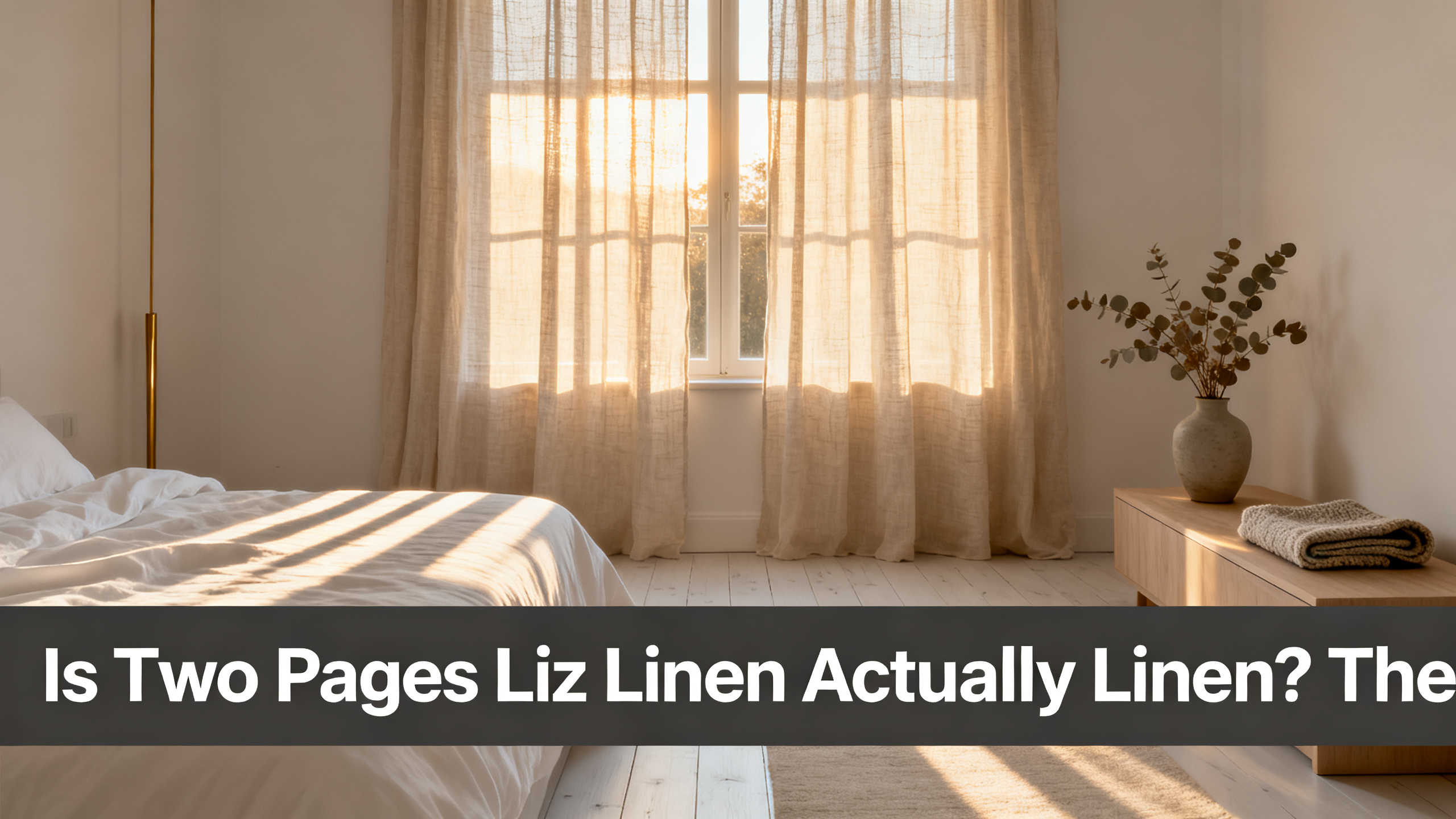
Yes. Liz Linen is real linen, but only 10 percent by fiber content. The other 90 percent is polyester, and if you skim past that number you will misread the whole product.
Composition: 10% Linen, 90% Polyester (OEKO-TEX Standard 100).
Weight: 350 gsm heavyweight.
Price: from $59.99/panel. Final price depends on size and lining.
Here is what that 10 percent is actually doing, why Two Pages built the fabric this way, and when the blend is a smarter buy than the pure linen alternatives sitting three collections away in the same catalog.

EDITOR’S PICK · LINEN BLEND
Liz Linen Drape Pleated
10% linen, 90% polyester, 350 gsm. The blend that gives linen texture with polyester drape memory. From $59.99/panel. Final price depends on size and lining.
Use code JULY for 20% off · Free shipping over $300.


What does the 90% polyester actually do?
The polyester in Liz is not filler. It is the reason the panel drapes cleanly at 350 gsm, holds a pinch pleat through the third wash, and does not need ironing every time the fabric is drawn.
Pure linen behaves badly on two dimensions that matter for curtains. Elastic recovery is close to zero, which is why a linen shirt keeps every crease you gave it in the car. And the fiber is thirsty, which means it stretches when the room is humid and shrinks when it is dry. Polyester fixes both problems: 85 to 95 percent shape recovery after deformation, and near-zero moisture regain. Blend the two and you keep the visual signature of linen (slub, matte hand, warm color depth) while the panel actually stays hung the way you installed it. For the full mechanics of how weight and fiber affect drape at every price point, our full linen curtain buying guide walks through the tradeoffs collection by collection.
Adds: visible slub texture, matte finish, natural fiber authenticity, warm color rendering.
Limits: would wrinkle, stretch, and fade fast if used alone at 350 gsm.
Adds: drape memory, wrinkle recovery, dimensional stability, UV resistance, easy care.
Limits: no natural slub, would look flat and synthetic if used alone.
Read practically: the 10 percent linen is what your eye sees, the 90 percent polyester is what your rod feels. Pull one fiber out of the equation and the fabric fails on the other dimension.
Why can Two Pages call it “Linen” if it’s only 10%?
Because US textile fiber labeling rules require the exact percentage on the product page, not restriction of the collection name. Two Pages discloses 10% Linen, 90% Polyester on the Liz product page, in the feed, and in the swatch card. The collection name reflects the aesthetic category, not the majority fiber.
This is industry norm, not a Two Pages workaround. Pottery Barn’s Emery Linen runs 55/45 linen-cotton, West Elm’s Belgian Flax Linen is often 60% linen with a lining backing, and IKEA Aina is 100% linen but only 130 gsm (which is why it looks so translucent). Two Pages sits at the aggressive end of the blend spectrum precisely because they also sell true 100 percent linen in other collections (Erin, Patti, Doris), and they want Liz to solve a different problem.
Wrinkles set after every draw. Steaming weekly to look intentional.
Softer creases, still needs steaming monthly. Common in premium.
Reads mostly synthetic, minor slub. Pleats hold cleanly.
Slub visible, pleats hold across seasons, near-zero maintenance.
The 10/90 split is not a shortcut. It is the ratio where the polyester dominates the mechanical behavior and the linen dominates the visual read. Anywhere between 5 and 15 percent linen achieves the same optical effect. Below 5 percent, the slub disappears and the fabric reads as pure synthetic.
Why not just make Liz 100% linen?
Because Two Pages already sells 100 percent linen curtains, and Liz solves a different buyer problem. The premium 100 percent linen lines (Erin, Patti Belgian, Doris European Flax) sit at $99 to $130 per panel, wrinkle visibly, and require a buyer who wants the linen ritual. Liz targets the buyer who wants the linen look without the ritual.
The 100 percent linen constraint fights the 350 gsm heavyweight spec too. Pure linen at that weight is stiff, expensive to produce, and difficult to pleat cleanly at full custom sizes (up to 240 by 240 inches). The blend lets Two Pages hit the heavyweight drape target without doubling the base price.
Erin Pure Linen vs Liz Linen Blend
The head-to-head that answers the real question: is 100 percent linen worth the wrinkle tax and the $40+ price bump per panel?
Owner feedback across Judge.me photos for Liz points at the same picture: the pleat lines hold, colors read warm, and returns cluster around size errors, not fabric complaints. The pure linen lines get more “I love the look but had to steam it every week” reviews, which is exactly what you would expect from the fiber physics.
How does Liz compare to Two Pages’ other “linen” collections?
Two Pages uses the word Linen across nine collections with wildly different compositions. Grouping them all as “linen curtains” hides useful information. Here is the actual fiber content by collection.
Two Pages Linen Composition, Decoded
Full breakdown of every “linen” line at Two Pages (Liz, Kyla, Erin, Patti, Doris, Ian, Ron, Jawara) with actual fiber percentages.
| Collection | Linen % | Other fibers | Weight | From price | Who it targets |
|---|---|---|---|---|---|
| Liz Linen | 10% | 90% Polyester | 350 gsm | $59.99 | Linen look, low maintenance |
| Kyla Linen Blend | 30% | 70% Polyester | 220 gsm | $64.99 | Lighter drape, softer hand |
| Ron Linen Cotton | 55% | 45% Cotton (herringbone) | 300 gsm | $79.99 | Textured natural feel |
| Jawara Linen Cotton | 55% | 45% Cotton | 330 gsm | $89.99 | Luxury blend, semi-sheer glow |
| Erin 100% Linen | 100% | – | 280 gsm | $99.99 | Purist, linen ritual accepted |
| Patti Belgian Linen | 100% | Belgian flax | 310 gsm | $109.99 | Heritage premium buyer |
| Doris European Flax | 100% | EU Flax certified | 265 gsm | $104.99 | Sustainability-first |
Liz is the lowest linen content and the lowest entry price in the “linen” family. That is not a coincidence. The two facts are locked together: reducing the linen ratio is what allows the price to sit at $59.99 instead of $99+, and the buyer trade-off is a matter of use case, not quality.
Is a linen blend worse than pure linen?
Worse is the wrong frame. Blends and pure linens solve different problems, and using one where the other belongs is what makes people unhappy. Our linen blend vs 100% linen breakdown covers the four dimensions that actually matter.
On drape memory, blend wins clean. On wrinkle behavior, blend wins clean. On breathability in warm rooms, pure linen wins. On longevity in south-facing exposure, blend wins because polyester is more UV-stable than flax. On tactile “linen-ness”, pure linen wins because the slub is dominant. Add lining and the breathability advantage of pure linen mostly disappears, which shifts the score even more toward the blend for most curtain applications.
What it means: every fiber, dye, thread and finish tested against 1000+ regulated substances.
Applies to the full fabric, not just the linen fraction. Safe for nurseries and skin contact. See the OEKO-TEX Standard 100 certification details.
The honest read is this. If your room is west or south facing, if you draw curtains daily, if you do not want to steam, Liz is the smarter fabric even though it is 10 percent linen. If your room is north-facing, mostly decorative, and you want the linen ritual as part of the aesthetic, one of the 100 percent lines is the better buy.
So who should actually buy Liz Linen?
The Liz Linen buyer is not the person shopping for pure linen and settling. It is a specific profile with a specific constraint set, and getting the match wrong is what drives returns.
Liz Linen Full Review — 10% Truth Deep-Dive
Owner feedback across 800+ Judge.me photos, drape behavior in south-facing rooms, and how the blend actually reads on camera.
Wants linen aesthetic, hangs curtains for 8+ years, will not steam weekly. Liz is the right buy.
Pinch pleat is non-negotiable, colors must hold across seasons on camera. Liz delivers.
Custom sizing, no landlord repairs, moves every 3-5 years. Blend survives the moves.
Skip Liz if you specifically want the natural fiber ritual, if the room is a high-humidity bathroom or laundry, or if the specific slub of 100 percent linen is the visual you are chasing. In those cases the pure linen lines are the correct spend.

The blend, honestly evaluated
If you want linen texture without the crumpled-shirt problem, this is the safest pick in the Two Pages catalog. From $59.99/panel · code JULY.
Roughly 40 to 45 percent cheaper than the pure linen lines before promo. That gap matters when you are outfitting three or four windows, because a full custom-linen room can hit $1200 in Erin or Patti and $700 in Liz. Same footprint, same header choice, half the wrinkle problem.
Order 8 free Liz Linen swatches
Fiber content matters less than how the fabric behaves in your specific light. Free swatches ship in 3-5 days.
Frequently asked questions
Does Liz Linen wrinkle like pure linen?
No. The 90 percent polyester is the reason. Pure linen wrinkles because flax fiber has almost no elastic recovery. Polyester restores 85 to 95 percent of its shape after deformation, which is why Liz keeps its pleat lines through daily draws and machine wash.
Is Liz Linen safe against skin?
Yes. The fabric carries OEKO-TEX Standard 100 certification, meaning every component (fiber, dye, thread, finish) has been tested against 1000+ regulated substances. Safe for nurseries, allergy-sensitive rooms, and direct skin contact.
Does the 10% linen actually add anything or is it marketing?
It adds real texture. Linen fibers are thicker and less uniform than polyester filaments, so even 10 percent by weight creates the slub visual that pure polyester cannot fake. Below 5 percent, the effect disappears.
Can I get Liz Linen with blackout lining?
Yes. Six lining options at checkout: unlined, cotton, sateen, room-darkening (85 percent block), blackout (99 percent), and interlining for heavy insulation. Blackout adds roughly $18 to $25 per panel depending on drop.
Will Liz Linen fade in a south-facing window?
Slower than pure linen. Polyester is more UV-resistant than flax, so a 10/90 blend fades noticeably less over 2 to 3 years than 100 percent linen in the same exposure. A room-darkening lining roughly doubles the protection.
How is Liz Linen priced compared to true 100% linen?
From $59.99 per panel vs Erin (100 percent linen) from $99.99 and Patti (100 percent Belgian linen) from $109.99. Liz is roughly 40 to 45 percent cheaper for a comparable width and drop, before promo.
The bottom line
Yes, Liz Linen is real linen. The 10 percent number is not a gimmick, it is an engineering choice. Linen at that ratio does the visual work (slub, matte hand, warmth of color) while polyester does the mechanical work (drape memory, pleat retention, UV resistance, near-zero maintenance). Anyone hunting the aesthetic of linen without the crumpled-shirt reality is buying exactly the right fabric. Anyone hunting the natural-fiber ritual is buying the wrong one and should look at Erin or Patti instead. Everything else (price, colorway range, lining choice, header style) is a downstream decision that starts here.
FINAL VERDICT
Liz Linen Drape Pleated
10% linen is not a trick. It is a fabric-engineering decision. From $59.99/panel · code JULY · free shipping over $300.
For the full picture on choosing linen curtains across every collection, weight, and lining option Two Pages sells, start with our linen curtain buying guide.
