
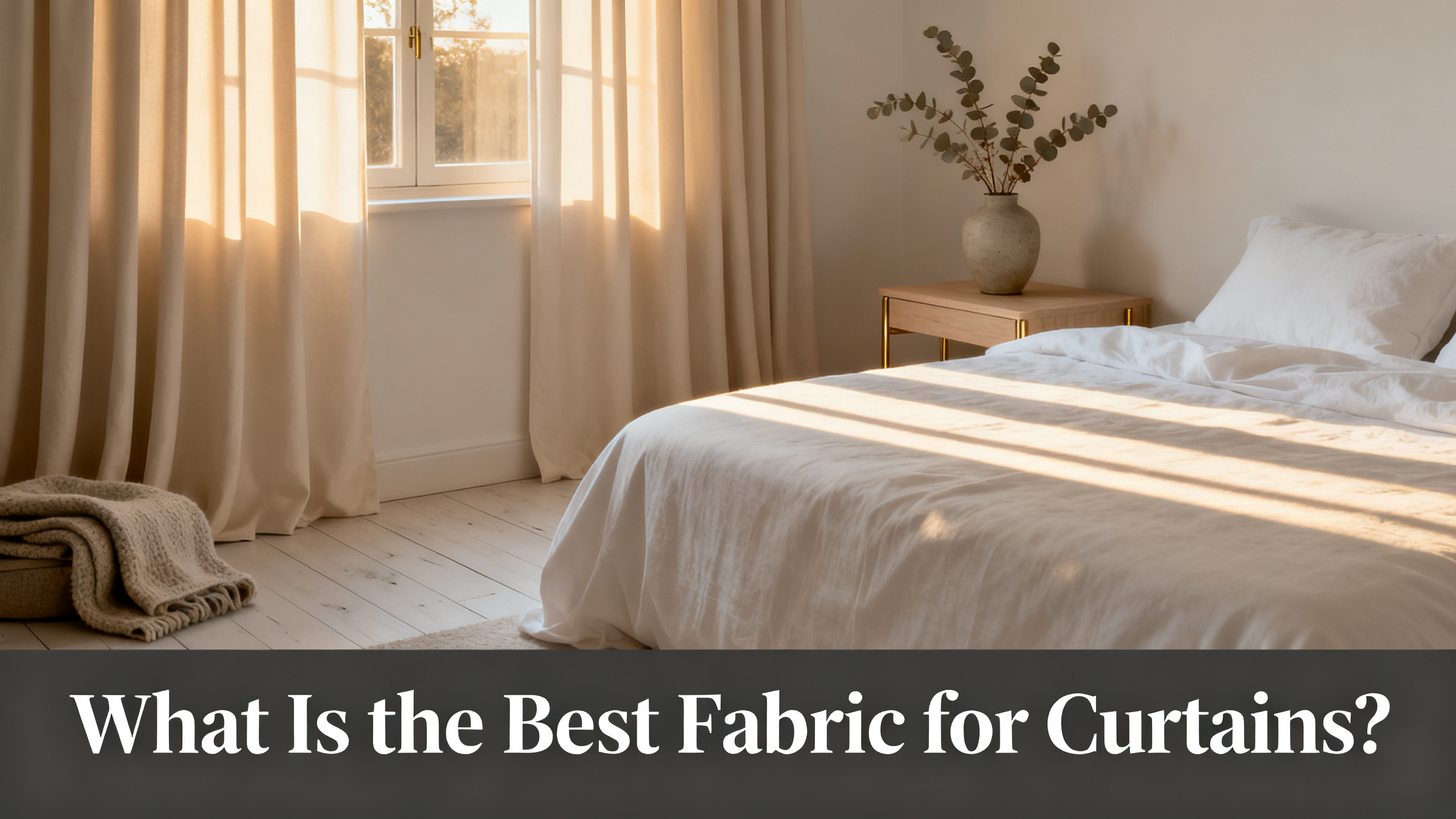
Here’s the deal, in one line: linen for drape and eco, velvet for privacy and drama, cotton for casual daily driver, polyester blend for a strict under-$60 budget, sheer voile for daylight layering. Which one is right for you depends on which trade-off you’re actually willing to make.
Five fabric families cover roughly 95% of what buyers put on a residential window in 2026, and each answers a different question. Owners ask “what’s the best fabric for curtains” for reasons that split into eight buyer angles: drape, light block, privacy, humidity, wrinkle, longevity, hand-feel, and eco. This guide walks each one against the Two Pages catalog with real gsm, configurator prices, and honest limitations, and it links out to the full linen curtains hub when the answer tilts that way.
The short version for a Featured Snippet reader: the best fabric for curtains depends on which trade-off matters. Linen wins on drape, biodegradability, and hand-feel. Velvet wins on privacy, acoustic dampening, and unlined light block. Cotton wins on machine-washability and casual style. Polyester blend wins on wrinkle-free budget. Sheer voile wins on daylight layering. Two Pages carries a real tier in every family from $59.99 to $109 per panel.
The 5 Fabric Families in 30 Seconds
Linen
Drape, eco, hand-feel. Wrinkles.
Velvet
Privacy, acoustics, drama. Dry-clean.
Cotton
Washable, structured, casual.
Poly Blend
Wrinkle-free, budget, humidity-proof.
Sheer Voile
Layering, airiness, daylight.

The living-room default when the answer is linen
Patti Premium 100% Belgian Flax Linen
from $79.99/panel · 100% Belgian Flax Linen · 140 gsm medium weight · 9 muted colorways · the honest entry point into real linen for buyers who want drape and biodegradability. Final price depends on size and lining.
Use code JULY for 20% off · Free shipping over $300
The Fabric Families at a Glance
Sounds technical. Here’s why you care: each family has a fingerprint on the spec sheet, and once you can read the numbers, you can predict how the panel will behave in your room before you spend $300 on custom widths. The table below is the honest side-by-side from the Two Pages catalog.
| Family | Two Pages tier | Fiber | Weight | Unlined light block | Drape | Longevity | From |
|---|---|---|---|---|---|---|---|
| Linen (medium) | Patti Premium | 100% Belgian Flax | 140 gsm | 60 to 70% | Soft, columnar | 8 to 12 yr | $79.99 |
| Linen (certified) | Doris | 100% European Flax | 117 gsm | 55 to 65% | Light, airy | 8 to 12 yr | $109 |
| Linen (heavyweight) | Erin Heavyweight | 100% Linen | 350 gsm | 75 to 85% | Dense, sculpted | 10 to 12+ yr | $89.99 |
| Velvet | Birkin | 100% cotton velvet | 400 gsm | 85 to 95% | Heavy, columnar | 8 to 12 yr | $89 |
| Cotton (heavyweight) | Isabella Heavyweight | Heavyweight cotton | ~300 gsm | 65 to 75% | Structured | 6 to 10 yr | $89.99 |
| Polyester blend | Liz Linen Drape | 10% linen, 90% poly | 350 gsm | 70 to 80% | Pressed, uniform | 5 to 8 yr | $59.99 |
Read the table by column, not by row. 140 gsm is medium weight and lets afternoon light through with warmth. 350 to 400 gsm is heavyweight and reads sculpted, blocks more light, and lasts longer at the fold. A polyester blend at 350 gsm behaves nothing like a 100% linen at 350 gsm because the fiber choice, not the weight, decides whether the panel breathes or holds heat.
Budget Ladder: Where Each Family Starts
Poly blend
$59.99
Liz Linen
Linen medium
$79.99
Patti Belgian
Velvet
$89
Birkin
Cotton / Linen heavy
$89.99
Isabella / Erin
Certified linen
$109
Doris European
The 8 Questions Buyers Actually Ask
Which fabric drapes the best?
Linen wins the drape competition, full stop. The reason is fiber physics: flax has a lower elastic recovery than polyester, so the fabric relaxes instead of springing back, and that relaxation reads as a soft fall rather than a stiff column. Patti Premium at 140 gsm and Doris European Flax at 117 gsm both produce the signature “wet-sand” fold that designers keep specifying.
Velvet drape is a different animal, heavy and columnar, closer to how a theater curtain reads. Cotton at 300 gsm falls structured and slightly boxy, especially before the first wash. Polyester blends like Liz Linen mimic linen’s look but the fold reads more uniform, less alive, because the fiber springs back into a set shape.
Are Linen Curtains Worth It? A Textile Analyst’s Answer
If this guide tilts you toward linen, the worth-it FAQ breaks the yes and no answers into four buyer angles (cost, longevity, aesthetic, eco) with configurator prices.
Picture the moment linen catches afternoon light at 5pm and the folds soften into shadow. That behavior is what you’re paying for, and no polyester blend at any price replicates it convincingly on close inspection.
Drape Signature by Fabric
Linen
Soft, wet-sand fall, relaxes over 48h
Velvet
Heavy, columnar, theater weight
Cotton
Structured, slightly boxy, tames after wash
Poly blend
Uniform, pressed, memory-set fold
Sheer voile
Airy, floats, no visible weight
Which fabric blocks the most light?
Velvet blocks best unlined. Birkin 100% cotton velvet at 400 gsm stops roughly 85 to 95% of transmitted light with no liner. That’s why home theaters and formal bedrooms keep gravitating toward velvet even when the room aesthetic would prefer a lighter fabric.
Linen at 140 gsm filters 60 to 70% unlined, cotton at 300 gsm filters 65 to 75%, polyester blend at 350 gsm sits around 70 to 80%, and sheer voile hovers at 15 to 25%. Erin Heavyweight 100% linen is the outlier for a natural fiber at 75 to 85% block because the density does part of the liner’s job.
Here’s where the honest answer flips, though: a blackout lining changes the math. Any face fabric plus a 150 gsm 2-pass blackout liner delivers 99% light block. The face fabric only wins the light game if you refuse to line, and once you commit to lining, the choice becomes purely aesthetic.
Unlined Light Behavior (transmittance %)
Sheer voile
75-85%
light passes
Linen 140gsm
30-40%
light passes
Cotton 300gsm
25-35%
light passes
Poly 350gsm
20-30%
light passes
Velvet 400gsm
5-15%
light passes
Which fabric handles privacy and drama best?
Cotton velvet is the privacy king. Dense pile plus 400 gsm weight eliminates silhouette even when the room is lit from inside and the street outside is dark. That’s the situation where linen at 140 gsm gives you away, and where a blackout liner behind sheer voile still shows movement.
Velvet also wins on acoustic dampening. The pile absorbs roughly 20 to 30% more mid-frequency sound than linen or cotton at similar weight, which is why apartments in noisy streets keep specifying velvet for the bedroom facing the intersection. It’s not marketing, it’s how a raised pile scatters sound waves.
The drama piece is aesthetic, and here Birkin cotton velvet reads plush and premium against modern minimalist or maximalist rooms without needing extra hardware weight. If it were my room and the window faced a shared courtyard, this would be the fabric family before anything else.

If the answer is velvet: Birkin Cotton Velvet
from $89/panel · 100% cotton velvet with a dense pile that reads as premium and blocks light naturally · 400 gsm heavyweight · 34 colorways from Snow White to Chocolate. The tier that earns the privacy, acoustic, and drama angle.
Which fabric handles humidity best (kitchens, bathrooms)?
Real talk: polyester blend wins humidity, and this is the one area where the synthetic fiber actually earns its place. Liz Linen Drape at 10% linen and 90% polyester resists mildew and dimensional swelling in kitchens where 100% linen and 100% cotton absorb moisture and soften noticeably over a summer of steam.
Cotton velvet is the wrong call for kitchens. Pile holds cooking oils and steam scent that never fully dry-clean out. Real linen tolerates humidity but softens more than most owners expect, and a wet season in a coastal home can leave 100% linen panels feeling limp until the room dries out.
Humidity & Care Match by Room
Linen
OK dry rooms. Skip kitchens.
Velvet
Dry rooms only. Never kitchen.
Cotton
Dry to moderate. Washable.
Poly blend
Kitchen & bath friendly.
Sheer voile
Hand-wash. Coastal OK.
Which fabric wrinkles the least?
Polyester blend keeps a pressed look longest, roughly 3x longer than 100% linen between steaming. That’s the whole reason Liz Linen sits at $59.99 and still sells to buyers who like the linen aesthetic but refuse to fight wrinkles.
Velvet and cotton hold shape well. Real 100% linen wrinkles the most, and the wrinkle is the aesthetic point, not a bug. If you’re fighting your linen panels every week, you either bought the wrong family or you have the wrong expectation of what real flax fiber does under gravity and humidity.
Memory training on Patti, Doris, Erin, or Liz locks the pleats into a consistent fold at the header, but it does not stop wrinkle bloom in the field of the panel between the pleats. That’s a fiber choice, not a service choice.
Wrinkle & Recovery (low → high)
100% Linen
1/5
wrinkle-prone
Cotton
2/5
creases at fold
Sheer voile
3/5
relaxes fast
Velvet
4/5
pile hides creases
Poly blend
5/5
wrinkle-resistant
Which fabric lasts the longest?
Where I land after all this: Erin Heavyweight 100% Linen at 350 gsm and Birkin 100% cotton velvet at 400 gsm are the longevity leaders in the Two Pages catalog. Both survive 10 to 12+ years under normal residential use, and both age gracefully rather than dropping off a cliff at year 6.
The mid-tier answer is straightforward. Patti Belgian Flax at 140 gsm lasts 8 to 12 years, Isabella Heavyweight Cotton at ~300 gsm lasts 6 to 10 years, and Liz polyester blend at 350 gsm lasts 5 to 8 years before the pile flattens and the dyes start pulling dull. Weight helps, but fiber choice matters more than the gsm number alone.
How to Measure for Custom Curtains: 6-Step Guide
Longevity depends on drop and return being right the first time. Before configuring any fabric family, walk the printable measurement checklist.
Longevity assumes correct measurement and care. Wrong drop means the panel drags on the floor, wears the hem, and drops years off the life estimate. Wrong care means a hot wash on 100% linen shrinks up to 5% on cycle one, and a home wash on cotton velvet leaves ring marks.
Expected Life to Visible Wear
Poly blend
5-8 yr
Liz
Cotton mid
6-10 yr
Isabella
Linen med
8-12 yr
Patti / Doris
Velvet
8-12 yr
Birkin
Linen heavy
10-12+ yr
Erin
Which fabric feels most premium in the hand?
Doris 100% European Flax is the tactile winner for buyers who want organic, matte, cool-to-touch drape with real field-to-loom traceability. At $109/panel and 117 gsm it’s the tier that reads premium the moment you touch it, and the certification stack matches the price.
Birkin cotton velvet reads plush and dense. Isabella Heavyweight Cotton at 300 gsm reads structured but honest, more everyday than luxurious. Liz Linen at $59.99 reads convincing at three feet but the hand-feel gives up the polyester on close inspection. Fair note: Liz was included in the ASID 2025 Fall Design Product Guide, which is real recognition for what a blend can achieve at that price.
Sheer voile is the outlier here. It wins airiness and loses structure, and that’s the whole point of the family. Judge sheer voile against curtain fabrics the way you’d judge tissue paper against cardstock, they’re not competing.
Hand-Feel Signature
Linen (Doris)
Cool, matte, dry, alive
Velvet (Birkin)
Plush, dense, warm nap
Cotton (Isabella)
Structured, honest, everyday
Poly blend (Liz)
Smooth, slightly slick close up
Sheer voile
Weightless, papery, light
Which fabric is the most eco-friendly?
Honestly? 100% linen wins the eco math when the certification stack is real. Belgian Flax and European Flax with Masters of Linen field-to-loom, plus OEKO-TEX Standard 100 textile safety certification on the yarn, is the honest package. Flax grows on rain-fed European land with roughly 50% less water than cotton, and 100% linen biodegrades in 18 to 36 months once discarded.
Sustainable Curtains Buying Guide: OEKO-TEX, Masters of Linen, GOTS Decoded
The eco angle for any fabric only holds if the certification stack is real. Full walk-through of what each label actually proves and where greenwashing sneaks in.
100% cotton with GOTS certification is a solid second, and cotton velvet with a cotton pile counts here too. Polyester blend does not qualify regardless of its OEKO-TEX Standard 100 status because the base fiber is petro-derived and does not biodegrade on any residential timeline. European Flax and Masters of Linen field-to-loom certification is the signal to look for on real linen.
Cards on the table: pairing a 100% linen face with a polyester blackout liner cancels the biodegradability angle, and the ASID recognition on Liz Linen is a design award, not a sustainability certification. If eco is the reason you’re asking, choose 100% linen or 100% cotton and match the lining to the same standard.
Certification Stack That Actually Means Something
OEKO-TEX Std 100
Baseline textile safety. Present on Two Pages inventory. Says nothing about fiber origin.
Masters of Linen
Field-to-loom traceability on European Flax. Present on Doris and Patti.
GOTS
Organic cotton with social and processing rules. The cotton equivalent of Masters of Linen.
Which fabric is the safest budget-to-mid pick?
Don’t overthink it. Liz Linen Drape at $59.99/panel is the safest sub-$60 pick because the polyester structure holds shape, the 10% linen slub reads convincing across most rooms, and the composition tolerates humidity that would fatigue real linen. See the full Isabella Heavyweight Cotton review breakdown if you want the mid-tier alternative before deciding.
Isabella Heavyweight Cotton at $89.99/panel is the safest mid-tier pick for buyers who want washable, structured, and versatile without committing to the linen wrinkle. It hits the sweet spot for family living rooms and kids rooms.
Patti Belgian Flax at $79.99/panel is the safest bridge into real 100% linen without jumping to Doris at $109. It’s the tier that answers “yes I want real linen but I don’t need the certification premium” honestly.
The Verdict Wrap
Coming back to the original question. The best fabric for curtains is a function of the buyer, the room, and the trade-off you’re willing to make, not a fabric award you hand out once. Linen wins drape and eco, velvet wins privacy and drama, cotton wins washable versatility, polyester blend wins wrinkle-free budget, sheer voile wins layering. Every family has a real Two Pages tier that costs between $59.99 and $109 per panel, and the honest next step is to match your room and your patience to the family, then start with the full linen curtains hub or the velvet or cotton equivalent depending on where this guide landed for you.
Verdict Matrix: Persona → Fabric Family
Design-first owner
Doris European Flax or Patti Belgian Linen. Real 100% linen, drape and eco.
Privacy-first buyer
Birkin Cotton Velvet. Dense pile, unlined privacy, acoustic bonus.
Family / kids room
Isabella Heavyweight Cotton. Washable, structured, everyday-durable.
Renter or strict budget
Liz Linen Drape. Poly blend, wrinkle-free, humidity-friendly, $59.99.
Feel the fabric before you pick a family
Every fabric family reads different in the hand. The Patti Belgian Linen 9-color booklet ships flat for $2.99 and lets you compare linen against whatever cotton, velvet, or blend swatch you already have before spending $300+ on custom panels.
If the guide points you to linen, start with Patti
100% Belgian Flax Linen, 140 gsm medium weight, 9 muted colorways, custom widths to 197 inches. from $79.99/panel. Code JULY (20% off) · Free shipping over $300 · lead time 7 to 12 days.
FAQ
What is the most durable curtain fabric?
Real 100% linen at heavyweight gsm and 100% cotton velvet are the durability winners in the Two Pages catalog. Erin Heavyweight 100% Linen at 350 gsm and Birkin Cotton Velvet at 400 gsm both survive 10 to 12+ years under normal residential use. Polyester blends like Liz Linen at 350 gsm last 5 to 8 years before pile flattens and dyes dull. Cotton at 250 to 300 gsm sits in the middle at 6 to 10 years. Weight alone does not predict longevity, the fiber choice matters more than the density number.
What fabric is best for blackout curtains?
No face fabric alone delivers true blackout. Even 400 gsm Birkin velvet blocks 85 to 95% unlined. Real blackout, defined as 99% light block, requires a 150 gsm 2-pass coated lining paired with any face fabric. The face fabric choice becomes purely aesthetic once you commit to lining. Linen faces read soft, cotton reads structured, velvet reads premium, polyester blend reads budget. Two Pages offers blackout lining as a configurator add-on across every collection.
What fabric is best for privacy curtains?
Cotton velvet like Birkin at 400 gsm delivers the strongest unlined privacy because dense pile eliminates silhouette even when backlit at night. Linen at 140 gsm shows silhouette when the room is lit from inside and the street is dark. Adding any liner solves privacy for any fabric, but if you refuse to line, velvet is the honest answer. Heavyweight cotton at 300 gsm is a solid second. Sheer voile is the wrong call unless you double it with a blackout panel behind.
Is linen or cotton better for curtains?
Both are natural, biodegradable, and machine-washable. Linen wins on drape (softer fall at lower gsm), biodegradability (18 to 36 months vs cotton 6 to 12 months at similar weight), and eco footprint (flax uses 50% less water than cotton). Cotton wins on wrinkle resistance, structured drape, and price (Isabella at $89.99 vs Patti at $79.99 puts them close). If the question is between them, ask which room and which look. Living room with soft drape aesthetic equals linen. Kids room with washable structure equals cotton.
What is the best fabric for wrinkle-free curtains?
Polyester blends win wrinkle resistance outright. Liz Linen Drape Pleated at $59.99 per panel with a 10% linen and 90% polyester composition holds pleats and a pressed look 3x longer than 100% linen between steaming. Structured cotton at 350 gsm holds shape well too but shows crease at high-humidity or after a wash. Real 100% linen wrinkles the most, and the wrinkle is the aesthetic point, not a bug. If wrinkle-free matters more than natural fiber to you, you already have your answer.
What curtain fabric is easiest to clean?
Polyester blend is easiest to clean, then cotton, then linen, then velvet. Liz Linen at 10% linen and 90% polyester machine-washes on gentle cold with no shrinkage risk. Cotton and 100% linen both machine-wash cold on gentle but linen shrinks up to 5% on first hot wash if you skip cold. Cotton velvet like Birkin requires professional dry-clean or careful spot-cleaning because water leaves ring marks on pile. Sheer voile hand-washes gently. Match the fabric to how often you actually plan to clean.
What curtain fabric is best for humidity (kitchens, bathrooms)?
Polyester blend wins humidity resistance because synthetic fibers do not absorb moisture. Liz Linen at 90% polyester is the honest kitchen and bathroom pick because it resists mildew and dimensional swelling. Real 100% linen and 100% cotton absorb humidity, soften noticeably, and can develop mildew if the room stays damp for weeks. Velvet is the wrong fabric for kitchens because pile holds cooking oils and steam scent. Reserve linen and cotton for living rooms, bedrooms, and low-humidity spaces.
Is velvet a good fabric for curtains?
Yes when the reason is privacy, acoustic dampening, or premium visual weight. Cotton velvet like Birkin at 400 gsm and $89 per panel delivers unlined light block 85 to 95%, absorbs mid-frequency sound roughly 20 to 30% more than linen at similar weight, and reads plush against modern minimalist rooms. No when the reason is casual daily use, a humid room, or a strict eco stance with heavy-wash cycles. Velvet earns bedrooms, formal living rooms, and home theaters. It does not earn kitchens, kids rooms, or low-maintenance houses.
