
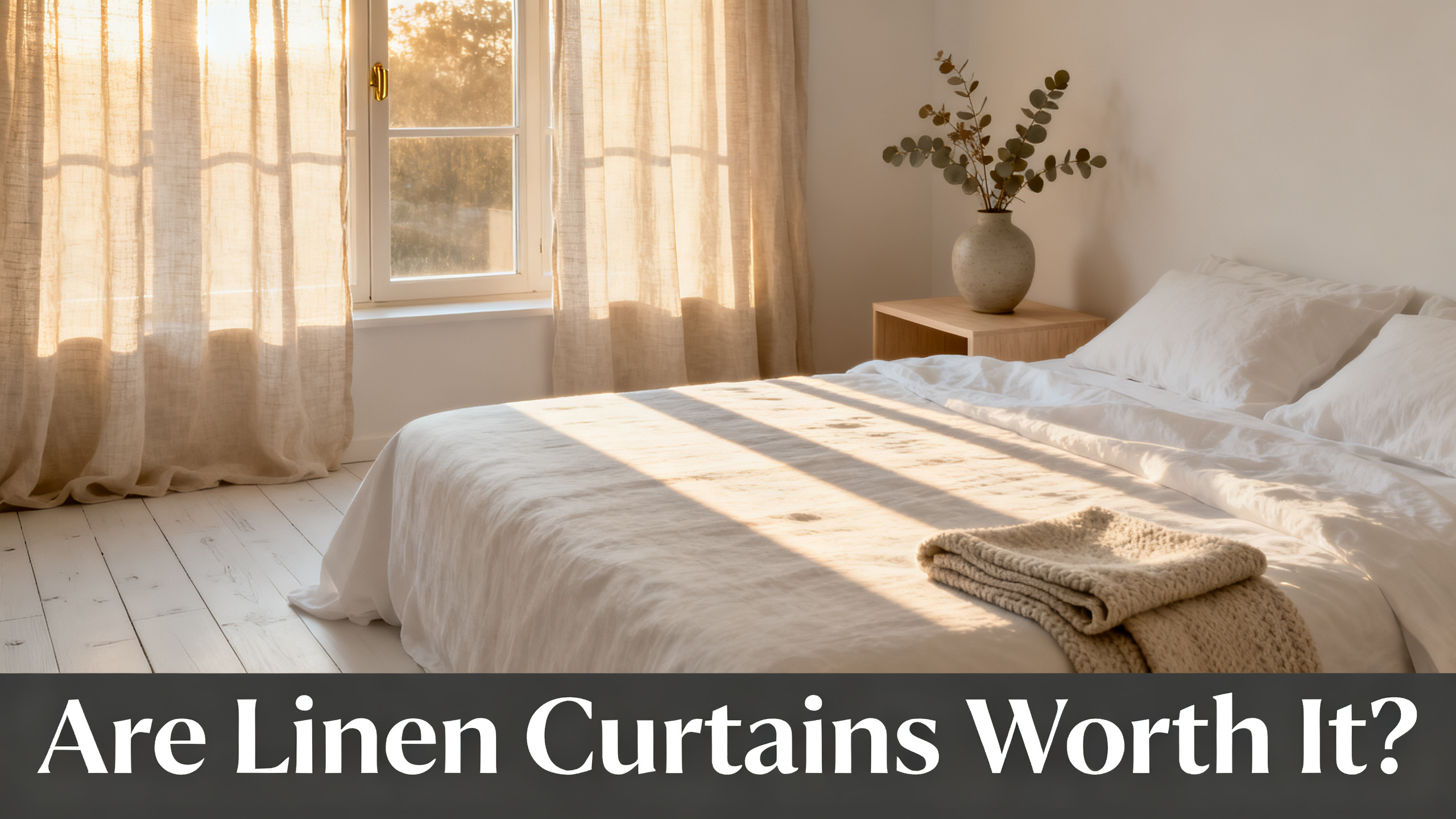
Owners ask this question for three reasons, and each reason opens onto a different answer. Some are staring at a $200 price gap between a real linen panel and a polyester lookalike and want to know if the fiber upgrade is real. Others already own linen from a decade ago and wonder if they should replace it with the same fabric or switch. A third camp is deep in the eco math and needs to know whether flax genuinely beats polyester on the sustainability ledger.
Those three motivations do not share a single verdict. What you actually want to know is which of the three reasons brought you to the search bar, and Two Pages carries four real linen tiers that map onto them: Liz Linen at $59.99 as a linen-look blend, Patti Premium 100% Belgian Flax at $79.99, Erin Heavyweight 100% Linen soft top at $89.99, and Doris 100% European Flax at $109. For the wider pillar view, browse the full linen curtains hub.
The honest short answer, held to Featured Snippet length: yes when you value drape, longevity, and biodegradability, no when you need wrinkle-free crisp under $60 a panel. The four-angle breakdown below is what turns that one-liner into a real decision.
Three reasons owners ask “are linen curtains worth it”
Cost: is the premium real?
Real Belgian Flax runs $80 to $110 per panel versus $30 to $50 for polyester. The question is whether the fiber earns the gap.
Longevity: how many years?
Owners already living with linen want to know if the 8-to-12-year lifespan claim is field-true or catalog copy.
Eco: is flax really better?
Sustainability shoppers need to know if 100% linen actually clears the polyester bar once linings and certifications enter the picture.

The most affordable real 100% linen at Two Pages
Patti Premium 100% Belgian Flax Linen
from $79.99/panel · 100% Belgian Flax Linen · 140 gsm medium weight · 9 muted colorways · the honest entry point into real linen if this article convinces you the answer is yes. Final price depends on size and lining.
Use code JULY for 20% off · Free shipping over $300
The Honest Answer, Angle by Angle
The “worth it” question is really four questions stacked, and treating them as one produces the vague verdicts you find on furniture blogs. Below, each angle gets its own answer with real prices, real gsm, and real longevity data, so you can locate your own reason for asking and read only the part that matters.
The cost angle: is real linen worth the premium over polyester?
Set the sticker prices side by side first. Big-box polyester curtains that mimic linen texture run $30 to $50 per panel. Two Pages Liz Linen Drape blend, which is 10% linen and 90% polyester, lists at $59.99. Real fiber begins with Patti Premium 100% Belgian Flax at $79.99, climbs to Erin Heavyweight 100% Linen at $89.99, and tops out at Doris 100% European Flax at $109. The gap between polyester and real linen is roughly $50 to $80 per panel.
The upgrade math only works when you run it over the ownership window. Polyester curtains at that price point typically need replacement at year 3 to 5 as fibers dull, pleats collapse, and colors fade under UV. Real linen at Patti or Doris runs 8 to 12 years, and Erin Heavyweight often past 12. Amortized over ten years, real linen costs about $8 to $11 per year per panel, and polyester costs about $10 to $17 once the replacement cycles are counted.
The blend counter-argument holds for a specific case. If you are renting for two years, do not want to sink money into custom drapery you will leave behind, and want the linen aesthetic in your space right now, Liz Linen at $59.99 is a legit answer. It is a blend, but Two Pages is transparent about the ratio, and the drape reads convincingly at eye level. See the full Liz Linen Drape review breakdown for the honest handling of what “linen aesthetic on a polyester base” actually delivers.
Linen Curtain Buying Guide 2026: Real Linen vs Blend, by Persona
If the “worth it” question tilts yes, the buying guide walks the four Two Pages tiers by persona (renter, owner, luxury, sustainability) with configurator prices and lining matches.
Cost of ownership over 5 years, per panel
Big-box polyester
$60 to $100
$30 sticker, replaced twice over 5 years as pleats collapse and color fades.
Liz Linen blend
$59.99
One panel, one lifecycle, still going at year 5 with periodic gentle wash.
Patti Belgian Flax
$79.99
One panel, no replacement expected before year 8. Softens rather than degrades over cycle count.
The longevity angle: how many years does real linen actually last?
The cluster of Trustpilot and Judge.me feedback on Two Pages linen collections points to an 8 to 12 year window under normal residential use, with an annual gentle wash and no dryer exposure. Belgian Flax and European Flax pieces get filed under the same durability tier, and Erin Heavyweight at 350 gsm pushes past the 12-year mark because the denser weave resists thinning at the folds where the drape pivots.
Polyester of comparable construction hits a wall earlier. The elastic fibers heat-set into pleats at manufacture, and after roughly 30 machine washes, the pleats begin to release. Color fade under UV accelerates around year 3, and the fabric develops a shine that reads as tired instead of soft. Owners typically reach replacement pressure at year 3 to 5, which is where the cost math flips against polyester.
Real linen longevity timeline, catalog-tested tiers
Year 1
Fabric softens after 2 to 3 washes, wrinkle relaxation stabilizes, memory training locks in the pleat memory.
Year 3
Drape reaches peak character. Owners report this as the year the panels look “settled” rather than new.
Year 7
Fold lines soften but hold. No shine. Color remains within one shade of original on OEKO-TEX dyed yarns.
Year 10
Erin Heavyweight still passes visual inspection. Patti and Doris often trigger a refresh decision, not a replacement one.
Erin Heavyweight 100% Linen soft top at from $89.99/panel is the Two Pages workhorse for the longevity-first buyer. The 350 gsm construction reads as substantial in hand and drapes with weight rather than float. If the reason you are asking the “worth it” question is that you want to buy once and stop thinking about window treatments for a decade, this is the tier that pays back.

If the answer is yes for eco reasons: Doris European Flax
from $109/panel · 100% European Flax with Masters of Linen field-to-loom traceability · 117 gsm light-filtering · OEKO-TEX Standard 100 yarn · 6 natural colorways. The tier that earns the sustainability angle.
The aesthetic angle: does the wrinkle and slub texture actually earn a place?
Picture the same window in early afternoon, south-facing, with Belgian Flax hung to the floor with a half-inch break. Light passes through and lands warm on the floor, softened by the slub weave that scatters photons unevenly across the panel. The fabric moves with air currents in a lazy, weighted way. That is what real 100% linen does that polyester cannot fake, and it is what the aesthetic argument is really about.
The wrinkle is the point, not the flaw. Flax has low elastic recovery, so wrinkles form after every touch and relax gently over 24 to 48 hours as gravity re-shapes the panel. The crumpled character reads as intentional, lived-in, and confident in a way a heat-set polyester pleat can never quite deliver. If you find yourself scrolling design accounts and stopping on rooms that feel calm and slightly rumpled, you are already looking at 100% linen most of the time.
Drape behavior varies by weight. Patti at 140 gsm falls with fluid movement and light diffusion, ideal for living rooms and daylight-heavy spaces. Doris at 117 gsm is finer and reads as more delicate, better suited to bedrooms and study nooks where you want light to filter. Liz Linen at 350 gsm is heavier and holds a straighter drape day-one, which is exactly why it exists as a blend answer for people who want the look without the wrinkle behavior.
How to Measure for Custom Curtains: 6-Step Guide
Linen drapes best when the drop, return, and rod placement are right. Before configuring Patti or Doris, walk the printable measurement checklist.
The aesthetic signature of real linen
Light behavior
Slub weave scatters daylight unevenly, producing the warm diffused glow that polyester slub cannot mimic.
Drape movement
Falls with weight and lazy sway. Memory training preserves pinch pleat crown while allowing bottom float.
Hand-feel
Cool to touch, softens with each wash cycle. Reaches peak character around year 3.
The eco angle: is linen genuinely more sustainable than polyester?
Flax grows on rain-fed European land, primarily in France, Belgium, and the Netherlands, and uses roughly half the water footprint of cotton and a fraction of what polyester manufacturing burns through in petrochemicals. The plant biodegrades in 18 to 36 months once discarded, versus polyester which persists for decades and sheds microplastics with every wash. For a deeper walkthrough of why European Flax uses less water than cotton and the OEKO-TEX Standard 100 textile safety certification that covers dye chemistry, both external sources hold up under scrutiny.
Sustainable Curtains Buying Guide: OEKO-TEX, Masters of Linen, GOTS Decoded
The eco case for linen only holds if the certification stack is real. Full walk-through of what each label actually proves and where greenwashing sneaks in.
Certification matters here because the word “sustainable” is used loosely. Doris and Patti both carry European Flax and Masters of Linen field-to-loom certification, which tracks the fiber from the exact French or Belgian field where it was grown, through retting, spinning, and weaving. That paper trail is what separates a legitimate eco claim from a greenwashed one, and it is the reason Doris costs $30 more per panel than Patti even though both are 100% linen.
The honesty check owes itself. Liz Linen at 10% linen and 90% polyester does not qualify as a sustainable choice regardless of its OEKO-TEX Standard 100 status, which certifies dye and chemical safety but says nothing about fiber sustainability. Worse, pairing a 100% linen face fabric with a polyester blackout liner cancels the eco math because the composite panel is no longer compostable. If eco is your reason for asking, choose Doris or Patti with a linen liner or leave the panel unlined.
The certification stack that makes real linen genuinely sustainable
OEKO-TEX Standard 100
Certifies that yarn and dye contain no harmful chemicals above safety thresholds. Baseline for skin contact.
Masters of Linen
Guarantees European growing, retting, spinning, and weaving. The provenance layer that stops offshore blend fraud.
European Flax
Field-to-loom traceability on flax from France, Belgium, and the Netherlands. Doris and Patti carry this label.
The Textile Specs: What Every “Worth It” Argument Depends On
Every one of the four angles above rests on a set of numbers, and if you skip the numbers you end up with the vague verdicts you find on Reddit at 2 a.m. Below is the honest sheet across the four Two Pages linen tiers plus a big-box polyester reference. All prices are catalog base, all gsm are catalog spec, all lead times are configurator returns as of 2026.
| Spec | Big-box polyester | Liz Linen (blend) | Patti Belgian Flax | Doris European Flax | Erin Heavyweight |
|---|---|---|---|---|---|
| Fiber | 100% polyester | 10% linen, 90% polyester | 100% Belgian Flax linen | 100% European Flax linen | 100% linen |
| Weight | 120 to 180 gsm | 350 gsm heavyweight | 140 gsm medium | 117 gsm light-filtering | 350 gsm heavyweight |
| Base price | $30 to $50/panel | from $59.99/panel | from $79.99/panel | from $109/panel | from $89.99/panel |
| Certifications | N/A | OEKO-TEX Standard 100 | OEKO-TEX Standard 100, Masters of Linen, European Flax | OEKO-TEX Standard 100, Masters of Linen, European Flax | OEKO-TEX Standard 100 |
| Expected life | 3 to 5 years | 5 to 7 years | 8 to 12 years | 8 to 12 years | 10 to 15 years |
| Colorways | Varies by brand | 14 colorways | 9 muted colorways | 6 natural colorways | 7 colorways |
| Lead time | Stock (2 to 5 days) | 7 to 12 days | 7 to 12 days | 10 to 12 days | 10 to 14 days |
| Biodegradable | No, sheds microplastics | No, majority polyester | Yes, 18 to 36 months | Yes, 18 to 36 months | Yes, 18 to 36 months |
Read the table row by row and the four angles resolve. On fiber, only Patti, Doris, and Erin clear the 100% linen bar. On weight, 117 gsm Doris drapes lightest and 350 gsm Erin drapes heaviest, and neither is objectively better. On certifications, only Patti and Doris carry the Masters of Linen provenance layer that eco shoppers actually need. On expected life, real linen buys a decade where polyester buys three to five years.
100% linen pros and cons, honest read
Pros
- Biodegrades in 18 to 36 months, no microplastic shed
- 8 to 12 year usable life, longer at 350 gsm
- Slub weave scatters daylight in a way polyester cannot fake
- Softens with washing, peaks around year 3
- Field-to-loom certification available on Patti and Doris
Cons
- Wrinkles readily, though relaxation is 24 to 48 hours
- Base price $80 to $109 per panel, two to three times polyester
- Shrinks up to 5% on hot wash, cold gentle only
- Unlined 100% linen filters light but does not block
- Dye lot variation on natural colorways, order all panels together
Care is where owners either preserve the fiber or blow the investment. Machine wash cold on gentle cycle, line-dry or hang damp from the wash, skip the dryer entirely because heat shrinks flax by up to 5%. Memory training on Patti and Doris preserves the pinch pleat crown across years, and hanging panels damp lets gravity re-form the pleats naturally as the fabric dries in place.
Care tip that decides the “worth it” verdict
If wrinkle behavior worries you at all, hang panels damp straight from the wash and let gravity relax the folds. Trained pleats will re-lock as the fabric dries in place, and the natural crumple will read as designed rather than accidental. Skip this step and linen will look like a laundry mishap for the first 48 hours after every wash cycle.
Feel the fiber before the yes or no verdict
Linen hand-feel divides opinion, and no article settles it. The Patti Belgian Linen 9-color booklet ships flat for $2.99 and lets you rub, drape, and daylight-test real fabric before spending $300+ on custom panels.
The Verdict Matrix: When Yes, When No
Locate your reason for asking in the row that matches, read the verdict, and act on it. The matrix collapses the four angles above into a single skimmable answer without pretending the trade-offs disappear.
Verdict by angle, condition attached
Cost
Yes if you hold 5+ years
Real linen wins the amortized math over polyester by year 5. Renters staying under 2 years should choose Liz blend at $59.99.
Longevity
Yes, unambiguously
8 to 12 years on Patti and Doris, past 12 on Erin at 350 gsm. Polyester cannot match on any tier.
Aesthetic
Yes if you love the wrinkle
The crumpled character reads as intentional. If you need wrinkle-free crisp, choose Liz blend or a linen-cotton like Jawara.
Eco
Yes with certified fiber
Choose Doris or Patti with Masters of Linen provenance. Skip polyester linings if compostability matters.
The full “worth it” answer is that yes, real 100% linen curtains earn their premium for buyers who plan to hold them, value the aesthetic, or want a defensible eco footprint, and no, they do not earn the premium for two-year renters or people who want crisp wrinkle-free drape at $30 a panel. Start from the complete linen curtains hub to browse the collections that match your reason, or jump straight to the Patti Belgian Flax tier below.
If the four angles convinced you, start with Patti
100% Belgian Flax Linen, 140 gsm medium weight, 9 muted colorways, custom widths to 197 inches. from $79.99/panel. Code JULY (20% off) · Free shipping over $300 · lead time 7 to 12 days.
Frequently Asked Questions
How long do 100% linen curtains actually last?
Real 100% linen curtains from tier makers like Patti Premium Belgian Flax and Doris European Flax last 8 to 12 years under normal residential use with an annual gentle wash. Erin Heavyweight at 350 gsm survives longer, often past year 12, because the denser weave resists thinning at the folds. Polyester curtains at similar price points typically hit a replacement wall at year 3 to 5 when the fibers dull and the pleats collapse.
Do linen curtains wrinkle a lot?
Yes, and the wrinkle is the point of choosing 100% linen. Flax fiber has less elastic recovery than polyester, so wrinkles form easily and relax over 24 to 48 hours after hanging. The natural crumpled drape is what buyers of Patti, Doris, and Erin are actively chasing. If wrinkle-free crisp matters more, a linen blend like Liz at 350 gsm holds a pressed look longer and reads closer to what polyester delivers.
Are linen curtains good for bedrooms?
Unlined 100% linen filters light beautifully but does not block it, so pair it with a lining if blackout matters. A polyester blackout liner delivers 99% light block while keeping the linen face fabric, and a linen liner delivers roughly 70% light reduction while keeping the panel compostable. Patti at $79.99 per panel with a blackout liner configures to about $155 for a 100 by 96 window in the Two Pages cart.
Is real linen worth the price over faux linen or polyester?
Yes when the reason is longevity, aesthetic, or eco. No when the reason is a strict budget under $60 per panel. Real Belgian Flax at $79.99 delivers 8 to 12 year life, natural biodegradability, and a drape polyester cannot replicate. Faux linen or linen blend at $30 to $60 wins on wrinkle resistance and short-term budget. The “worth it” answer hinges on which reason brought you to the question.
How much do real linen curtains cost from Two Pages?
Prices start at $59.99 per panel for Liz Linen Drape blend, $79.99 for Patti Premium 100% Belgian Flax, $89.99 for Erin Heavyweight 100% Linen soft top, and $109 for Doris 100% European Flax. A configured 100 by 96 pinch pleat Patti panel unlined runs about $220 in the cart simulator, and adding a blackout lining bumps it to roughly $290. Code JULY takes 20% off sitewide, and free shipping applies over $300.
Are linen curtains sustainable?
Yes when the fiber is genuinely 100% linen and the lining follows suit. Flax grows on rain-fed European land with roughly half the water footprint of cotton and biodegrades in 18 to 36 months once discarded. Doris and Patti carry field-to-loom traceable flax through European Flax and Masters of Linen certification schemes. The caveat is honest: pairing a 100% linen panel with a polyester blackout liner cancels the eco math, and Liz Linen at 10% linen and 90% polyester does not qualify as sustainable regardless of its OEKO-TEX Standard 100 status.
Do linen curtains shrink or fade over time?
Real linen shrinks up to 5% on the first hot wash if you skip the care instructions, which is why Two Pages ships every 100% linen panel with cold gentle wash directions. Color fade is minimal on Belgian and European Flax pieces because the yarn is dyed under OEKO-TEX Standard 100 protocols. What does happen is softening. The hand-feel loosens noticeably after the first three wash cycles, and most owners report the drape improves rather than degrades over year 1 to 3.
What is the difference between Belgian Flax and European Flax linen?
Belgian Flax refers to fiber grown and often woven in Belgium, historically the reference standard for fine linen. European Flax is a broader certification schema managed by CELC that covers flax grown across Northern Europe, primarily France, Belgium, and the Netherlands, with field-to-loom traceability under the Masters of Linen program. Patti at $79.99 is Belgian Flax, and Doris at $109 is European Flax with the traceability stack. Both are real 100% linen, and the price gap reflects the certification premium, not a fiber quality gap.
