
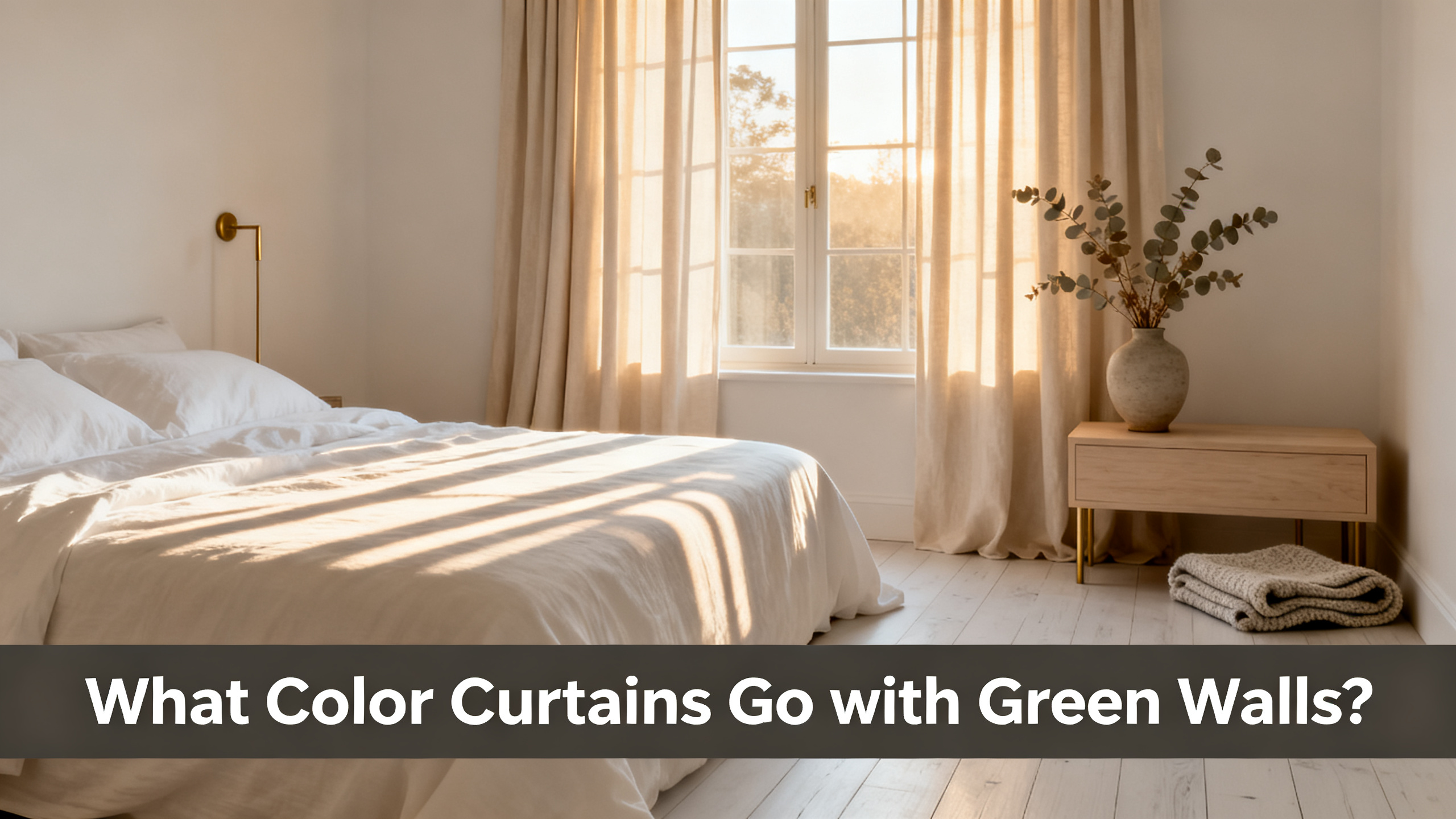
Owners ask this in three contexts. A sage feature wall behind a bed. Emerald or forest saturating a dining room. Olive kitchen or mint nursery. Each context leads to a different curtain colorway, but the underlying rule is the same: match the undertone of the green, then swatch three candidates against the wall at three different hours.
Green pigment amplifies light-temperature swings more than any other wall family. A colorway that looks perfect at noon can flip warm at 4pm and clinical at 9pm under LED. What follows breaks the problem into 5 green families, assigns two safe curtain picks per family, then covers the four questions that decide 80% of buyer regret. Everything else lives in the full curtain color hub for the other wall colors.
The 5 Green Families at a Glance
Family 1
Sage
Cool cendré or warm yellow-green. Soft saturation.
Family 2
Olive / Moss
Warm terreux, yellow-green base. Mid saturation.
Family 3
Forest
Cool blue-green, deep value. High saturation.
Family 4
Emerald
Cool jewel tone, luminous. Bold saturation.
Family 5
Mint / Pastel
Cool pale, desaturated. Whisper tier.

The single panel that covers 5 green families
Liz Linen Blend Drapery Pleated
from $59/panel · 140 gsm linen blend · 38 colorways spanning warm and cool neutrals · 9 header styles · 6 lining options. Final price depends on size and lining.
Use code JULY for 20% off sitewide · Free shipping over $300
Curtain Colors for Green Walls, by Green Family
Curtains for Sage Green Walls (Cool Cendré or Warm Yellow-Green)
The reason sage is the trickiest green to pair is that sage is not one color. It splits into a cool cendré variant (dusty grey-green, lean cool) and a warm yellow-green variant (moss-adjacent, lean warm). The Munsell hue notation for green pigment families locates both variants inside the 5G and 5GY hue slices, and the split changes which curtain colorway reads right.
For warm sage (yellow-green base), the curtain pick is a warm off-white or soft warm beige: Liz Sand Beige 1908-3, Ivory White 1908-2, or Kyla Linen in Natural. Kyla Linen Drapery Pleated in Natural is the specific Two Pages colorway that mirrors sage warm without competing with it. For cool sage (cendré), pivot to Fog 1908-18 or Pure Cashmere 1908-15, both cool enough to sit inside sage’s grey-green field instead of fighting it.
Sage Green Wall · Curtain Pairing Card
Best warm pick
🟡 Liz Sand Beige 1908-3
Warm neutral that anchors sage yellow-green without pulling green toward mustard.
Best cool pick
🔵 Liz Fog 1908-18
Cool grey that sits inside sage cendré’s field for a monochromatic modern read.
Verdict
Match by undertone
Warm sage → warm curtain. Cool sage → cool curtain. Never cross the axis.
⚠️ Warning. Sage walls with a warm undertone (yellow-green base) reject a cool grey curtain. The two read tolerable at noon and clash at 4pm under west sun. The safest sage pairing is a warm off-white or a soft warm beige, never a cool grey.
Fabric verdict for sage: linen 140 gsm dominates. The linen slub texture mirrors the organic feel of sage pigment and rewards north-facing rooms where sage often lands. Avoid heavy velvet on sage: velvet’s dense pile reads oppressive against sage’s soft desaturation.
Curtains for Olive and Moss Green Walls (Warm Terreux)
Olive and moss sit deep in the warm yellow-green field. They read terreux, kitchen-adjacent, mid-century. The curtain pick doubles down on warm neutrals or introduces a warm mid-tone that mirrors the olive family without matching the saturation.
Three Liz colorways carry olive walls: Burlywood Birch 1908-5 (warm terracotta neutral, the most cohesive with olive at 3pm), Tapioca 1908-7 (warm greige that softens olive without competing), and Ivory White 1908-2 (warm off-white for high-contrast breathing room in tight kitchens). Cool whites and cool greys read clinical against olive because they subtract the warmth that gives olive its identity.
Olive & Moss Green Walls · Curtain Pairing Card
Best mid-tone
🟠 Liz Burlywood Birch 1908-5
Terracotta-adjacent warm neutral, most cohesive with olive at afternoon light.
Best warm neutral
🟤 Liz Tapioca 1908-7
Warm greige that softens olive without competing for saturation.
Best contrast
⚪ Liz Ivory White 1908-2
Warm off-white for high-contrast breathing room in tight olive kitchens.
Fabric verdict for olive: linen 140 gsm or cotton medium-weight. Avoid sheer voile on olive walls: the wall carries too much saturation for a filtered layer to hold structure. If it were my own olive dining room, the pick would be Burlywood Birch in 180 gsm cotton with a cotton flannel lining for the extra body against a warm accent wall.
Curtains for Forest and Emerald Green Walls (Cool Deep Saturation)
Forest and emerald sit in the cool blue-green field with deep value and high saturation. These are feature-wall greens: dining rooms, libraries, formal living. The pairing splits two ways: high-contrast pure cool white for statement, or monochromatic matte velvet for luxury depth.
For high contrast, Liz Fog 1908-18 or Snow White 1908-0 in linen delivers the cleanest read: the deep green wall absorbs light, the pale cool curtain reflects it, and the room reads intentional. For monochromatic luxury, Birkin Velvet Drapery Pleated in Cream Velvet or Champagne takes over. The matte pile absorbs light instead of reflecting it, which is why velvet drapery pile behaves under low light in a way that linen cannot on deep walls.
Forest & Emerald Green Walls · Curtain Pairing Card
High contrast pick
⚪ Liz Fog 1908-18
Cool pale linen that reflects light against the wall’s absorption. Modern statement.
Monochromatic luxury
🍾 Birkin Cream Velvet
Matte 400 gsm velvet at a 108-inch drop. Absorbs light, reads deep against emerald.
Verdict
Velvet wins on deep greens
Linen slub reads busy against forest walls. Matte pile or smooth cotton reads calmer.

Dark Green Walls Reward Velvet, Not Linen.
from $115/panel · Birkin Velvet Drapery Pleated · 37 colorways · 400 gsm cotton velvet · matte pile that absorbs light instead of reflecting it. On a forest or emerald wall, matte velvet reads intentional in a way that linen never will.
⚠️ Warning. Dark green walls magnify curtain fabric texture. A linen slub on a forest wall reads busy under raking sunlight because the wall absorbs light and the linen texture picks it up. Matte velvet or a smooth cotton reads calmer on deep greens.
If it were my own dining room with forest walls, the pick would be Birkin Cream Velvet at a 108-inch drop with blackout lining. The velvet swallows the west-afternoon glare that forest walls turn into flat light, and the pale colorway keeps the room from going cave.
Curtains for Mint and Pastel Green Walls (Cool Pale)
Mint and pastel green are the whisper tier of the green family. They land in nurseries, powder rooms, and coastal bedrooms. The risk with these walls is “hospital feel” if the curtain adds another cool desaturated note without warmth to soften it.
Three Liz colorways lock mint pastels into their intended vibe: Snow White 1908-0 for monochromatic freshness, Ivory Beige 1908-2 for a barely-warm neutral that keeps the room breathing, and Pure Cashmere 1908-15 for a warm-luxe read that softens the coolness of pastel green. Skip Fog and Grey on mint walls: two cool pales in one field flatten the room.
Mint & Pastel Green Walls · Curtain Pairing Card
Monochromatic pick
🤍 Liz Snow White 1908-0
Cool white for a coastal or nursery clean read against pale mint.
Neutral pick
🌾 Liz Ivory Beige 1908-2
Barely-warm neutral. Keeps mint from reading clinical without competing.
Warm luxe pick
💛 Liz Pure Cashmere 1908-15
Warm cream that softens pastel green in a primary bedroom or reading nook.
Fabric verdict for mint: sheer voile or linen 140 gsm dominates. Heavy velvet crushes the pastel by pulling the room toward formal, which fights the whisper mood mint walls set up. Cotton medium-weight works if privacy matters more than airiness.
Common Cross-Family Questions
Should curtains match green walls or contrast?
Match for feature walls under 9-foot ceilings, contrast for feature walls over 10 feet. Green tolerates contrast better than beige does because green sits far enough from every neutral that a well-chosen split-complementary pairing reads intentional instead of accidental.
How to Choose Curtain Color: The Buyer Framework
The 5-criterion framework (undertone, contrast, room function, light exposure, saturation tolerance) that this green-wall guide applies. Read it if you own more than one room to decorate.
Real talk: if your green wall is a feature wall next to a neutral wall, the curtain reads against the neutral wall, not the green. That is where owners get the pairing wrong. They pick the curtain to fight the green feature and end up with a panel that clashes with the beige side wall it actually hangs beside.
What Color Curtains Go with White Walls?
If the room you are decorating has one white wall next to the green feature wall, the white side changes the curtain math. Cross-reference before ordering.
Match vs Contrast Matrix · Green Wall × Curtain Pick
| Green family | Monochromatic pick | Low-contrast pick | High-contrast pick |
|---|---|---|---|
| Sage warm | Kyla Natural linen | Sand Beige 1908-3 | Ivory White 1908-2 |
| Sage cendré | Fog 1908-18 | Pure Cashmere 1908-15 | Snow White 1908-0 |
| Olive / Moss | Burlywood Birch 1908-5 | Tapioca 1908-7 | Ivory White 1908-2 |
| Forest / Emerald | Birkin Cream Velvet | Birkin Champagne Velvet | Fog 1908-18 linen |
| Mint / Pastel | Snow White 1908-0 | Ivory Beige 1908-2 | Pure Cashmere 1908-15 |
Best curtain fabric for green walls?
Linen 140 gsm dominates for sage, olive, moss and mint because the linen slub texture mirrors the organic feel of green pigment. The eye reads a natural fiber next to a nature-derived color as cohesive without doing any work.
Matte velvet 400 gsm dominates for forest and emerald. Deep green walls absorb light and turn any reflective fabric into flat light at 4pm. Velvet’s dense pile matches that absorption and reads deep instead of dulled.
Linen Curtain Buying Guide
Sage and olive walls read most cohesive with natural linen textures. The full linen guide covers gsm ranges, hand-feel, and OEKO-TEX certifications for green-wall rooms.
Fabric Family Verdict · By Green Wall
Linen 140 gsm
🌾 Sage · Olive · Moss · Mint
Slub texture mirrors organic green pigment. Default choice for pale to mid greens.
Cotton 180 gsm
🧵 Olive · Nursery mint
Smooth surface for tight kitchens or blackout nurseries. Works across families.
Velvet 400 gsm
🎭 Forest · Emerald
Matte pile absorbs light to match wall absorption. Feature-room formal.
Sheer voile
☁️ Mint · Pale sage only
Filtered light on pale greens. Never solo on deep greens.
Do sheer curtains work with green walls?
Sheers work with mint, pastel green and pale sage where filtered light reads soft and the wall does not absorb the daylight coming through. Sheers fail on forest, emerald and deep sage because the wall absorbs too much light and the sheer reads limp instead of luminous.
The reliable move on any green room is a layered sheer under a color panel: sheer voile for daytime softness and privacy, full linen or velvet panel for evening opacity. That combo covers the full daily cycle without asking one fabric to do two jobs.
Verdict on sheers: sheers only on pale greens. Deep greens need the opacity of a full panel.
Best curtains for a green nursery or kids room?
Pale warm neutral in blackout-lined cotton or linen. The Sherwin-Williams color psychology reference on green rooms notes that green nurseries read soothing when curtain choice preserves the calm rather than adding stimulation.
The standard nursery combo for sage or mint walls: Liz Snow White 1908-0 or Ivory Beige 1908-2 in Cotton Flannel Lining, pinch pleat header, floor-length drop. Cotton flannel delivers medium blackout at a gentler feel than heavy blackout for daytime naps.
Verdict nursery: pale green wall behind crib, warm off-white blackout curtain, cotton flannel lining. That combo naps a baby.
Swatch Protocol for Green Walls
Picture your Sand Beige swatch taped to a sage wall at 4pm, backlit by west sun, next to a Fog swatch on cool morning light. The two curtains read like different products across those two moments. Green pigment amplifies light-temperature swings more than any other wall family, which is why studio photos of curtain and wall together lie by 40% of the daily light window.
The protocol: order the Liz booklet, tape three candidate colorways to the wall at eye height, observe at 9am (cool morning light), noon (neutral), and 4pm (warm afternoon). Leave the swatches for 24 hours and check again at 9pm under whichever LED bulbs the room actually runs. Decide only after that fourth observation.
The 12 Liz Colorways Most Used on Green Walls
Snow White 1908-0
Ivory White 1908-2
Sand Beige 1908-3
Burlywood Birch 1908-5
Tapioca 1908-7
Grey Beige 1908-6
Pure Cashmere 1908-15
Taupe Grey 1908-8
Fog 1908-18
Grey 1908-11
Rock Grey 1908-12
Sepia Ebony 1908-14
Green Walls Shift Undertone Every 3 Hours. Swatch Before You Commit.
The Liz Linen Blend Booklet ships all 38 colorways flat for $3.99. Green walls read differently at 9am, noon, and 4pm because green pigments amplify light-temperature swings. Tape three candidate colorways to the wall and check under morning cool light, midday neutral, and afternoon warm before ordering the panel.
Green Wall Persona Picks
Sage wants warm off-white. Olive wants cream or terracotta neutral. Forest wants deep saturation or pure cool white. Emerald wants matte velvet. Mint wants pale warm neutral. Every pick above assumes you swatched against your own wall at 4pm.
Renter with sage feature wall
🔑 Sand Beige 1908-3
Warm neutral that follows through 2 to 3 apartments. Skip lining upgrades.
from $59/panel
First-home owner, olive kitchen
🏠 Burlywood Birch 1908-5
Terracotta-warm mid-tone with cotton flannel lining. 8-year cohesion with olive family.
from $59/panel
Luxury designer, forest dining
🎨 Birkin Cream Velvet
Matte 400 gsm at 108-inch drop with blackout lining. Absorbs west-afternoon glare.
from $115/panel
Five Greens, One Rule: Match the Undertone, Then Swatch.
Sage wants warm off-white. Olive wants cream or terracotta neutral. Forest wants deep saturation or pure cool white. Emerald wants matte velvet. Mint wants pale warm neutral. Every pick above assumes you swatched against your own wall at 4pm. The full curtain color hub extends the same framework to every other wall color. Liz Linen Blend Drapery Pleated from $59/panel with 38 colorways is the single starting point that covers most greens. Code JULY · Free shipping over $300 · lead time 3-4 weeks handcrafted.
Frequently Asked Questions
What color curtains go best with sage green walls?
Warm off-white or soft warm beige is the widest-safe pairing for sage green walls. Liz Sand Beige 1908-3 and Kyla Linen in Natural work in 8 out of 10 sage rooms because they share the yellow-green undertone family with sage without competing for saturation. Cool grey curtains reject sage walls that lean warm and read clashing at 4pm under west sun.
What color curtains go with dark green walls (forest or emerald)?
Pure cool white for high-contrast statement or matte velvet in cream, champagne or sand for monochromatic luxury depth. Liz Fog 1908-18 or Snow White 1908-0 delivers the contrast. Birkin Velvet Drapery Pleated in Cream Velvet or Champagne delivers the monochromatic. Linen slub reads busy against forest walls because deep green absorbs light and the linen texture picks it up under raking sunlight.
Do beige curtains go with green walls?
Yes for sage, olive and moss walls where the shared warm undertone makes beige read grounded. No for emerald, forest or mint walls where beige reads muddy against cool green. The specific beige matters more than the beige category: Sand Beige 1908-3 warm works, Grey Beige 1908-6 cool works on cool sage, Burlywood Birch 1908-5 works on olive.
Do white curtains go with green walls?
White curtains work with every green family but the white must be picked by undertone. Warm walls (sage yellow-green, olive, moss) take Ivory White 1908-2 or Ivory Beige 1908-2 warm. Cool walls (emerald, forest, mint pastel) take Snow White 1908-0 or Fog 1908-18 cool. A cool white on a warm sage wall reads clinical and blue-shifted at 4pm.
Should curtains match green walls or contrast?
Match for feature walls under 9-foot ceilings, contrast for feature walls over 10 feet. Green walls tolerate contrast better than beige walls do because green sits far enough from every neutral to make split-complementary pairings read intentional. The safest bet is match the neutral wall adjacent to the green feature wall, not the green itself.
Best fabric for curtains on green walls?
Linen 140 gsm dominates for sage, olive, moss and mint because the linen slub texture mirrors the organic feel of green pigment. Matte velvet 400 gsm dominates for forest and emerald because dense pile absorbs light instead of reflecting it and reads deep against dark walls. Sheer voile works only on pale greens as a layering piece, never as a solo panel on deep greens.
Do sheer curtains work with green walls?
Sheers work with mint, pastel green and pale sage where filtered light reads soft and the wall does not absorb it. Sheers fail on forest, emerald and deep sage because the wall absorbs too much light and the sheer reads limp instead of luminous. Layering a sheer under a full color panel gives you both privacy and daytime softness in any green room.
What color curtains work best in a green nursery?
Pale warm neutral in blackout-lined cotton or linen. Liz Snow White 1908-0 or Ivory Beige 1908-2 in Cotton Flannel Lining is the standard nursery combo for sage or mint walls. Blackout matters more than color choice in a nursery: a bad color with proper blackout still naps the baby, a beautiful color with sheer alone does not.
