
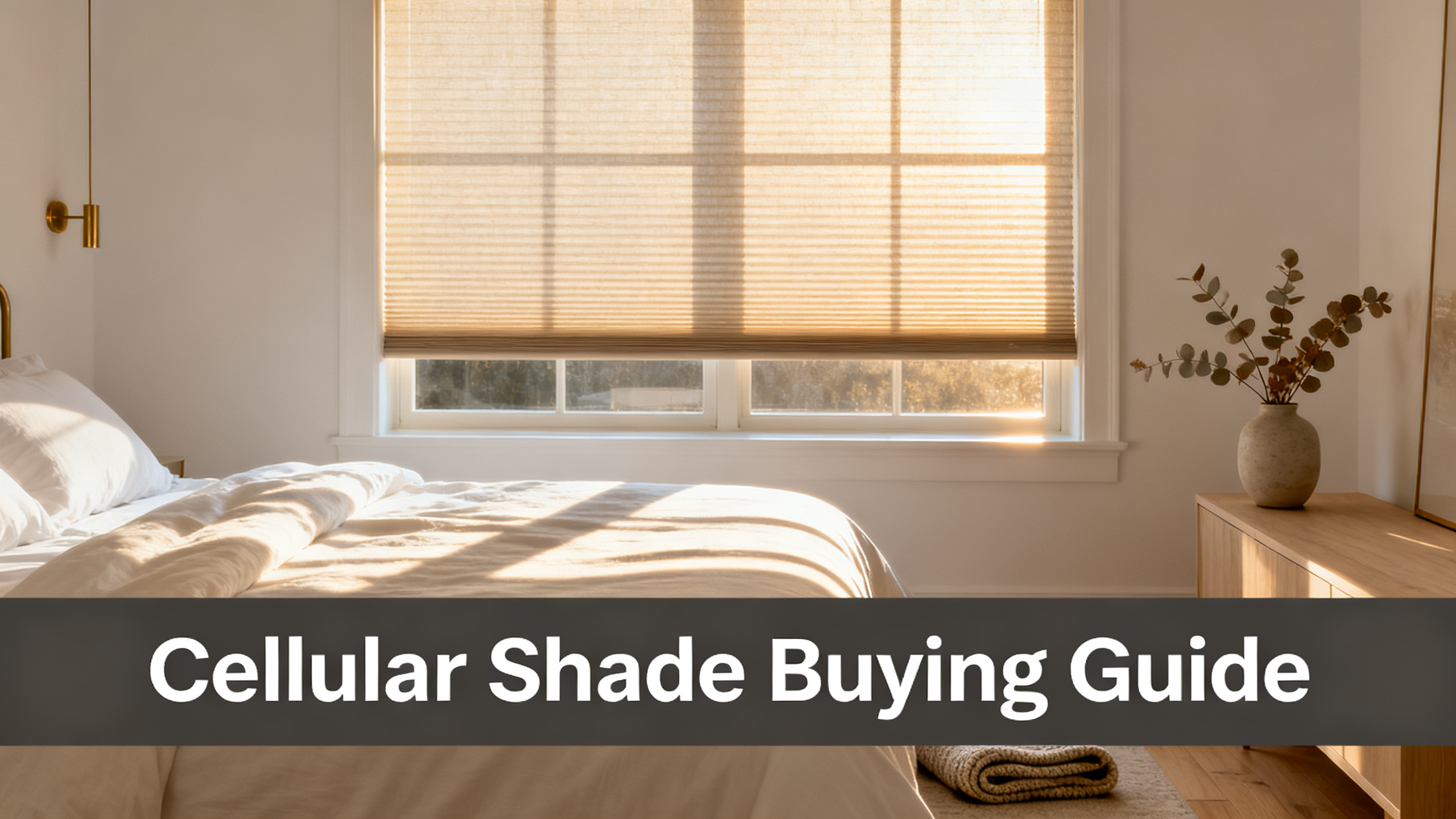
Four questions decide this whole category. Are you a renter who cannot leave a single screw mark, an owner who wants the strongest hold at the best price per window, a feature-maxi who wants one shade to do two jobs at once, or an energy-saver chasing a lower winter bill? Each answer routes you to a different Aura SKU on the same 225 gsm honeycomb fabric.
This guide walks each persona in that exact order, with real Two Pages catalog data, live configurator pricing, and the trade-offs owners are calling out on Trustpilot after a full heating season. For the wider view on honeycomb, roman, and roller options side by side, our complete cellular shades hub maps the full landscape.
🧭 Decision flowchart: which Aura fits your life
Renter
Lease blocks drilling. Deposit at risk. Windows under 48 inches wide. → Aura No-Drill Cordless from $108.99.
Owner
Permanent mount. Best price per window. Simple up-down operation. → Aura Blackout Cordless from $88.99.
Feature-maxi
Privacy plus light on the same window. Dual behaviour on one headrail. → Aura Day Night from $118.99 or TDBU from $102.99.
Energy-saver
Winter draft. Older single-pane windows. Long-run bill reduction. → Any Aura shade closed at night, R-value gain first.
Two Pages runs a single 225 gsm polyester honeycomb across all five Aura SKUs. The fabric is constant. The mechanism is what changes.

Default pick across personas
Aura Blackout Cellular Cordless
from $88.99/shade · 225 gsm polyester honeycomb · full blackout with aluminum-coated interior · 7 colors · 2 inch min inside-mount depth. Final price depends on size and drop.
Use code JULY for 20% off · Free shipping over $300
Cellular Shades in 60 Seconds
Here is the deal with the whole category. A cellular shade is a pleated fabric folded so each pleat forms a sealed honeycomb chamber that runs the width of the window. Air gets trapped inside the chamber, and trapped air is what insulates.
Roller shades, roman shades, mini-blinds, none of them do this. That is why cellular shades sit at the top of the US Department of Energy’s ranking for insulation among window coverings. The whole design goal is dead-air.
🪟 Three cell architectures in one glance
Single cell 3/8″
Small chamber, thin stack when raised. R-2.9 to R-3.4. Best for shallow window frames.
Single cell 1″ (Aura)
Larger chamber. Better light-blocking coverage. R-3.5 to R-4.0. The Two Pages default.
Double cell 3/8″
Two stacked chambers, doubled dead-air. R-4.0 to R-4.86. Best for cold-climate insulation.
Two Pages ships the 1 inch single cell across the Aura lineup, which lands in the mid-tier R-value bracket at a friendlier price than Hunter Douglas Duette double cell.
Two Pages plays one fabric structure across five SKUs. The polyester honeycomb, the 225 gsm weight, the aluminum-coated blackout interior, the cordless mechanism, all constant. What changes SKU to SKU is the drive train (standard bracket vs no-drill tension vs dual-drive vs day-night duo). Same fabric, different mechanical package.
For the Renter: You Cannot Drill and You Need Deposit-Safe
Picture the moment you hand back the keys and the property manager runs a finger along the window frame. Every screw hole is a $50 patch charge. Every drill mark in a metal frame is a full pane replacement dispute. That is the constraint most cellular-shade guides quietly ignore.
The Aura No-Drill Blackout Cellular Cordless is engineered specifically for this. It uses an adjustable tension bracket system that grips inside the window jamb with calibrated spring pressure. No screws in the wood, no anchors in the drywall, no residue on the metal. At move-out the whole system pops out clean.
🪟 Renter vs owner: how the same fabric mounts differently
Renter (No-Drill)
→ Tension bracket, no screws
→ Max 48 inches width safely
→ 5 minute install per shade
→ from $108.99
Owner (Standard)
→ Bracket + 2 screws into casing
→ Max 72 inches width per shade
→ 15 minute install per shade
→ from $88.99
Same 225 gsm honeycomb fabric, same 7 colors, same cordless operation. The chassis is what changes.
Now, where No-Drill is the wrong call. The tension mount holds firmly up to roughly 48 inches of width. Beyond that the shade weight overcomes the bracket friction and the whole assembly slowly drifts down over weeks. Patio doors, wide living room windows, oversized studio glazing: those need bracket-mount. Cards on the table, No-Drill is a bedroom and small-window play.

Renter-safe pick
Aura No-Drill Blackout Cellular Cordless
from $108.99/shade · same 225 gsm honeycomb fabric · tension bracket system, no screws in the frame · 7 colors · deposit-safe removal.
Code JULY · Free shipping over $300
For the Owner: Permanent Mount, Best Price per Window
If nothing stops you from putting two brass screws into the top of the window casing, do it. Bracket-mounted shades are the strongest, quietest, most predictable install in the category. They also cost the least: the standard Aura Blackout Cellular Cordless at $88.99 is the price floor of the whole lineup.
The Aura Blackout Cellular Shade product page spells out the mount: two aluminum brackets attach to the window casing, headrail clips into them. Two Pages ships them factory-calibrated for the cordless mechanism, and the Window Covering Safety Council cord-safety guidelines post-2018 explain why every Aura variant is cordless in the first place.
Best Cordless Cellular Shades: The Full Roundup
Editor picks across the Aura lineup and a few outside competitors, ranked for cord-safety families and everyday use.
Honestly, the upgrade path most owners underrate is the Top Down Bottom Up cordless at $102.99. Same fabric, same cordless mechanism, but two independent drive points on the same shade. For a $14 premium over the standard Blackout, you get a full second use case on kitchens, bathrooms, and any window where you want street privacy at eye-level and view above. If pricing matters more than TDBU flexibility, the Aura TDBU on the Two Pages configurator is the exact SKU to compare.
Where does Aura land against the premium tier? Two Pages positions Aura in the mid-market bracket, meaningfully below Hunter Douglas Duette, which runs $200 to $500 per shade at similar dimensions. Our Two Pages vs Hunter Douglas cellular comparison breaks down the fabric weight delta (225 vs 275 gsm), the cell architecture (single vs double cell option), and whether the price premium is worth it on your specific window count.
🌿 Pleat size and R-value, decoded
1 inch pleat (Aura default)
→ Larger chamber = more trapped air per pleat
→ Cleaner light-block seal top-to-bottom
→ Slight stack height when fully raised (~5 inches for a 60 inch drop)
3/8 inch pleat (competitors)
→ Tighter stack (~3 inches for the same drop)
→ More pleats visible when lowered = busier look
→ Lower R-value per chamber, compensated by double-cell stacks
For the Feature-Maxi: When One Shade Should Do Two Jobs
Real talk on this persona. You have a bedroom that needs full blackout at 3am and diffused daylight at 8am. Or a bathroom that needs privacy below the sightline and open view above it. One shade, two behaviours, no compromise between the two.
What Are Cellular Shades? The Fabric-Level Deep Dive
Honeycomb chambers, single vs double cell, why the pleat size matters for R-value. Ten minutes to close every knowledge gap.
The Aura Day Night Cellular Cordless at $118.99 solves this with a genuinely clever dual-fabric build. Two separate honeycomb sections share one headrail: light-filtering sheer honeycomb on top, full blackout honeycomb on bottom. You raise the blackout portion up, the sheer section stays put above, giving privacy without total darkness.
The Top Down Bottom Up model at $102.99 does something related but different. Same fabric top and bottom (blackout), two independent drive points on the same shade. You lower from the top or raise from the bottom independently. If it were my bedroom, I would pick Day Night for the dual-privacy problem. If it were my kitchen or bathroom, I would pick TDBU. Our top-down bottom-up shade roundup covers the room-by-room decision in more depth.
🎨 The 7 Aura colorways at a glance
White HCB-1
Bedroom default
Light Blue HCB-2
Nursery pick
Light Gray HCB-3
Neutral all-rounder
Slate Blue HCB-4
Moody bedroom
Black HCB-5
Home theater
Light Taupe HCB-6
Warm living room
Dark Brown HCB-7
Wood-tone match
Not sure yet?
Order a small test shade first.
All 7 colors ship the same 225 gsm honeycomb. Color choice is aesthetic, not performance.

Feature-maxi pick
Aura Day Night Cellular Cordless
from $118.99/shade · dual honeycomb (light-filtering top + full blackout bottom) on one headrail · 7 colors · one shade replaces two window treatments.
Code JULY · Free shipping over $300
For the Energy-Conscious: R-Value, Insulation, Winter Bills
Real talk on the R-value marketing. The US Department of Energy window coverings insulation data is unambiguous: cellular shades sit at the top of the pack. Adding a mid-tier honeycomb over a single-pane window shifts effective insulation by roughly R-3 to R-5, which translates to a real 10 to 20 percent bedroom heat retention gain during a Chicago winter.
The math varies with cell design. A 3/8 inch single cell hits roughly R-2.9 to R-3.4. The Aura 1 inch single cell moves that to R-3.5 to R-4.0. A double cell 3/8 stack pushes to R-4.0 to R-4.86. Two Pages made a calculated choice sitting in the middle: better R-value than the entry tier, cleaner light-blocking than double cell, at $88.99 base instead of $150-plus.
How to Clean Cellular Shades Without Crushing the Cells
Vacuum settings, spot-cleaning, dust prevention. Keep the R-value intact for a decade instead of five years.
Longevity is where energy-conscious buyers get burned. A crushed honeycomb chamber never fully recovers its loft, and a shade with 30 percent crushed cells has 30 percent less trapped air, which means 30 percent less insulation. That is why the cleaning method matters more than most guides admit.
🌿 R-value tip: Close the shades at sundown in winter to keep the trapped-air layer working overnight. Reopen at sunrise to let passive solar in on south-facing rooms. This one habit doubles the measurable heat-retention benefit versus leaving the shades permanently down. Modeled on DOE case studies, expect a payback horizon of 3 to 5 years on a full-house install.
Pricing by Configuration
Two Pages runs a single price ladder across the Aura lineup. Base pricing is dimensionally scaled, so the numbers below are for the entry configuration in each SKU. Actual cart-simulation values will move up with larger windows, taller drops, and any color premium (which does not apply to Aura in this lineup, all 7 colors are same-price).
💰 Drop & coverage: what real Aura orders cost
Standard bedroom window
30″ W x 48″ H, Blackout Cordless, White
$88.99 base
→ $71.19 with JULY 20%
3-window bedroom (owner)
3x Blackout Cordless standard
$266.97 base
→ $213.58 with JULY, clears free shipping
Feature-maxi bedroom (Day Night)
2x Day Night Cordless, 36×60
$237.98 base
→ $190.38 with JULY, dual behaviour on both windows
All figures are cart-simulation baselines. Larger drops or wider widths shift prices upward by roughly 15 to 25 percent per size step.
The JULY code is the highest-value promo Two Pages runs on cellular. It stacks with the standard configurator pricing, so a 3-window bedroom order that lands at $266.97 base drops to $213.58 after the discount. That difference alone often pays for the color test shade below.
Test the 7 Aura Colorways on a Small Window First
Cellular fabric reads differently under LED at night than under morning sun. Configure a small 24 by 36 shade in the color you love most for around $62 after the JULY code, live with it for a week, then order the rest with confidence. Cheaper than repainting a bedroom.
What to Do Next
Coming back to the original question. Whichever persona you land on, the path from this article to a shade on your window is three steps, in this order. Skip any of them and the return rate on this category climbs sharply.
📋 The 3-step Aura install plan
Step 1. Measure
Measure your minimum inside-mount depth. 2 inches minimum, 2 1/4 for flush. Windows shallower than that need outside-mount install.
Step 2. Test
Order one small 24 by 36 test shade in your top color. Live with it for a week, on the actual wall. Confirm the mood.
Step 3. Configure
Configure the persona-matched Aura SKU (No-Drill for renters, Blackout for owners, Day Night for feature-maxi). Apply the JULY code at checkout.
Renter goes to No-Drill. Owner goes to Blackout Cordless. Feature-maxi goes to Day Night. Energy-saver goes to whichever SKU fits the mount, then commits to closing the shades at sundown all winter. Full stop.
Configure Your Aura Cellular Shade
Polyester honeycomb, 225 gsm, full blackout, cordless. from $88.99/shade. Code JULY (20% off) · Free shipping over $300 · 7 colors · ships in 5-8 business days.
Frequently Asked Questions
What is the difference between single cell and double cell cellular shades?
Single cell has one honeycomb chamber running the width of the shade. Double cell stacks two smaller chambers front-to-back, roughly doubling the dead-air trap. Double cell adds meaningful R-value in cold climates (roughly R-4 to R-4.86 versus R-3.5 for equivalent single cell), and slightly better sound damping.
The trade-off: double cell stacks taller when raised, so a fully-raised shade sits about 20 percent deeper at the top. Two Pages’ Aura lineup is engineered as single cell 1 inch honeycomb, which lands squarely in the mid-tier R-value bracket at a friendlier price.
Are cellular shades worth it for insulation?
Yes, more than roller shades or mini-blinds and by a real margin. The US Department of Energy lists cellular shades as the highest-R-value window covering category, adding roughly R-3 to R-5 on a single-pane window depending on cell design.
That translates to a 10 to 20 percent bedroom heat retention gain in a Chicago winter, based on DOE modeling. The payoff is largest on drafty single-pane windows in older houses. On new triple-glazed windows the delta is smaller but still measurable.
Can renters install cellular shades without drilling?
Yes, if you pick the Aura No-Drill Cellular Cordless. It uses a tension bracket system that grips inside the window frame with adjustable pressure, no screws in the wood, no drywall anchor. Deposit-safe removal at move-out, no patching.
The catch is width: tension mounts hold securely up to roughly 48 inches. Anything wider drifts under the weight and eventually slips. Bedroom and small-window play, not patio-door play.
How much do cellular shades cost at Two Pages?
Base pricing runs from $88.99 for the Aura Blackout Cellular Cordless up to $122.99 for the No-Drill Top Down Bottom Up variant. Final price depends on window width and drop.
A standard 30 by 48 inch bedroom window in the entry-level SKU cart-simulates at around $88.99 base. Applying the JULY code drops that to about $71.19. Free shipping kicks in over $300, which a 3-window bedroom order clears comfortably.
How do I clean cellular shades without crushing the cells?
Use a vacuum on the lowest suction setting with the soft brush attachment. Run it lengthwise across the closed shade, one gentle pass per side. For localized dirt, spot-clean with a barely damp microfiber and mild soap, then air-dry.
Skip full submersion or steam. Crushed honeycomb chambers lose their R-value and never fully recover their loft, so heavy scrubbing is a false economy.
What is the minimum window depth for cellular shades?
The Aura headrail specifies a 2 inch minimum inside-mount depth, 2 and 1 quarter inch for a fully flush mount. Windows shallower than that need outside-mount bracket install on the surrounding trim instead of inside the frame.
Measure with a ruler from the glass to the outer edge of the frame stop before ordering. Getting this wrong is the number one return reason on cellular shades industry-wide.
What is the difference between Day Night and Top Down Bottom Up cellular shades?
Day Night uses two different fabrics on one shade: light-filtering sheer honeycomb on top, full blackout honeycomb on bottom, both driven by the same cordless mechanism. You raise the blackout portion to expose the sheer, giving privacy without total darkness.
Top Down Bottom Up uses a single fabric but two independent drive points, so you can lower from the top or raise from the bottom independently. Day Night suits bedrooms where you want privacy at eye-level and light above. TDBU suits kitchens and bathrooms where you want privacy at eye-level and view above.
How long do cellular shades last?
On a normal-humidity window with monthly light cleaning, a mid-tier cellular shade like Aura holds full function for 8 to 12 years. The failure points are usually the internal cord retractor and the cell edges, not the fabric.
Direct sun-facing shades in south-exposed rooms fade the front face after year 6 or 7. Kitchens and bathrooms compress the lifespan by 20 to 30 percent because ambient grease and moisture attack the honeycomb structure faster.
