
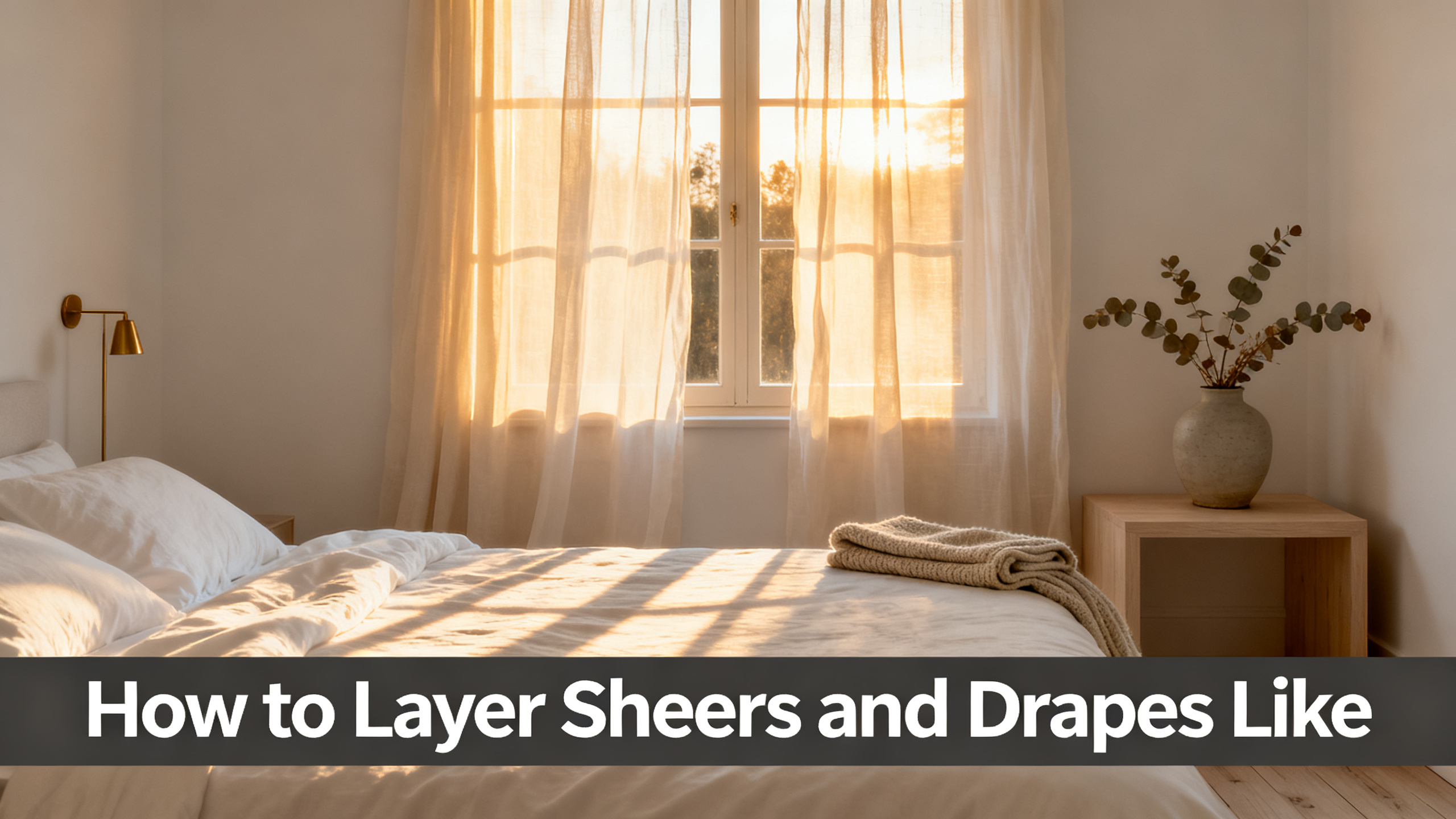
Done right, a sheer plus drape combo takes 20 seconds to swap the mood: sheer full-time for the diffuse morning light, drape drawn only at 9pm for privacy. Done wrong, you spend 90 minutes re-pinning a header that never sat flat, because the rods were mounted 2 inches too close to the wall and the sheer weight fought the drape at every slide.
The gap between those two outcomes is not fabric quality. It is 7 quiet decisions made before the panels ship. This guide walks each one, in the order a working decorator makes them, with the numbers that separate a hotel-boutique window from a hardware-store improv. For the wider set of hang, measure, and install pieces, the full install-curtains hub keeps every guide one click away, and the layered window treatments in editorial rooms reference confirms the aesthetic pedigree is real, not Pinterest folklore.
🎯 Done right vs done wrong: the visible tell
Done right
20-second mood swap
Sheer full-time, drape drawn only at night. Front rod slides free, back rod holds still. Reads boutique hotel.
Wrong rod gap
Sheer scrapes drape
Rods mounted under 3 in apart, panels catch on each slide. Fix is a re-drill, not a re-pin.
Wrong header
90-minute re-pin
Pinch pleat sheer with grommet drape reads improv, no matter the fabric price. The fix ships from the mill.
The 7 decisions below sit before any of these outcomes are locked in.

The heavyweight back layer that carries the whole look
Liz Linen Drape Pleated
from $59.99/panel · 10% linen / 90% polyester OEKO-TEX · 350 gsm heavyweight · pinch pleat header · body memory shaping included · 38 colorways. Final price depends on size and lining.
Use code JULY for 20% off · Free shipping over $300 · 10 to 14 days made-to-order
The 7 Layering Decisions At A Glance
Sounds like a lot of rules for a curtain. It is. But the 7 decisions collapse into 4 numbers on a shopping list once you know them: front sheer weight, back drape weight, rod projection front, rod projection back. The rest falls out of those four.
The order matters. Each decision constrains the next, so working out of sequence is how a beautiful fabric ends up on the wrong wall. The overview below is the record card, the seven H2s that follow expand each one into the number that matters.
📋 The 7 decisions in the order they must be made
1
Layer order
Sheer in front, drape behind (95% of setups).
2
Rod height + projection
4-6 in above frame, 8-12 in per side, 3-4 in back and 6-8 in front projection.
3
Rod configuration
Double rod, or two stacked singles, or wraparound (rarely).
4
GSM ratio
1:3 to 1:5 between front sheer and back drape.
5
Header match
Both panels share the same header family. No exceptions.
6
Opening choreography
Sheer moves 6-8× daily, drape once at night.
7
Width and fullness per layer
2× window width, per layer, never shared. A 60-in window needs 120 in of sheer AND 120 in of drape.
Decision #1: Which Layer Goes In Front (And Why It’s Almost Always The Sheer)
If the sheer sits behind the drape, no fabric budget saves the look. This is the rule that everybody hears once and half of first-time layerers still try to reverse, because it feels intuitive to “protect” the delicate sheer behind the heavier fabric. The room disagrees.
The mechanical reason (sheer moves daily)
The sheer is the layer that moves 6 to 8 times a day in the average living room or bedroom: opened at 7am for the diffuse light, half-closed at noon for glare, opened again at 4pm, closed at 9pm for privacy. The drape moves once, at night.
Front position lets the layer that does the labor slide freely without disturbing the heavy back panel. Behind the drape, the sheer has to be pushed past a curtain that outweighs it 4 to 1 every single time, and the header hooks scrape at the drape lining.
The aesthetic reason (light wraps into pleats)
Light travels through the sheer first, hits the front face of the drape pleats behind, and wraps into the folds as diffuse ambient. That’s the boutique-hotel effect that photographs so well. Reverse the order and the drape kills the light before it ever reaches the sheer: the sheer becomes a pointless second layer, adding no depth, doing no work.
The 5% exception (pure blackout back)
The one setup where inverse order makes sense is a pure blackout back layer in a north-facing bedroom, where the back panel isn’t a decorative drape but a functional light-blocker. There, the inverse order sharpens the shadow line at the drape edge and cuts a fraction more side-glare. But that setup uses blackout fabric, not a decorative drape, and the decisions further down (GSM ratio, opening choreography) change with it.
Decision #2: Where The Rod Actually Sits (Height And Projection)
Three numbers rule this decision, and skipping any one is the reason 40% of Pinterest-worthy layered rooms look off in person even when the fabrics are correct.
Height above frame (4 to 6 inches)
Mount the double rod 4 to 6 inches above the window frame. Lower and the drape reads squat, higher (up to 12 inches or ceiling-height) and the ceiling reads taller but the top light gap gets awkward with a shorter panel. For a standard 8-foot ceiling, 4 to 6 inches is the sweet range.
Width extension per side
Back rod extends 8 to 12 inches wider than the window frame per side. Front rod extends 4 to 8 inches per side, slightly narrower than the back. The offset lets the drape “stack” past the window when fully open, revealing the sheer at full glass width without either layer blocking the view.
Projection from wall (3-4 in back, 6-8 in front)
Back rod projects 3 to 4 inches from the wall. Front rod projects 6 to 8 inches. That gap of 3 to 4 inches between the two layers is the single most important number in the whole install. Tighter and the sheer catches on the drape at every slide. Wider and the front rod cantilevers off the wall and pulls at its anchors within a month.
📐 Side-view diagram: how the two rods stack from the wall
Wall face
0 in
Reference plane. Studs or masonry behind.
Back rod (drape)
3-4 in
Holds the heavy Liz Linen at 350 gsm.
Gap between
3-4 in
The non-negotiable slide clearance.
Front rod (sheer)
6-8 in
Holds the Flynn Sheer at 90 gsm.
Wall clearance stacks additively. A 3-inch back plus 3-inch gap plus 90 gsm sheer sitting at 6-inch front = the standard boutique double.
How to Measure for Curtains (Complete Guide)
The width plus drop plus wall-clearance math that a layered setup demands, with the two extra inches of return you have to add per layer.
Decision #3: Single Wide Rod Versus Double Rod (Or The Wraparound Cheat)
Three configurations exist. Two of them work for layering, one is a trap dressed as a shortcut.
Purpose-built double rod
Cleanest option. One bracket kit, one drill session, one wall plate per side. Standard consumer double rods project 3 to 4 inches for the back rod and 5.5 to 6 inches for the front rod, with the gap engineered into the bracket. Cost typically $40 to $80 for a good hardware-store kit that spans 48 to 84 inches.
Two independent single rods stacked
The renter option. Two single-rod brackets mounted one above the other, each rod carrying one layer. Slightly more drill holes, slightly more wall damage on move-out, but every hardware store carries the parts and you can reuse them elsewhere. This is the choreographer’s setup because you can raise or lower one rod without disturbing the other.
Wraparound bracket cheat
A wraparound bracket holds two panels on a single wide rod, both hanging on the same plane. Works for shallow layered looks where the front panel is very light and the back is a stiff decorative piece that stays put. Does not work for a real sheer plus drape combo because the two layers can’t share the same slide plane without hooking each other.
⚠️ Single rod for a real sheer plus drape combo: never
A wraparound bracket with a sheer and a 350 gsm drape sharing one plane has both panels dragging against each other on every slide. The sheer will show tug lines within 2 weeks and the drape header pins will scuff the sheer fabric at every hook. If the budget is tight, go with two stacked single rods, not a wraparound.
How to Install a Curtain Rod (Double Rod Included)
The bracket depth, the anchor choice, and the 3-inch front-back gap that decides whether your two layers ever slide past each other.
Decision #4: The GSM Ratio That Makes Layering Read Designer
This is the invisible rule that separates a hotel window from an accidentally-matched pair of curtains from the same clearance rack. The ratio is a number you set on the shopping list, before either panel is ordered.
The 1:3 to 1:5 designer window
Front sheer at 60 to 100 gsm. Back drape at 250 to 400 gsm. Ratio sits between 1:3 and 1:5. That’s the window where the eye reads two distinct materials working together. Flynn Airy Sheer at 90 gsm paired with Liz Linen at 350 gsm hits exactly 1:4, which is the middle of the range and the reason the pairing works out of the box.
Why 1:2 looks accidentally matched
A 150 gsm faux linen sheer with a 200 gsm cotton drape reads as two attempts at the same fabric. The eye sees “two curtains that almost match” rather than “a light layer over a heavy one”, and the layering effect disappears.
Why 1:6 looks unbalanced
A 60 gsm chiffon behind a 500 gsm velvet reads as if the sheer forgot to show up. The front layer disappears against the mass of the back, and the light-diffusion job the sheer is supposed to do gets crushed by the heaviness behind it.
⚠️ Two similar-weight fabrics = both look cheap
A 180 gsm sheer with a 220 gsm drape both hanging on the same double rod reads as a hardware store impulse buy, even if you paid $180 per panel. The eye does not read the price tag, it reads the weight contrast. Lock the ratio before the tone or the color.
⚖️ GSM ratio scorecard: three Two Pages fabrics against the same Liz Linen back
Front sheer option
Flynn Airy Sheer
90 gsm
Ratio vs Liz Linen 350 gsm.
1:4 · designer window ✓
Front sheer option
Kyla Faux Linen
200 gsm
Ratio vs Liz Linen 350 gsm.
1:1.75 · too matched ✗
Front sheer option
Scandina Voile
50 gsm
Ratio vs Liz Linen 350 gsm.
1:7 · sheer disappears ✗
The Flynn Airy front paired with a Liz Linen back is not a marketing accident, it’s the only Two Pages pairing that lands inside the 1:3 to 1:5 window.
Fabric safety on the back layer matters too: the Two Pages spec sheet for Liz Linen quotes OEKO-TEX Standard 100 certification, which is why the panel is safe next to a bassinet or a bed. Not every 350 gsm linen blend on the market carries that.

The Front-Layer Sheer That Reads 1:4 Against Liz Linen
Flynn Airy Lightweight Sheer Pleated ships at 90 gsm in the same pinch pleat header family as Liz Linen. The GSM ratio (1:4 against 350 gsm drape) is what makes the front-back contrast read designer instead of accidentally matched. from $49/panel, 4 core colorways, 10 to 14 day lead.
Decision #5: Header Match (The Silent Failure Nobody Photographs)
Matching headers is the invisible rule. It’s the reason a $2,000 fabric budget on the drape and $600 on the sheer can still photograph like a hardware-store improv. The header is what the eye reads at the top of the panel, and if the two layers speak different header languages, the room reads mismatched no matter what happens below.
Matched pinch pleat (default)
Both panels in pinch pleat. This is what boutique hotels use because the pleats read as tailored on both layers, and the pin hooks slot into the same style rings on both rods. Flynn Sheer and Liz Linen both ship in pinch pleat by default, which is why they’re a native duo.
Matched grommet
Both panels in grommet. Modern-industrial look, works well in loft or contemporary rooms. Requires a rod thin enough for both grommet sets to slide without binding. Rare in luxury builds because grommet reads casual next to a heavy drape.
Matched rod pocket (flat layered look)
Both panels in rod pocket. Flattest layered look, no header hardware visible. Slower to open and close because the fabric grips the rod, so this is for setups where the drape barely moves.
The mismatch tell
Pinch pleat sheer with grommet drape. Or rod pocket sheer with ripple fold drape. Or tab-top sheer with pinch pleat drape. The tell is that the top 6 inches of the two layers look like they came from different stores, because they did. No fabric quality below rescues that first inch.
🧵 Header combinations: matched vs mismatched
Matched pinch pleat
Sheer + drape both pinch
The boutique-hotel default. Tailored on both layers.
Reads designer ✓
Matched rod pocket
Sheer + drape both pocket
Flat, hardware-free look. For rooms where the drape stays put.
Reads clean ✓
Mixed header
Grommet + pinch pleat
The silent failure. First 6 inches look like two brands.
Reads improv ✗
The Two Pages advantage on this decision is quiet: both Flynn Airy Sheer and Liz Linen Drape ship in the pinch pleat header family with matching hook spec, so the front-back panels read as a pre-matched duo out of the box. No mixing across brands, no header conversion drama.
Decision #6: The Opening Choreography (Which Layer Moves When)
Picture the room at 6pm: the sheer stays open for the last hour of daylight, the drape slides across at 9pm, and neither layer has to fight the other for space. That’s the choreography, and it’s the reason the sheer sits in front.
Sheer daily labor (6 to 8 opens per day)
Average living room or bedroom: sheer opens at 7am, partial close for glare at noon, open at 4pm, close at 9pm for privacy. That’s 4 named opens per day, and in reality closer to 6 to 8 including quick adjustments for angle-of-sun changes and privacy-when-a-neighbor-walks-by moments.
Drape night-only (1 to 2 opens per day)
The drape moves once at 9pm and once at 7am in most homes. In a shared-wall apartment or a nursery, the drape might close for a nap and open for a bath, so 2 or 3 times per day. Either way, its work is punctuation, not choreography.
Blackout variant (see bedroom layering guide)
If the back layer is a functional blackout rather than a decorative drape, the choreography inverts: the blackout may open only at 7am and close at sunset for a sleep-training baby’s room, while the sheer stays half-open all day for the diffuse gray. Different scenario, different math on the GSM ratio and the mounting height.
Bedroom Layering: Sheers Plus Blackout (Not Drape)
The variant where the back layer is 100% blackout rather than a decorative drape, with the GSM ratio adjusted to 1:5 and the mounting height raised 2 inches.
☀️ A day in the life of the two layers
🌤️
Morning (7-10am)
Sheer open, drape parked at the returns.
Light through Flynn 90 gsm: 65% transmission, diffuse.
🌞
Midday (11am-4pm)
Sheer stays, drape stays. Half-close sheer if the sun angle glares.
Sheer half-close cuts glare to about 40% transmission.
🌙
Evening (9pm)
Drape closes across. Sheer stays behind or in front, matter of taste.
Liz Linen 350 gsm without lining: 85% light block. With cotton lining upgrade: 95%.
Renters and shared-wall bedrooms adjust the choreography by adding one privacy sheer-close in the middle of the day when a neighbor’s shadow crosses the window, but the front-layer-does-the-labor rule holds either way.
Decision #7: Width, Fullness, And The 2× Rule For Layered Panels
Real talk on the width math: each layer needs the full 2× window width for proper fullness, and the two layers don’t share it. A 60-inch window needs 120 inches of sheer width AND 120 inches of drape width, not 120 total split between them.
For the exact math per panel size and drop, the curtain size calculator handles the numbers including the added inches for return, hem, and header pleats. It saves the mental gymnastics of computing 2.2× on an odd window width.
Layered panels demand more fullness than solo panels because the two layers create a double-fullness expectation in the eye. A 1.5× fullness that reads fine on a single-layer drape reads visibly flat in a layered setup: the sheer needs the extra gathers to soften the light, and the drape needs the extra folds to sit behind the sheer without looking pinched.
| Window width | Sheer width needed (2× per layer) | Drape width needed (2× per layer) | Standard panel count | Back rod length (frame + 20 in) |
|---|---|---|---|---|
| 36 in | 72 in | 72 in | 1 sheer + 1 drape (or 2+2 for a fuller look) | 56 in |
| 48 in | 96 in | 96 in | 2 sheer panels + 2 drape panels | 68 in |
| 60 in | 120 in | 120 in | 2 sheer + 2 drape | 80 in |
| 72 in | 144 in | 144 in | 2 sheer + 2 drape (2 wide panels each) | 92 in |
| 96 in | 192 in | 192 in | 3 sheer + 3 drape (or 2 wide custom) | 116 in |
The 4 Layering Mistakes That Ruin Otherwise Good Fabrics
Recapping the pitfalls the guide keeps pointing at. Most of these are cheap to fix before purchase and expensive to fix after: a wrong header ships from the mill, a wrong rod gap needs a re-drill.
⚠️ The 4 layering mistakes that ruin otherwise good fabrics
🔀
Sheer behind drape
Reverses the light path. The layer that moves 6-8× a day is stuck behind the layer that moves once.
📐
Rod gap under 4 in
Sheer scrapes the drape on every slide. Fix is a re-drill, not a re-hang.
⚖️
GSM ratio out of 1:3 to 1:5
1:2 reads accidentally matched. 1:6 reads unbalanced. Ratio locks the whole look.
🧵
Header style mismatch
Pinch pleat with grommet reads improv. First 6 inches of the panel tell the whole story.
The pattern across the four: they all get set on the shopping list, not on the wall. Which is why locking the GSM ratio and the header language before hitting order is the highest-leverage 30 minutes of the whole project.
Order The 39 Collections Booklet Before You Pick Your Layer Tone
Layering two fabrics means matching two tones under morning light, lunch light, and 8pm lamp light. The 39 Collections Fabric Booklets ship flat, cover every Two Pages line (Liz Linen and Flynn Sheer included), and are the only way to test how a Natural sheer reads against a Sand Beige drape in your actual room before the 10-day lead time starts.
The Duo That Ships Pre-Matched: Flynn Sheer + Liz Linen Drape
You’ve mapped the 7 decisions. If the shopping list still feels open, the Two Pages combination that ships all 7 pre-solved is Flynn Airy Lightweight Sheer Pleated in front, Liz Linen Drape Pleated behind, both in matching pinch pleat header, GSM ratio locked at 1:4, both on the same 10 to 14 day lead time.


🌿 The pre-matched duo, side by side
Spec
Fabric weight
Header
Colorways
Base price
Lead time
Front layer
Flynn Airy Sheer
90 gsm lightweight
Pinch pleat, hooks incl.
4 core (Natural, White, Light Brown, Sandstone)
from $49/panel
10 to 14 days
Back layer
Liz Linen Drape
350 gsm heavyweight, OEKO-TEX
Pinch pleat, hooks incl., body memory shaping
38 (Ivory, Sand Beige, Snow, Beige White, and 34 more)
from $59.99/panel
10 to 14 days
Combined base price from about $109 for the two-panel duo before size and lining upgrades. Both panels ship in the same window, in the same header language, at the same 1:4 ratio.
The practical case: same lead time, same header spec, same hook system, tone-tuned through the same 39 Collections booklet. It’s the shopping list that closes 6 of the 7 decisions in one order. For further authority reading, the Liz Linen Drape Pleated product page lists the full 38-color range and lining upgrade options.
Order The Duo That Reads Like A Boutique Hotel
Liz Linen Drape Pleated (350 gsm, 38 colorways, pinch pleat, body memory shaping) plus Flynn Airy Lightweight Sheer (90 gsm, pinch pleat) is the pre-matched duo. Both ship 10 to 14 days, header aligned, GSM ratio locked. Code JULY (20% off) · Free shipping over $300.
FAQ
Do sheers go in front or behind drapes?
Sheers go in front, drapes behind, in about 95% of layered setups. The sheer is the layer that moves 6 to 8 times a day for daily light control, so front position lets it work without disturbing the heavy back drape. The 5% exception is a pure-blackout back layer in a north-facing bedroom, where the inverse order sharpens the shadow line at the drape edge.
How far apart should a double curtain rod be?
The front rod projects 6 to 8 inches from the wall, the back rod projects 3 to 4 inches, giving a front-to-back gap of about 3 to 4 inches between the two layers. Any tighter and the sheer scrapes the drape when it slides, any wider and the front rod cantilevers off the wall and needs an anchor stronger than a standard drywall plug.
Can you layer curtains on one rod?
Yes, with a wraparound bracket that holds two panels on the same rail, but only if both layers share the same header and both are light enough to hang flat on a single plane. A true two-layer setup with a sheer moving independently of a heavier drape needs two rods (either a purpose-built double rod or two single rods stacked), because the sheer and drape cannot share the same slide plane without hooking each other.
What GSM ratio should sheer and drape have?
Aim for a 1:3 to 1:5 GSM ratio between the front sheer and back drape. Flynn Airy Sheer at 90 gsm paired with Liz Linen Drape at 350 gsm hits exactly 1:4, which is the designer window. Below 1:3 (say a 150 gsm sheer with a 200 gsm drape) reads as two identical fabrics and looks accidentally matched. Above 1:5 (a 60 gsm chiffon behind a 500 gsm velvet) reads as unbalanced with the front layer disappearing.
Do sheer and drape headers have to match?
Yes, in the same visual sense that shoes have to match a belt. Both panels should share the same header type: pinch pleat with pinch pleat, or grommet with grommet, or rod pocket with rod pocket. Mismatched headers (pinch pleat sheer with grommet drape, for example) are the silent failure nobody photographs because the panels read as a hardware-store improv even when the fabrics are premium.
How wide should layered curtains be?
Each layer needs the full 2× window width for proper fullness, not a shared width. A 60-inch window needs 120 inches of sheer AND 120 inches of drape width. Layered panels demand more visual fullness than solo panels because the two layers create a double-fullness expectation in the eye: 1.5× fullness that reads fine solo reads visibly flat in a layered setup.
What is the fastest way to get a designer-looking layered curtain setup?
The fastest path is a pre-matched duo where the sheer and drape ship from the same brand in the same header family with a locked GSM ratio. Flynn Airy Lightweight Sheer Pleated (90 gsm) plus Liz Linen Drape Pleated (350 gsm) from Two Pages ships both panels in matching pinch pleat headers at a 1:4 GSM ratio, both in 10 to 14 days made-to-order. Combined base price from about $109 for the two-panel duo before size and lining upgrades.
