
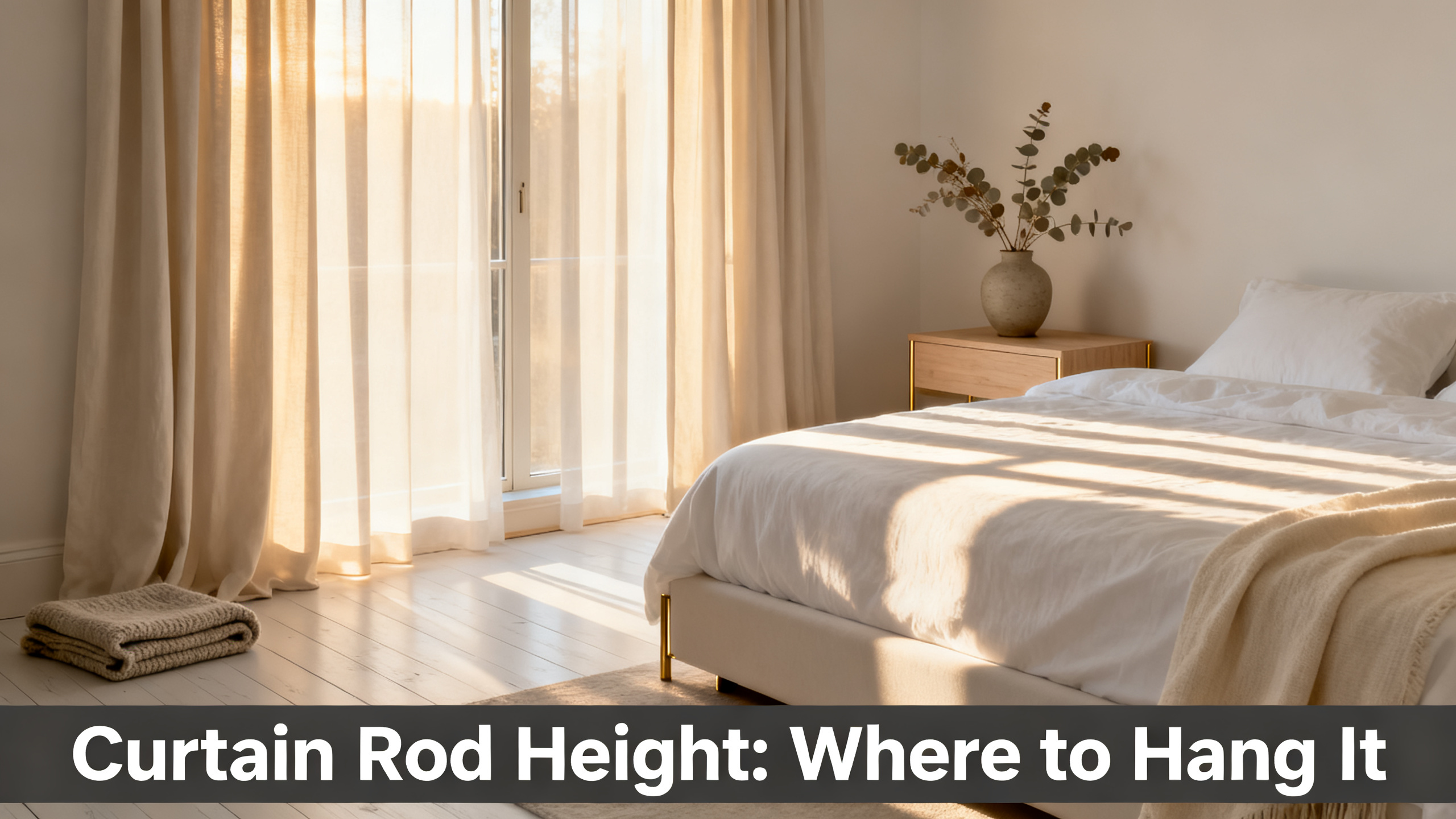
Before you touch a drill: a tape measure, a stud finder, a phone photo of the window taken at eye level from 8 feet back, and 15 minutes on a Saturday morning. If those four are in hand, you are exactly one decision away from a rod height that will read for the next 5 years.
The placement of the rod matters more than the fabric. A $600 pinch pleat panel hung 4 inches above the frame on a 9-foot ceiling reads short and window-sized. The same panel hung 14 inches above the frame reads floor-to-ceiling and expensive. Studio McGee has been arguing this in Studio McGee curtain height authority posts for years, and Two Pages spec sheets quietly assume it. The checklist below covers the full curtain install landscape in its most useful form, and it works for renters and homeowners equally.
Tools & Prep Checklist · 15 min decision + $0 to mock up
📏
Tape measure, 25 ft
Cloth or steel, minimum 25 ft.
📐
Stud finder
Marks studs in the extension zone.
🪜
Step ladder
Reach frame top on 9 to 10 ft ceilings.
✏️
Pencil & painter’s tape
Mock the rod line before drilling.
📱
Phone photo, 8 ft back
Judge the mock line at eye level.

The pinch pleat that reads best when hung high and wide
Liz Linen Drape Pleated
from $59.99/panel · 10% linen / 90% polyester slub blend · 350 gsm heavyweight · pinch pleat header · body memory shaping · 38 colorways. Final price depends on size and lining.
Use code JULY for 20% off · Free shipping over $300 · 10 to 14 days made-to-order
The Number Everyone Quotes (4 to 6 Inches Above the Frame)
Why the 4-6 inch default works
The classic default is 4 to 6 inches above the top of the window frame. It works on standard 8-foot ceilings, on rental units where drilling holes has consequences, and on windows where the above-frame trim is decorative and worth keeping visible. The rule preserves the window silhouette and gives an easy horizontal drill line.
Cart-simulation math on a Two Pages configurator confirms: for a rod placed at 84 inches (4 inches above an 80-inch frame top), the panel drop lands at 82 to 83 inches with a float finish. That fits the standard 8-foot ceiling without crowding.
How High to Hang Curtains (The Complete Reference)
The full altitude discussion by room, ceiling type, and window shape, with the exact panel-length conversions once the rod is placed.
Where it underdelivers
Where the 4-6 inch default falls apart is on 9-foot and 10-foot ceilings. At 4 inches above frame with a 9-foot ceiling, there are 24 inches of blank wall between the rod and the ceiling. The eye reads that gap as wasted, and the panel reads short.
The rule also underdelivers on statement living rooms, primary bedrooms with pinch pleat panels, and any window where the intent is to feel taller than the actual frame. In those setups, the 4-6 inch default is the floor of the acceptable range, not the ceiling.
The High-and-Wide Method (And When It Wins)
The high and wide curtain rule, as Emily Henderson has documented, places the rod halfway between the top of the window frame and the ceiling, and extends the rod 6 to 10 inches past each side of the frame. It is a design choice, not a construction one, and it changes how the room reads.
Sounds like design fluff. Here is why the extra 6 inches change the room by 20%: on a 9-foot ceiling with a window frame ending at 84 inches, the halfway line lands at 96 inches. Placing the rod at 96 gives a 96-inch panel drop, floor-to-ceiling visual scale, and a window that reads twice as tall as its actual glass.
Rod Height Decision Card
Safe default
4 to 6 inches above frame
8 ft ceilings, rentals, standard rooms.
High & wide
12 to 14 inches above frame
9 ft ceilings, statement rooms.
Ceiling mount
At the ceiling line
10 ft+, vaulted, floor-to-ceiling glass.
High-and-wide pairs best with pinch pleat or ripple fold headers that carry the drop plumb. It also pairs best with heavier fabrics, because the extra drop distance needs weight to hang straight and not billow.
Ceiling Mount (When You Skip the Rule Entirely)
Vaulted and dramatic ceilings
Ceiling mount places the rod directly on the ceiling, and the panel drop equals the full ceiling height. On 10-foot ceilings, vaulted or cathedral spaces, and floor-to-ceiling glass installations, ceiling mount is the honest answer. It bypasses the above-frame math and lets the fabric do the room-tall work.
Two Pages spec sheets note that a 120-inch drop panel needs a minimum 300 gsm fabric to hang plumb, and the pinch pleat header holds the top-of-drop shape without warping over the extra span.
When ceiling mount goes wrong
Skip ceiling mount on ceilings under 8 feet (the room reads oppressive), on popcorn ceilings that resist clean bracket anchoring, and on windows where the above-frame trim is decorative wood you want visible. On a standard 8-foot rental with a 6-inch decorative crown, ceiling mount hides the crown and reads flat.
The Reference Table for 8, 9, and 10 Foot Ceilings
The 4-6 inch default works cleanly for 8-foot ceilings (the 8-foot ceiling breakdown covers the specific edge cases). Once the ceiling climbs past 8 feet, the placement math changes, and the “just add a few inches” instinct misfires.
Real talk on 9-foot ceilings: the 9-foot is the trickiest tier. 4 inches above frame reads short and leaves a huge wall gap. Full ceiling mount reads over-committed and hides the frame. The sweet spot is 12 to 14 inches above the frame top, which places the rod at roughly 96 to 98 inches on a standard 84-inch frame top.
Curtain Rod Height for 9 Foot Ceilings (Room-by-Room)
The 9-foot ceiling is the trickiest tier: too high for the 4-inch rule, too low for a full ceiling mount. The exact 12 to 18 inch above-frame numbers by room.

| Ceiling height | Above-frame placement | Rod-to-floor drop | Recommended look |
|---|---|---|---|
| 8 ft (96 in) | 4 to 6 in above frame | 84 to 86 in drop | Standard, frame-anchored |
| 9 ft (108 in) | 12 to 14 in above frame | 96 to 98 in drop | High-and-wide sweet spot |
| 10 ft (120 in) | 18 to 24 in above frame or ceiling mount | 108 to 118 in drop | Dramatic, floor-to-near-ceiling |
| Vaulted / cathedral | Ceiling mount at lowest ceiling line | 120+ in drop | Full room-tall, pinch pleat only |
Width Extension Math (How Far Past the Frame)
The 4-to-12-inch extension rule
The rod should extend 4 to 12 inches past each side of the window frame. Less than 4 inches, and the open panel covers the glass. More than 12 inches, and the bracket lands so far into the wall that stud alignment becomes a lottery.
The specific number depends on stack-back. A pinch pleat panel with body memory shaping stacks back to roughly one-third of its total panel width when fully open. So a 100-inch wide panel stacks to about 33 inches, which needs 8 to 10 inches of extension past the frame to clear the glass.
Panel stack-back allowance
Picture the panel at 7am: the light hits the top of the pinch pleat first, and the wall between the frame and the rod glows for 20 minutes before the sun clears the ceiling. That geometry only works if the open panel is entirely off the glass and stacked against the wall extension.
Width Extension Math
A · Window width
60 in frame
Measured outer trim to trim.
B · Extension per side
8 in each
4 in minimum, 12 in maximum.
C · Total rod length
76 in rod
Frame width + both extensions.
D · Stack-back
~25 in per side
Pinch pleat: 1/3 panel width.
The 350 gsm slub of the Liz Linen Drape Pleated is a pinch pleat header that stacks about 1/3 of the panel width, so cart simulation on a 100-inch rod returns 66 inches of glass coverage when open, and 100 inches of coverage when closed. This is why extension math needs to know the header type before the drill hits the wall.
Rod Placement Diagram
A · Frame top
Reference point
Outer trim edge, not sash or sill.
B · Above-frame gap
4 to 14 in
Depends on ceiling height.
C · Extension
4 to 12 in each side
Stack-back off the glass.
D · Return depth
3 to 4 in off wall
Panel wraps bracket to frame.

Rod Decided? The Panel Drop Follows Automatically
Once the rod height is set, the panel drop is rod-to-floor minus 1/2 inch for a float finish, or rod-to-floor plus 2 inches for a puddle. Liz Linen Drape Pleated cuts to your exact drop at from $59.99/panel, with 38 colorways and 6 lining options.
The Common Mistakes That Add Up To A Wrong Rod Height
Measuring from the wrong reference
The most common misfire is measuring the “above-frame” distance from the sill, the top of the sash, or the mullion divider instead of from the outer top edge of the trim. A 6-inch above-sash measurement can land the rod 2 inches below where it should be, and the panel reads short by that much.
Always measure from the outer top edge of the visible window trim. Painter’s tape a small mark on that exact line before starting.
⚠️ Warning: Measuring From The Wrong Reference
Frame top means the outer edge of the visible trim, not the top of the sash and not the top of the glass. On a window with a 2-inch trim, the difference is 2 inches, which is the whole margin between “reads tall” and “reads awkward”.
Over-extending past the stud
The second mistake is over-extending width so aggressively that the bracket lands on drywall between studs with no anchor. A 20-inch extension on a 40-inch wall gap between studs puts the bracket dead-center on drywall, which holds a light panel for 6 months and a heavyweight pinch pleat for about 3 weeks.
How to Hang Curtain Rods (Drilling and Bracket Guide)
Once the height is decided, the drilling method matters. Studs vs drywall anchors, bracket spacing for wide panels, center support for spans over 60 inches.
⚠️ Warning: Over-Extending Past The Stud
Studs sit at 16 or 24 inch centers behind drywall. If the extension math places the bracket between studs, either shorten the extension to hit the nearest stud, use a toggle bolt rated for 30+ lb, or add a mid-rod center bracket for spans over 60 inches.
Ignoring return depth
Return depth is how far the rod stands off the wall. A shallow 2-inch return leaves the panel bunched on the bracket, and light leaks through the gap where the panel meets the frame edge. A 3 to 4 inch return with a bay bracket or extension bracket lets the panel wrap the bracket cleanly and close over the trim.
⚠️ Warning: Ignoring The Return Depth
Standard bracket depth is 2 inches. On heavyweight pinch pleat panels, that leaves a visible light gap at the frame edge. Order a 3.5 to 4 inch return bracket, or an extension bracket that pushes the rod off the wall to 4 inches minimum for blackout setups.
The 3 Places Rod Height Goes Wrong
Reference
Wrong measure point
Sash instead of trim = 2 in low.
Extension
Bracket on drywall
Over-extend, sag in weeks.
Return depth
Shallow bracket, light gap
2 in return leaks at frame edge.
The Decision Framework
Short ceiling, standard window
If the ceiling is 8 feet and the window is a standard 60-inch frame in a rental, the answer is the 4-to-6-inch default. Do not overthink it. Painter’s tape the line at 5 inches above frame, step back 8 feet, take the phone photo, adjust up or down 1 inch if it reads off.
9-foot ceiling, statement window
If it were the primary living room with a 9-foot ceiling and a wide window facing the sofa, I would go high-and-wide every time. Rod at 12 to 14 inches above frame, extension at 8 to 10 inches per side, pinch pleat header, 350 gsm heavyweight fabric. The room reads 20% taller for the same square footage.
DIY Placement vs Liz Linen at Correct Drop
Rod placement time
15 min mock-up
Same for both paths.
Panel drop calc
DIY: manual math
Liz: configurator returns cut
Drop precision
DIY: +/- 1 in
Liz: cut to 1/8 in
Fabric drape
DIY: any weight
Liz: 350 gsm plumb
Final read
DIY: variable
Liz: pinch pleat plumb
10-foot or vaulted
If the ceiling climbs to 10 feet or vaulted, the panel does the room-tall work. Ceiling mount, 350+ gsm fabric, pinch pleat header. The panel drop hits 108 to 120+ inches, and lighter fabrics start to billow at that scale.

Now Order The Panel To Match
The rod is placed. The panel drop is now a math problem, not a design one. Measure rod-to-floor from the top of the installed rod straight down to the floor.
Subtract 1/2 inch for a float finish (panel hangs cleanly, small gap above floor). Add 0 inches for a level break (panel just touches the floor). Add 1 inch for a gentle puddle (soft pooling). Add 4 inches for a full puddle (dramatic, formal).
Premium Room Read (Same Window, Three Rod Placements)
Standard 4 in
Reads window-sized
Safe, unremarkable, rental-fine.
High and wide
Reads room-tall
The magazine placement.
Ceiling mount
Reads floor-to-ceiling
Dramatic, vaulted-ready.
Why the Liz Linen Drape Pleated product page rewards a high-and-wide rod: the 350 gsm slub blend hangs plumb over 96-inch drops without billowing, the pinch pleat header carries the drop straight from the rod down to the hem, and 38 colorways lets the panel match the wall paint under the exact light the rod sits in. A lighter fabric hung high-and-wide reads flappy at the top of the drop within a month.


Order the 38-Color Fabric Booklet Before You Drill
Before you commit the rod placement, the fabric color needs to read right against your wall paint at the exact height the rod will sit. The booklet ships flat for $3.99 and shows how each Liz Linen blend reads at morning, noon, and evening light.
The Rod is Placed. Now Cut the Panel to Match.
Liz Linen Drape Pleated ships cut to your exact rod-to-floor drop, with pinch pleat header, body memory shaping, 350 gsm slub blend, and hooks included. from $59.99/panel, 38 colors, 10 to 14 day lead. Code JULY (20% off) · Free shipping over $300.
FAQ
How high should you hang a curtain rod above the window?
The classic default is 4 to 6 inches above the top of the window frame, which works for standard 8-foot ceilings and rental setups. For 9-foot ceilings, push to 12 to 14 inches above the frame. For 10-foot ceilings or vaulted spaces, consider a ceiling mount that skips the above-frame math entirely. The higher the rod within reason, the taller the room reads.
What is the high-and-wide curtain rule?
The high-and-wide method places the rod halfway between the top of the window frame and the ceiling, and extends the rod 6 to 10 inches past each side of the frame. It optically enlarges the window, lets the open panel stack-back off the glass, and reads as a full drop rather than a window-sized panel. It works best on 9-foot and taller ceilings, and pairs best with pinch pleat or ripple fold headers that carry the drop plumb.
How far past the window should a curtain rod extend?
Extend the rod 4 to 12 inches past each side of the window frame, depending on how much wall space and how much stack-back allowance is needed. A pinch pleat panel stacks back to about one-third of the total panel width when open, so a 100-inch rod covers about 66 inches of window when the panel is drawn open. Aim to have the open panel entirely off the glass, not partially covering it.
Should curtain rods be hung from the ceiling?
Ceiling mount works well for vaulted ceilings, floor-to-ceiling glass, and dramatic living or bedroom setups. It skips the above-frame math and lets the panel drop the full ceiling height. Skip ceiling mount if the ceiling is under 8 feet (reads oppressive), if the above-window trim is decorative and you want it visible, or if the ceiling has popcorn texture that resists clean bracket anchoring.
What is the correct curtain rod height for an 8-foot ceiling?
For a standard 8-foot ceiling with a window frame top at 80 inches, the rod sits at 84 to 86 inches (4 to 6 inches above the frame). This leaves 10 to 12 inches of visible wall above the rod, which reads clean and preserves the window silhouette. Higher than 6 inches on an 8-foot ceiling starts crowding the ceiling line.
What is the correct curtain rod height for a 9-foot ceiling?
For a 9-foot ceiling, the sweet spot is 12 to 14 inches above the frame top. On a window frame that ends at 84 inches, that places the rod at 96 to 98 inches. This preserves 10 to 12 inches of wall above the rod, hits the high-and-wide look without over-committing to ceiling mount, and reads tall without reading gimmicky.
What is return depth and why does it matter for rod placement?
Return depth is the distance the rod stands off the wall (typically 3 to 4 inches). It matters because the panel needs to wrap around the bracket and close over the outer edge of the window frame, blocking the light gap. If the rod hugs the wall too tightly (under 2 inches), the panel bunches on the bracket and leaves a visible light gap on the frame edge. A 3-to-4-inch return with a bay bracket is the safe default.
