
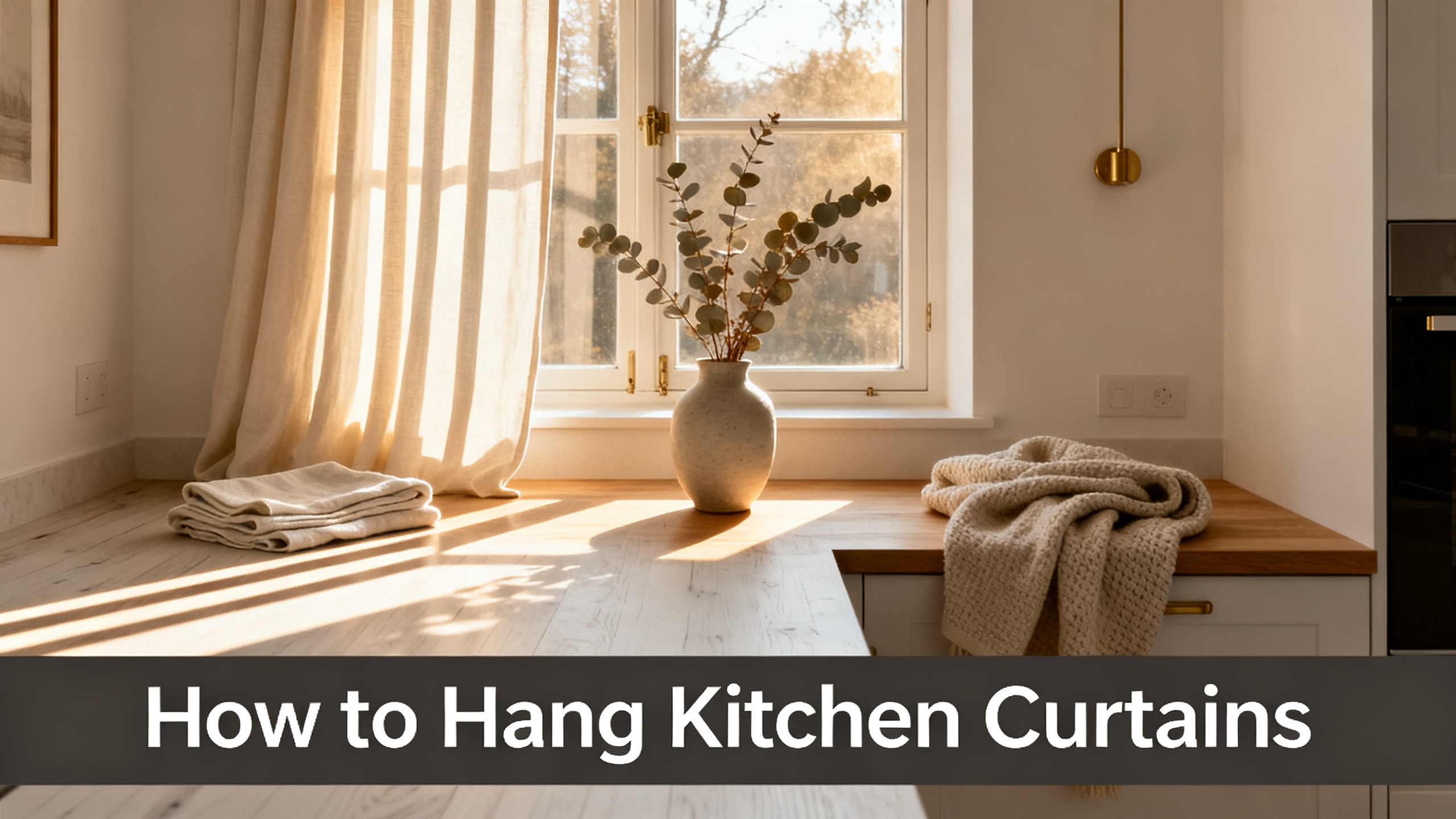
Done right, hanging a kitchen curtain is a 12 minute job per window. Done wrong, it turns into two re-measures, a wet drip zone, and a shade that soaks up grease within a month. The kitchen is the room where a mount decision matters most, because steam, splash, and cooktop heat punish every shortcut that a living room forgives.
Three window setups drive 90% of kitchen curtain installs: over the sink, along a sidelight next to the range, and on a garden window or pass-through. Each wants a different mount, a different height, and a different fabric. The rest of the hardware path (bracket spacing, wall types, rod length) is covered in the full curtain install hub.

The roman shade built for kitchen windows
Liz Linen Window Roman Shades Loop Cord Lift
from $59.99/shade, 90% polyester 10% linen blend, 350 gsm slub texture, custom width 18 to 71 inches, drop 12 to 90 inches, 38 colors, OEKO-TEX certified. Final price depends on size and lining.
Use code JULY for 20% off. Free shipping over $300.
The three kitchen mounts, in one glance
A kitchen window is not a bedroom window scaled down. It sits above a wet zone, next to a heat zone, or between two upper cabinets that eat clearance. Before picking hardware, decide which of the three mount families the window belongs to. The comparison card below matches each family to the window type that actually suits it.
Kitchen mount families at a glance
Roman shade
Over-sink, garden window, tight ceiling clearance
Cafe rod
Pass-through, side window, privacy above eye line
Full-length panel
Side kitchen door, floor-to-ceiling glazing
Valance only
Softens the top when the window has zero privacy need
The rest of this guide walks through the mount decision, the measure, the height, the drill, the anchor, and the fabric, in that order. Every step includes the failure mode that comes with skipping it.
Step 1: Pick the mount that fits the window
Over a sink or a counter, a roman shade is the mount most kitchens actually want. A lifted shade clears the faucet entirely, a lowered shade is a flat plane that resists splash pickup, and the headrail sits high enough that no fabric ever meets the drip zone. A full-length curtain panel above a sink is a bad match: the hem finds the wet countertop within a week.
On a sidelight next to the range, a cafe rod at mid-height gives privacy in the upper half while keeping natural light on the counter. On a garden window or a pass-through window, the cafe format is the standard because it splits the visible area cleanly. On a full glazed side door, a full-length panel on a wall-mounted rod is the correct move, hung with the same rules as any other room.
Cafe Curtains and Valances Hub
If the window sits above a counter with a plumbing wall behind it, a cafe rod or a valance is often the cleaner mount than a full-length panel. The hub compares both formats.
Step 2: Measure width and drop for a kitchen window
Two measurements decide everything: the finished width and the finished drop. For an outside mount (bracket above the window frame), add 3 to 6 inches on each side for stack-off, plus 3 to 4 inches above the frame for the header. For an inside mount (bracket inside the window casing), subtract 1/4 inch from the frame width for clean clearance, and match the frame drop exactly.
Kitchen window sizing matrix, drop by mount
Roman over sink
Drop ends 4 in above faucet spout, min
Cafe rod
Panel bottom 2 in above counter surface
Full-length side door
Hem 1/2 in above finished floor, no puddle
Note the position of the existing rod or bracket before removing anything. Kitchen walls hide plumbing runs, electrical for under-cabinet lights, and hood vent chases. An old anchor hole is a useful landmark for the next one.
⚠️ Important: Measure before you unscrew the old rod, and photograph the current setup. If the new mount misses a hidden stud or a plumbing chase, the reference photo is what tells you where the working stud actually was.
Step 3: Set the height above the sink or counter
Height is the step most rushed kitchen installs get wrong. The default rule (rod 4 to 6 inches above the window frame) still applies, but the counter or sink surface below the window sets a hard lower boundary the fabric cannot cross. That boundary is what keeps the panel dry and grease-free.
Bracket height by kitchen zone
Over the sink
Shade bottom 4 in above faucet at full down
Over the counter
Panel or shade bottom 2 to 4 in above surface
Sidelight to range
Cord and fabric 24 in min from cooktop edge
The cooktop clearance is a safety line, not a suggestion. A cord that dangles into an open flame, or a fabric hem that sits near a gas burner, is the reason kitchen curtain fires still happen. The Family Handyman curtain hanging basics gives a good visual on the geometry.
⚠️ Important: Cord clearance from an open flame or gas cooktop is 24 inches minimum, edge to edge. If the window sits directly above a range, drop the cafe idea and use a headrail with a discreet cord routed to the far side.
Step 4: Mark the bracket line and drill
Mark the outer bracket points first, drop a level line between them, then mark inner bracket positions if a rod runs longer than 48 inches (which needs a center support). Use the wall type to pick the bit: a standard wood bit into a window frame, a masonry or drill-through-tile bit into a ceramic backsplash, and a drywall anchor bit into plaster or gypsum board.
How to Hang Curtain Rods
Bracket spacing, center support, and rod length rules apply the same in a kitchen as in a living room. Read this before you commit to a hole in the tile backsplash.
Drilling through a tile backsplash is the failure point most kitchen installs hit. Tape an X over the mark, run the drill on the lowest torque setting, and start with a small pilot before stepping up to the anchor bit. A tile that cracks now cracks the whole splash later.
Step 5: Anchor, mount, and level
Seat the anchor flush with the wall face, slide the bracket over the screw, and check level with the spirit tool before loading any fabric. On a wood window frame, a #8 wood screw into a pre-drilled pilot is enough for most cafe rods and light shades. On plaster, a self-drilling drywall anchor rated 50 lb or higher handles a mid-weight roman shade with room to spare.
Any cord lift roman shade ships with a loose cord end. Tie that cord to a wall-mounted cleat above kid and pet reach, per the CPSC window covering safety guidance. It is the single install detail that gets skipped most and causes the most preventable injuries.

The shade that clears the sink and takes the steam
A cord-lift roman keeps the fabric off the faucet and out of the splash zone, and the 350 gsm blend takes weekly kitchen humidity without wrinkling into a wet rag. Liz ships in custom widths from 18 to 71 inches, which covers most single kitchen windows and small doubles.
⚠️ Important: Never leave a loose cord within reach of a child, pet, or a counter someone might step on. Tie every cord to a wall cleat, every time.
Step 6: Choose a kitchen-friendly fabric
Fabric is the last step because it depends on which mount and which height won the earlier calls. A polyester linen blend around 350 gsm, OEKO-TEX certified, takes weekly steam without wrinkling and washes cleaner than pure linen. That OEKO-TEX Standard 100 is the certification worth checking on the label.
| Fabric | Kitchen fitness | Wash | Best mount |
|---|---|---|---|
| 350 gsm polyester linen blend | Excellent, resists steam and grease | Machine, cold | Roman over sink, cafe |
| 100% linen 200 gsm | Fair, wrinkles fast from steam | Cold, hang dry | Side door full-length only |
| 150 gsm cotton | Good on sidelight, N/A over sink | Machine, warm | Full-length side door |
| Sheer polyester | Poor, grease clings quickly | Cold, hang dry | Avoid in active kitchens |
For a curated shortlist by kitchen type, the best cafe curtains for kitchen roundup compares five picks against the mount families above. It saves the guesswork on which brand actually ships a kitchen-fit blend.
Order the Liz 38-color booklet before you commit to a shade
Kitchen light shifts from warm bulbs at breakfast to cold north light at 4pm, and a color that looks buttery on a screen can read grey against stainless. The booklet is $3.99 and lets you tape the real 350 gsm slub against the window frame before you order.
When the kitchen is a rental
Rental kitchens rule out most drilling. Tile backsplashes cannot be patched cheaply, plaster crumbles unpredictably around old anchor holes, and property managers charge back any hole outside a stud line. The two viable no-drill paths in a rental kitchen are a tension rod inside the window frame and adhesive brackets rated for the shade weight.
How to Hang Curtains Without Drilling
Tension rods, adhesive brackets, and command tabs cover most kitchen renters who cannot patch holes in a plaster or tile wall. This is the fallback path.
Adhesive brackets work only when the wall face is clean, dry, and painted with a modern latex. On a greasy kitchen wall, the adhesive fails within a month. Wipe the mounting area with isopropyl alcohol, let it dry, and press the bracket for a full 30 seconds before adding any load.
Grease stain on fabric
Blot dry with baking soda, wait 20 min, then machine wash cold
Cord tangled by faucet
Re-route the cord to the wall side away from the sink and re-cleat
Shade rides crooked
One bracket is off level, re-shim it before adjusting the cord
FAQ
How high should I hang kitchen curtains above the sink?
For an over-sink roman shade, the bottom of a fully lowered shade should sit at least 4 inches above the faucet spout, so the fabric never dips into the drip zone. For a cafe rod, the rod itself typically sits at the horizontal midline of the window. Full-length panels above a sink are a bad match and should be avoided.
What is the best fabric for kitchen curtains?
A polyester linen blend around 350 gsm hits the sweet spot for most kitchens. It has the slub texture of linen with the wash and wrinkle resistance of polyester, which is what steam and cooking humidity actually demand. Pure 100% linen looks great on a display shot but wrinkles after the first pasta night.
Should kitchen curtains touch the counter or hang above it?
Above, always. A curtain that touches the counter picks up grease, crumbs, and moisture within a week. For a roman shade the bottom line should clear the counter by 2 to 4 inches when fully lowered. For a cafe rod, the panel bottom should sit at least 2 inches above the counter surface.
How do I hang kitchen curtains without drilling into the tile backsplash?
Mount above the backsplash, into the wall or the top of the window frame, so the tile is never drilled. Where that is not possible, tension rods inside the window frame or heavy-duty adhesive brackets rated for the shade weight are the two viable no-drill paths for a rental kitchen.
Are roman shades or cafe curtains better for kitchen windows?
Roman shades win over a sink, because a lifted shade clears the faucet entirely and a lowered shade is a flat plane that resists splash pickup. Cafe curtains win on garden or pass-through windows where the goal is privacy in the upper half while keeping natural light on the counter. Neither is a universal answer.
How do I keep kitchen curtains from getting greasy?
Mount them high enough that the fabric never sits in the splash or steam zone, use a polyester linen blend that machine washes without shrinking, and run the range hood on high during any oil-based cooking. A shade or panel that hangs 4 to 6 inches above the cooking surface lasts far longer between washes than one that hangs at counter level.
Final verdict
The kitchen curtain that lasts is the one whose mount, height, and fabric all account for the wet zone below. Pick the roman shade for over-sink, the cafe rod for a garden window or a pass-through, and a full-length panel only for a side door with clean vertical wall space. Skip the mount decision and every downstream step gets harder.
Now that the bracket line, the height, and the fabric fit are all decided, the panel choice is the easy part. A 350 gsm polyester linen blend in a cord-lift roman shade covers 80% of real kitchen windows without drama.
Now that the bracket is set, choose the shade that hangs clean over a kitchen sink
Liz Linen Window Roman Shades is the shade most kitchen installs actually want: 350 gsm slub linen blend, OEKO-TEX certified, custom width and drop, cord lift so the fabric never hits the faucet. from $59.99/shade. Code JULY for 20% off.
