
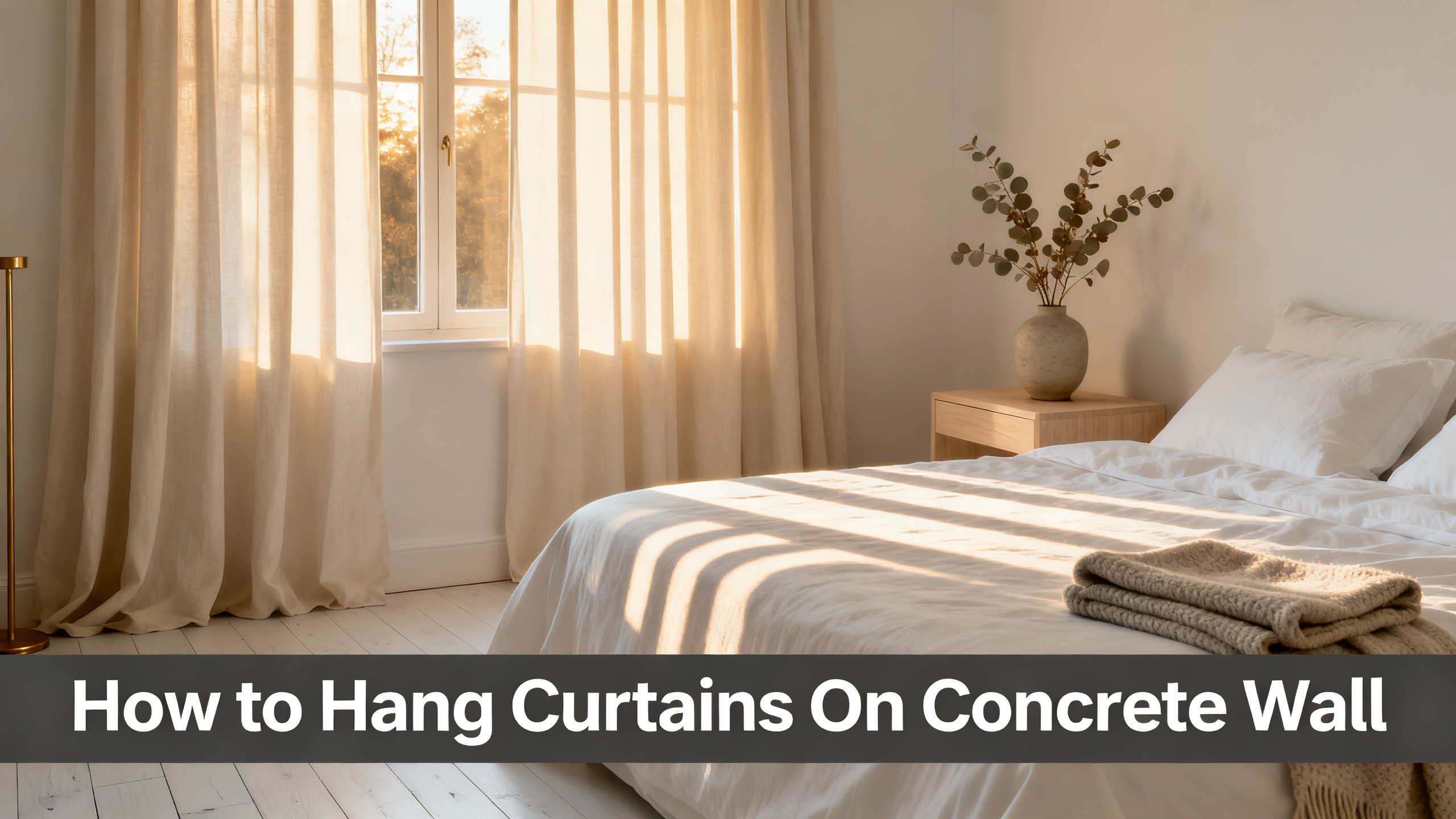
Before you touch a drill, gather seven things: a hammer drill, a tungsten carbide masonry bit, 1/4 inch sleeve anchors rated for concrete, a curtain rod with wall-mount brackets, tape, a pencil, and a level. Budget 45 minutes. Concrete is not drywall, and it punishes the shortcuts that drywall forgives.
Two wall families make this method work: poured concrete and painted cinder block. If you want the full rod, bracket, and height side of the process too, the full curtain install hub covers the hardware path end to end.

The heavyweight drape that anchors clean on concrete
Isabella Heavyweight Cotton Drapery Pleated
from $89.99/panel, 100% heavyweight cotton, 500 gsm structured drape, 36 colors, pleated header that pairs with any wall-mounted rod bracket. Final price depends on size and lining.
Use code JULY for 20% off. Free shipping over $300.
Why heavyweight cotton works on concrete
Real talk: concrete walls surface every weakness in your panel. A flimsy 90 gsm ready-made looks limp against raw board-formed concrete, and a bracket loaded with a light panel tends to torque outward under its own hardware weight because there is nothing pulling it straight down.
A middle-weight cotton in the 150 gsm range solves that. The fabric hangs with enough authority to keep the rod straight, but not so much weight that a properly rated 1/4 inch sleeve anchor is fighting for its life. If sustainability is a factor, the OEKO-TEX Standard 100 framework is what to look for on the label.
Weight load matrix, panel gsm to anchor rating
90 gsm ready-made
50 lb plastic anchor is technically fine, wall looks weak
150 gsm cotton
1/4 inch sleeve anchor rated 100 lb, ideal match
300 gsm blackout
3/8 inch wedge anchor or Tapcon rated 200 lb
⚠️ Important: Anchor ratings are pull-out, not shear. A rod bracket loads mostly shear, but under a heavy blackout the vertical drag becomes real. Match anchor weight rating to 2 to 3 times your total panel weight per bracket, not one to one.
Step 1: Choose the right anchor for your wall
Concrete is not one material. Poured concrete, cinder block, and painted masonry each want a different fastener, and picking the wrong one is where most concrete curtain installs quietly fail six months later.
Concrete anchor family cheat sheet
Sleeve anchor
Best all-round for a curtain rod bracket on solid concrete
Wedge anchor
Heavier duty, overkill for most panels but never wrong
Tapcon screw
Removable, easier to install, works on painted concrete
Toggle bolt
For hollow cinder block only, needs a void behind the face
Between us, if you are hanging Isabella Heavyweight Cotton Drapery in a standard loft window, a 1/4 inch by 2-1/4 inch sleeve anchor per bracket is the correct answer 90% of the time. The Family Handyman concrete anchoring guide is a solid photo-led primer if you want to see the anchor families before you buy.
⚠️ Important: Never trust the plastic anchors that ship with cheap curtain rod kits on a cinder block wall. Painted cinder block hides voids and crumbly face material, and a plastic anchor spinning inside a void will still feel tight for a week, then fail with the panel weight loaded.
Step 2: Mark bracket height and rod length
Standard drywall advice says mount the rod 4 to 6 inches above the frame. Concrete lofts and finished basements often break that rule because the window sits low in a very tall wall, and the reasonable rod height wants to move closer to the ceiling for proportion.
How High To Hang Curtains
Concrete walls in lofts and basements often push the reasonable rod height above the standard six-inch above-frame rule. Reset expectations here before you mark the bit.
Work center-out so both sides mirror. Mark the two outer bracket points first, drop a level line between them, and only then mark the intermediate support bracket if the rod length exceeds 72 inches. Concrete pushes you toward more support brackets, not fewer, because a long rod flexing on two anchors is more visible against a flat concrete backdrop than against textured drywall.
Step 3: Drill the concrete without cracking the paint
Set the drill to hammer mode. A regular cordless drill on rotary-only will polish the concrete for ten minutes without cutting a real hole, and you will get a shiny divot instead of an anchor pocket.
How to Hang Curtain Rods
Bracket spacing, center support, and rod length all follow the same rules on concrete as on drywall. This guide covers those before you commit anchor holes.
Drill 1/4 inch deeper than the anchor length. That extra depth catches the dust that always survives the vacuum step and stops the anchor from riding up as it seats.
⚠️ Important: Dust blowout is the number one killer of concrete anchors on curtain installs. A hole packed with concrete flour looks fine, feels tight when you tap the anchor in, then wobbles under the panel weight two weeks later. Vacuum the hole. Always.
Step 4: Set the anchor and torque the bracket
Tap the sleeve anchor flush with the wall surface. Proud of the surface means the bracket will not sit flat, and countersunk means the sleeve is losing grip in the concrete face where it needs the most.

The panel weight that works with concrete anchors
A 500 gsm cotton panel sits between the flimsy 90 gsm ready-mades and the 300 gsm blackouts. That range keeps a wall-mounted rod on sleeve anchors from flexing at the bracket. Isabella ships with a pleated header, custom drops, and pairs with any 3/4 inch to 1 inch rod.
Slide the bracket over the exposed stud, drop the washer, thread the nut, and torque it firm. Firm here means hand-tight then a quarter turn. Cranking a sleeve anchor past that point pulls the expansion ring against the concrete edge and starts to crack the surface outward from the hole.
⚠️ Important: If the sleeve keeps spinning as you tighten the nut, the anchor is stripped inside the hole. Do not try to force it. Back it out, move over an inch, and drill a fresh hole. Trust that hole once, and the whole rod will drop mid-summer.
Step 5: Hang the rod, hang the panel, dress the folds
Load the curtain rings onto the rod before mounting the rod. Trying to thread rings after the rod is already fixed on concrete brackets is a two-person job, and one of those people is usually swearing.

Steam the pleats down the leading edge, then hand-walk the folds so each pleat opens in the same direction. If you want to skim the collection first, the Isabella Heavyweight Cotton Drapery review covers drape behavior, color accuracy, and lead time in more detail.
Bit is spinning, not cutting
Hammer mode is off, or the bit is dull. Switch modes, replace the bit.
Paint chipping around hole
Tape an X over the mark next time, and start rotary-only for the first 1/4 inch.
Bracket loose after one week
Dust blowout inside the hole. Pull the anchor, vacuum, reset.
When drilling is not an option
Renters, historic buildings, and painted cinder block that flakes on contact are the three cases where drilling into concrete is either forbidden or a bad idea. There is a clean path for each.
How to Hang Curtains Without Drilling
Renters on painted cinder block or tenants who cannot patch anchor holes should read this first. Command tabs, tension rods, and ceiling clips replace the drill in the right cases.
Ceiling-mounted tracks are the honest answer for finished basements with concrete perimeter walls. The load transfers to a joist above the drop ceiling instead of the concrete face, which is stronger and less permanent. The Tapcon concrete screw installation reference is worth bookmarking anyway, because Tapcons are the fallback fastener when a sleeve anchor is not appropriate for the wall condition.
Order the Isabella 36-color booklet before you drill
Painted concrete and raw concrete reflect light very differently, and a color that reads soft on drywall can go grey on cinder block. The booklet is $3.99 and lets you hold the real 150 gsm cotton against the wall before you commit to bracket placement.
FAQ
What kind of drill do I need to hang curtains on a concrete wall?
A hammer drill is the honest answer. A regular cordless drill on rotary-only can score a shiny divot into concrete but will not cut a real anchor hole in any reasonable time. Rent or borrow a hammer drill for the day if you do not own one, and pair it with a tungsten carbide masonry bit sized to the anchor spec.
What is the best anchor for a curtain rod in concrete?
A 1/4 inch by 2-1/4 inch sleeve anchor is the correct answer for most curtain rod brackets on solid concrete. It is rated around 100 lb shear, easy to install cleanly, and forgiving of small alignment errors. For heavier blackout panels or long rods with a center support, step up to a 3/8 inch sleeve or wedge anchor.
Can I hang curtains on a cinder block wall the same way?
Not exactly. Cinder block has hollow cells, so a sleeve anchor drilled into a void will spin and fail. Toggle bolts or a Tapcon set into the solid web between voids are the right calls. If the face is painted and crumbly, tape the mark, drill slowly, and expect to move the hole an inch if the face crumbles instead of drilling clean.
How much weight can a sleeve anchor hold on concrete?
A properly seated 1/4 inch sleeve anchor is rated around 100 lb shear in solid concrete. That is far more than any curtain panel plus rod plus bracket will ever pull. The number to watch is not the rating, it is whether the hole is dust-free and drilled to the right depth. A stripped or dusty hole will fail at a fraction of the rated load.
How do I hang curtains on a concrete wall without drilling?
Ceiling-mounted tracks are the strongest no-drill answer, because the load transfers to a wood joist above the ceiling instead of the concrete face. Tension rods work for shallow window casings if the frame is deep enough to grip. Heavy-duty adhesive hooks rated for the fabric weight can carry a light sheer panel but should not carry a lined blackout.
Does painted concrete need a different anchor than raw concrete?
Same anchor family, different technique. Painted concrete chips at the surface if you slam the bit straight into hammer mode, so tape the mark and start rotary-only for the first quarter inch, then switch to hammer. That protects the paint face and keeps the anchor hole clean. Everything else, from bit size to torque, stays the same.
Final verdict
If your wall is solid concrete, a 1/4 inch sleeve anchor, a hammer drill, and a middle-weight cotton panel is the honest full recipe. Vacuum the hole, torque hand-tight plus a quarter turn, and pick a panel that has enough drape authority to keep the rod straight without overloading the anchor.
Now that the anchors are set, choose the panel that hangs cleanly on concrete
Isabella Heavyweight Cotton Drapery is the middle-weight cotton drape most concrete-wall installs need: 150 gsm, custom drops, 36 colors, and a pleated header that pulls straight from a wall bracket without pulling the sleeve anchor sideways. from $89.99/panel. Code JULY for 20% off.
More install guides
