
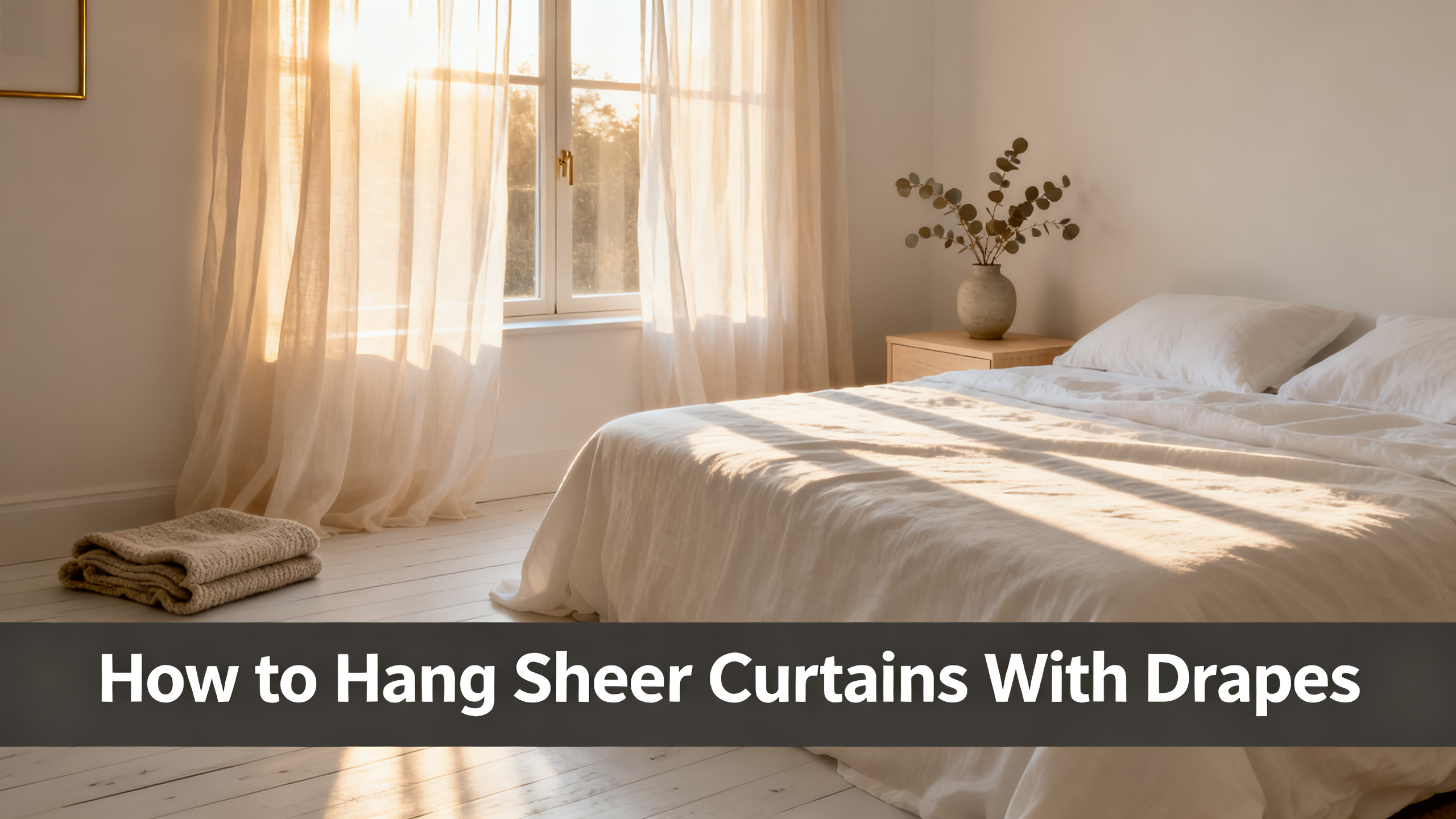
Done right, layered curtains take one double rod, two panels, about 25 minutes, and read like the room was styled by someone with a Pinterest board. Done wrong, you end up with a 96-inch sheer floating six inches off the floor next to a drape that grazes the boards, and the whole thing looks like an ordering mistake.
The trick is not the install itself. The trick is deciding, before you buy anything, that both panels share the same rod-to-floor drop and the same header type. Get that number pinned down and the rest is prep, brackets, and a level.
⏱️ WHAT DONE-RIGHT LOOKS LIKE
The 25-Minute Layered Install
🪟
One double rod
Sheer on the inner rod, drape on the outer. Same bracket, two independent panels.
📏
Two matching drops
Sheer and drape land within half an inch of each other. No visible height gap.
🧵
Matching header
Both panels pleated, or both grommet. Mixed headers read cluttered.
⏱️
25 min per window
Bracket in, rods on, sheer up, drape up. Skip measuring and you redo it twice.
❌
The wrong version
Ready-made 96″ sheer floats 6″ off the floor. Undoes the whole layer.
✅
The right version
Custom sheer at the same drop as the drape. Both kiss the floor.

🪟 EDITOR’S PICK OUTER LAYER
Liz Linen Drape Pleated
Pinch-pleated 10/90 linen blend, memory-trained, custom length to the inch. The outer layer that stacks cleanly next to a sheer without wrestling the rod.
From $59.99/panel
Final price depends on size & lining. Code JULY for 20% off. Free shipping over $300.
The One Decision That Comes First
Before you shop for hardware, before you pick colors, you make one call: the sheer and the drape hang from the same rod-height reference and land within half an inch of each other at the floor. That is what a “layered window treatment” actually means. Editors at Architectural Digest recommend starting every window plan with that rod height, and it applies double when you’re stacking two panels.
The second call is header type. Pleated sheer with pleated drape reads as one piece of tailoring; grommet with grommet reads relaxed. Mixing the two makes the two panels argue at eye level, and no rod placement fixes that. For the wider rod-height context, our complete guide to hanging curtains covers the fundamentals both layers depend on.
Ready-made pairs almost never solve for both at once. Standard sheer panels come in 84″ or 96″. Standard drapes come in 84″, 96″, and 108″. Rod-ring drop varies by a couple of inches between headers, so a 96-inch sheer and a 96-inch drape rarely end up at the same hem. Custom drops are how you skip that arithmetic entirely.

Choose Your Rod Setup
Four hardware routes carry a layered pair. The default is a double curtain rod: one bracket, two telescoping rods, roughly 3 inches of spacing between them, projection 5 to 7 inches from the wall. It handles a voile sheer plus a light-to-mid-weight drape without sag, and it’s the least-fussy install.
Two independent rods, mounted separately, give you more depth. Useful when the drape is heavier or you want it to stack further from the sheer for a fuller puddle. The tradeoff is more brackets, more holes, and a wider footprint on the wall.
Ceiling-mounted tracks with two channels are the modern route. No visible hardware, both panels drop from the ceiling, and the room reads taller. This one lives or dies on whether you can drill into a ceiling joist, so renters usually skip it.
The single-rod alternative: skip layering entirely and hang a Cady Linen–Sheer patchwork panel. The linen and sheer are sewn together, so one rod carries both textures. It’s the renter-friendly, no-double-hardware version of the look.
🪟 ROD SETUP
Double Rod vs Two Rods vs Track vs Patchwork
Double Curtain Rod
Best for: the standard layered look. Sheer 3″ behind drape.
Hardware: one bracket, two telescoping rods.
Skip if: your wall depth is under 4 inches.
Two Independent Rods
Best for: maximum stack depth, formal puddles.
Hardware: two rod sets, wider projection.
Skip if: narrow trim or shallow window casing.
Ceiling Track (two channels)
Best for: tall drops, modern rooms, no visible hardware.
Hardware: aluminum track, roller hooks.
Skip if: you rent and can’t drill the ceiling.
Single Rod, Patchwork Panel
Best for: renters, one-hardware setups, hallway windows.
Hardware: one rod, one bracket per side.
Two Pages: Cady Linen–Sheer Patchwork covers this in one panel.
How to Hang a Curtain Rod (Anchor-First Method)
Toggle bolts, stud placement, and the double-rod bracket that carries both a sheer and a lined drape without sag.
Get the Panel Lengths Right
Here is the rule that most guides bury and every install depends on. Both panels reference the same rod height. Your drape drop = distance from the top of the rod-ring (or grommet) down to the floor. Your sheer drop = same number, minus half an inch. The drape kisses the floor; the sheer floats.
Why the half-inch offset? A sheer that touches the ground wicks dust every time you walk past. A sheer that floats reads intentional. Order both to the same base drop through the Scandina voile configurator and apply the offset at checkout.
How High to Hang Curtains: The Universal Rule
The 4-to-6-inch above-the-window logic. Both layers reference the same rod height, so this is the number you start from.
Now the ready-made trap. A 96-inch sheer with a 108-inch drape sounds like a small difference. In practice, the sheer floats 12 inches above the floor while the drape kisses it. That gap reads as a mistake to anyone who walks into the room, and no rod tweak fixes it. The only clean answer is matching custom drops.
📐 LENGTH ALIGNMENT
Both Panels Land Within Half an Inch
SHEER PANEL
Rod-ring to floor − ½”
Float. Sheer hem never touches the floor, else it wicks dust.
DRAPE PANEL
Rod-ring to floor + 0″
Kiss. Or +1 to 2 inches for a soft break in a formal room.
ORDER LOGIC
Same drop, one number
Feed one drop into both configurators. Half-inch offset optional per panel.
RED FLAG
Sheer 96″ + drape 108″
Ready-made mismatch. Sheer floats 12″ off the floor. Undoes the layer.

🌤️ CUT THE INNER LAYER TO MATCH
Scandina Voile Sheer, Made to Your Drape’s Drop
50 gsm voile in 14 solid colors. Order the sheer at the same custom drop as the outer drape so the two hems land within a half inch of each other. No hemming, no float, no visible gap.
The Install, Step by Step
Once the panels are on their way, the physical install takes about 25 minutes per window. Six steps, one bracket set, one level. Do the first window slowly. The second one takes half the time.
🧰 STEP BY STEP
Six Steps From Empty Wall to Layered Window
STEP 1
Mark rod height first
4 to 6 inches above the window trim. This one number drives both panel lengths.
STEP 2
Measure the drop
From rod-ring position down to the floor. Order both sheer and drape to that exact drop.
STEP 3
Anchor the double bracket
Into a stud, or with toggle bolts if drywall only. A layered pair pulls twice as hard.
STEP 4
Thread the sheer (inner rod)
Sheer goes on the rod closest to the window. It carries the diffusion job.
STEP 5
Thread the drape (outer rod)
Outer rod carries the opaque layer. Rings, hooks, or grommets, matching the sheer’s header.
STEP 6
Dress the pleats
Fold each pleat to the front, tie loosely for 48 hours. Memory training locks the shape.
On step 3, the anchor decides whether the whole thing stays up. A layered pair on a wide window can weigh close to 10 pounds loaded. If the bracket lands on a stud, wood screws hold fine. If it lands on drywall, toggle bolts are non-negotiable. Skip this and the rod pulls out of the wall within a week.
⚠️ WARNING
Double-rod brackets project 5 to 7 inches from the wall. Check your window casing depth before you drill. A shallow casing traps the drape against the glass on hot days and the fabric fades unevenly along the edge.
Once both panels are up, dress the pleats. Fold each pleat to the front of the panel and tie it loosely with a strip of fabric or an unused shoelace. Leave the ties on for 48 hours. Memory training does the rest, and the panel keeps a clean fold instead of collapsing into a limp curtain within a week.
Give the layer a full first day before you judge it. Fabric settles overnight. The sheer, especially, may need to hang a few hours before it stops looking bunched at the rings. Don’t reach for the scissors on day one.
Mistakes That Ruin the Layer
Five things tank a layered install more often than everything else combined. Every one is preventable before you drill a hole, and every one is expensive to fix after the panels are up. Read this section slowly; skip it and the room ends up looking like a compromise.
The ready-made trap is the biggest one. Two panels sold as “96 inch” are almost never identical: header type, rod-pocket depth, and drop-tolerance vary between sheers and drapes. If you must go ready-made, buy one panel first, measure the actual drop from a ring, then match the second. Custom drops sidestep the whole problem.
The rod-load mistake is close behind. Budget double curtain rods rated for a single panel sag 2 inches at the center once loaded with two. Look for a rod set rated for at least 8 pounds combined, or splurge on a track. The rest are cosmetic details.
⚠️ WATCH OUT
Five Warnings You’ll Wish You’d Read First
⚠️
Mixing header types
Grommet sheer + pleated drape reads uneven. Match the header on both.
⚠️
Ordering both ready-made
Standard lengths force one panel to hem, the other to float. The layer never lines up.
⚠️
Undersized double rod
Cheap sets sag by 2″ at the center once loaded. Get one rated for at least 8 pounds combined.
⚠️
Ignoring wall depth
Double brackets project 5 to 7 inches. Shallow casing traps the drape against the glass.
⚠️
Skipping memory training
A pleated drape without it relaxes and folds unevenly against the sheer within a week.
Color Pairings That Actually Work
The rule of thumb: sheer and drape stay in the same warm family, one shade apart. A snow-white voile behind an ivory linen reads clean. A beige voile behind a sand-beige linen reads warm and lived-in. Both look intentional because the layered edge blurs instead of stripes.
Two exceptions worth breaking the rule for. A soft sage voile behind a taupe drape gives a quiet, nature-leaning palette. A blush voile behind ivory warms morning light in a bedroom without turning the room pink.
The pairing to skip: pure white sheer with a charcoal drape. High contrast at layered edges reads as a seam, not a gradient. If you want dark drapes, pair with a beige or sand sheer for a softer visual transition.
🎨 COLOR PAIRINGS
Sheer + Drape Combos From the Two Pages Palette
Snow White sheer + Ivory drape
The classic bright-neutral. Reads clean and modern.
White sheer + Sand Beige drape
Warm and lived-in. Best for south-facing rooms.
Beige sheer + Grey Beige drape
Muted, textural. Reads slightly darker than pure white.
Sage sheer + Taupe drape
The unexpected pick. Nature-leaning, quiet contrast.
Skip: pure white + charcoal
Too much contrast at layered edges. The seam between panels reads as a line, not a gradient.
Blush sheer + Ivory drape
Bedroom-friendly. Sheer warms the light at sunrise.
FREE SWATCH KIT
Match Your Drape and Sheer in Your Actual Light
Layered fabric reads different from either panel alone. Order the Liz Linen swatch card plus a Scandina voile clip and hold them up together before you commit to a color pair.
Pro Tips for Layered Panels
A few small moves separate the styled version from the amateur one. Space the drape 3 inches behind the sheer on the double rod so it stacks cleanly when open. Add a small drapery weight to the bottom hem of the drape only; the sheer needs to move with light air. Overlap the two panels by 1 inch in the center when closed so no stripe of window shows through.
If your ceiling sits at nine feet or higher, layered panels need a longer custom drop, and the double-rod bracket has to carry more weight; the [9-foot ceiling walkthrough](/guides/how-high-to-hang-curtains-9-foot-ceiling/) has the exact panel-length matrix and rod-height numbers.
Frequently Asked Questions
Which curtain goes in front, the sheer or the drape?
The drape goes on the outer rod (closer to the room), the sheer on the inner rod (closer to the glass). The sheer’s job is to diffuse light; putting it in front would trap the drape against the window and stop it from stacking cleanly when you pull the layer open. On a double curtain rod, “outer” means the rod that projects further from the wall.
Should sheer curtains be the same length as drapes?
Yes, within half an inch. Both panels should hang from the same rod-height reference. Order the drape to kiss the floor (drop = rod-ring to floor), and the sheer at drop minus ½” so it floats and doesn’t wick dust. Any bigger gap between the two hems reads as a mistake and undoes the layered effect.
Can you hang sheers and drapes on the same rod?
Not on the same rod on the same rings, the fabrics fight for space and won’t stack. Options that share hardware: a double curtain rod (one bracket, two rods, standard route), a ceiling track with two channels, or a single-panel patchwork like Two Pages’ Cady Linen–Sheer which sews the two fabrics together and hangs on one rod.
Do I need custom lengths for a layered sheer-and-drape look?
Almost always, yes. Standard ready-made panels are typically 84″, 96″, or 108″. A 96″ drape with a 96″ sheer sounds identical, but rod-ring drop varies by header, and the two panels’ hems rarely align. Custom-length pairs from Two Pages let you enter one drop and get both panels cut to it, no hemming.
How far apart should the sheer and drape be on a double rod?
About 3 inches of horizontal spacing between the two rods is the sweet spot. Less than that and the drape catches on the sheer when you pull it. More than 5 inches and the drape projects awkwardly into the room. Off-the-shelf double curtain rods project 5 to 7 inches total from the wall, check yours before mounting.
Now You’ve Planned the Layer. Here’s How to Order.
Three numbers close the loop. Rod height, four to six inches above the trim. Drape drop, rod-ring to floor. Sheer drop, same number minus a half inch. Header type, matched on both panels. Everything else is finish work.
Order the Liz Linen drape first through the configurator: it sets the drop, the header, and the color anchor. Then match a Scandina voile sheer to the same drop. Both ship inside the same 10-to-12-day made-to-order window from Two Pages, so they arrive together and go up in one afternoon.
🪟 NEXT STEP
Now You’ve Planned the Layer. Here’s How to Order.
Order the Liz Linen drape first, it sets the drop, header, and color anchor. Then match a Scandina voile to the same drop. Both ship inside the same 10-12 day window from Two Pages.
From $59.99/panel · Code JULY for 20% off · Free shipping over $300
