
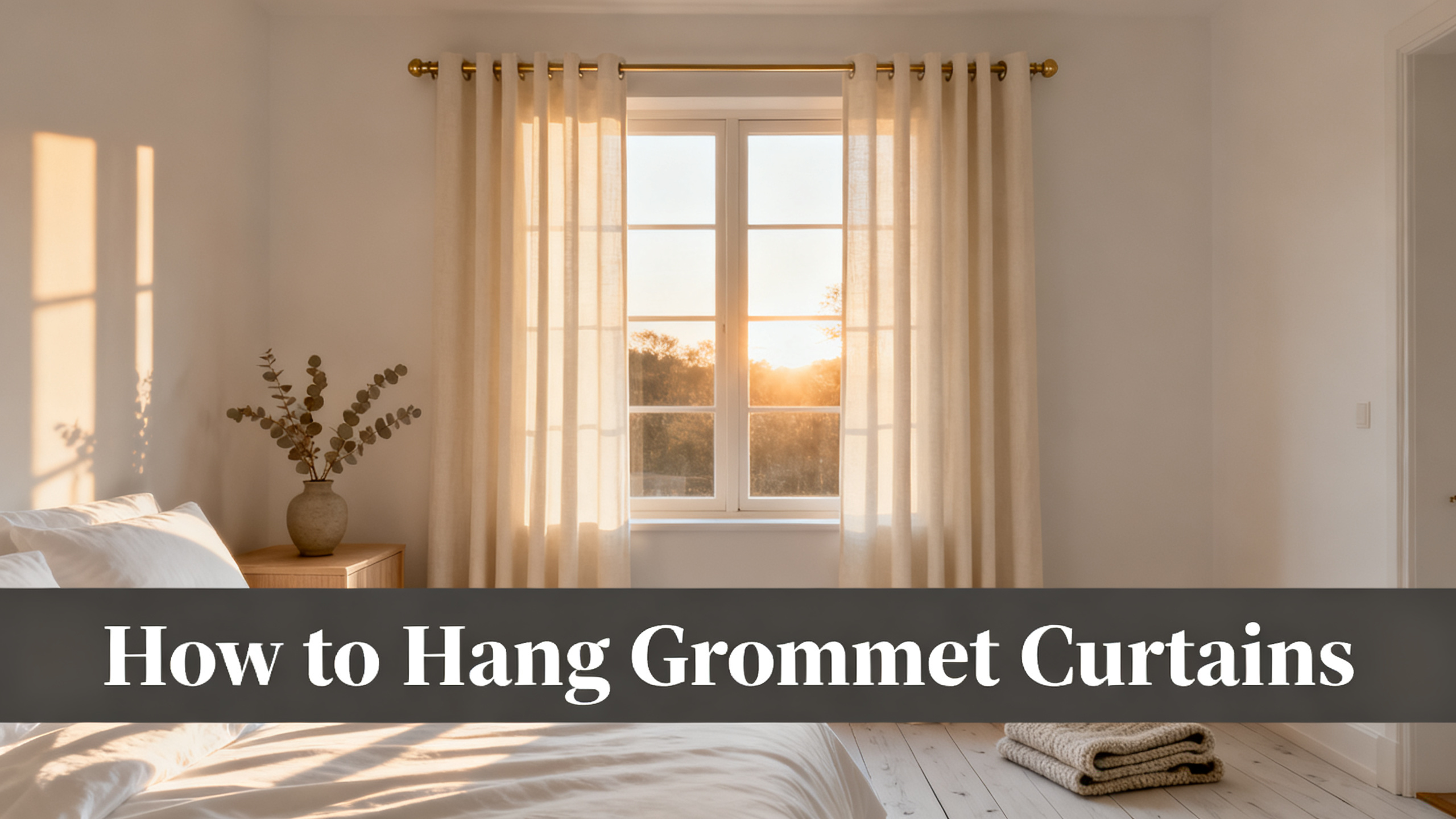
Here’s the deal with grommet curtains. Once the rod is up, the whole hang is a threading exercise: you slide the panels on, level, step back. It reads simple, and it is, provided the rod diameter matches the grommet size and the height math was done before anyone picked up a drill.
Most re-hangs happen because one of those two numbers was wrong. The rest of this guide is the routine buyers who nailed it the first time use, plus a Pro Tips block for the upgrades that hold for years. For rod-mounting on drywall vs plaster, pinch-pleat threading, or the wider install landscape, see our complete install curtains hub.
🧰 Tools & Prep Checklist
Everything you need before you touch the rod
Total time from unbox to full hang: 12 to 15 minutes per window if the rod is already mounted, 45 minutes if you’re installing brackets from scratch.
Tools
- Tape measure (25 ft, metal blade)
- Pencil and painter’s tape
- Stud finder
- Cordless drill and level (bubble or laser)
- Step ladder rated for the ceiling height
Hardware & Drape
- Rod with outer diameter ≤ 1.5″ (fits 1.6″ grommet)
- Brackets rated for the panel weight
- Drywall anchors or toggle bolts (if no stud)
- Grommet drape panels (count math in Step 2)
- Steamer or handheld iron on low

Blocks below run in order. If your brackets are already up, skip Step 1 and start at Step 2.
Step 1: Set the Rod at the Right Height and Width
The single choice that changes the room most is where the rod sits vertically. On a standard 8-foot ceiling, mount the rod 4 to 6 inches above the window frame, not on the frame itself. This lifts the eye, makes the window read taller, and stops an open drape from cutting off any glass at the top.
On a 9-foot ceiling, push higher: 8 to 12 inches above the frame. On 10-foot ceilings and up, ignore the frame and mount 3 to 4 inches below the ceiling line. Boring number, real impact: the same drape at the wrong height reads chintzy at frame-mount and dramatic at ceiling-mount.
📐 Rod Height Rules
Where the rod goes vs where most people put it
Standard 8ft ceiling
4-6″
above window frame
9ft ceiling
8-12″
above frame, closer to ceiling
10ft+ ceiling
3-4″
below ceiling line
Extend brackets 4-8″ past each side of the frame so the open drape doesn’t cover any glass.
How to Hang Curtain Rods (Drywall, Plaster, Metal Stud)
If the brackets aren’t up yet, start here. The rod-mount guide covers stud placement, anchor selection and the 3 mistakes that make brackets sag under a full-width panel.
Width matters just as much. Extend the rod 4 to 8 inches past each side of the window frame. This gives the drape somewhere to stack when open, so no glass gets covered, and it lets more daylight into the room during the day.
The Department of Energy on window coverings notes the same wider extension also creates a better thermal seal at the frame edge when the drape is closed. Two benefits, one bracket placement.
How High to Hang Curtains (Standard, 9ft, 10ft Ceilings)
Deeper breakdown of ceiling-mount vs frame-mount, with rod height charts for 8ft, 9ft and 10ft ceilings. The 4-inch rule works most of the time; here is when it fails.
One last spec on the rod itself: bracket projection. The distance from the wall to the rod centerline needs to be 3 to 4 inches, not the 2 inches most builder-grade brackets ship with. A short projection crushes the fold every time the drape closes, and the header ends up permanently creased at the bracket. Deeper brackets or standoff extenders solve it in one part.
Step 2: Do the Grommet and Panel Count Math
Grommet as a header stacks tighter than pinch pleat, which means the fullness ratio has to work harder. The rule is simple: rod width × 2 = total drape width. Anything below that 2× ratio reads flat and cheap; above 2.5× wastes fabric and money without adding to the look.
Now the grommet count itself. Two Pages panels ship with an even number of grommets per panel so the fabric stacks front-back-front-back when closed. Both edges of the panel end up facing the window, the drape lies flat, and the S-fold silhouette that grommet is known for reads clean.
An odd count flips the last edge outward. It’s the small thing that makes an otherwise-perfect hang look wonky in every photo of the room. If you ordered custom width and the maker gave you an odd count, request a re-cut before threading. This is not a tolerable defect.


Last piece of Step 2, the rod diameter check. The Two Pages grommet inner diameter is 1.6 inches. Your rod outer diameter has to sit at or below 1.5 inches so the panel threads without binding. A 1.75″ rod will not fit, period. Even a 1.5″ rod with a decorative finial wider than the rod itself can jam mid-panel. Verify before you drill.
Step 3: Measure the Drop and Order the Right Length
Drop is where most re-orders happen, so the math has to be right the first time. Measure from the top of the rod down to the floor. That’s your raw drop. Now subtract the grommet-to-rod offset, which for Two Pages is about 1 inch (the fabric sits below the grommet by that much when threaded).
What you do with the last inch or two depends on the finish you want. Three standard drops read very differently in the same room.
📏 Drop & Coverage
Three drop lengths, three different room reads
Kiss the floor
Floor − 0″
Panels graze the floor. Cleanest look for grommet, easiest to vacuum around.
Half-inch break (recommended)
Floor + 0.5″
Panel touches floor with a subtle stack. Hides small drop-length errors from wonky floors.
Puddle
Floor + 2-4″
Extra fabric pools on the floor. Formal look, but grommet handles it worse than pinch pleat: trip and lint magnet.

The half-inch break is the pick for most rooms. It absorbs the small floor imperfections you cannot see with your eye but the drape will find. Puddle looks beautiful in a formal living room with a still footprint, and terrible in any room where the drape gets opened and closed twice a day. Kiss is the modernist default and demands a perfectly measured drop.
Step 4: Steam, Thread, and Level
Linen-look panels ship folded. The creases from packaging are set in the fabric and stay there until steam hits them. Lay each panel flat on a clean floor or bed, run a handheld steamer along both sides, then thread. Steaming after threading is possible but harder, because the fabric is under tension and the fold lines resist.
⚠️ 4 Mistakes That Force a Re-Hang
Each one costs 30 minutes to fix. Skip them once.
1. Rod diameter too big
Grommet inner diameter is 1.6″. Rod outer diameter must be ≤ 1.5″. A 1.75″ rod won’t thread and panels bind mid-glide.
2. Odd grommet count per panel
Grommet counts must be even so the drape stacks with both ends facing the window (front-back-front-back). Odd counts flip the last edge outward.
3. Bracket too close to wall
Brackets need 3-4″ projection so the header clears the window frame when open. Standard 2″ brackets crush the fold.
4. Hanging before steaming
Linen-look panels ship folded. Creases are far easier to steam while the panel lies flat than after threading.
Threading itself takes two minutes per panel. Feed the rod through the grommets one at a time, alternating front, back, front, back. That alternation is what creates the uniform S-fold silhouette grommet is known for. Every fifth grommet, check the stack: the folds should be even and roughly parallel. If they’re not, back the rod out and re-thread the offending section.
📏 Pro Tip: Space the grommets evenly along the rod before you seat it in the brackets. Panels bunch to one side otherwise, and rebalancing after the fact means lifting the rod off the brackets again.
Final step: level. Set the rod in the brackets, put a bubble level on the top of the rod, and confirm side-to-side. A rod that’s off by even a quarter-inch shows once the drape hangs, because the puddle depth on each side won’t match. Adjust the low bracket up a hair, re-check, done.
Rod and Grommet Sizing Math: Quick Recap
Before ordering, three numbers have to line up: 1.6″ grommet matched to ≤ 1.5″ rod, even grommet count so the fabric stacks correctly, and 2× fullness ratio so the drape reads full when closed. Miss one and you re-order or re-hang.
The grommet drape most buyers stop searching after
Liz Linen Drape Grommet ships with a 1.6″ inner-diameter grommet already punched, spaced to standard fullness, and cut to your exact drop. 28 colors, from $59.99/panel. Final price depends on size and lining.
Code JULY · Free shipping over $300
Pre-punched grommets matter more than the marketing copy suggests. DIY grommet kits exist, but the metal ring seating requires a punch press to hold true under load. A hand-crimped grommet loosens after a few months of glide and eventually pops off entirely. Buying panels with the grommets already set (like every Two Pages grommet SKU) removes the failure mode entirely.
Choose the Right Drape Before You Hang
The routine above is fabric-agnostic. It works for polyester blends, cotton, velvet, linen, and blackout. But the drape you choose changes the whole read of the room, and buyer feedback (Trustpilot 4.5/5 across 5,000+ Two Pages reviews) consistently points to two decisions that matter most: fabric weight and header type. Get those two right and the rest is threading.
Best Blackout Grommet Curtains (2026 Picks)
If the reason you’re hanging grommet drapes is a bright bedroom, the routine is identical but the fabric spec changes. Our roundup ranks 5 blackout grommet collections including a Liz Linen with blackout lining.
🧵 Header vs Header
Why grommet, and when to switch
Grommet (this guide)
Fastest to hang. Modern, casual read. Panels stack in uniform S-folds.
Best for: living rooms, home offices, rentals
Pinch pleat
Formal look. Requires rings + hooks. Threading time doubles.
Best for: dining rooms, formal bedrooms
Rod pocket
Cheapest. Panels don’t glide well because rod friction pins the header.
Best for: sheer curtains, decorative-only
If it were my room, I’d order a 140 gsm linen-look drape in grommet header. That weight catches window light without going heavy, drapes with soft stack folds, and reads warm in Snow White through Rust Brown across 28 color options. Two Pages’ Liz Linen sits in that spec range: composition is 10% linen + 90% linen-look polyester, so it’s honest to call it a linen-look drape rather than a pure flax weave. Owners who want 100% linen should look at Patti or Erin instead.
The blend has real advantages though. It resists wrinkling better than pure linen, holds dye lot color longer, and washes machine-cold without shrinking. For rentals and homes where the drape gets closed daily, that trade beats pure linen most of the time. See the grommet-header linen drape from Two Pages for the current color range and lining options.


Pro Tips: 5 Upgrades From Owners Who Nailed It the First Time
Don’t overthink it. These five moves take under 5 minutes each and add years to the drape’s life. Owner feedback consistently points to Tip 3 (stud anchoring) as the single biggest predictor of whether a hang holds or fails at the 6-month mark.
🌿 Pro Tips (Owners Who Nailed It The First Time)
Five upgrades that add ≤ 5 min but hold for years
Tip 1: Steam first, thread second
Every fold set in shipping stays set until steam hits it. Lay panels flat, steam both sides, then thread.
Tip 2: Train the folds for 48 hours
Close the drape fully, stack the folds evenly by hand, tie loose with ribbon. Two days later the panel remembers the shape.
Tip 3: Anchor to studs, always
A single anchor bracket holds ~15 lb. Two lined blackout panels weigh 8-12 lb each. Studs prevent the mid-year sag.
Tip 4: Wax the rod
A thin coat of paste wax on the rod cuts grommet friction ~40%. Panels glide silently instead of snagging at the brackets.
Tip 5: Order 1 extra panel
Dye lots drift between production runs. Buying the exact panel count leaves zero margin if one is damaged in shipping.
Two Pages ships free swatch sets, which is the least-friction way to lock the color before you commit to a full order. Grommet drapes hang open longer than any other header, so the color you pick is the color your room lives with all day. Get it right the first time.
🎁 Order swatches before you commit to a color
Grommet drapes hang open longer than any other header, so the color you pick is the color your room lives with all day. Two Pages ships free swatches in Snow White, Sand Beige, Light Khaki, Taupe Grey, Rust Brown and beyond. $8.99 shipping, 3 to 5 day delivery.
FAQ
What rod diameter fits a 1.6-inch grommet?
The grommet inner diameter is 1.6 inches on Two Pages Liz Linen Drape Grommet and most premium linen-look grommet panels. The rod outer diameter must sit at or below 1.5 inches so the panel threads without binding. Standard 1″ and 1.25″ curtain rods work perfectly.
A 1.75″ or 2″ rod will not thread through, and even 1.5″ rods with decorative finials wider than the rod itself can jam mid-panel. Check the rod spec sheet before ordering the drapes, not after.
How many grommet curtains do I need per window?
The math is rod width × 2 = total drape width, then divide by the panel width (usually 50 inches for Two Pages standard). A 60-inch rod needs 120 inches of total fabric, which is 3 panels at 50 inches each.
Grommet headers stack tighter than pinch pleat, so a 2× fullness ratio is the minimum for a proper full-drape look when closed. Under 2× fullness reads flat and cheap. Over 2.5× wastes fabric and money.
How high should I hang grommet curtains on an 8-foot ceiling?
On a standard 8-foot ceiling, mount the rod 4 to 6 inches above the window frame, not on the frame itself. This makes the window look taller, the ceiling higher, and stops the fully-open drape from covering any glass at the top.
On 9-foot ceilings, extend to 8 to 12 inches above frame for the same visual lift. On 10-foot ceilings and up, mount 3 to 4 inches below the ceiling line and order longer drops.
Do grommet curtains need rings or hooks?
No. The grommet is the mounting hardware. The rod threads directly through the metal-lined ring punched into the header. This is the whole reason grommet drapes install in 12 minutes where pinch pleat with rings and hooks takes 30-plus.
If a grommet drape sits on rings, someone is doing extra work for a worse result. Skip the rings. Keep the wax-the-rod trick from Pro Tip 4 for silent glide.
Can I iron grommet curtains before hanging?
Steaming is safer than ironing. Linen-look polyester blends like Liz Linen Drape Grommet melt at high iron heat. If you must iron, set the dial to low or synthetic setting, and iron on the fabric side only, never directly on the metal grommet ring.
A handheld steamer removes shipping folds in 3 to 5 minutes per panel with zero risk of scorching, and works better on the natural texture of linen-look fabric than a flat iron.
Are grommet curtains good for blackout?
Yes, if you spec them right. Grommet as a header is neutral to shading. What matters is the fabric and the lining. Liz Linen Drape Grommet ships with three lining options: unlined (light-filtering only), cotton lining (adds body, blocks about 70% of light), or blackout lining (100% light block, ideal for bedrooms and nurseries).
The blackout lining is a separately-woven 150 gsm sheet that hangs behind the linen face. It adds body and thermal seal but also adds panel weight, which is why Pro Tip 3 (anchor to studs) becomes non-negotiable.
Picture the moment you draw them at 7am and the room reads exactly the way you pictured it: rod at the right height, drape kissing the floor, folds stacking clean because the grommets are threaded front-back-front-back. The routine above gets you there in 12 minutes per window. The drape you thread onto the rod decides how it reads for the next five years.
Now Level Up The Drape
Liz Linen Drape Grommet
from $59.99/panel
The routine above is fabric-agnostic, but the drape you thread onto the rod decides how the room reads. 350 gsm linen-look, 1.6″ grommets pre-punched, 28 colors, unlined or blackout. Final price depends on size and lining.
Code JULY for 20% off · Free shipping over $300 · 10-12 day lead time
