
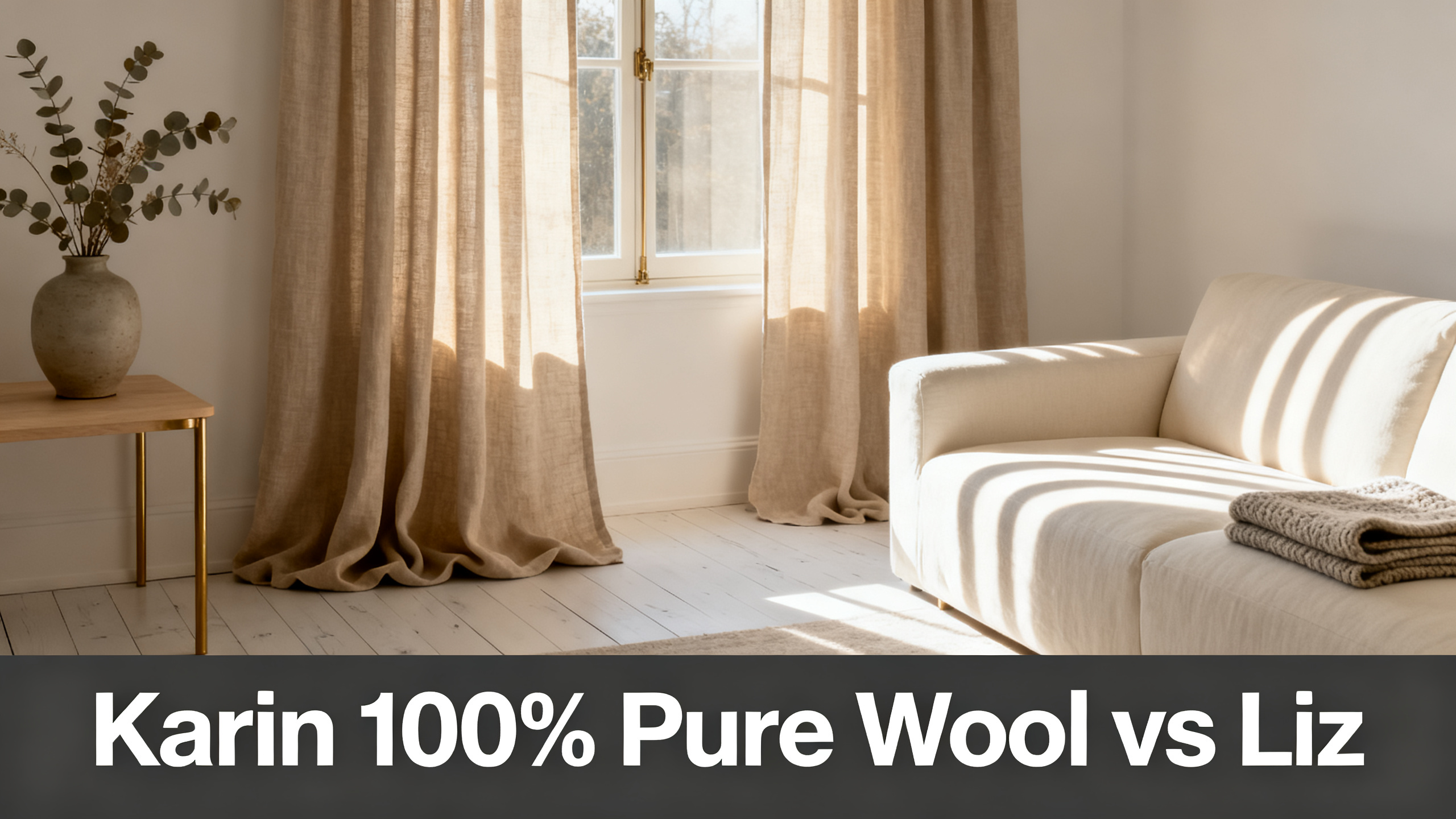
If a room needs a natural fiber that regulates its own temperature and reads like a sustainability brief on the floor, the answer is Karin Pure Wool Curtain Pleated. If the brief is a tailored designer drape at half the panel cost with a 38-colorway palette, the answer is Liz Linen Drape Pleated. The two collections share a header and a lining catalog, but almost nothing else.
Two Pages catalogs both as heavyweight pleated drapery, and both ship through the same configurator. What splits them is fiber, not finish. Karin is 100% wool, 268 gsm, from $119/panel. Liz is 10% Linen / 90% Polyester, 350 gsm, from $59.99/panel, OEKO-TEX Standard 100, and a 2025 ASID Fall Design Product Guide listee. This comparison walks the decision through three scenarios: when Karin wins, when Liz wins, and when neither is the right answer.

Natural fiber heavyweight
Karin Pure Wool Curtain Pleated
100% Wool, 268 gsm. 10 colorways, biodegradable, inherent flame resistance, thermal regulating.
from $119/panel · Final price depends on size, header & lining · code JULY 20% off · Free shipping over $300

Designer-approved blend
Liz Linen Drape Pleated
10% Linen / 90% Polyester, 350 gsm. OEKO-TEX, anti-wrinkle, memory-trainable. ASID 2025 Fall Design Product Guide.
from $59.99/panel · Final price depends on size, header & lining · code JULY 20% off · Free shipping over $300


Real customer installs
Real rooms photographed by verified Two Pages buyers
Verified
When Karin Pure Wool wins
Natural fiber sourcing without compromise
Karin sits inside the full natural fiber curtain landscape Two Pages catalogs, and it is one of the only entries that is 100% wool rather than a blend. The spec sheet lists no polyester core, no synthetic backing, no PFAS coating. The fiber is dyed and woven into the panel, the panel is hemmed, and that is the entire stack until a buyer adds an optional lining at checkout.
That matters in two distinct buyer briefs. Sustainability sourcing rules that require a single declared fiber (commercial trade jobs, eco-design retainers, allergy-sensitive households) pass on Liz the moment the 90% polyester body appears in the spec sheet. Karin clears the same rule by definition. The second brief is the home owner who wants a natural fiber for its own sake, not as a marketing claim, and is willing to read a wool dry-clean tag without flinching.
Thermal regulation, sound and humidity by fiber structure
Wool is a natural insulator. The crimped fiber traps air in the panel and slows heat exchange between the room and the cold air pocket behind the curtain. The same crimp absorbs mid-frequency sound, which is why the wool collection reads as visibly calmer in rooms with hard floors and tall ceilings. The fiber also regulates humidity, taking on and releasing moisture without the panel feeling damp.
The Two Pages product copy describes this as “warm in winter, cool in summer, promoting energy efficiency”, which sounds like marketing until the math is checked against the fiber. At 268 gsm Heavyweight, Karin lands lower on the GSM scale than Liz’s 350 gsm, but the thermal performance comes from fiber structure rather than mass alone. Liz dampens cold by raw thickness, which works, but the wool panel works differently and works first.
🌿 The hand, side by side
Karin, 268 gsm pure wool
Falls in soft natural columns, slight nap from the brushed surface. Hand reads warm and slightly weighty, holds humidity in the fiber, refuses to take a permanent pleat.
Liz, 350 gsm linen blend
Falls in tailored columnar pleats, the polyester core holds the shape between washes. Hand reads crisp slub, anti-wrinkle, dry to the touch.
Inherent flame resistance and the biodegradability question
Wool resists ignition by structure: the keratin protein chars rather than melts, and the flame self-extinguishes once the heat source is removed. That property is “inherent”, meaning it cannot be washed out or worn off the panel the way a chemical flame-retardant coating can. For homes with open fireplaces, candles, or trade jobs near NFPA-adjacent specs, the wool collection lands on the safer side of the catalog without a separate retardant treatment.
Biodegradability is the other half of the sustainability story. Karin’s wool panels return to the soil over decades rather than centuries. The IWTO wool sustainability framework documents the end-of-life math in detail for the commercially-curious. Liz, as a 90% polyester body, does not share that endpoint. For a single-curtain decision, this is a secondary factor, but for a buyer who commissions textiles every few years, it accumulates.
Wool Curtain Buying Guide
Before locking pure wool, the buying guide covers thermal value, care, dye-lot variance and where wool falls short.
The budget tradeoff at $119/panel
Karin starts at $119/panel. Liz starts at $59.99/panel. That is a 2× ratio at the entry point, and the gap stretches further when both are configured at 108-inch drop with a blackout liner. The wool premium is not arbitrary: it pays for raw fiber cost, finer dyeing process, and the slower production cycle a natural fiber demands. But it is a real number that has to clear before the sustainability or thermal argument matters.
Buyers stretching a multi-window budget often find Karin lands on the master bedroom and Liz lands on the living room and guest spaces. The configurator math rewards that split: the natural fiber goes where the buyer feels the thermal and acoustic gain, the blend covers the rest of the house at half the cost per opening.

🌿 If you want the natural fiber
Karin Pure Wool, biodegradable thermal regulating
100% wool, naturally flame-resistant, regulates room temperature year-round. from $119/panel, code JULY for 20% off.
🧮 Thermal & acoustic, qualitative read
Karin 268 gsm pure wool
Liz 350 gsm linen blend
Wool fiber regulates humidity and absorbs mid-frequency sound by structure. A linen blend dampens by mass alone. Add a Blackout liner to either panel to push thermal performance closer.
🎨 Karin Pure Wool, 9 base colorways
White K41-1
Light Khaki K41-2
Light Blue K41-3
Steel K41-4
Moss Green K41-5
Dark Gray K41-6
Stone K41-7
Gray K41-8
Dark Blue K41-9
When Liz Linen Drape wins
The half-price entry to the heavyweight pleated drape
Liz starts at $59.99/panel and stays under $100/panel at a standard 84-inch drop unlined. That price ceiling matters because most homes have more than two windows that need treatment, and the math on six openings at the wool price is what stops the project. Anyone weighing Liz also has to face the difference a polyester-linen blend brings versus a 100% natural fiber, and the answer is not the one a sustainability brief expects.
The 90% polyester body delivers structural properties the natural fiber cannot. Color fastness across dye lots, dimensional stability across washes, and the heat-set memory of the pleated header are all polyester contributions. The 10% linen shows on the face of the weave and gives the panel its slub-textured visual hand. Buyers get the linen read and the polyester resilience in one panel.
Memory-trained pleats and anti-wrinkle service life
The Two Pages product description confirms Liz is built with “carefully finished seams, even stitching, and well-proportioned headers for a polished, durable result”. That description is shorthand for memory training: the pinch pleats are heat-set into the panel during finishing and they hold through wash cycles. Two years in, the panel still drapes the way it did on day one.
Karin cannot do this. The wool product copy is explicit: “100% wool material does not support memory shaping”. The pleats stay soft and natural rather than crisp. For a buyer who reads tailored pleats as the defining visual of a designer-grade drape, that single sentence in the Karin spec settles the decision in Liz’s favor.
Liz Linen Drape Pleated, the standalone review
If Liz is already leading the shortlist, the full review walks through 38 colorways, drape behavior and the ASID listing detail by detail.
ASID 2025, OEKO-TEX and the 38-colorway palette
The Liz collection was included in the ASID 2025 Fall Design Product Guide, which is a design-trade credential rather than a marketing badge. The American Society of Interior Designers selects products that meet specifier-grade requirements for residential and commercial projects. That listing reaches the buyer who needs a curtain that will read correctly to a designer or a stager, not just to the home owner.
The fiber blend is also OEKO-TEX Standard 100 certification, which tests the finished textile for substances harmful to humans. Karin ships without that line in its spec. The wool fiber carries its own biodegradability story, but for a buyer who weighs certifications as a hard requirement, Liz is the one that produces the paperwork. Add to that 38 colorways versus Karin’s 10, and the palette argument follows the same direction.
🎨 If you want the budget and the pedigree
Liz Linen Drape, ASID-listed and memory trainable
350 gsm slub-textured blend, 38 colorways, OEKO-TEX. from $59.99/panel, code JULY for 20% off.
📏 Pricing by configuration, side by side
84″ drop, single panel, unlined
Karin ~$155
Liz ~$79
108″ drop, single panel, unlined
Karin ~$185
Liz ~$99
96″ drop, single panel, blackout lined
Karin ~$225
Liz ~$135
80″ wide × 96″ drop, single panel, unlined
Karin ~$205
Liz ~$119
Estimates before JULY 20% off. Configurator returns final price by exact size, header and lining selected.
Lining stack and the blackout shortcut
Both collections accept the full Two Pages lining range: Unlined, Cotton Light Filtering, Privacy Liner, Light Filtering, Blackout, and Thermal. The shading rates climb from 0% (unlined) to roughly 99% (blackout). The lining is the leverage point that lets either panel solve a bedroom blackout brief without buying a thicker base fabric. For Liz, a blackout-lined configuration is the most common path: it reaches the same shading as a heavier wool panel at a lower total price.
🧵 Lining stack, what it does to each panel
Unlined
Karin keeps its nap visible and breathes. Liz reads slub-textured against daylight.
Privacy Liner (~70%)
Both gain daytime privacy. Karin keeps the wool insulation profile, Liz keeps the trained pleat sharpness.
Light Filtering (~85%)
Mutes both into a soft glow. The right lining for bedroom-but-not-blackout briefs.
Blackout (~99%)
Pushes Karin into a true sustainable blackout option (per Two Pages product copy). Liz reaches the same shading at half the panel cost.
When neither is the answer
Some briefs do not fit Karin and do not fit Liz. The most common is a buyer who needs a 100% natural fiber but cannot stretch to $119/panel. Two Pages catalogs three direct alternatives at lower entry prices: Doris 100% European Flax Linen (170-200 gsm), Erin 100% Linen (335 gsm Heavyweight), and Patti 100% Belgian Flax Linen (248 gsm Heavyweight). All three are linen rather than wool, which means the thermal regulation profile changes, but the natural fiber rule is preserved at a lower price tier.
The second mismatch is the buyer who wants a premium natural fiber, just not wool. Selman 100% Dupioni Silk at 120 gsm Lightweight covers a luxury silk brief. Tavis Velvet at 445 gsm Heavyweight covers a heavier draped look in a polyester velvet that reads couture from across the room. Each of these answers a different question than “wool or linen blend”.
Sustainable Curtains Buying Guide
If neither pure wool nor a polyester-linen blend fits the brief, the sustainable guide ranks OEKO-TEX, European Flax and GOTS-certified alternatives.
The third mismatch is the buyer who actually wants a sheer (Flynn, Freya, Florida) or a true blackout (Atlanta Room Divider, Regal Fire Retardant). Pleated drapery is one product class, but it is not the only answer to “we need to dress the windows”. Anyone whose brief is really about light filtering or full room-darkening should step out of the wool versus blend question entirely and look at the right collection from the start.
🪟 Decision flowchart, 3 questions
Q1: Is a 100% natural fiber a hard requirement (sustainability brief, allergy, sourcing policy)?
→ Yes = continue to Q2. → No = Liz Linen Drape Pleated wins on price and color range.
Q2: Is the budget ceiling above $119/panel before lining and size?
→ Yes = continue to Q3. → No = step out to a 100% linen entry (Doris, Erin, Patti) at a lower natural fiber tier.
Q3: Does the room need thermal regulation, acoustic damping or inherent flame resistance?
→ Yes = Karin Pure Wool is the answer. → No = Liz Linen Drape still covers the brief at half the price.
Exit → Karin
Natural fiber, thermal, $119+
Exit → Liz
Designer blend, memory, $59.99+
Pricing, promo codes and how to commit
Configurator math, code JULY and free shipping
Both Karin and Liz price by configuration. The base panel cost ($119 for Karin, $59.99 for Liz) reflects a stock size unlined. Final price climbs with custom width, custom drop, header upgrade, and lining choice. The Two Pages configurator returns the exact number before checkout. Code JULY applies 20% off sitewide and stacks with free shipping over $300, which most full-window orders clear easily once both panels and lining are configured.
🌿 Karin is for buyers who
- Hold a 100% natural fiber sourcing rule and refuse polyester
- Live in a cold or echoey room and want fiber-level thermal regulation
- Read inherent flame resistance and biodegradability as load-bearing specs
- Accept $119+/panel and dry clean care for the fiber tradeoff
🎨 Liz is for buyers who
- Want designer-tailored pleats that hold their shape between washes
- Need a broad palette (38 colorways) for matching existing wall and floor
- Stretch a $60-100/panel budget across multiple windows
- Read OEKO-TEX + ASID listing as the right kind of design credential
Order swatch booklets before the panel order
Photos do not transmit the difference between a brushed wool and a 350 gsm slub blend. The fall of the panel, the way the fiber catches afternoon light, the exact warmth of a dyed natural fiber against the buyer’s wall and floor: none of this survives a phone camera. Two Pages prints booklets for both collections that ship in days and arrive flat for direct in-room comparison.
🧵 Order both booklets before you commit
Pure wool and a 350 gsm linen blend feel nothing alike. A photo cannot tell you which one suits the room.
Two Pages ships printed swatch booklets for both collections. Set them against the wall, the floor and the late-afternoon light before locking a $119 panel order.
🧵 Before you order either panel
Karin colorways shift between dye lots because the wool absorbs dye unevenly by nature. Two Pages confirms this in product copy.
Liz lengths vary by 1 inch due to handcraft cutting. Both points argue for ordering all panels in one batch and pulling printed swatch booklets before the production order.
FAQ
Is Karin Pure Wool actually 100% wool with no synthetic backing?
Yes. The Two Pages product spec lists Karin as 100% Wool, 268 gsm Heavyweight, with no polyester core or synthetic backing in the panel. The fiber is biodegradable and naturally flame-resistant by structure. The only synthetic that enters the panel is the optional lining, which is sold separately and ranges from Unlined to Blackout (~99% shading). Buyers who need a fully natural stack should pair Karin with the Cotton Light Filtering lining to keep the natural fiber chain intact.
Why is Liz called a linen blend if it is 90% polyester?
Two Pages labels Liz as a linen blend because the visible slub texture and hand come from the 10% linen content, the fiber that shows on the face of the weave. The 90% polyester body delivers the structural properties of a heavyweight pleated drape: anti-wrinkle behavior, color fastness, memory-trainable pleats. The blend label is honest, but a buyer with a 100% natural fiber sourcing rule has to step out to Patti Belgian Linen, Erin 100% Linen or Doris European Flax.
Can Karin Pure Wool be machine washed?
Dry cleaning is the safer route. Wool felts and shrinks under agitation and warm water, so the Two Pages product copy recommends professional cleaning to preserve the 268 gsm density and the dimensional stability of the panel. Liz Linen Drape, by contrast, is cold gentle wash compatible thanks to the polyester core. That is one of the practical cost-of-ownership differences between the two collections over a 5 to 10 year horizon.
Does Liz Linen Drape hold its pleats permanently?
Yes. The Two Pages product description confirms Liz is built with carefully finished seams, even stitching, and well-proportioned headers, and the polyester body holds heat-set pleats through wash cycles. Karin Pure Wool is the opposite: the product copy explicitly states that 100% wool material does not support memory shaping, so the pleats stay soft and natural rather than crisp. A buyer who wants the tailored designer look should default to Liz.
Which Two Pages curtain is better for a cold bedroom?
Karin Pure Wool wins on fiber physics. Wool traps air in its crimped fiber structure and regulates humidity between the room and the cavity behind the curtain, which translates into a perceived warmth gain in winter. Liz at 350 gsm dampens cold by mass alone, which is also effective but less efficient. Both panels can be lined with Blackout (~99% shading) to push thermal performance further. For cold rooms with high ceilings or single-pane windows, Karin justifies the price gap.
Are both curtains OEKO-TEX certified?
Only Liz is explicitly OEKO-TEX Standard 100 certified in the Two Pages product description. Karin Pure Wool ships without an OEKO-TEX line in its spec sheet, although the biodegradable wool fiber carries its own sustainability story. Buyers who weigh certifications as a hard requirement should request the latest certification documentation from the Two Pages trade team before locking the order.
Final verdict
Karin Pure Wool and Liz Linen Drape Pleated answer two different briefs at two different price points. Karin is the right call when a 100% natural fiber, thermal regulation, inherent flame resistance and biodegradability are load-bearing requirements, and the budget clears $119/panel before lining. Liz is the right call when tailored memory-trained pleats, a 38-colorway palette, OEKO-TEX certification and an ASID 2025 design credential matter more, and the budget needs to land at $59.99/panel. Both ship through the same configurator with code JULY 20% off and free shipping over $300.
Verdict for natural fiber rooms
Karin Pure Wool Curtain Pleated
Choose Karin when the brief is a natural-fiber-only sourcing, a cold or echoey room, or a sustainability narrative.
Verdict for designer-tailored rooms
Liz Linen Drape Pleated
Choose Liz when the budget is half, the room needs trained pleats and 38 colorways open the palette.
