
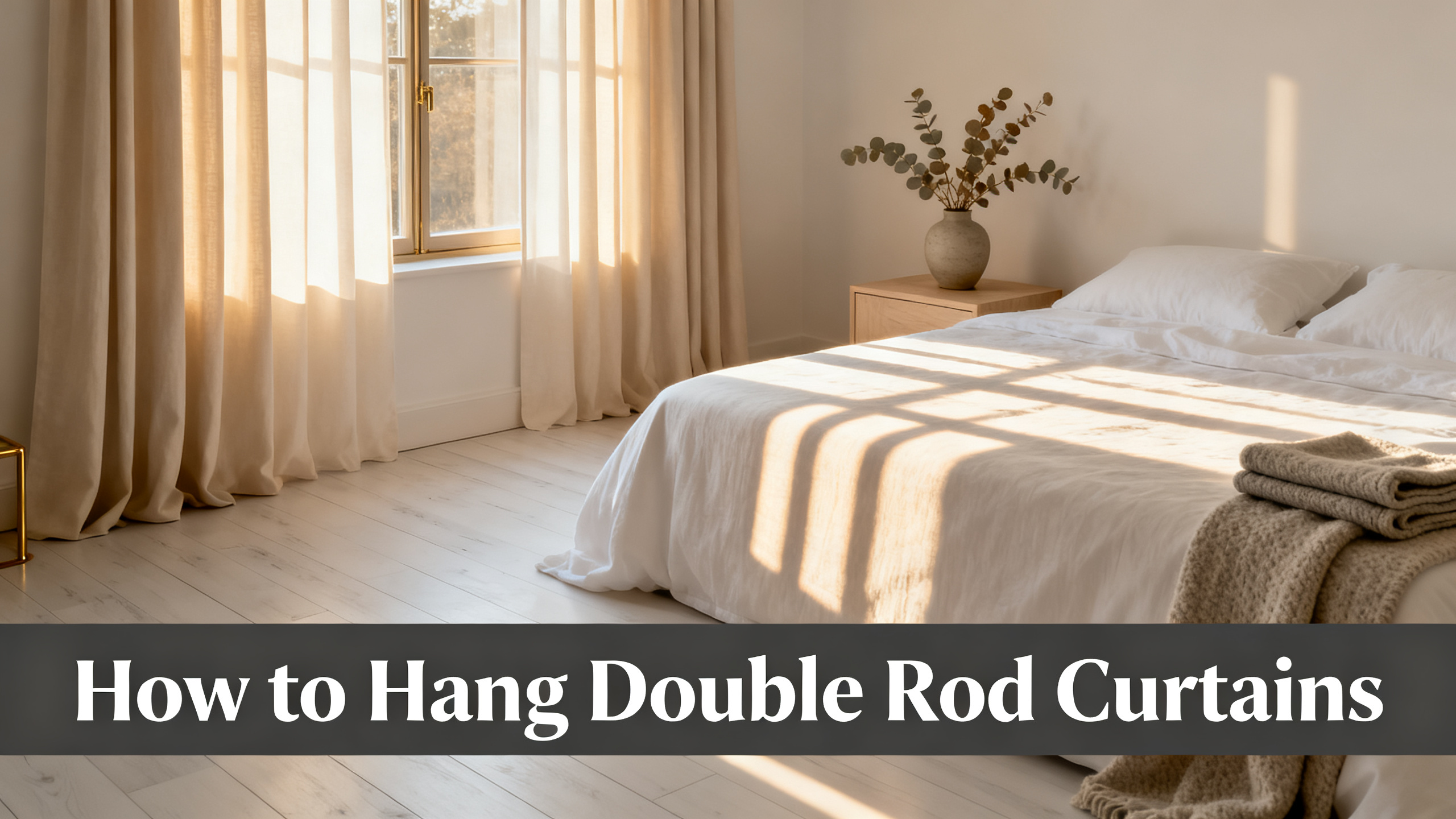
A standard double rod bracket install runs 40 to 60 minutes if the wall is drywall and a stud lands where the bracket sits. Longer if it does not, longer again if the trim is deeper than the bracket clears, and much longer if you skip the projection math and drill the pilot holes at the wrong height. This guide covers the toolset, the math, and the six steps in the order a working installer runs them.
Two Pages does not sell the double rod bracket itself (that is Amazon territory), but everything that hangs on the two rods afterward is the reason to get the install right the first time. For the wider set of hang, measure, and install pieces across every curtain type in the house, the complete curtain install hub keeps every guide one click away.
🔧 Tools & prep for a double rod install
🪛
Cordless drill
18V minimum for masonry, any grade for drywall.
📏
Tape + level
Long bubble level or laser line for the mounting mark.
🧲
Stud finder
Magnetic works; electronic reads deeper through plaster.
🔩
Anchors + bits
3/16 in drywall, 1/2 in toggle bolt, masonry bit for brick.
📐
Double rod bracket kit
Front + rear rods, wall plates, set screws included.
✏️
Pencil + safety glasses
Mark once, drill once. Dust from drywall is fine, from plaster is not.
Time estimate: 45 minutes on drywall with stud alignment. Add 15 minutes for toggle bolts, add 30 for plaster or masonry.

The drape for the outer rod
Liz Linen Drape Pleated
from $59.99/panel · 90% polyester / 10% linen · 350 gsm heavyweight · pinch pleat header (matches Flynn sheer for a clean double hang) · 38 colors · custom drop to 130 inches · OEKO-TEX certified. Final price depends on size and lining.
Use code JULY for 20% off · Free shipping over $300
Before You Drill: Wall Projection and Trim Depth Math
Sounds obvious. It is not: the projection math rules out the wrong bracket in 30 seconds, and skipping it is how a $40 hardware buy turns into a return and a redrill. A double rod carries the drape rod 2 inches farther from the wall than the sheer rod, and the outer rod projection has to clear both the trim depth and the drape header thickness.
The The Spruce double rod comparison confirms standard consumer-grade double brackets project the inner rod 3 to 4 inches off the wall and the outer rod 5.5 to 6 inches. If your trim casing depth exceeds 3 inches, the rear arm binds against the trim and the bracket rocks. That is a two-separate-rods problem, not a double bracket problem.
🧮 Wall projection math for a double rod
Inner rod (sheer)
3-4 in
Projection from wall face. Sits closest to glass.
Outer rod (drape)
5.5-6 in
Projection from wall face. Clears the sheer swing.
Gap between rods
2 in
Standard bracket spec. Enough for a 350 gsm drape to swing without brushing the sheer.
Trim depth threshold
3 in
Above this, most consumer-grade double brackets bind. Go two separate rods instead.
Measure trim depth with a tape from the wall face to the outer casing edge before ordering hardware.
⚠️ Trim depth trap: If your trim depth exceeds 3 inches, most standard double brackets will bind against the casing. Measure with a tape from wall face to outer casing edge before you order the bracket. Ordering the panels first and the bracket second is how you find out too late.
The 6-Step Install (At a Glance)
Two things to know before we go step by step. Each step below expands into its own H2 with the prose, the anchor selection, and the level pass called out. If you want the scannable version, this is it.
🪟 The double rod install in 6 steps
1
Mark the mounting line
4-6 in above trim. Level end to end.
2
Locate the studs
Stud finder pass, plan anchors if none aligned.
3
Drill pilot holes
Bit matches anchor spec, not screw diameter.
4
Anchor the brackets
Rated for 2x single-rod load. Toggle bolts on drywall spans.
5
Mount both rods
Front rod outer, rear rod inner. Set screws snug.
6
Dress the two panels
Sheer first on inner, drape second on outer.
Step 1: Mark the Mounting Line
The standard mounting height is 4 to 6 inches above the top of the window trim, matching a single-rod install. If the ceiling is 9 feet or higher, mount closer to the ceiling to elongate the window visually. If the drape is planned as a puddle, add the extra inches to the panel drop rather than raising the rod.
Mark the outer bracket point with a pencil dot at your chosen height, then measure across to the opposite side and mark the second point at the same height. A long bubble level or a laser line across both marks confirms the line is true. If your marks drift by even a quarter inch, the eye will read the finished hemline as off.
How to Measure for Curtains: The Complete Guide
Width, drop, and mounting-height math on a single worksheet, including the extra drop the inner rod adds when its bracket sits half an inch below the outer.
📐 Mounting height by ceiling
8 ft ceiling
4 in above trim
Standard call. Keeps the visual break under the crown line.
9 ft ceiling
6-8 in above
Push higher to elongate the window read.
10 ft plus
Close to ceiling
2-4 in below the ceiling line. Custom drop required.
Step 2: Locate the Studs (Or Plan for Anchors)
Pass the stud finder along the mounting line at each bracket point. Mark stud centers with a pencil where they land. If a stud sits inside a two-inch window of either bracket point, you can drive a wood screw directly into it and skip a wall anchor. If no stud lands where the bracket sits, plan for an anchor sized to the wall type.
The double rod carries roughly 2x the load of a single rod (two panels of fabric instead of one), which changes the anchor calculation. What holds a single sheer on drywall will fail under two custom-drop panels within months. Anchor grade matters more here than it does on a single install.
⚠️ No shortcut on this one: Never assume drywall alone will hold a double rod loaded with heavy drapes. The load doubles vs a single rod and standard plastic drywall anchors will pull out within weeks under a 350 gsm panel pair. Use toggle bolts, self-drilling zinc anchors, or hit a stud.
Step 3: Drill Pilot Holes
The drill bit matches the anchor packaging spec, not the screw diameter. 3/16 inch for standard plastic drywall anchors, 1/2 inch for toggle bolts (the standard size), a masonry bit sized to anchor spec for brick or concrete. Drilling too small stresses the anchor into the wall material and cracks it. Drilling too large leaves the anchor loose and useless.
How to Hang Curtain Rods (Complete Guide)
The single-rod fundamentals that transfer directly to a double bracket, with anchor selection by wall type and stud alignment methods.
Before you commit to the drill, hold the bracket plate against the mark and re-check the level. A quarter-inch drift at this stage compounds to a visible tilt when both panels hang at their full drop. Correct now, not after.
Step 4: Anchor the Brackets to the Wall
Drive the anchors flush with the wall face. For toggle bolts, feed the bolt through the bracket plate first, then thread the toggle onto the bolt, then push through the pilot hole and let the toggle spring open behind the drywall. Seat the bracket plate against the wall, tighten the bolt until the bracket sits snug without deforming the drywall face. The This Old House drywall anchor reference is the standard write-up on load ratings by anchor type if you want the deeper math.
Real talk on drywall: the double rod bracket rating on a standard steel double is 15 to 25 pounds per bracket pair, which handles two mid-weight panels comfortably. But if you are pairing a jacquard sheer with a 350 gsm blackout-lined drape, you are at the edge of the rating and worth stepping up to a heavier bracket. The heavy-drape rod comparison covers the upgrade options.
| Wall type | Anchor | Drill bit | Load rating |
|---|---|---|---|
| Drywall (into stud) | Wood screw, no anchor | 1/8 in pilot | Full bracket rating |
| Drywall (no stud) | Toggle bolt or self-drill zinc | 1/2 in (toggle) or none (self-drill) | 30-50 lb per anchor |
| Plaster over lath | Toggle bolt through lath | 1/2 in slow-speed | 40-60 lb per anchor |
| Brick or masonry | Sleeve or wedge anchor | Masonry bit per spec | 75+ lb per anchor |
| Concrete | Concrete screw (Tapcon) | 3/16 in masonry | 100+ lb per anchor |
⚖️ Load rating for a double rod pair
Bracket pair rating
15-25 lb
Standard steel double, per pair. Roughly 2x single rod.
Drape panel (350 gsm)
4-6 lb
100 in drop, custom width. Times 2 for a pair.
Sheer panel (90 gsm)
1-2 lb
Airy weight. Times 2 for a pair on the inner rod.
Total combined load for a two-panel drape + two-panel sheer install: 10 to 16 lb. Well under bracket rating for standard weights, at the edge for blackout-lined heavy drape pairs.
Step 5: Mount Both Rods on the Bracket
The front rod is the outer rod (drape). The rear rod is the inner rod (sheer). Slide each rod through its bracket seat on both wall brackets, tighten the set screws snug. Do not overtighten: the set screw is holding position, not clamping a load, and stripping it means replacing the bracket.
Verify both rods sit level end to end after the set screws are snug. A dip at one end usually means the bracket plate on that side was not fully seated against the wall. Loosen the wall bracket screw a quarter turn, adjust plate against wall, retighten. Better to fix now than after two panels are hanging.
🔩 Double rod bracket anatomy
Wall plate
Anchors to the wall via 2 screws. Bears the full combined load.
Bracket arm
Extends from wall plate. Holds both rod seats at staggered projection.
Front rod seat
Outer, at 5.5-6 in projection. Drape rides here.
Rear rod seat
Inner, at 3-4 in projection. Sheer rides here.
Set screws
Lock each rod against rotation. Snug, do not overtighten.
Finials
Cap the rod ends, prevent rings sliding off. Front rod only on most kits.

The sheer for the inner rod
Flynn Airy Lightweight Sheer Pleated
from $49/panel · 100% polyester · 90 gsm airy sheer · same pinch pleat header as Liz Linen for a matched double hang · custom drop to 120 inches · sits on the inner rod against the glass.
Code JULY 20% off · Lead time 10 to 12 days · pair with the drape above
Step 6: Dress the Two Panels
Picture the moment the rod is level and both panels hang clean. The order matters: hang the sheer on the inner rod first. The sheer disappears behind the drape once both are up, and any correction on wrinkles or hook spacing is easier to make while the outer rod is still bare. Load the sheer through pinch pleat hooks or clip rings, distribute the pleats evenly, then step back and check the fall against the floor.
How to Double Hang Curtains (Layering Playbook)
Sheer and drape layering formulas by room type once the rod hardware is up: which weights pair, which headers match, which colorways read intentional.
Hang the drape on the outer rod second. If the drape header type matches the sheer (pinch pleat with pinch pleat is the standard call), align the pleat tops on both rods so the eye reads a single unified top line rather than two staggered ones. The Liz Linen product page lists header options and drop specs to match against your Flynn Sheer order.
Pro Tips from Installers
Four practices that separate a clean install from one that reads sloppy after a week. None of them add real time to the job, but skipping them creates the small tells that make a double hang look amateur.
🧵 Steam both panels on the rod after 48 hours. Fabric relaxes into the pleat shape you set in the first two days. Those two days matter more than the next two years, so it is worth doing a warm steam pass once the panels have hung under their own weight.
📏 Order both panels at custom drop from the same brand. Ready-made lengths from mismatched brands leave a 1-inch gap between hemlines. The eye reads that gap as sloppy install, even when the rod is perfectly level and the wall anchors are dead-on.
🔩 Snug the bracket set screws once, verify the rods are level, then walk away for 24 hours before final tightening. Wall anchors settle slightly under the initial load. Coming back the next day to add a quarter turn on each set screw locks the install for the long haul.
🎨 Sample the drape color against wall paint before ordering. On a double rod, the drape sits 5.5 inches off the wall and reads more saturated than a swatch flat against paint. Order the swatch booklet, hold it at rod distance, then commit to the color. Flynn Sheer inline order (Flynn Sheer config) locks after the color decision, not before.
The Rod Is Up: Order the Two Panels That Hang on It
Coming back to the original question. The double rod bracket is the install; the two panels are the reason for it. A standard combined order runs a 350 gsm Liz Linen Drape Pleated on the outer rod (Liz Linen config) and a 90 gsm Flynn Airy Sheer Pleated on the inner rod, both in matched pinch pleat header.
Cart simulation on the Two Pages configurator returns roughly $240 per window for a standard 50 in wide × 84 in drop pair (drape + sheer, unlined, unpleat-matched), before the JULY 20% discount. Larger windows scale linearly with width; blackout lining on the drape adds roughly $40 per panel.
💰 Pricing by configuration (per window pair)
Standard 50 × 84
~$240
1 Liz drape (unlined) + 1 Flynn sheer, pinch pleat matched. Before JULY.
Custom 100 × 108
~$420
Wider window, 2 pairs. Add blackout lining on drape for +$80.
Blackout lining upgrade
+$40/panel
Drape only. Sheer stays unlined by design.
JULY 20% off
−$48 to $84
Applies sitewide. Free shipping over $300.
Order the 38-Color Liz Linen Booklet
A double rod install commits you to two custom-drop panels. Before you drill the bracket, sample the drape color against your wall paint and floor. Booklet ships flat for $3.99.
The Rod Is Up. Now Order the Two Panels That Hang on It.
Liz Linen Drape Pleated ships made-to-order at your exact width and drop, up to 130 inches. Pinch pleat header matches Flynn Airy Sheer on the inner rod for a clean double hang. from $59.99/panel, 38 colors, 350 gsm heavyweight. Code JULY (20% off) · Free shipping over $300 · lead time 10 to 12 days.
Frequently Asked Questions
How far apart should double curtain rods be?
Standard double rod brackets space the two rods 2 inches apart in projection, meaning the outer rod sits 2 inches farther from the wall than the inner. Vertically, both rod centers align on the same horizontal line. The inner rod sits at 3 to 4 inches wall projection, the outer at 5.5 to 6 inches, and the 2-inch gap gives a 350 gsm drape enough swing to never brush the sheer.
How much weight can a double curtain rod hold?
Standard steel double rod brackets are rated for 15 to 25 pounds per bracket pair, roughly double the load of a single rod. Two panels of 90% polyester / 10% linen at 350 gsm on a 100-inch drop weigh 4 to 6 pounds per panel, so a two-panel drape layer plus a 90 gsm sheer layer stays well within rating. Confirm the specific bracket spec on its packaging or the manufacturer page.
How do you install a double curtain rod on drywall?
Use toggle bolts or heavy-duty drywall anchors rated for the combined panel weight if no stud is centered where the bracket lands. Drill a 1/2 inch pilot hole for toggle bolts, insert the anchor, seat the bracket plate flush against the wall, then drive the screw through the bracket into the anchor. Never rely on standard plastic drywall anchors alone for a double rod on drywall.
How high should a double curtain rod be mounted?
The standard is 4 to 6 inches above the top of the window trim, matching a single rod install. If the ceiling is 9 feet or higher, mount closer to the ceiling for a taller-window illusion. If the drape is planned as a puddle, add an extra 8 to 10 inches to the drop rather than raising the rod.
Can you hang double curtains without a double rod?
Yes, using the two-separate-rods approach: mount the sheer rod flush against or inside the window frame, and mount the drape rod 4 to 6 inches above and around the trim. This works when the trim depth exceeds 3 inches and a standard double bracket cannot clear the trim, and it also works for renters using tension rods for the sheer.
What size drill bit for a double curtain rod?
It depends on the anchor. 3/16 inch for standard plastic drywall anchors, 1/2 inch for toggle bolts (the largest common size), and a masonry bit sized to the anchor spec for brick or concrete walls. Always match the drill bit to the anchor packaging spec, not to the screw diameter.
What curtains work best on a double rod?
The best pairing is a 90 to 100 gsm lightweight sheer on the inner rod (Flynn Airy Sheer or equivalent) with a 150 to 350 gsm mid-to-heavyweight drape on the outer (Liz Linen Drape Pleated at 350 gsm or a lighter alternative). Both panels should share the same header type (pinch pleat matches pinch pleat) so the pleat tops align across the two rods.
