
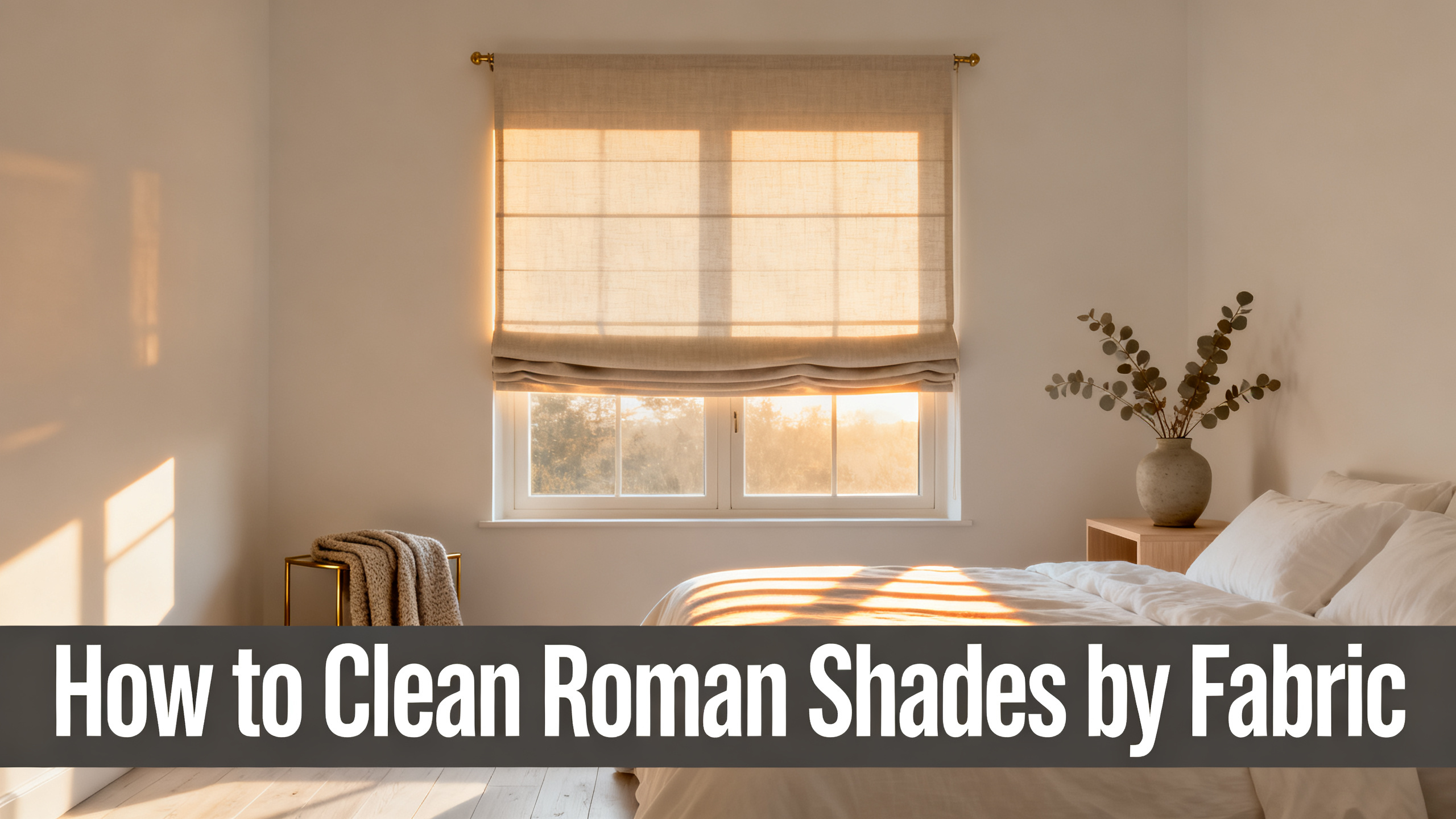
Most owners clean roman shades the way they clean curtains: bundle the panel, throw it in the washer on delicate, hang to dry. The dowels bow, the ring tape frays, the cordless spring loses tension, and the shade never hangs straight again.
Roman shades are a mechanism wrapped in fabric, not a fabric panel. Six fibers show up on U.S. roman shades (linen, cotton, wool, silk, polyester blend, bamboo), each with its own cleaning tolerance, and the lift system underneath has its own water-exposure risk. This guide walks through the 5-step process that works across all of them without wrecking any, and hands off to the full curtain care hub for fabric-by-fabric protocols beyond roman shades.
Tools & Supplies Checklist
🪣 Tools
- Lambswool duster with extension pole
- Vacuum with upholstery attachment
- Soft-bristle brush (natural bristle)
- White microfiber cloths (dye-free)
- Spray bottle
- Handheld garment steamer
- Clean cotton sheet for flat drying
🧵 Cleaning agents
- Clear (dye-free) dish soap
- Cold fresh water
- Distilled water (silk only)
- Dry cleaning sponge (wool)
- No chlorine bleach, ever
- No perc-based dry cleaner

The shade this guide is built around
Liz Linen Roman Shade Cordless
from $59.99/shade · 90% polyester 10% linen blend · 90 gsm · 22 colorways · cordless mechanism · inside or outside mount. Final price depends on size and lift system.
Use code JULY for 20% off · Free shipping over $300
The 5 Steps at a Glance
01
Identify
Fabric type + lift system dictate everything.
02
Dust weekly
90% of the work happens dry.
03
Spot-treat
Solvent choice is fabric-driven, not stain-driven.
04
Deep clean
In place, or demount flat if it soaked to the lining.
05
Dry & reset
Flat-dry, re-hang, steam vertically. No iron.
Step 1: Identify the Fabric and Lift System
Six fabrics common on U.S. roman shades
The fabric on the front tells you the water tolerance, the chemical tolerance, and the drying method. Linen and its blends (like the 90% polyester 10% linen weave on the Liz Linen and the Belgian linen on the Patti) sit at the sensitive end: cold water only, blotting motion, no submersion. Wool (Karin) sits at the most restrictive end: no wet cleaning at all beyond a targeted dry sponge.
Cotton (Isabella, Jana, Kate Frost) sits in the middle: cold water is fine, warm water is not, and rubbing is what causes the visible ring around a spot after it dries. Polyester and synthetic blends handle up to 30°C and a mild detergent without complaint. Silk shades are rare and treated separately, and bamboo woven wood is a different protocol entirely.
Cord lift vs cordless vs motorized: three failure modes
The mechanism underneath decides how the shade can be cleaned. A corded lift has a lift-cord channel through the fabric and a set of pulleys in the headrail: water dripping into the headrail rusts the metal internals and warps the wood spacers on non-alu headrails.
Cordless shades (the Liz, Patti, and Karin cordless models) house a coil spring that provides the lift tension. That spring is housed in the headrail, sealed but not waterproof. One immersion cycle is enough to loosen the tension permanently. Motorized shades add a lithium battery pack and a control board that fails silently when moisture reaches the circuit.
Liz Linen Window Roman Shades: Full Review
The 90 gsm polyester-linen blend behind most Two Pages roman shades. The full review breaks down the ring tape spacing, dowel count, and headrail materials that dictate what cleaning method is safe.
Reading the care tag beyond the ISO symbols
Care tags on custom roman shades often show generic ISO symbols that assume you can detach the fabric. On a Two Pages shade, you can’t: the ring tape, dowels, and header are sewn into the panel. Read the ISO symbols as guidance, then default to the fabric protocol below regardless of what the machine wash symbol says.
Two industry references cover the color and fiber behavior in more depth. The AATCC colorfastness test methods document how each fiber holds dye under wet agitation, and The Spruce fabric shade cleaning guide cross-references care instructions across major shade brands.
| Fabric | Lift system common | Dowel count (60″ drop) | Cleaning tolerance |
|---|---|---|---|
| Linen / linen blend (Liz, Patti) | Cordless or cord lift | 5 to 6 | Cold water blot only |
| Cotton (Isabella, Jana) | Cord lift or cordless | 6 | Cold water, no rubbing |
| Wool (Karin) | Cordless | 5 | Dry sponge only |
| Silk | Cord lift (rare) | N/A | Professional only |
| Polyester blend (Cloe) | Cord lift or cordless | 6 | Warm to 30°C, blot |
| Bamboo / woven wood (Sybil, Jawara) | Cordless | N/A (slat structure) | Dry brush only |
⚠️ Warning. Never treat a roman shade like a drapery panel. The dowels, ring tape, and headrail interior turn machine wash into mechanism death. There is no gentle cycle that a coil spring survives.
Step 2: Dust and Vacuum Weekly (The 90 Percent Rule)
Why dry maintenance handles 90 percent of the work
Owner feedback on Two Pages Trustpilot is consistent on this point: shades that get dusted weekly rarely need a deep clean. Airborne dust, dead skin cells, cooking particulates, and pollen bond to the fabric surface within days and turn matte after three months.
Reverse that with a weekly dry pass, and the fabric holds its tone for years. 90% of the cleaning burden disappears if you never let the surface film build up in the first place.
Lambswool duster technique top-to-bottom
A lambswool duster on an extension pole is the correct tool. Start at the top of the shade, work down in long strokes on the same side (front, then sides, then bottom hem). The lanolin in lambswool grabs dust electrostatically without pressing it into the weave.
Vacuum upholstery attachment on low suction
Every 2 to 4 weeks (depending on room), swap the duster for a vacuum with the upholstery attachment on the lowest suction setting. Move slowly across each visible fold and along the back ring tape, one pass per surface. The vacuum picks up what the duster left behind, especially in the fold creases where lambswool doesn’t reach.
Cleaning Frequency by Season
SPRING
Quick dust
Pollen peak, weekly lambswool pass.
SUMMER
Monthly vacuum
Open windows drive more dust in, add vacuum pass.
FALL
Quarterly spot
Check for kitchen grease film and pet dander compression.
WINTER
Annual deep
Heating dust and low humidity, plan the full protocol.
Frequency tracks room exposure. Bedroom shaded windows: once a month. Kitchen shades: weekly, because cooking grease bonds fast and gets harder every week you skip. Living-room shades with pets: twice a month. Bathroom shades: twice a month to intercept condensation-bound dust.
⚠️ Warning. Vacuuming with the beater bar engaged snags the ring tape and pulls stitches. Upholstery attachment on low suction only. If your vacuum has no such attachment, use the duster and skip the vacuum step.
Step 3: Spot-Treat by Fabric
Water and solvent choice is fabric-driven, not stain-driven. The same coffee ring on a linen shade calls for cold water and a blot; on a wool shade it calls for a dry sponge and patience; on a bamboo slat it calls for nothing wet at all. Match the protocol to the fiber, then to the stain.
Fabric-Specific Cleaning Matrix
Linen and linen blend (Liz, Patti)
Cold water below 25°C, one part clear dish soap to twenty parts water, applied with a white microfiber cloth and blotted from outside the stain inward. Never rub. Linen fibers swell fast in warm water and shrink 3 to 5 percent as they dry, which pulls the shade out of square permanently.
The Liz Linen at 90 gsm and the Patti Belgian Linen at similar weight both sit at the sensitive end of this category. Test on a hem corner first for 15 minutes, then work in short blot passes on the visible stain. The full linen curtain protocol below covers pre-wash prep, water temperature ceilings, and re-hanging without setting new wrinkles.
How to Clean Linen Curtains: Full Fabric Protocol
Roman shade linen cleaning shares 80% of the process with linen drapery. The full linen protocol covers pre-wash prep, water temperature, and re-hanging without wrinkling.
Cotton and cotton blend (Isabella, Jana, Kate Frost)
Cotton behaves similarly to linen but with a slightly higher water tolerance (up to 30°C) and a higher risk of visible watermark rings if you rub. The rule is blot to dab, never scrub. White microfiber only, because printed or dyed cloths can transfer color into wet cotton.
Picture the moment you spot a coffee ring on the ivory shade and reach for a wet cloth. The instinct is to press and rub the mark out. On cotton that motion sets the tannin deeper, and the water ring is now visible at the edge of your blot. Blot inward, wait 60 seconds, blot again with a dry corner of the cloth.

When Cotton Cleaning Goes Wrong: The Isabella Test Case
from $79.99/shade · heavyweight cotton blend · blackout-ready · cordless. Isabella is the cotton roman shade Two Pages designers cite when explaining why cotton needs colder water and no rubbing. If your cotton shade is past step 3 cleaning, replacing one panel costs less than re-doing the room.
Wool (Karin)
Wool is the shade fabric that punishes agitation harder than any other. Wool fibers felt when they get wet and rubbed, and felting is irreversible. Dry sponge only on the majority of the shade, and if a spot demands water, use a 3:1 ratio of water to clear dish soap on a cotton pad, press it against the spot for 30 seconds, then blot with a dry pad.
Real talk: dry clean only on a wool shade tag is not a suggestion, it is the only path that keeps the ring tape intact. The Karin Pure Wool Roman Shade Cordless (from $129.99/shade) is 100% wool and is the reference Two Pages product for this category.
Silk (rare in shade format)
Silk shades exist but are uncommon: Two Pages does not offer silk in roman shade format (the Selman Dupioni silk line is drapery only). If a silk shade is present in the home, dry-brush only, no water at all, and hand it to a professional textile cleaner for any real stain. Home spot-treatment on silk is a coin flip.
Polyester and synthetic blends (Liz 90/10, Cloe)
Polyester is the most forgiving shade fiber. Warm water up to 30°C, a mild detergent, and a blot motion handle most stains without incident. AATCC 61 colorfastness ratings usually hold through several spot-treatment cycles.
The Liz Linen at 90% polyester and 10% linen inherits most of the polyester tolerance, which is why it sits at the friendly end of the maintenance spectrum. Cloe cotton blend and similar synthetic blends behave the same way.
Water Temperature Ceiling by Fabric
🌡️ Linen
25°C
🌡️ Cotton
30°C
🌡️ Wool
Dry
🌡️ Silk
Pro
🌡️ Poly blend
30°C
🌡️ Bamboo
Dry
Bamboo and woven wood (Sybil, Jawara wooden headrail)
Bamboo shades are structurally different: horizontal slats bound with cotton yarn, not a fabric panel. No water, no soap, no oil. A soft-bristle brush along the slat direction handles all the routine cleaning, and a dry microfiber wipes down the wooden headrail.
How to Clean Bamboo & Woven Wood Shades
Bamboo shades sit outside the fabric-roman-shade rules entirely. The dedicated protocol covers dry brush cadence, warping risk from moisture, and when to oil the slats.
⚠️ Warning. Water temperature above 30°C shrinks cotton and felts wool. Cold water on 100% of fabric spot-treats, warm water only on tested polyester blends. When in doubt, cold.
Step 4: Deep Clean In Place or Demount Flat
When in-place cleaning is enough
In-place cleaning is enough for roughly 80% of shades. If the stain sits on the front face and hasn’t soaked through, spot-treat while the shade is hanging, work with the shade partially lowered so the fabric is flat and taut, and let the treated area air-dry before raising the shade.
In-Place vs Demounted Cleaning
✅ In place
- Faster (15 to 20 minutes)
- No re-hanging alignment
- Mechanism stays dry by default
- Works for surface stains
✅ Demounted flat
- Reaches lining and dowel channels
- Even drying, no dripping
- Only when stain soaked through
- 60 to 90 minutes total
Demount procedure for cordless and cord-lift shades
Release the headrail from its brackets (most Two Pages headrails snap out with a quarter turn), and for cordless shades release the spring tension first by lifting the shade fully before removing it. Lay the shade flat on a clean cotton sheet on the floor, front face up, and work the spot treatment with the fabric supported flat.
When dry cleaning is appropriate (silk only, hydrocarbon method)
Dry cleaning is a last resort, and even then only for silk. Ask the cleaner for solvent-free hydrocarbon method or DF-2000. Perchloroethylene (perc) causes dye migration into the ring tape and can permanently stain adjacent panels or nearby drapery.
⚠️ Warning. Never dry clean silk or wool roman shades with perc-based solvents. The dye migrates into the ring tape and stains adjacent panels. Hydrocarbon or DF-2000 only, and only when spot-treat has failed.
Lift Mechanism Risk
Corded lift
Keep the headrail bone dry. Water in the pulley housing rusts the metal internals in one season.
Cordless spring
One immersion cycle loosens the coil tension permanently. Never soak, never submerge.
Step 5: Dry, Re-Hang, and Steam Out the Folds
Flat-dry protocol by fabric
Flat-dry 6 to 8 hours on a cotton sheet, away from direct sun on wet linen and cotton, and away from radiators or heat vents. Direct sun on wet fabric fixes any residual soap into visible watermarks. Radiators dry too fast and shrink the fibers unevenly.
Drying Position
🛏️
Flat on sheet
Correct for cotton, linen, wool.
🪟
Hanging in place
Fine for polyester blend after light spot-treat.
🚫
Tumble dry
Never. On any fabric, on any setting.
Re-hang timing and tension check
Re-hang only when the shade is fully dry to the touch on both faces and along the dowel channels. On cordless shades, check the lift tension before securing: raise and lower once, listen for even resistance. Uneven resistance means the spring absorbed moisture and needs another day of drying with the headrail unwrapped.
Handheld steamer method to reset folds
Steam vertically from 6 inches away, in 3-second bursts, moving down the panel from top to bottom. The steam relaxes the fabric fibers just enough to reset the folds without touching them. The handheld steamer method for drapery applies here too, with the caveat that on a shade you never let the steamer head make contact.
Match the Lining Before You Order a Replacement Shade
Fabric ages, dye lots shift, and the original lining behind your shade is rarely the one you’d pick again. The Two Pages Lining Booklet ships 6 lining types flat for $2.99 so you can hold the actual weave against your existing fabric before committing to a new order.
⚠️ Warning. Ironing the fabric while assembled melts the polyester ring tape and warps the dowels. Steam vertically from 6 inches away, never touch the fabric, never iron while assembled.
How Often Should You Actually Clean Each Fabric?
Frequency table by fabric and room
Frequency is a function of fabric plus exposure. A wool shade in a shaded bedroom needs almost nothing (monthly dust, no wet clean ever). A linen shade in a south kitchen needs a weekly dust and quarterly spot-treat. Polyester blends in a living room fall in the middle.


Red flags that force an out-of-schedule clean
Between scheduled cleanings, four signals demand an immediate response: cooking grease film visible in raking light on kitchen shades, pet dander compression that dulls the surface tone, allergen buildup that a duster no longer picks up, and mildew shadowing on bathroom or shaded shades. Any of the four resets the schedule.
Bridge: When Cleaning Is Not Enough
Three indicators that say “replace, not clean”
Cleaning has a ceiling. After Step 4, if the panel still shadows in raking light, still smells musty, or if the ring tape shows visible fraying, the shade has passed the maintenance threshold. Three specific indicators say replace, do not clean:
Dye migration into the ring tape. If the color from the fabric front has bled onto the white ring tape on the back, the fiber has broken down at the dye-bonding level. No cleaner reverses that.
Dowel warp from repeated moisture. Run a hand along each dowel channel from the back. If any dowel feels curved or the fabric no longer sits flat above it, the wood or fiberglass has swelled and dried multiple times. The shade will never hang flat again.
Cordless spring tension loss. If the shade drifts down on its own within an hour of being raised, or if lifting feels asymmetric, the spring is done. Replacement is faster and cheaper than a mechanism repair.
What to check on a replacement shade order
If the fabric is past saving, the wash curtains by fabric type guide walks you through choosing a replacement material that survives more cleaning cycles. Match the color against the existing wall paint and adjacent drapery, order the lining booklet to see how the backing changes the front tone, and use the promo code JULY for 20% off before checking out.
Cleaned and Still Looks Tired? Start Fresh.
90% polyester and 10% linen blend, 90 gsm, 22 colorways, cordless mechanism engineered for 8 to 10 years of daily lifts. from $59.99/shade. Code JULY (20% off) · Free shipping over $300 · in-stock colorways ship in 7 to 10 days.
Frequently Asked Questions
Can you machine wash roman shades?
No. Roman shades are a mechanism wrapped in fabric: dowels running horizontally through sewn channels, ring tape on the back, and a headrail housing either a cord lift or a cordless spring. Machine washing bows the dowels, frays the ring tape stitching, and, on cordless models, saturates the spring housing and permanently reduces lift tension. Every fabric type covered in this guide, including the most forgiving polyester blends, is meant for spot cleaning and dry maintenance only.
How do you clean linen roman shades without shrinking them?
Cold water below 30°C, a 1:20 dilution of clear dish soap, and a blotting motion with a white microfiber cloth. Never rub, never scrub, and never submerge the panel. Linen fibers swell in warm water and shrink 3 to 5 percent as they dry, which pulls the shade out of square. Two Pages Liz Linen shades at 90 gsm are especially sensitive because the poly-linen blend has just enough linen content to shrink, but not enough to relax back into shape.
How often should you dust roman shades?
Frequency tracks room exposure. Bedroom shaded windows: once a month with a lambswool duster. Kitchen shades: once a week. Living-room shades with pets: twice a month with vacuum on upholstery attachment, low suction. Bathroom shades: twice a month to intercept condensation-driven dust bonding. Skipping dusting turns a 15-minute quarterly clean into a 2-hour deep clean.
Can you dry clean roman shades?
Only silk shades benefit from dry cleaning, and only with a professional textile cleaner using hydrocarbon method or DF-2000. Perchloroethylene (perc) causes dye migration into the ring tape and can permanently stain adjacent panels. For linen, cotton, wool, polyester blend, and bamboo shades, dry cleaning is unnecessary at best and destructive at worst.
How do you remove stains from fabric roman shades?
Test first on a hidden hem corner for 15 minutes. If the test area holds color under AATCC 61 conditions (cold water, mild agitation, no bleach), proceed with a fabric-specific spot treatment: cold water and dish soap for linen and cotton, dry sponge for wool, distilled water only for silk, warm water and mild detergent for polyester blends, dry brush only for bamboo. Blot from the outside of the stain inward.
Can you steam roman shades?
Yes, but only vertically from 6 inches away and only after the shade is fully dry. Steam resets the folds without touching the fabric. Never iron a roman shade while assembled: the heat melts the polyester ring tape, warps the dowels, and permanently distorts the fold count. Handheld garment steamers on low setting are the right tool, in short 3-second bursts moving down the panel.
How long do roman shades last with proper cleaning?
Fabric roman shades with weekly dusting, monthly spot inspection, and correct fabric-specific spot cleaning typically last 8 to 10 years. Mechanism life (cordless spring, cord lift, motorized) is the bottleneck, not fabric fading. Two Pages Trustpilot feedback consistently mentions year-seven shades still lifting smoothly when owners avoided machine wash. Poor cleaning cuts lifespan roughly in half.
What is the biggest mistake owners make when cleaning roman shades?
Treating the shade like a drapery panel and immersing it. The dowels, ring tape, and mechanism are engineered to hang dry, not soak. Second worst: vacuuming with the beater bar engaged, which snags ring tape and pulls fold stitching. Third: dry cleaning silk or wool with perc-based solvents, which triggers dye migration. All three mistakes compress a 10-year shade into a 3-year shade.
