
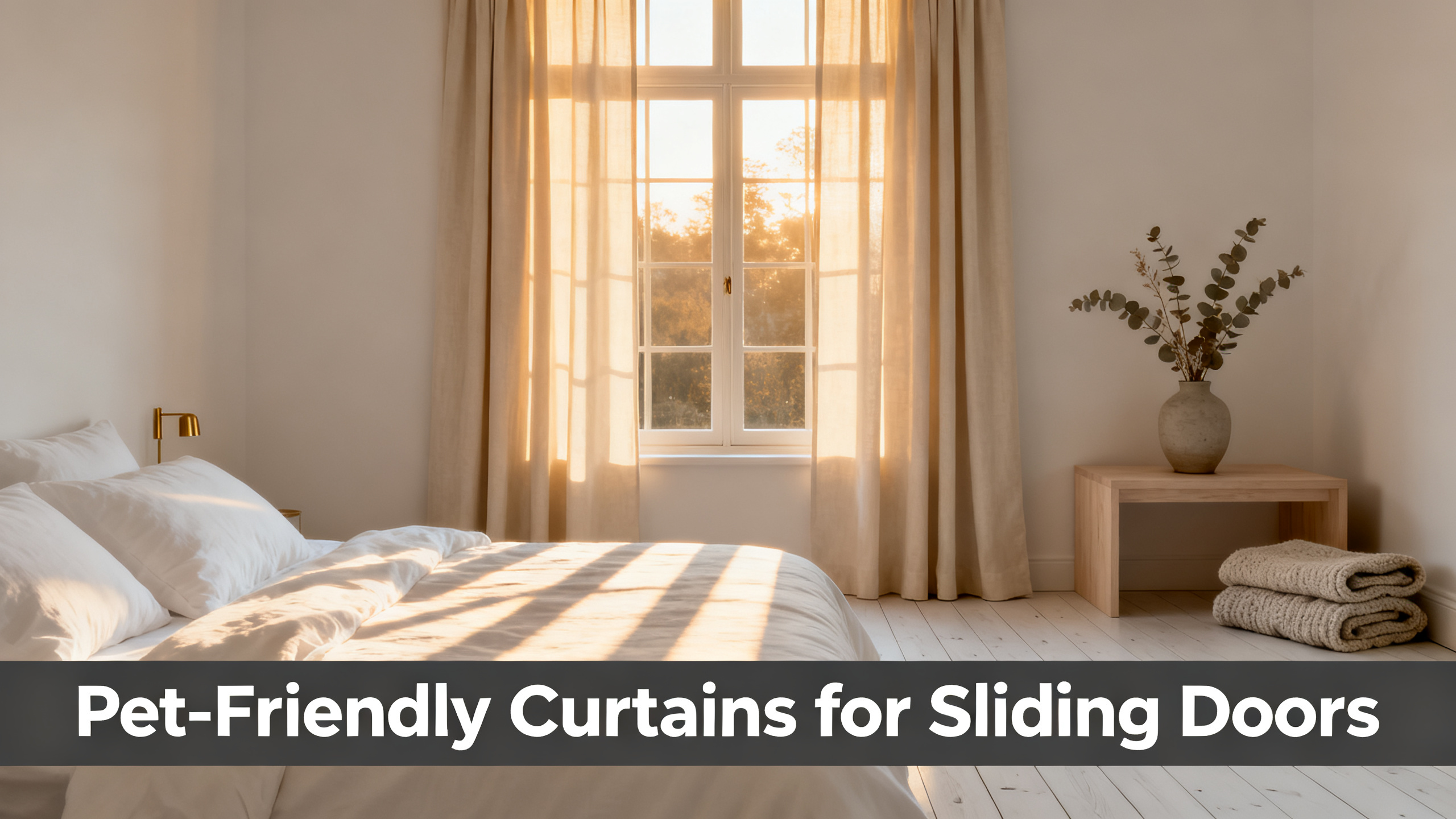
Picture the late afternoon in a house that has a slider onto the yard. The golden retriever is splayed across the warm patch of tile, tail twitching in a dream. The cat is perched on the sliding-door track, watching a squirrel, one paw testing the fabric that hangs beside her. And there is a curtain, a heavyweight sand-colored one, hem stopping 4 inches above the tile, absorbing the fridge hum, holding its pleats after 40 wash cycles, not pilling under the retriever’s shed and not unspooling under the cat’s claws. That is the goal of this guide.
Most curtain articles talk about drape and light and mood. Pet households need one more variable: the fabric has to survive. Below, three household setups mapped to three specific Two Pages panels, with wash-cycle math, colorway logic, and a length rule that keeps the puddle away from the accident zone. Use code JULY for 20% off sitewide if you decide anything is worth ordering.
The Sliding Door Is the Pet Trigger Zone
Here’s the thing nobody says out loud: on a slider, the traffic path, the light exposure, and the accident zone all converge on the same 8 feet of fabric. The dog crosses it 30 times a day. The cat treats the vertical panel as a jungle gym. The toddler drags a juice cup along the hem. That is why a curtain that lives on a bedroom window can retire gracefully at year 8, and the same curtain on a slider is ready for the trash at year 2.
🐾 The Pet Threat Matrix on a Sliding Door
Large-Dog Household
Attack vector: tail sweep, shed embedding, storm panic
Height zone: 26 to 34 inches
Wash cycles / year: ~8
Cat Household
Attack vector: claw catch, panel climb, weave picking
Height zone: full panel, 0 to 96 inches
Wash cycles / year: ~4
Multi-Pet + Young Kids
Attack vector: accident absorption, food stain, wash-cycle abrasion
Height zone: 8 to 14 inches (accident) + full panel
Wash cycles / year: ~14
The scale of the problem is not niche. Per the AVMA pet ownership statistics, roughly 60% of US households live with a dog, cat, or both. Overlay that with the fact that most single-family homes built after 1975 have at least one sliding glass door, and the pet-friendly slider setup is not a niche use case. It is the default that nobody has written a proper guide for.

Anatomy of a Pet-Proof Sliding Door Curtain
The four levers below are pulled straight out of the complete sliding glass door curtain guide, with one added constraint that changes every ranking: the presence of a claw, a paw, or a wagging tail within reach of the fabric. Every choice below flows from that constraint.
Fabric composition: cotton-poly plain weaves outperform pure linen and pure cotton for pets. Polyester adds abrasion resistance, cotton adds softness and dye retention. The 24/76 cotton-poly mix in Isabella Heavyweight is close to the sweet spot for a household where the panel gets touched. Pure linen looks incredible on a north bedroom window and shreds when a cat treats it as scratch surface.
The weave density matters more than the fiber label. A tight plain weave gives a claw nothing to hook. A basket weave or a loose linen offers thousands of tiny loops for a claw to catch and pull, each pull unspooling a yarn. This is the single reason why 500 gsm cotton-poly beats 180 gsm sheer linen at wash cycle 40, even when the linen costs twice as much. The claw physics is unforgiving.
⚠️ Sheers and Voile on Sliders with Pets: Don’t
A 180 gsm sheer linen or a polyester voile looks beautiful on a bedroom window at 6am. On a slider, at cat-height, it is a scratching post that also happens to filter light. Every claw catch pulls one warp yarn. By month three the panel reads as damaged, not designed. Reserve sheers for windows above the pet ceiling.
Real talk on lining: for pet households, skip the sheer inner layer entirely. A single heavyweight panel with an optional cotton flannel liner is cheaper, warmer, and one fewer thing for a claw to test. If blackout is the goal, choose Atlanta with its integrated 99% blackout rather than layering.
A Beige Panel Hides Golden Retriever Shed Better Than a White One.
The 38 Isabella colorways vary in how they read pet hair. Order the swatch booklet, drape three candidates against the floor and wall you actually live with, and eliminate the ones that show dander at 6pm light. Free returns on swatches. from $3.99/booklet.
The claw-resistant hero for pet-heavy sliders
Isabella Heavyweight Cotton Drapery Grommet
from $89.99/panel, 500 gsm heavyweight cotton-poly (24% cotton, 76% polyester), tight plain-weave that resists claw pulls and paw picks, machine-washable cold, tumble low, grommet glides smooth over the sliding-door traffic path, 38 colorways (Paper White, Flax, Beige White, Ivory, Seedpearl and 33 more), custom widths to 100 inches, lengths 84, 96, 102, 108 inches. Final price depends on size and lining.
Use code JULY for 20% off sitewide, free shipping over $300.
Persona #1: Large-Dog Household (50+ lbs, Sheds, Storm-Anxious)
If you live with a labrador, a golden, a shepherd, or any hound in the 50-plus-pound class, the slider carries a specific triad of problems. Tail sweep at 26 to 34 inches means the wear zone is exactly where the panel gathers. Shed embeds in the weave, especially in undercoat-blowing seasons. And when a summer storm rolls in, the dog’s anxiety spikes right when the panel is thinnest at deflecting flash and thunder.
The fabric answer here is a two-tier decision. For daily-use sliders, Isabella grommet at 500 gsm cotton-poly is the pick. It hits the sweet spot: heavy enough to resist shed embedding, tight enough to release it in the wash, and grommet-headed so pacing does not tangle the panel. For sliders over 10 feet wide or households where the dog panics at storms, Atlanta ceiling-track blackout is the second choice. The track eliminates the floor-hem accident zone entirely and the 99% blackout gives the dog a dark space on-demand.
Best Curtains for Sliding Glass Doors 2026
Five picks scored on drape, light control, build and value. The pet-friendly angle here is one constraint, the roundup covers the full slider matrix.
Storm anxiety deserves its own paragraph because a $200 curtain kit can do what a $60 anti-anxiety wrap cannot. Per ASPCA thunderstorm anxiety guidance, a dark enclosed space is a first-line coping tool during storms. A 252 gsm polyester blackout on a ceiling track cuts external flash by 99% and takes 6 to 10 decibels off the mid-frequency rumble. Deploy it before the storm rolls in, not during, and the dog associates the darkened room with calm.
Best Blackout Curtains for Sliding Glass Doors
For thunder-phobic dogs, 99 percent blackout plus sound dampening is the same setup a vet behaviorist recommends. The blackout roundup ranks 5 sliders on shading rate and coverage.
The Two Pages match for storm-anxious large-dog households: Atlanta Room Divider Blackout with Ceiling Track Kit. Complete flush-mount aluminum track, roller hooks, end caps, six size classes from 3 to 18 feet wide, six colorways. Curtain and track ship separately. The kit runs from $200.99 for the smallest configuration.

When the Slider Is 12 Feet Wide and the Storms Trigger the Dog.
Atlanta Room Divider Blackout with Ceiling Track Kit, from $200.99/kit, 252 gsm polyester heavyweight, 99% blackout, sound-dampening for lightning and thunder desensitization work, complete flush-mount aluminum track A or B series, 6 size classes from 3ft to 18ft wide, beige, black, blue, brown, gray, white. Ceiling track eliminates the floor-hem accident zone entirely. Curtain and track ship separately.
Persona #2: Cat Household (Climbers, Clawers, Sill-Perchers)
The cat threat model is not zoned. A dog attacks the fabric at tail height. A cat attacks it at every height, from the hem she bites to the top rod she vaults onto. If it were my room, I would treat every square inch of a cat-household slider panel as reachable, because it is.
Weave density is the single biggest lever for a cat household. Tight cotton-poly plain weave gives a claw no loop to catch. Rod-pocket and tab-top headers offer fabric loops as scratch-magnets, so the correct answer is a grommet: the header is smooth metal, and the panel glides on the rod, so any climb attempt shifts the fabric rather than resisting. Ripple-fold is a distant second because the S-fold hides the top edge, which cats treat as a perch.
Colorway logic for hiding shed is simple: match the panel to the primary shed color, then step one shade lighter. Golden retriever, orange tabby, yellow lab, cream persian? Choose Flax, Beige White, or Ivory. Black lab, tuxedo cat, dark shepherd? Choose Bone White as the light-neutral option for dark-floored rooms, or a deep neutral to disappear the shed entirely. A pure white panel reads every dander speck at 6pm backlight, which is when the room looks its best and you least want to notice the mess.


One more note for cat households: if the cat repeatedly tests the vertical panels of the slider, the sliding door curtains vs blinds trade-off flips: vertical blinds are the single worst option for a climber because each slat is a solo challenge, and a heavy grommet curtain becomes the default answer.
Persona #3: Multi-Pet + Young Kids Apartment (Wash Cycle Math)
Now, where things get real: the household with a dog, a cat, and a toddler. The accident zone concentrates at 8 to 14 inches from the floor, which is exactly the wrong height for a puddle hem. Wash frequency jumps from 4 cycles a year in a cat-only home to 14 cycles a year in a multi-pet plus kids setup. The fabric has to be spec-rated for that abuse.
On the wash-cycle side, the standard to look for is AATCC colorfastness to washing standards (AATCC 61 series). A 500 gsm cotton-poly holds color through 40-plus cycles before visible fade, which at 14 cycles a year is almost three years of same-panel life. A 140 gsm polyester basic fades visibly by cycle 20, which is under 18 months in the same household. The math on cost-per-wash-cycle heavily favors the heavier panel even at 3x the sticker price.
If the slider opens onto a covered balcony or a screened porch where the cat or small dog uses a pet door, the outdoor-facing panel has a different job. Humidity, mildew, and dirt beat a cotton-poly weave down in a season. This is where the acrylic outdoor curtain for slider patios earns its slot: 100% solution-dyed acrylic at 260 gsm, mildew-proof, wipe-clean, blocks up to 98% UV, and unbothered by a cat brushing past every morning on the way to the sun spot.


For the renter who cannot justify the custom price yet, Broad 100% Cotton Plain Weave Curtain Pleated at ready-cut sizes is a defensible budget stopgap: 100% cotton, machine-washable, no track required. It sacrifices the polyester abrasion boost but hits the essentials for under $60 per panel.
Length & Header Math for Pet Households
Two safe hem targets and only two. Sill-length (the bottom hem stops at the sliding door track) or 4 inches above the finished floor. Both avoid the puddle pool where accidents absorb, tails sweep, and claws grab. If the slider opens outward or slides over a raised threshold, add 1 inch clearance for a total of 5 inches above floor.
How to Measure for Sliding Glass Door Curtains
Sill-length or 4 inches above floor changes the width calculation because you lose the puddle bulk. The measurement guide walks the exact steps for slider-only mounts and full-wall mounts.
Grommet is the default header for pet sliders. Ripple-fold is a strong second when the slider width is over 10 feet and a track makes sense. Rod-pocket is a distant third because the header bunches and fabric loops are claw-tempting. Pinch pleat is elegant but exposes the top edge and encourages cat perching.
The Verdict: One Panel, Two Backup Paths
Where I land after all this: if you have a slider, pets, and a mid-single-digit hem budget, the default answer is Isabella Heavyweight Cotton Drapery Grommet. It survives claws, releases shed, machine washes, and hides pet hair when you pick the right neutral. Don’t overthink it.
Two backup paths cover the edges. Atlanta ceiling-track blackout when the slider is wider than 10 feet or a storm-anxious dog needs a dark space on-demand. Heck acrylic outdoor when the slider opens onto a covered balcony or screened porch and mildew is the enemy. Three panels, three problems, one brand.
One Cotton-Poly Panel That Survives Cat Claws and Wash Cycle 40.
Isabella Heavyweight Cotton Drapery Grommet: 500 gsm cotton-poly plain weave, machine-wash cold and tumble low, 38 colorways with dander-hiding neutrals (Flax, Beige White, Ivory, Seedpearl), grommet header for a smooth slide across the door traffic path, custom widths to 100 inches, lengths 84 to 108. from $89.99/panel. Code JULY (20% off sitewide), free shipping over $300, lead time 3 to 4 weeks handcrafted.
Frequently Asked Questions
Are linen curtains safe for cats?
Loose plain-weave linen at 180 to 240 gsm is exactly the fabric structure that catches claws and unspools yarns one loop at a time. Linen-cotton blends over 350 gsm with a tight construction hold up better, but a cotton-poly plain weave at 500 gsm like Isabella Heavyweight is the safer default for a cat household on a sliding door. Reserve pure linen for windows above sill height a cat cannot reach.
What curtain fabric is most durable for large dogs?
Heavyweight cotton-poly plain weave at 400 to 500 gsm resists tail sweep, shed embedding, and paw picks better than pure cotton (which softens at wash cycle 20) and better than pure polyester basic (which pills). Isabella Heavyweight (500 gsm, 24% cotton, 76% polyester) is the reference. For wider sliders (over 10 feet) or storm-anxious dogs, Atlanta Room Divider Blackout at 252 gsm on a ceiling track adds sound dampening and eliminates the floor-hem accident zone.
How high should I hang curtains if I have pets?
Two safe hem targets: sill-length (bottom hem stops at the sliding door track) or 4 inches above the finished floor. Both avoid the puddle-length pool where accidents absorb, tails sweep, and claws grab. If the slider opens outward or slides over a raised threshold, add 1 inch clearance for a total of 5 inches above floor.
Do heavy curtains help with dog storm anxiety?
Yes, though the effect is combined light and sound reduction, not just visual blackout. A 252 gsm polyester blackout on a ceiling track cuts external flash by 99 percent and reduces mid-frequency thunder rumble by roughly 6 to 10 decibels at the panel face. The ASPCA lists dark enclosed spaces as a first-line coping tool during storms. The curtain creates that space on-demand without confining the dog.
Are grommet curtains cat-proof?
No fabric is cat-proof. Grommet headers are less claw-tempting than rod pocket or tab top because the header hardware is smooth metal rather than fabric loops, and the grommet glides on the rod so any climb attempt shifts the panel rather than presenting a fixed target. Grommet plus a tight 500 gsm cotton-poly plain weave is the closest to cat-resistant available for a sliding door.
What color curtain hides pet hair best?
Match the panel color to the primary shed color, then step one shade lighter. Golden retriever, yellow lab, orange tabby: Flax, Beige White, or Ivory. Black lab, black cat, tuxedo: Charcoal or a deep neutral (Isabella offers Bone White as the light option for dark rooms). A pure white panel reads dander and light-colored shed at afternoon backlight. A warm off-white or sand hides both.
Can I machine wash blackout curtains?
Depends on the lining. Cotton flannel liners are machine-washable cold. Foam-backed blackout liners degrade in the wash and must be spot-cleaned. Atlanta Room Divider Blackout is polyester through and through, wash cold on gentle, hang dry. Isabella with cotton flannel lining tolerates cold wash and tumble low. Always test one panel first.
Sources & Standards Cited
- AVMA pet ownership statistics
- ASPCA thunderstorm anxiety guidance
- AATCC colorfastness to washing standards
More roundups
