
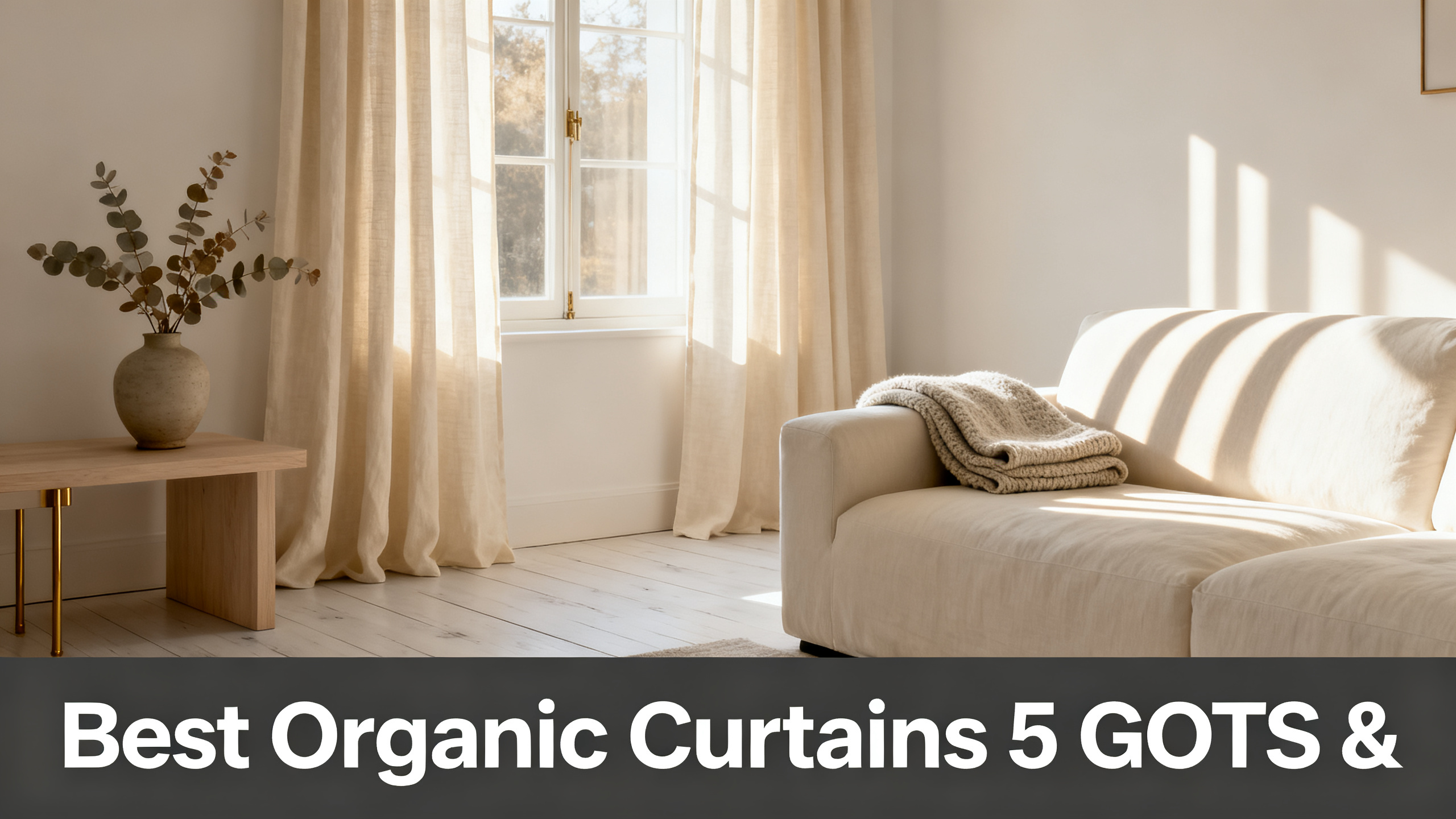
If you typed “best organic curtains” into a search bar, odds are you fit one of 5 buyer profiles: a parent shopping a low-tox nursery, a homeowner allergic to formaldehyde finishes, a designer briefed on a Japandi remodel, a renter who wants a curtain they can actually trust, or a purist who only buys traceable European flax. Each profile lands on a different pick.
That’s the map this article uses. If you want the underlying material primer before diving into picks, our sustainable curtains hub maps the GOTS / OEKO-TEX / European Flax landscape in plain English.
5 Buyer Profiles → 5 Picks
Nursery / low-tox parent
Liz OEKO-TEX
Budget, certified, 35 colors.
Formaldehyde-sensitive
Doris 100% Flax
Zero synthetic blend, traceable cultivation.
Japandi / organic modern
Patti Belgian Flax
Soft top, relaxed drape, heritage fiber.
Big window, opaque needed
Erin 100% Linen
Heavyweight, structured drape.
Cotton-first, warm depth
Veda 100% Cotton
Velour, antibacterial, hypoallergenic.
The honest verdict before the deep dive: Doris 100% European Flax Linen is the cleanest organic signal Two Pages sells. It is 100% flax, European Flax certified, traceable to rain-fed Belgian or French cultivation, and carries zero synthetic blend. If you only have time to read one pick, read that one.

Editor’s Pick · Best Overall Organic
Doris 100% European Flax Linen Pleated
from $109/panel (final price depends on size & lining)
- 100% European Flax linen, traceable Belgian/French cultivation, zero polyester
- 117 gsm midweight, triple tailor pleat structured drape
- European Flax certified (low-impact, rain-fed, no irrigation)
Code JULY for 20% off · Free shipping over $300 · Up to 5 free fabric swatches
One transparency note before the deep dive. Two Pages does not currently carry a curtain stamped GOTS (Global Organic Textile Standard). It does carry OEKO-TEX Standard 100 across its core Liz line, European Flax certification on Patti and Doris, and several 100% natural-fiber lines without third-party labels. The methodology below treats those as three angles of the same intent: fiber purity, screened toxicity, traceable cultivation.
What “Organic” Actually Means for Curtains
“Organic” in textile shopping usually collapses three distinct ideas into one fuzzy claim. To pick a curtain that actually fits your reason for searching, it helps to separate them out.
GOTS (Global Organic Textile Standard)
GOTS is the strictest organic textile label on the market. It certifies the fiber itself (organic cotton, organic wool, organic linen grown without synthetic pesticides) plus the entire processing chain, from ginning and spinning to dyeing and finishing. Forbidden inputs include formaldehyde, chlorine bleach, heavy metals, and most azo dyes. It is the certification a buyer searching “GOTS curtains” most often has in mind. See the GOTS criteria (Global Organic Textile Standard) for the full screening list.
Certification
GOTS
Certifies fiber + full processing chain. Organic cultivation required.
Two Pages products: none currently
Certification
OEKO-TEX Standard 100
Screens finished textile for 100+ harmful substances. Fiber origin not regulated.
Two Pages products: Liz entire line
Certification
European Flax
Certifies traceable EU flax cultivation: rain-fed, no irrigation, no defoliation.
Two Pages: Patti, Doris
OEKO-TEX Standard 100
OEKO-TEX is the certification you most often actually need. It screens the finished textile for over 100 regulated substances: formaldehyde, lead, cadmium, phthalates, pesticide residues, banned azo dyes, and chlorinated phenols. It is fiber-agnostic, meaning a polyester blend can carry it as long as the finished product passes screening.
Sustainable Curtains Buying Guide
Deep-dive on GOTS vs OEKO-TEX vs European Flax, fiber traceability, and what each label actually certifies.
For nurseries, OEKO-TEX caps formaldehyde at 16 ppm for baby textiles, vs roughly 300 ppm on unregulated imports. If you’re new to textile certifications, our explainer on what OEKO-TEX Standard 100 actually tests covers the chemicals on the screening list. The full official spec lives at OEKO-TEX Standard 100 specification.
European Flax Certification
European Flax (administered by the CELC alliance) certifies where and how the flax was grown. To qualify, flax must be cultivated in Western Europe (Belgium, France, the Netherlands), grown rain-fed without irrigation, and produced without GMOs or chemical defoliants. It does not regulate the finishing chain like GOTS does, but it gives buyers the traceability story most “organic linen” searches are actually about. Reference: European Flax certification (CELC alliance).
What Two Pages Actually Offers (Honest Map)
Putting it together: Two Pages has no GOTS-stamped curtain, has OEKO-TEX Standard 100 across the Liz line, and has European Flax certification on Patti and Doris. It also sells 100% natural-fiber curtains without third-party labels (Erin pure linen, Veda 100% cotton). That gives buyers four practical levers depending on what they actually care about.
If your priority is certified screened-for-toxics, Liz is the obvious pick. If your priority is traceable cultivation, Doris or Patti. If your priority is maximum fiber purity, Doris or Erin. The 5 picks below ladder those priorities by tier.
5 Picks Ranked by Tier (Premium → Mid → Budget)

#1 Editor’s Pick · Premium: Doris 100% European Flax Linen Pleated
Badge: Best for purists wanting traceable flax.
Doris is the closest analog to a GOTS curtain in this catalog. The fiber is 100% European Flax linen, traceable to rain-fed cultivation in Belgium or northern France, with zero polyester or blend. The 117 gsm midweight gives a softer, more breathable drape than the heavyweight 100% linens, and the triple tailor pleat header keeps it visually structured rather than slouchy. It is the pick for the buyer who searched “GOTS curtains,” found none, and is willing to accept European Flax as the next-best certification signal.
Doris 100% European Flax Linen Review
spec-by-spec breakdown of the Editor’s Pick — drape feel, color accuracy, lead time, configured pricing across 6 sizes.
Configure Doris on Two Pages → from $109/panel · Code JULY 20% off
Best 100% Real Linen Curtains (Not Blends)
If fiber purity matters more than the certification label, our 100% linen roundup digs into the 4 pure-linen lines Two Pages sells.
#2 Mid: Patti Premium Belgian Flax Linen Soft Top
Badge: Best for Belgian flax purists with patience.
Patti is the heritage option. It uses the same 100% Belgian flax fiber that drives luxury draperies at 3× the price, woven heavier at 248 gsm for body that catches light without becoming stiff. The soft top header keeps the drape relaxed, which is the right choice for coastal grandmother, Japandi, and organic modern interiors that want fabric to look lived in, not tailored. Lead time on custom drops runs a touch longer than the Liz line, so order swatches early.
Configure Patti on Two Pages → from $79.99/panel · Code JULY 20% off
#3 Mid: Erin Heavyweight 100% Linen Soft Top
Badge: Best for purists who also want body and structure.


Erin is the opaque sculptural option. It is 100% linen like Patti and Doris, but woven heavyweight, which delivers a denser drape that hangs almost like a column rather than draping. That makes it the right call for a large south-facing window where Doris’s midweight 117 gsm would let too much light through. Six grounded colors (white, beige white, natural, sand beige, haze blue, stone grey) cover the entire Japandi and organic modern palette. No third-party cert, but the fiber is genuinely pure.
Configure Erin on Two Pages → from $89.99/panel · Code JULY 20% off
#4 Mid: Veda Luster 100% Cotton Velour Pleated
Badge: Best for cotton-first buyers wanting depth and warmth.
Veda is the cotton-first answer. It is 100% cotton velour (not the synthetic velvet most retailers sell as “luxury”), woven at 280 gsm midweight with a luster finish that reflects light without turning shiny. The spec sheet calls it hypoallergenic, antibacterial, and fade-resistant. The honest limit: there is no third-party certification on the fiber, so “Eco-Friendly Choice” is Two Pages’s own claim rather than an outside label. If you want the warmth and depth of velour without the polyester compromise, this is the only practical pick.
Configure Veda on Two Pages → from $98/panel · Code JULY 20% off
#5 Budget: Liz Linen Drape Pleated (OEKO-TEX Certified)
Badge: Best for renters and nurseries on budget OEKO-TEX.

Liz is the pragmatic budget answer. The fiber is a linen blend (10% linen, 90% polyester), so it is not a fiber-purity pick. What it delivers instead is OEKO-TEX Standard 100 certification across the entire range, which screens the finished textile for formaldehyde, heavy metals, banned azo dyes, and pesticide residues. At 350 gsm heavyweight with 35 colors, it covers the widest range in the catalog at the lowest entry price. For a nursery where the priority is “no off-gassing toxics” more than “pure fiber,” this is genuinely the right answer.
Configure Liz on Two Pages → from $59.99/panel · Code JULY 20% off
🍼 Pro Tip — Nursery safety: Conventional curtains can off-gas formaldehyde from anti-wrinkle finishes for up to 6 months after install. OEKO-TEX Standard 100 caps formaldehyde at 16 ppm for baby textiles (vs roughly 300 ppm unregulated). For nurseries, prioritize a certified pick (Liz OEKO-TEX is the budget default) over a “natural fiber but uncertified” option.
Criteria Matrix: Each Pick Scored 1-5
Five picks across five dimensions that actually matter for an organic-curtain buyer: fiber purity, depth of third-party certification, drape weight (heaviness of fall), color range, and value per panel. Higher is better.
| Pick | Fiber Purity | Cert Depth | Drape Weight | Color Range | Value |
|---|---|---|---|---|---|
| Doris (Premium) | 5/5 | 5/5 | 3/5 | 3/5 | 4/5 |
| Patti (Mid) | 5/5 | 4/5 | 4/5 | 3/5 | 5/5 |
| Erin (Mid) | 5/5 | 2/5 | 5/5 | 3/5 | 4/5 |
| Veda (Mid) | 5/5 | 2/5 | 4/5 | 3/5 | 4/5 |
| Liz (Budget) | 2/5 | 5/5 | 5/5 | 5/5 | 5/5 |
Fiber Purity rates % natural fiber. Cert Depth weights GOTS > European Flax > OEKO-TEX > none. Drape Weight scores gsm. Scoring derives from Two Pages spec sheets and certification registries.
The matrix surfaces what’s intuitive once you see it laid out: no single pick scores 5 across every dimension. Doris wins on purity and cert depth, Liz wins on certification breadth and value, Erin wins on drape body. The right pick depends on which dimension dominates your room and your reason for shopping.
If you only read one section, read this:
Doris 100% European Flax — the closest thing to GOTS in this catalog
Two Pages doesn’t carry a GOTS-stamped curtain. Doris is the next-best signal: 100% flax, European Flax cert, traceable rain-fed cultivation, zero synthetic blend.
Pricing, Configuration & Promo Codes
Two Pages prices each pick as from $X/panel, with the actual configured price depending on width, drop, header style, and whether you add a lining. The table below benchmarks the Editor’s Pick Doris in three common window configurations so you can sanity-check what your total order is likely to land at.
Real Pricing: Doris European Flax for Common Configurations
🪟
Bedroom window (52″W × 84″L, 2 panels)
~$218
unlined flax linen
🛋️
Living room standard (84″W × 96″L, 2 panels)
~$398
cotton liner add-on
🏛️
Large picture window (100″W × 108″L, 3 panels)
~$687
unlined, custom drop
Configured from Two Pages cart simulation. Apply code JULY for 20% off across all picks. Free shipping over $300.
For credibility on the Two Pages service side, see the Trustpilot 4.5/5 across 5,000+ owner reviews. Code JULY runs 20% off sitewide on the curtain picks above; the VIP22 and WOVEN codes do not apply to these specific lines (VIP22 is luxury trade only, WOVEN is bamboo specific).
Organic Palette: 12 of the natural-fiber tones across the 5 picks
Ivory
Beige White
Natural
Sand Beige
Stone Grey
Haze Blue
Taupe
Oak Dim
Rock Grey
Fog
Rust Brown
Dusty Blush
Swatch hex codes are approximate. Order free fabric swatches to confirm in your room’s actual light.
🎁 Hold the linen in your room’s actual light before you commit
Order up to 5 free swatches per request, or grab the Liz polyester linen swatch (entry palette) for under $2 shipped.
Who These Are For (and Who Should Skip)
Organic curtains are not the right call for every room. The picks above earn their price tag when you actually care about fiber traceability, certified absence of off-gassing toxics, or both. Below is the decisive triage.
✅ Choose an organic pick if…
- You’re shopping a nursery and want screened-for-formaldehyde fabric
- You react to anti-wrinkle finishes and need a curtain without them
- You’re styling Japandi, organic modern, or coastal grandmother and want a fiber that reads as real
- You want a curtain you can compost or recycle at end of life
❌ Skip these if…
- You need full blackout for a south-facing bedroom (organic linens are not blackout grade)
- You’re outfitting a high-humidity bathroom (cotton mildews, flax wrinkles aggressively)
- You want a sub-$50/panel option (the organic premium starts around $60)
- You want printed pattern (the organic-leaning lines here are solids only)
One subtle point worth flagging: “organic” and “non-toxic” are not synonyms. A 100% organic cotton curtain dyed with an unregulated azo dye is technically organic and still chemically problematic. The OEKO-TEX Standard 100 layer is what closes that gap. If you have to choose between the two, pick the certification that maps to your actual concern.
FAQ
Are organic curtains really worth it compared to regular curtains?
Yes if your goal is screened-for-toxics fabric or fiber traceability. Conventional curtains often carry anti-wrinkle finishes that off-gas formaldehyde for months, plus pesticide residues from non-organic cotton. A certified pick eliminates those exposures. If you’re shopping purely on style, the premium is harder to justify.
What’s the difference between GOTS, OEKO-TEX, and European Flax certifications?
GOTS certifies both the organic origin of the fiber and the full processing chain (no formaldehyde, no banned dyes). OEKO-TEX Standard 100 only certifies the finished textile for harmful substances, regardless of fiber type. European Flax certifies traceable rain-fed flax cultivation in Western Europe. Each label answers a different question.
Is European Flax the same as organic linen?
Not exactly. European Flax certifies low-impact cultivation (no irrigation, no GMOs, no chemical defoliants) but does not require strict USDA organic protocols. In practice, the environmental footprint is similar enough that most “organic linen” shoppers accept European Flax as equivalent. For a Flax-specific deep dive, see our best European Flax linen roundup.
Does Two Pages sell GOTS-certified curtains?
Not currently. The closest signals in their catalog are European Flax certification (Patti, Doris) and OEKO-TEX Standard 100 (Liz). If GOTS is a strict requirement, you will need to look outside Two Pages or wait for an upcoming line.
Are organic cotton curtains safe for a nursery?
Yes when the curtain carries OEKO-TEX Standard 100 or GOTS certification. Those caps regulate formaldehyde at 16 ppm for baby textiles, which is the threshold associated with low off-gassing. A 100% organic cotton curtain without third-party screening still beats a conventional polyester curtain with anti-wrinkle finish for nursery use.
How long do natural fiber curtains last compared to polyester?
Linen and cotton typically outlast polyester by 5 to 10 years when cared for properly, because natural fibers don’t pill, melt, or develop static. The trade-off is wrinkling: pure linen wrinkles aggressively and most owners accept that as part of the aesthetic.
Can organic curtains be machine washed?
Liz (linen blend) machine washes safely on a gentle cold cycle. Pure 100% linens (Patti, Doris, Erin) and 100% cotton velour (Veda) are best dry-cleaned for the first wash to lock dimensions, then hand-washed or gentle-cycled cold afterward. Hang to dry; never tumble dry pure linen.
Why do organic curtains cost more than synthetic ones?
Three reasons stack. The fiber itself costs more (organic cotton runs roughly 20-50% above conventional, European Flax is similarly premium). Third-party certification audits add overhead per yard. And natural fibers require more careful weaving and finishing to avoid the chemical shortcuts polyester accepts.
Final Verdict & Tier Ladder Recap
The honest take: Doris 100% European Flax is the cleanest organic signal Two Pages sells, and it’s the right default for roughly 70% of organic-curtain shoppers. It carries a real third-party certification (European Flax), zero synthetic blend, traceable cultivation, and a midweight that fits most rooms. If your room demands more body, ladder up to Erin heavyweight. If your budget is tight or you specifically need OEKO-TEX certification for a nursery, drop to Liz. If you want cotton velour warmth, Veda is the only practical pick.
Tier Ladder Recap
Premium
Doris 100% Flax
from $109/panel
Mid
Patti · Erin · Veda
from $79.99 to $98/panel
Budget
Liz OEKO-TEX
from $59.99/panel
Doris 100% European Flax Pleated
from $109/panel
The cleanest organic signal Two Pages sells: traceable European flax, certified low-impact cultivation, zero synthetic blend. The right default for 70% of organic-curtain shoppers.
Configure & Order on Two Pages →
Code JULY for 20% off · Free shipping over $300 · European Flax certified
