
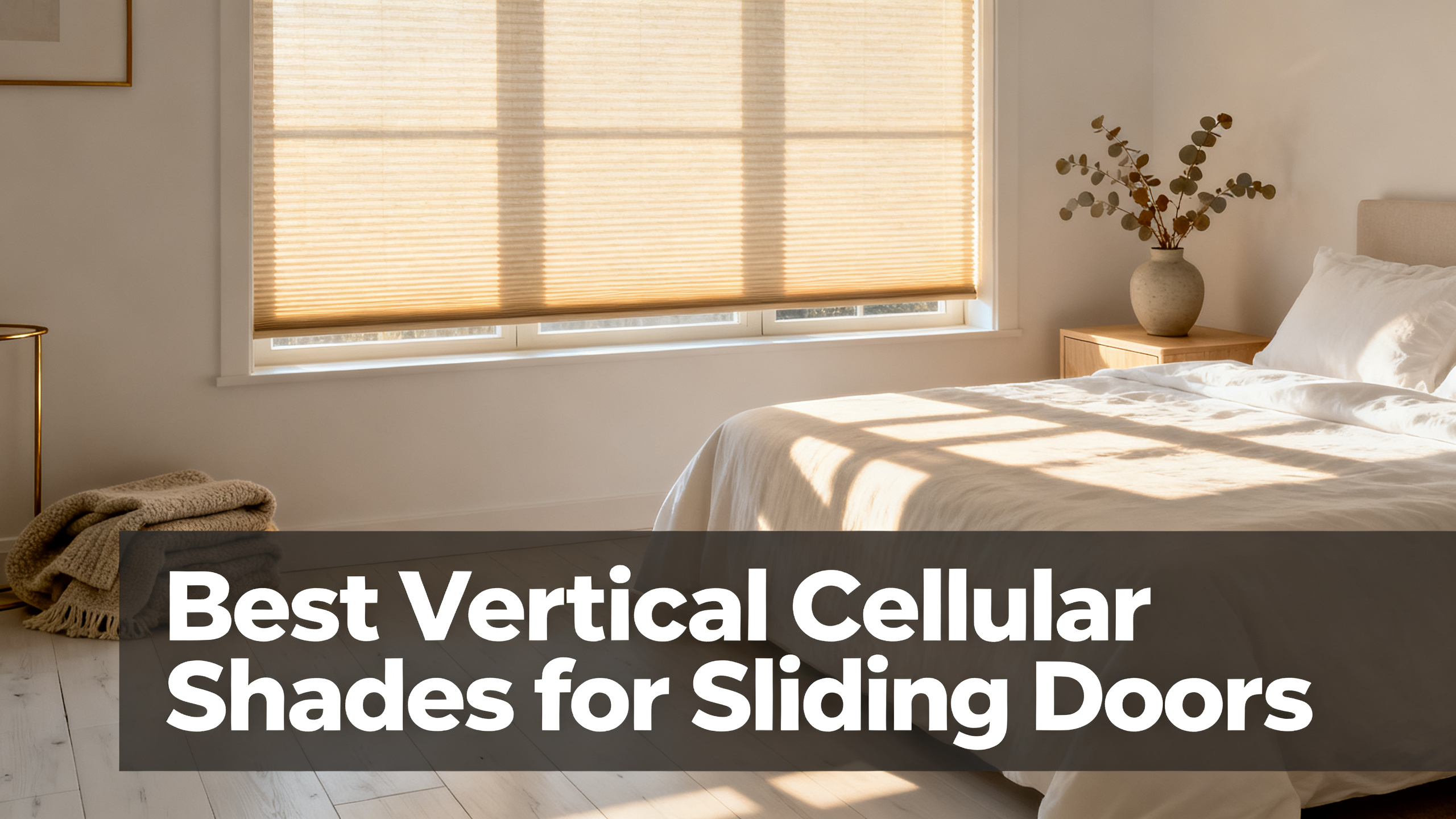
We screened 6 cellular shade configurations for sliding glass doors against 5 criteria that actually matter on a 6-to-10-foot slider: light control, drop coverage, insulation R-value, install friction on the door frame, and price per panel. Five configurations made the cut. One got dropped as a functional duplicate. The picks below are all Two Pages Aura Cellular, sourced from the same 225 gsm honeycomb fabric across every configuration, so the differences read as pure architecture, not fabric quality.
Before we get to the picks, a piece of category housekeeping most buying guides skip: “vertical cellular shades” as a distinct product barely exists anymore outside one Hunter Douglas SKU. Almost every buyer searching that phrase ends up on a horizontal wide honeycomb mounted above the slider, and that is what the picks below are.
If you are still deciding between cellular, curtains, panel track or roller for the same opening, our full sliding-door treatment guide compares the four categories head to head.
What “Vertical Cellular Shades” Actually Means for a Sliding Door
The term “vertical cellular shade” refers to a honeycomb blind where the cells stack side to side and the shade pulls horizontally along a track, like a curtain. The only mass-market example still in production is the Hunter Douglas Duette Vertiglide, and it starts near $700 for a 60-inch slider before hardware.
Everything else the internet calls “vertical cellular” is actually a wide horizontal honeycomb: cells stacked top to bottom, mounted above the sliding door, dropping down to floor. That is what Two Pages sells under the Aura Cellular line, and what the other three brands most often cross-shopped against it also sell.
⚠️ What buyers get wrong
Searching “vertical cellular shades for sliding glass door” and expecting a track-mounted honeycomb curtain will surface exactly one product family (Duette Vertiglide) at 3 to 5 times the price of a horizontal wide honeycomb doing the same job. The horizontal approach covers wider spans, drops in one clean panel, and reaches the same R-2 to R-4 insulation range for a fraction of the cost.
Our Methodology: 5 Criteria, 6 Configurations Screened
We ran every Two Pages Aura Cellular configuration through the same 5-criteria grid. The goal was not to reward the most expensive shade. It was to identify which single configuration solves the specific pain a sliding-door buyer is trying to solve.
Methodology
The 5 criteria we scored
Criterion 1
Light control
Blackout, day-night, or graduated top-to-bottom control on a floor-to-ceiling glass surface.
Criterion 2
Drop coverage
Standard slider heights (80-96 in) covered from head to floor without gap.
Criterion 3
Insulation
R-value delta added to the uninsulated glass, per DOE window treatment reference.
Criterion 4
Install friction
Drill vs no-drill, bracket clearance for the track headrail.
Criterion 5
Price per panel
Base price on a standard slider width, before promo codes.
Of the 6 configurations screened, 5 earned a place on the list. The one we dropped is the No-Drill Standard Blackout: it is functionally identical to the drilled Standard Blackout at $20 more per panel, and if you have already committed to no-drill install you are almost certainly going to want the Day-Night or TDBU flexibility that comes at only $14 to $30 more still. The standard No-Drill is not a bad shade. It just gets outclassed inside its own product family.

Editor’s Pick 2026
Aura Day Night Blackout Cellular Shade
Dual-cell honeycomb with a sheer top band and a blackout bottom band. The single configuration that handles daytime privacy and night-time blackout on a sliding door without stacking two products.
from $118.99/panel · Final price depends on size & configuration
Use code JULY for 20% off · Free shipping over $300
5×5 Criteria Matrix: Every Pick Scored
The matrix below is the fastest way to see why each pick earned its badge. Scores are on a 5-point scale where 5 is best in class within the Aura Cellular product family, not against every window treatment ever made.
Signature scorecard
5 = best in class within the Aura Cellular family. Build materials are identical across the line (225 gsm honeycomb, aluminum-coated interior, OEKO-TEX Standard 100), so build was not scored separately.
Reading across: the standard Blackout Cordless pulls the highest average when you weight price. The Day-Night pulls the highest average when you weight daily usability. The two No-Drill variants only make sense if a drilled install is off the table, at which point they become the only realistic choice. That is why the picks below are ordered by what solves the most common sliding-door problem first, not by average score.
Best Sheer Curtains for Sliding Glass Doors
If you want daytime view and airflow more than insulation, sheer curtains beat cellular here.
The 5 Picks
#1 Aura Day Night Blackout Cellular Cordless: Best Overall (Editor’s Pick)
The Day Night is the only Aura configuration that solves two sliding-door problems with one shade. The top band is a sheer honeycomb that filters afternoon light while preserving the daytime view onto the patio. The bottom band is the full 225 gsm blackout honeycomb that drops for privacy or nighttime blackout. On a west-facing slider that spends the whole afternoon getting cooked, the top band handles glare without cutting the outside off, and the bottom band handles privacy the moment the deck neighbor comes home. At $118.99 to start, it undercuts a Hunter Douglas Duette Vertiglide of the same width by roughly 5 to 6 times.
Pros & cons
✔ Pros
- Two functions (sheer view + blackout) in one shade
- Cordless, safe for kids and pets near the track
- 7 color options, OEKO-TEX 100 certified fabric
- Under $120 vs $700+ for vertical honeycomb competitors
✘ Cons
- Dual-cell headrail is 2 3/16″ deep, needs mount clearance
- Lead time trends to 14 business days on custom sizes
- No motorization option in this configuration yet
from $118.99/panel · Code JULY for 20% off
#2 Aura Top Down Bottom Up Blackout Cellular: Best for Street-Facing Sliders

The TDBU is the one for a slider that opens onto a street, walkway, or a neighbor’s second-floor window. The shade lowers from the top and raises from the bottom independently, so you can cover the bottom half for privacy while leaving the top half open for daylight and airflow. On a 96-inch tall patio slider, that means the bottom 40 inches can sit at blackout while the top 56 inches stays clear. The full 225 gsm blackout honeycomb runs the whole panel, so R-value stays at the top of the range even in half-drop mode.
from $102.99/panel · Code JULY for 20% off
#3 Aura Blackout Cellular Cordless (Standard): Best Budget

The standard Blackout is the highest-value pick in the range if the slider only needs one job done: total light block plus insulation. At $88.99 to start, it delivers the same 225 gsm honeycomb, aluminum-coated interior, and OEKO-TEX Standard 100 fabric as the more elaborate configurations, minus the dual-cell architecture. On a bedroom slider that faces a driveway or an east-facing morning sun, the single-function Blackout is arguably the smarter buy: nothing to fumble with, single lift point, and 15 to 30 dollars saved per panel.
from $88.99/panel · Code JULY for 20% off
#4 Aura No-Drill Day Night: Best for Renters

The No-Drill Day Night is the renter’s dream on a sliding door. Tension-mounted inside the door casing, it holds without a single screw, a single anchor, or a millimeter of adhesive residue on the frame. On move-out day it lifts off the casing in under a minute. The trade-off is a 3/4-inch minimum casing depth for the tension bracket, and the mounts assume an inside-mount install, which means the shade sits inside the door frame rather than covering the trim. For a slider with a clean rectangular casing, that constraint is invisible. On a slider where the casing is textured or narrow, measure twice.
from $138.99/panel · Code JULY for 20% off
#5 Aura No-Drill Top Down Bottom Up: Best for Renter Flexibility

The No-Drill TDBU is the pick for a renter whose slider faces a shared walkway or a neighbor’s window at a specific height. It combines the tension-mount install of the No-Drill Day Night with the split-drop mechanic of the TDBU. On a 80-inch tall rental slider looking onto a second-floor balcony, the bottom third can sit at privacy while the top two thirds pull daylight in. At $122.99 to start, it prices $16 under the No-Drill Day Night while trading dual-cell architecture for split-drop flexibility. Which of those matters more is a decision only the specific opening can answer.
from $122.99/panel · Code JULY for 20% off
How to Measure a Sliding Door for Cellular Shades
Sliding-door measurement is where 90% of cellular shade returns originate. The rules are not complicated, but they differ from a standard window in two specific ways: the width can push past 72 inches (single vs double panel decision) and the drop has to clear the track hardware at floor level.
Mount decision
Inside mount
Shade sits inside the door casing. Cleaner look. Needs 2″ minimum casing depth for the headrail.
Outside mount
Shade covers the trim. Adds 4 to 6 inches on each side for stackback. Best for maximum coverage and minimum light gap.
No-drill (tension)
Inside mount only. Needs 3/4″ minimum casing depth for the tension bracket.
For width, order the window casing width minus 1/4 inch on an inside mount. On a 72-inch slider, that means a 71 3/4 inch shade. For outside mount, add 3 to 6 inches on each side to fully cover the trim and prevent light leak.
📏 Measurement tip
Measure the drop from the top of the casing to the floor, then subtract 1/2 inch. That 1/2 inch keeps the shade clear of the sliding-door track and prevents the bottom rail from dragging on the metal. The Day-Night and TDBU headrails add 2 3/16″ to the top clearance, so the effective drop drops by roughly 2 inches on those configurations.
Bracket and headrail clearance is the last thing to check. The Aura standard headrail is 2 3/16″ deep by 1 3/8″ high. On a slider with a shallow casing (under 2 inches), that headrail will project past the frame and prevent the door from opening cleanly. The fix is outside mount, which projects the entire shade forward and avoids the clearance issue.
How to Hang Curtains Over Sliding Glass Door
The rod-placement rules from our curtains guide translate to outside-mount cellular headers too.
Still on the fence?
Aura Day Night handles both jobs on one shade.
Sheer at the top for daytime view, blackout at the bottom for privacy. Cordless lift keeps sliding-door tracks safe for pets and kids.
Code JULY for 20% off
Pricing by Configuration
Sliding doors come in a handful of standard widths, and Aura Cellular pricing scales predictably with width. The table below covers the five most common slider sizes across all 5 picks. Prices are base configuration before promo codes. Final price at checkout adjusts for exact width, drop, and any add-on lift options.
Drop & coverage pricing
60″ × 80″ (small slider)
from $89 to $139
Standard Blackout to No-Drill Day Night
72″ × 80″ (standard patio)
from $109 to $169
Full range, single panel still possible
96″ × 80″ (wide slider)
from $145 to $215
Split at center recommended over single panel
108″ × 84″ (patio doorwall)
from $175 to $255
Two panels meeting at center
120″ × 96″ (full doorwall)
from $205 to $305
Two or three panels depending on lift
The Day-Night and TDBU configurations add roughly 15 to 30 percent to the standard Blackout base price at any size. The Aura Day Night configurator calculates exact price for any custom width and drop combination before checkout.
See the 7 Aura colors in your own light
Two Pages ships free honeycomb fabric swatches so you can check white, light blue, light gray, slate blue, black, light taupe and dark brown against your slider trim before ordering.
Cellular vs Curtain vs Panel Track for Sliding Doors
Cellular is not automatically the right answer for every sliding door. It wins on insulation and privacy. It loses on drape, motion, and aesthetics against fabric. Our curtain picks for the same opening cover Liz Linen, Atlanta Room Divider and three other configurations if fabric drape is a better fit than a honeycomb stack.
Category comparison
Cellular (honeycomb)
R-2 to R-4 insulation, cordless-safe, best for cold climates and blackout needs. Loses on drape and motion.
Curtain (fabric)
Best drape, best aesthetics, motion breaks up glass. R-1 to R-2 insulation only. Best for warm climates, style-first buyers.
Panel track
Wide flat panels on a top track, glide horizontally. Modern look, but no insulation gain over the bare glass.
The short version: cellular for cold climates or bedrooms that need blackout, curtain for style-forward living rooms, panel track for a modern minimalist look on very wide openings. The picks in this article assume the buyer has already landed on cellular. If that decision is still open, the sliding-door hub above is the better starting point.
Who Should Skip Cellular and Choose Curtains Instead
Three buyer types consistently do better with fabric than with honeycomb on a slider. If any of these fit, save the money on cellular and buy a curtain instead.
Who is this not for?
Style-first living rooms
If the slider is the centerpiece of the room, a linen or velvet curtain adds motion and drape that cellular flat honeycomb cannot match.
Nursery with a slider
Blackout curtains with a sage or blush backer read softer for a nursery than a taut honeycomb pleat, and the fabric muffles slider noise better.
Warm climate, view-first
In a warm climate where insulation gain does not matter, a sheer or semi-sheer curtain preserves the view without the boxy stack of a honeycomb at half drop.
FAQ
Are vertical cellular shades still made for sliding glass doors?
Yes, but the market has narrowed to essentially one product. Hunter Douglas still produces the Duette Vertiglide, a true vertical honeycomb that stacks side to side on a track. Most other brands, including Two Pages, discontinued vertical honeycomb in favor of wide horizontal cellular shades that mount above the slider and drop down. The horizontal approach is cheaper, easier to size, and covers wider openings without special hardware.
What is the difference between horizontal cellular and vertical cellular shades?
Horizontal cellular shades stack their honeycomb cells one on top of another and lift from the bottom up. Vertical cellular shades stack cells side by side and pull horizontally across a track, like a curtain. For a sliding glass door, horizontal cellular in a wide single panel gives the same coverage as vertical cellular at roughly one third of the price, and both deliver the same R-value insulation.
What R-value do cellular shades add to a sliding glass door?
Cellular shades add roughly R-2 to R-4 depending on cell count and fabric weight. The Aura 225 gsm single-cell blackout adds about R-3 at the shade surface. Compared with an uninsulated sliding glass door (typically R-1 to R-2), that is a 50 to 100 percent improvement in thermal resistance. The Department of Energy window-treatment reference confirms honeycomb cellular is one of the highest-R window treatment categories.
Can I mount a cellular shade on a rental sliding door without drilling?
Yes. The Aura No-Drill Cellular Shade uses tension mounts inside the door casing and holds up to standard-weight panels. There is no drilling, no adhesive residue, and the shade removes in under a minute. Renters typically choose the No-Drill Day Night for a slider because it offers daytime privacy without permanent hardware.
What is the maximum width for a Two Pages Aura cellular shade?
Two Pages Aura cellular shades ship in configurable widths up to standard sliding-door panels. For openings wider than a single panel, two shades meet at center. Below 72 inches wide, a single panel is the default. For openings 72 to 120 inches, the configurator recommends either one wide shade or a pair meeting in the middle depending on cord and lift preference.
Are cellular shades child-safe on a sliding door?
The Aura line ships cordless by default. There are no pull cords, tilt wands, or exposed loops. This matches the Window Covering Manufacturers Association guidance for homes with kids under 8 or pets that could tangle. Corded cellular is available from other brands but is not the Aura default.
How long do cellular shades take to arrive from Two Pages?
Two Pages Aura cellular shades typically ship within 7 to 14 business days from order. The Day Night and Top Down Bottom Up configurations sit at the top of that range because both require dual-cell assembly. No-Drill variants ship inside the same window.
Do Two Pages cellular shades qualify for the JULY promo code?
Yes. Code JULY applies 20 percent off sitewide at Two Pages including all Aura Cellular configurations. Free shipping applies over $300 order value. Codes do not stack with other site promotions.
Final Verdict
Across every criterion that matters on a sliding door, the Aura Day Night Blackout Cellular Shade is the single configuration that solves the most sliding-door problems at once. Daytime view at the top, nighttime blackout at the bottom, 225 gsm honeycomb across the whole panel, cordless lift, 7 colors, priced from $118.99. If the slider is street-facing, upgrade to the Top Down Bottom Up. If the shade has to come down at move-out, upgrade to the No-Drill Day Night. If the only job is total blackout and pure value, drop to the standard Blackout Cordless and save $30.
Color range


Our 2026 pick for sliding-door cellular
Aura Day Night Blackout Cellular Shade
Sheer top for view, blackout bottom for privacy, cordless lift, 7 colors, 225 gsm honeycomb. Priced under $120 to start where a Hunter Douglas Duette Vertiglide of the same width starts near $700. The trade-off is one horizontal shade instead of a wide vertical stack, which most sliding-door owners preferred once they saw both installed.
Code JULY · 20% off · Free shipping over $300 · Final price depends on size & configuration
