
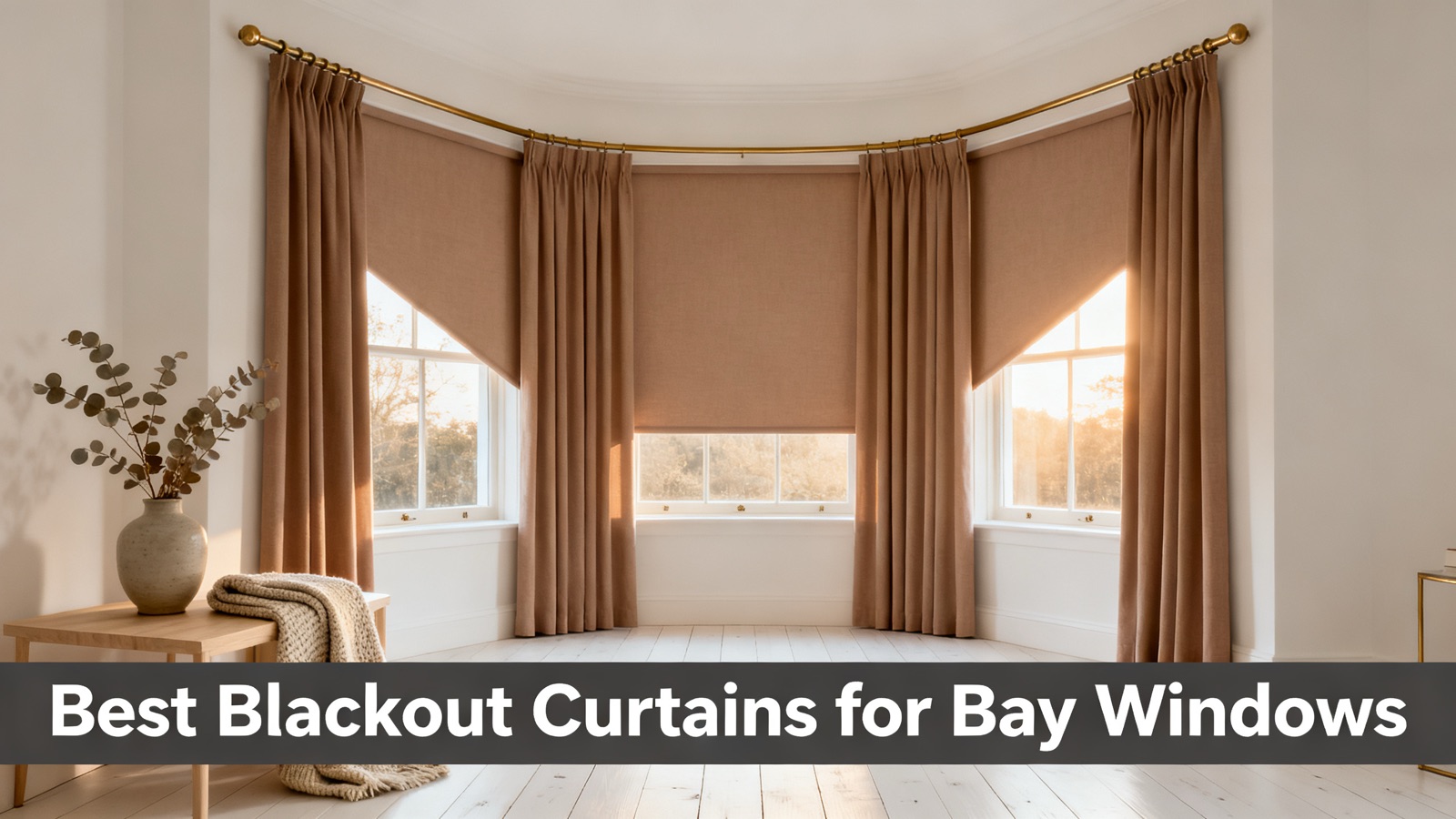
Most best-of lists on blackout drapes get the fabric right and the window wrong. A bay is not a single flat pane, it is three to six panes at 30-45 degree returns, and blackout on that geometry fails at the corner more often than at the fabric. So this roundup starts with the screening criteria, then names the five Two Pages picks that clear them. For the wider picture beyond blackout, sheers, layered treatments, ripple fold vs pinch pleat, rod systems for 3-section bays, start with our complete bay window curtain guide and come back once the light-blocking question is your priority.
Five picks, five bay-typical rooms: living room bay, master bedroom bay, nursery bay, home office bay, kitchen breakfast-nook bay. One editor’s pick handles the geometry problem all five share.
How We Picked
Two Pages sells a dozen collections that call themselves blackout. Only five earn a spot on a bay window. The other seven either fail on drape at the angled returns, or ship in a header that cannot seal the corner, or price out of any realistic bay config. Here is the screening rubric we ran every collection against.
🪟 Our 5 screening criteria for a bay blackout pick
Shading %
≥99% at the fabric, no leak in white or ivory colorways
Bay-Angle Drape Fit
Panel width ≥40″ and fabric weight ≥250 gsm to hold shape on returns
Header Return Flexibility
Pinch pleat, grommet, or ceiling track glide, no rod pocket
Configured Price
3-panel bay total under $800 configured for standard geometry
Install Fit
Owner-installable in a weekend, or ships as a ready-made kit
The bay is the actual protagonist. Shading percentage matters less than whether the drape can seal a 30 degree corner. Fabric weight matters because a 150 gsm blackout panel sags at the return and drapes badly on a wall that curves. Header choice matters because a rod pocket physically cannot slide past a bay bracket.
Configured price matters because 3-4 panels multiply fast on a bay wall. Install fit matters because most owners hire nobody, they hang it themselves on a Saturday.

Editor’s Pick, Best for Living Room Bay
Atlanta Blackout with Ceiling Track Kit
from $200.99/kit (final price depends on bay width & height)
- Aluminum ceiling track flush-mounts overhead, follows the bay geometry the wall cannot
- 252 gsm heavyweight polyester, 99% blackout shading, sound-dampening pile
- Six size classes cover 3 to 18 feet of bay width, kit ships with track, hooks, screws and saw
Configure Atlanta on Two Pages →
Code JULY for 20% off · Free shipping over $300 · Up to 5 free fabric swatches
Best Curtains for Bay Windows (All Styles)
The broader bay roundup covering sheer, linen, velvet and outdoor picks when blackout is not the priority.
What to Look For in a Bay Blackout Curtain
Shading Rate (and why 100% is not the same as 99%)
Shading rate is where blackout marketing overpromises. A “blackout” panel at 90-95% shading looks pitch dark at midnight but leaks visibly at 6am. A true 99% shading fabric reads dark enough for most bedrooms.
A coated 100% shading fabric like Lila is the only path to zero light on ivory or snow white colorways, because uncoated white blackout weaves inevitably leak 3-6% at the fibre gap. Per DOE energy-efficient window coverings guidance, the same coating that stops light also cuts heat loss meaningfully, which reads as a thermal bonus on a bay wall exposed on three sides.
Coated 100% blackout
100% shading
Lila fabric. Coating stops photons and warm air.
99% blackout heavyweight
99% shading
Atlanta ceiling track. Reads pitch-dark at 6am.
Face + thermal blackout liner
100% shading
Liz Linen ready-made. 250 gsm microfiber liner.
Velvet + blackout add-on
100% shading
Birkin. Add the blackout lining, the velvet does the rest.
Here’s the reframing: on a bay window, shading rate is decided at the corner seam, not at the fabric weave. A 100% blackout panel with a bad return still leaks a slim vertical line where the return meets the wall. Oversizing the panel width by 3-4 inches beyond the pane on both sides erases that leak. Every pick below is sized to allow that overlap.
Blackout Curtains: The Complete Guide
The full blackout pillar: coated vs self-blackout fabric, shading rate benchmarks, and how the coating that stops light also holds heat.
Bay-Angle Drape Fit and Fabric Grade
A blackout panel that hangs flat on a straight window looks awkward on a bay. The angled return pulls the fabric toward the corner, and lightweight blackout polyester (below 200 gsm) tends to bunch, catch light, and refuse to swag cleanly.
The picks below are all ≥250 gsm, with the Birkin Velvet reaching 300 gsm cotton velvet, the heaviest single-panel fabric Two Pages sells. Fabric weight is the single strongest predictor of drape behavior on a bay return.
Fabric grade matters for the second reason blackout curtains fail on a bay: the fabric sits inches from three panes of glass warmed and cooled every day for years. Coated blackout can flake or peel if the coating is cheap. Two Pages’ Birkin Velvet holds the OEKO-TEX Standard 100 certification, which flags safe chemistry across the fabric supply chain. On a nursery bay especially, that certification is worth double-checking before ordering.
Header Return Flexibility
Here’s the deal with headers on a bay: the header determines whether the drape can seal the corner. A rod pocket cannot slide past a jointed rod bracket, so it fails immediately. A grommet header works on smaller nook bays where the sections are short, and the tension-rod compatibility opens the renter path.
A pinch pleat is the strongest all-round choice, the sharp folds hold shape at the return and seal the corner seam. A ceiling track bypasses the wall geometry entirely and glides a continuous drape across any bay shape, which is why the Atlanta kit earns the editor’s pick slot.
🧵 Which header seals the light at a bay corner?
Pinch Pleat
Best for blackout bay
Sharp folds seal the corner seam. Lila, Liz, Birkin.
Ceiling Track
Bypasses bay geometry
Atlanta kit. No wall bracket compromise.
Grommet
Good for kitchen nook
Silent glide, tension-rod compatible. Lila Grommet.
Rod Pocket
Avoid on bay blackout
Cannot slide past a bracket, seals badly at corners.
A note on rod pocket: it is fine on a flat window, and it looks lovely on a sheer. On a blackout bay, it will annoy you every morning when the sun crawls up the corner seam. Don’t overthink it, skip rod pocket for this brief.
How to Hang Bay Window Curtains: Step-by-step
Bay rods, jointed rod vs ceiling track, bracket placement, and the corner light-gap most homeowners miss on blackout installs.
The blackout fabric only holds its light seal as well as the hardware behind it, so once the pick is chosen, our best curtain rods for bay windows roundup maps flexible vs jointed vs ceiling track for the exact bay in front of you.
5 Picks at a Glance: Criteria Matrix
Five picks scored on the same five criteria. Read across each row to see where a pick shines and where it trades off. The Atlanta Ceiling Track wins on drape and header return because the track sidesteps the bay bracket problem entirely. Lila Pleated and Grommet win on price. Liz Linen wins on install fit because it ships ready-made.
| Pick | Shading % | Bay-Angle Drape | Header Return | Config. Price | Install Fit |
|---|---|---|---|---|---|
| Atlanta Ceiling Track Kit Living room bay |
5/5 | 5/5 | 5/5 | 4/5 | 4/5 |
| Lila Blackout Pleated Master bedroom bay |
5/5 | 4/5 | 5/5 | 5/5 | 4/5 |
| Liz Linen Ready-Made Nursery bay |
5/5 | 4/5 | 5/5 | 3/5 | 5/5 |
| Birkin Velvet Pleated Home office bay |
5/5 | 5/5 | 5/5 | 3/5 | 4/5 |
| Lila Blackout Grommet Kitchen breakfast nook |
5/5 | 4/5 | 4/5 | 5/5 | 5/5 |
Boring number, real impact. The Atlanta kit’s config score of 4/5 is not a slight, it’s a note that a full bow window kit (14-18 feet, XXX-Large A or B class) crosses the $300 threshold on its own. The Lila panels each cost less individually, but 3 panels of Lila plus a jointed rod tends to land in the same price band as the Atlanta kit. Match the pick to the room, the config total will follow.
One pick handles the bay geometry problem all five share.
Atlanta Ceiling Track Blackout, the shortcut around bay-angle drama
The track follows the ceiling, not the wall. No jointed rod. No corner light gap. 252 gsm, 99% blackout, kit ships pre-drilled with roller hooks.
🪟 Which rod system for a blackout bay?
Aluminum ceiling track
Best for blackout. Zero corner light gap. Atlanta kit ships one.
Jointed 3-segment bay rod
Works with pinch pleat, but the elbow bracket casts a slim light band.
Three independent rods
Cheapest path. Corner seams overlap each pane, decent seal.
Tension rods per section
Renter path. Fine for kitchen nook, weaker seal in bedroom.
Pick #1, Living Room Bay: Atlanta Blackout with Ceiling Track Kit (Editor’s Pick)
Drape and Body
The Atlanta drape is a 252 gsm heavyweight polyester, dense enough to hang cleanly without a lining, matte enough to read as a proper drape rather than a shiny blackout blind. What sets it apart on a bay is the aluminum ceiling track the kit ships with, pre-drilled, flush-mount, six size classes covering 3 to 18 feet of bay width.
Instead of fighting a jointed rod that follows the wall corners, the track follows the ceiling straight across the bay opening. The drape glides on roller hooks, one continuous run from side wall to side wall. Zero corner bracket, zero light band at the joint, zero fabric bunching at the return.
Light Control
99% shading at the fabric weave. Reads as pitch dark at 6am on a west-facing living bay, and functionally indistinguishable from a 100% coated blackout in a use case where the drape is drawn primarily at night. The sound-dampening pile is a quiet bonus, three panes of bay glass are a soundboard for street noise, and the Atlanta fabric absorbs a meaningful amount of it.
The one honest note: because the track carries a single continuous drape, when the drape is open during the day it stacks off to one side of the bay opening. That stack takes about 12-18 inches of wall space. Plan for the stack when you measure the track length.
Price by Configuration
Configured pricing runs from $200.99 for the Small A kit (fits 3′-4’6″ bay) to about $310+ for the XXX-Large A double-curtain kit (14′-18′ bow window). A standard living room bay of 6′-9′ width lands in the Large A class at ~$238.99 for the kit.
That includes the drape, the track, the end caps, roller hooks, connectors, screws, and a saw for cutting the track to length. Owner-installable in a weekend.
Real pricing: Lila Blackout Pleated on a 3-section master bedroom bay
🪟
Modest bay (3 panels 40″W × 84″L unlined)
~$267 total
Before code JULY
🛏️
Standard master bay (3 panels 40″W × 96″L)
~$420 total
Configured with memory training
🏛️
Bow window (5 panels 40″W × 108″L)
~$780+ total
Premium config
Configured pricing from Two Pages cart simulation. Apply code JULY for 20% off the total.
Verdict
If it were my client’s living room bay, I’d pitch Atlanta first, every time. The bay geometry problem is real, and every other pick works around it. The Atlanta kit solves it directly with the ceiling track. The safe default when the bay geometry is the actual problem. Skip Atlanta only if you cannot ceiling-mount (rental, popcorn ceiling, exposed beam), in which case Lila Pleated is the fallback.
Editor’s Pick, Best for Living Room Bay
Atlanta Blackout with Ceiling Track Kit
from $200.99/kit
252 gsm 99% blackout, aluminum ceiling track pre-drilled for the bay geometry, 6 size classes covering 3-18 feet.
✅ Buy Atlanta Ceiling Track Kit if…
- Your bay is a full 3-6 section living room wall (3-18 feet total)
- You do not want to fight jointed rod brackets and corner light gaps
- You want a ready-made kit that ships fast with track, hooks and hardware
❌ Pick another option if…
- You cannot ceiling-mount (rental, popcorn ceiling, exposed beam)
- You need a natural-fibre look (Lila and Atlanta are polyester coated)
- You want a nursery ready-made panel that ships in days, not weeks (Liz Linen ready-made)
Pick #2, Master Bedroom Bay: Lila 100% Blackout Drape Pleated
Drape and Body
Cards on the table: Lila is the Two Pages fabric that took the Apartment Therapy 2026 Best in Home Awards “Best Blackout Curtains” title, and the reason is a coated 100% shading construction that holds even in ivory and snow white. On a bay, the fabric ships as a 280 gsm heavyweight polyester with a 112″ fabric width per panel, meaning a single panel covers a full center-pane bay section wall-to-wall.
Three panels handle a 3-section master bedroom bay, oversized to overlap the returns. The pinch pleat header holds the pleat structure at the corner, which is where the 100% shading actually translates into a dark room. On paper this is just a spec. In practice, it means the difference between a bedroom that reads pitch dark at 6am and one that leaks a slim line of dawn.
Light Control
100% shading, no leak in ivory or snow white. That is the pitch, and the coating delivers on it. The 280 gsm fabric weight also adds a thermal case: the coating stops warm air the same way it stops photons, which matters on a bay bedroom that runs cold in January because three panes of glass leak heat.

Price by Configuration
Lila runs from $89 per panel. Three panels sized 40″×84″ for a modest bay land around ~$267 total unlined. Bump to 40″×96″ with memory training and the config climbs to ~$420. Add code JULY for 20% off, the actual out-of-cart total lands 15-20% lower.
Compared to the Atlanta kit, Lila wins on flexibility (you can size each panel to a different bay section) and loses on the corner gap (the pinch pleat still relies on a jointed rod, ceiling track, or overlapping tension rods, none of which ship with Lila).
Verdict
The version I’d pick is Lila when the bay is not too wide, when the ceiling is not conducive to a track, and when the palette calls for a color like Khaki or Ivory that has to be a true 100% blackout. Between us, the Lila Pleated is the second-best pick on this list, and it beats Atlanta on any bay where the wall-mount path is the only realistic install. The safe pick for a master bedroom bay when ceiling track is off the table.
Editor’s Pick, Best for Master Bedroom Bay
Lila 100% Blackout Drape Pleated
from $89/panel
280 gsm coated polyester, 100% shading in every colorway including ivory, 112″ fabric width covers a full bay pane per panel.
⚠️ Important: Lila and Birkin are made-to-order
The 100% blackout Lila panels and the Birkin velvet drapes cut and sew to your bay measurements. Lead time is 3-4 weeks before ship, non-returnable outside a defect. For a nursery bay where the timeline is tight, the ready-made Liz Linen (Pick #3) or the ready-made Atlanta kit (Pick #1) are the safer paths.
Pick #3, Nursery Bay (Ready-Made): Liz Linen Pinch Pleat with Blackout Thermal Lining
Drape and Body
Real talk, most nursery timelines cannot absorb a 3-4 week made-to-order wait. Liz Linen ready-made is the pick for nurseries because it ships in standard sizes (52″×84″ through 52″×108″) in about 5 business days. The face is a 350 gsm 90% polyester + 10% linen blend, upgraded with a 250 gsm microfiber thermal blackout liner for 100% shading. The linen-blend face reads soft and organic, right register for a nursery, while the thermal liner keeps the small bay nook warm.


Light Control
The 100% shading spec comes from the microfiber blackout liner behind the linen face. It reads as fully dark, and it holds even under the Snow White 1908-0 or Beige White 1908-1 colorways where a lot of nursery-palette blackout fabrics leak. On a bay with three panes, the pinch pleat also stops the corner light band that most nurseries eventually notice when the baby starts stirring at 5:30am.
Price by Configuration
Ready-made pricing starts from $188.99 per panel for the 52″×84″ size, up to about $220 for the 52″×108″ size. Three panels for a 3-section nursery bay land around ~$566 total. That is more per panel than the made-to-measure Lila, but the timeline advantage is real: 5 business days vs 3-4 weeks. When the baby arrives Sunday, the timeline matters more than the per-panel price.
Verdict
If it were my nursery, I’d pick Liz Linen ready-made without hesitating, then run the swatches against the wall paint to confirm the white pairs cleanly. The right call when the timeline is tight and the palette is neutral. The one honest limitation: sizes are fixed at 52″ wide, so if the nursery bay has an oversized center pane (>44″), you’ll need to double up on one section or size to a wider panel.
Editor’s Pick, Best for Nursery Bay (Ready-Made)
Liz Linen Pinch Pleat Ready Made Blackout
from $188.99/panel
350 gsm linen-blend face + 250 gsm microfiber thermal blackout liner, 100% shading, ready-made in 52″ wide standard heights.
Pick #4, Home Office Bay: Birkin Velvet Curtain Pleated
Drape and Body
Picture the moment you close the Birkin Velvet on a Monday morning before a Zoom call, and the office bay reads dark, still, and quiet. 300 gsm cotton velvet, the heaviest single-panel fabric in the Two Pages catalog.
The velvet pile absorbs sound bounce (three panes of bay glass are a soundboard for street noise, and velvet kills it), and the pile weight holds pleat shape on the angled returns better than any lighter fabric. On a home office bay, the professional palette matters, and Birkin ships in 30+ tonal colors (Chocolate MJ11-81, Sable, Wheat, Cream, Ivory, Grey).
Light Control
Base Birkin fabric is not 100% blackout on its own, it needs the blackout lining add-on to reach 100% shading. With the lining, the assembly is theater-grade dark, and the 300 gsm velvet mass adds the thermal case DOE credits with the largest heat-loss reduction from any drapery. Without the lining, expect roughly 85-90% shading, still respectable for a home office where the priority is glare reduction, not pitch dark.
Price by Configuration
Birkin runs from $89 per panel unlined. Three panels sized 40″×84″ for a modest office bay land around ~$267 unlined. Add the blackout lining and the config climbs to ~$540 for a 3-panel 40″×96″ bay. Code VIP22 takes 22% off (luxury/velvet positioning), which is worth applying on the higher-config total.
Verdict
The way I’d think about it, Birkin is the pick when the office bay reads as a serious room and the palette leans deep. If the office is casual or the palette is airy, Liz Linen ready-made or Lila Pleated read cleaner. If the office is a Zoom-call studio, Birkin’s sound-dampening pile is a real spec, not a marketing note. The version to pick when the office palette calls for velvet mass and the acoustics matter.
Editor’s Pick, Best for Home Office Bay
Birkin Velvet Curtain Pleated
from $89/panel
300 gsm cotton velvet pile holds pleat shape on bay returns, blackout and thermal lining add-ons bring shading to 100%.
Code VIP22 for 22% off
Pick #5, Kitchen Breakfast-Nook Bay: Lila 100% Blackout Drape Grommet
Drape and Body
Same fabric as Pick #2, different header. The Lila Grommet ships with a 1.6″ inner diameter grommet compatible with standard rods and tension rods, which unlocks the renter path and the no-drill install.
Kitchen breakfast-nook bays are often small (3 sections of 20-30″ width each), sometimes rented, sometimes not worth drilling a jointed bay rod into the soffit. Tension rods per section handle the install in under an hour.

Light Control
Full 100% shading, same coated polyester construction as Pick #2. On a kitchen nook, blackout mostly reads as heat control rather than sleep control, cutting the west-afternoon-sun heat gain that turns a breakfast nook into an oven by 4pm. The grommet header seals decently at the corners as long as the tension rods are set close enough for the panels to overlap slightly.
Price by Configuration
Lila Grommet runs from $89 per panel, same base as Pick #2. Three panels for a small kitchen bay in standard 40″×84″ land around ~$267 total. Add the tension rods separately (Two Pages does not ship these), budget another $30-60 for three rods. Code JULY 20% off applies.
Verdict
My pitch to a renter would be Lila Grommet every time. No drilling, no drywall anchors, no move-out patches. The right call when the bay is small, the install must be reversible, and the light control is more about afternoon heat than midnight sleep. Skip this pick if the bay is oversized (>60″ per section), the grommet header cannot span that width cleanly.
Editor’s Pick, Best for Kitchen Breakfast-Nook Bay
Lila 100% Blackout Drape Grommet
from $89/panel
Same 280 gsm coated blackout fabric as Pick #2, grommet header slides on any standard or tension rod, no drilling.
📏 Pro tip: a bay is not one window, and blackout doubles down on that
Measure the center pane width, each side pane width, plus the return depth on each angle. Blackout fails at the corner more than at the fabric, so oversize each panel by 3-4 inches beyond the pane on both sides to overlap the return. Two Pages’ configurator takes each panel as a separate line item, use code JULY for 20% off the configured total.
FAQ
Do blackout curtains actually work on bay windows?
Yes, when the header choice and rod system respect the bay geometry. A pinch pleat or ceiling track holds the light seal at the angled returns. A rod pocket fails because it cannot slide past a bracket. Oversize each panel by 3-4 inches beyond the pane on both sides to overlap the return, that overlap is where most bay blackout installs leak the last few percent of light.
How many blackout panels do I need for a 3-section bay?
Three panels minimum, one per pane, sized to overlap the returns. For full closure at the corner seam, add a fourth panel or opt for a ceiling track that carries a continuous drape across the whole bay. On a 5-6 section bow window, budget 5-6 panels or a single ceiling-track configuration.
Ceiling track vs jointed bay rod for blackout: which is better?
Ceiling track. A jointed bay rod’s elbow bracket sits proud of the corner, and even the tightest fabric hooks cast a slim light band at the joint. Ceiling track (like the Atlanta kit) flush-mounts overhead, follows any bay curve the ceiling allows, glides a continuous run of panels with roller hooks. The bay geometry problem largely disappears.
Pinch pleat or grommet on bay-angle returns?
Pinch pleat for maximum light seal. The fold structure holds the fabric flat against the corner seam, which is where blackout typically fails. Grommet works well on smaller bay nooks (kitchen breakfast bay) where the sections are short and light leakage matters less, and the tension-rod compatibility is a bigger win.
Are Two Pages blackout curtains 100% blackout or 99%?
Depends on the collection. Lila 100% Blackout is a coated 100% shading polyester across every colorway including ivory and snow white. Atlanta ceiling track blackout is 99% at the fabric weave, functionally pitch dark. Liz Linen ready-made blackout stacks a 350 gsm face over a 250 gsm microfiber blackout liner for 100% shading. Birkin Velvet reaches 100% with the blackout lining add-on.
Ready-made vs custom blackout for a nursery bay window?
Ready-made if the timeline is tight. Custom made-to-order panels ship in 3-4 weeks. Nurseries that need blackout before the baby arrives are safer with the Liz Linen ready-made pinch pleat (52″ wide standard heights, ships in about 5 business days) or the Atlanta ceiling track kit (ready-made). Custom is worth the wait if the bay is oversized or the palette is specific.
Do blackout curtains also help thermal insulation on a bay window?
Yes, meaningfully. A bay wall has 3-6 panes of glass and the surface area to leak heat. Coated blackout fabric (Lila) stops both photons and warm air escape. Heavyweight blackout (Birkin Velvet at 300 gsm) traps a still-air layer against the glass, the mechanism DOE credits with the largest heat-loss reduction from any drapery. A bay bedroom that runs cold in January often warms noticeably by adding blackout drapes on the same wall.
🎁 A bay exposes the fabric to three directions of light. Check the color before you commit.
Two Pages ships up to 5 free fabric swatches, plus the Lila Blackout Sample Book with 10 colorways. Tape the coated swatches across the bay pane, hold your hand behind them, feel the blackout case before the order goes in.
Final Verdict
Coming back to the original question: which blackout curtain is best for your bay? The room decides. Living room bay with a wall-to-wall opening and a workable ceiling? Atlanta Ceiling Track, always. Master bedroom bay where 100% shading in ivory matters and the ceiling is off the table? Lila Pleated. Nursery bay where the timeline is measured in weeks, not months? Liz Linen ready-made. Home office bay where the palette is deep and the Zoom-call acoustics matter? Birkin Velvet. Kitchen breakfast-nook bay in a rental? Lila Grommet.
The through-line across all five: the bay geometry is the actual protagonist, not the fabric weave. Pick the header first (pinch pleat, grommet, or ceiling track), the rod system second (jointed, independent, or ceiling track), and the fabric third. Get the first two right, any of these five picks will read as a proper blackout on your bay. Get them wrong, no fabric will save the install.

Atlanta Ceiling Track Blackout Kit
from $200.99/kit
The safe default when the bay geometry is the actual problem: aluminum ceiling track flush-mounts overhead, follows any bay curve, 252 gsm 99% blackout drape glides on roller hooks. Kit includes everything, ready-made, ships fast.
Configure & Order on Two Pages →
Code JULY for 20% off · Free shipping over $300 · Ready-made kit, ships in-stock
