
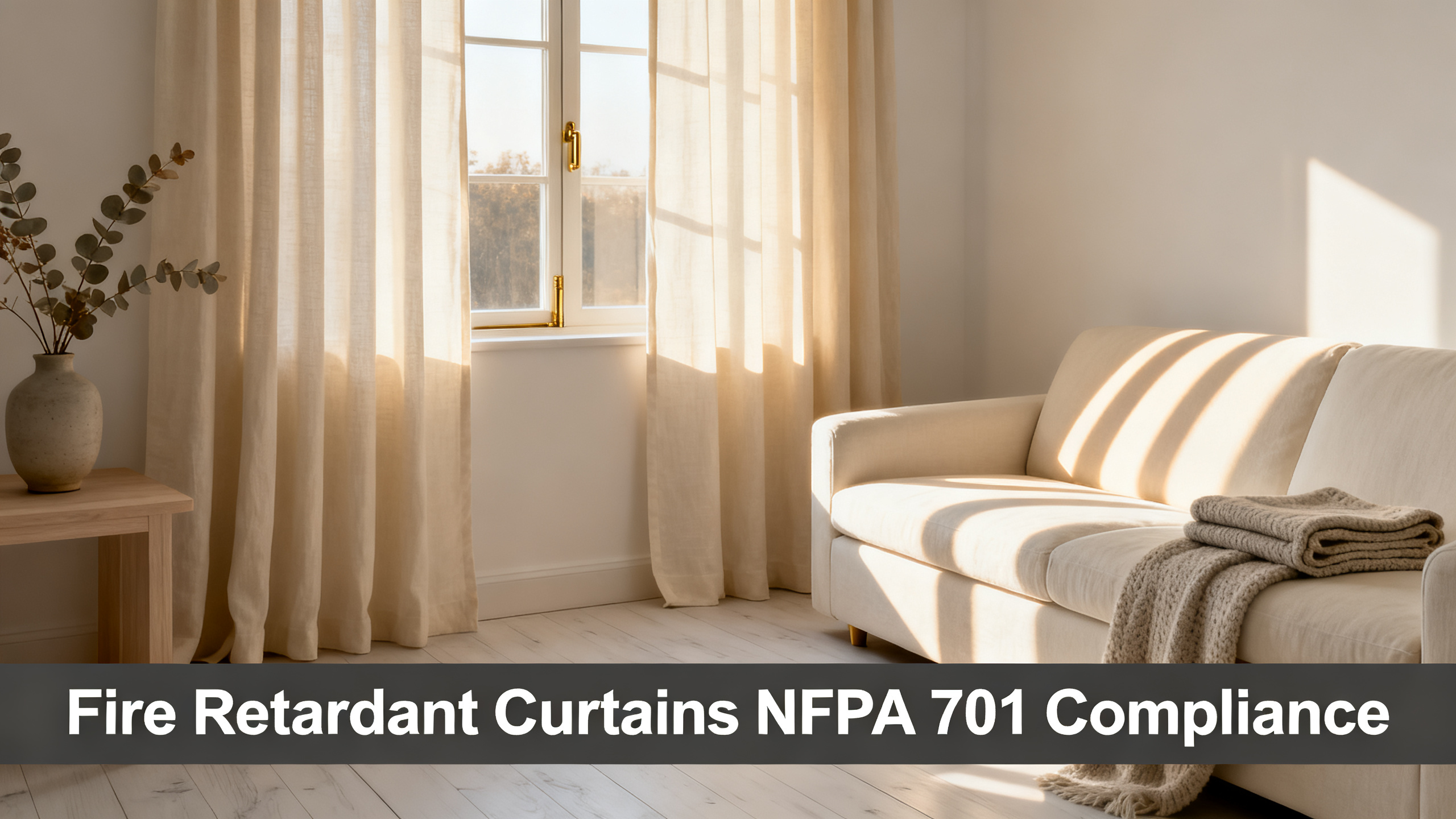
Hotel operator, nursing home administrator, theater manager, Airbnb host. Your NFPA 701 answer is not the same as the person sitting next to you, and the wrong specification gets caught at inspection time, not at install time. Real talk on the four questions that actually drive this purchase: which code applies to your property, whether your fabric is inherently flame retardant or topically treated, whether your lining is part of the same test report, and how many wash cycles your panels are honestly expected to survive.
Two Pages has exactly one panel in the catalog that satisfies all four answers cleanly: REGAL Fireproof Flame Retardant Curtain Pleated, inherently FR, SGS-tested to NFPA 701, 250 gsm, 10 colorways, from $79/panel. Most of this guide is about the decision around it, persona by persona, because the same panel reads differently to a 200-room boutique hotel buyer than to a single-unit Airbnb landlord in a Manhattan high-rise. The full landscape is mapped in our commercial curtains coverage, with this article serving as the compliance-decoding entry point.
🏨
Hospitality
Hotels, boutique properties, inns. NFPA 101 + IBC §803 + brand standards.
🏥
Healthcare
Clinics, nursing homes, medical offices. NFPA 101 healthcare occupancy + state DOH rules.
🎭
Public Assembly
Theaters, schools, churches, convention halls. Fire marshal inspections + tagged certificates.
🏢
Multi-Family / STR
High-rise rentals, Airbnb, vacation properties. Jurisdiction-specific above 75 ft.

Editor’s pick for NFPA 701 buyers
REGAL Fireproof Flame Retardant Pleated
from $79/panel. Inherently flame retardant, SGS-tested to NFPA 701, 250 gsm 3-pass blackout, 10 colorways, retains FR through 50+ wash cycles. Final price depends on size and lining.
Use code JULY for 20% off. Free shipping over $300.
What NFPA 701 Actually Tests (and What It Doesn’t)
Quick answer. NFPA 701 is a vertical flame propagation test method published by the National Fire Protection Association. It is not a certification: a fabric sample passes or fails in an independent lab, and the document of record is the lab’s test report (typically SGS, Intertek, or UL).
The vertical flame propagation test method
The full standard, NFPA 701 Standard Methods of Fire Tests for Flame Propagation of Textiles and Films, defines how a lab applies a flame to a fabric specimen hanging vertically and measures three things afterward: char length (how far the burn traveled), afterflame time (how long the fabric kept burning after the flame source was removed), and afterglow (residual smoldering). Pass thresholds are set for each measurement. If the specimen exceeds any one, the report comes back as a fail.
What the standard does not do is prevent fire. A fabric that passes NFPA 701 still burns under sustained ignition. It is engineered to resist sustaining combustion long enough for occupants to evacuate and for sprinklers and fire suppression to do their work. That distinction matters when a property owner asks “is my room fireproof now?” The honest answer is “your drapery will no longer be a primary fuel source.”
Small-scale (Test 1) vs large-scale (Test 2)
NFPA 701 has two test variants. Test 1 covers single-layer fabrics up to roughly 700 grams per square meter, which spans the entire residential and commercial drapery weight range. Test 2 covers heavier and multi-layer constructions, typically theatrical stage curtains, large blackout rigs, and layered window assemblies in convention spaces. REGAL at 250 gsm sits firmly in Test 1 territory and the SGS independent textile testing services report on the product page confirms Test 1 pass.
For a 1 200 square foot main stage drape with a layered acoustic and blackout lining, the buyer should ask the supplier explicitly whether the combined assembly was Test 2 verified. That conversation belongs at the trade desk, not at the shopping cart.
Treated vs inherently flame retardant: the durability gap
Two paths get a fabric to a passing NFPA 701 result. Treated fabrics receive a topical FR chemical, either applied at the textile finishing stage or sprayed onto already-installed panels by a certified applicator. Inherently flame retardant fabrics have the FR property engineered into the polymer of the fiber itself. The two paths look identical on the day-one test report. They diverge sharply after the first laundry cycle.
Layer 1
Test method
Vertical flame, 12-second exposure, measured char length, afterflame, afterglow.
Layer 2
Test 1 vs Test 2
Test 1 up to 700 gsm single layer. Test 2 for heavy, multi-layer stage rigs.
Layer 3
Treated vs inherent
Treated panels lose FR after 5 to 10 washes. Inherent FR survives the fabric’s life.
Layer 4
Lab and document
SGS, Intertek, UL issue the report. Keep the PDF, the inspector wants it, not a NFPA seal.
Most treated panels surrender FR performance after 5 to 10 wash cycles, sometimes faster with the commercial laundry chemistry typical of hospitality and healthcare properties. The REGAL panel’s inherent FR construction is documented to retain compliance through 50+ wash cycles according to the published spec sheet. For any environment where panels see regular laundering, the conversation effectively reduces to inherent FR, full stop.
⚠️ Watch the language on the spec sheet
“Flame retardant” with no test reference is marketing. “FR treated” without a wash-cycle durability number is short-life. “Inherently flame retardant, SGS-tested to NFPA 701, retains performance through 50+ wash cycles” is what an inspector accepts without follow-up questions. If your candidate panel does not state all three, ask for the test report PDF before purchase.
For Hospitality (Hotels, Boutique Properties, Inns)
Hospitality is the largest commercial buyer of NFPA 701 drapery in the United States, and also the one where the code stack runs deepest. The reference documents most properties face are NFPA 101 Life Safety Code (occupancy classification, means of egress, interior finish requirements), IBC §803 Interior Finishes (referencing NFPA 701 directly for drapery and other suspended textiles), and the brand standards manuals from Hilton, Marriott, IHG, Hyatt, and Wyndham, which typically extend the requirement to guest rooms above a defined floor threshold.
REGAL fits the hospitality buyer for three concrete reasons. The 10-color palette (Beige R-1, Black R-2, Blue R-3, Brown R-4, Greyish White R-5, Gray R-6, Hazel R-7, Merlot R-8, Oak R-9, Saxony Blue R-10) covers the neutral, warm, and accent tones that most brand standard manuals approve without exception. The custom width capacity reaches up to roughly 200 inches per panel, which handles a typical hotel ballroom or two-story lobby drop without seaming. And the inherently FR construction means housekeeping can run the panels through commercial laundry indefinitely without re-treating.
REGAL Flame Retardant Pleated: Full Review
The honest deep-dive on the only NFPA 701 SGS-tested panel in the Two Pages lineup, including the 250 gsm hand, the 50-wash durability claim, and the 10 color performance under hotel lighting.
Color and brand standard alignment
Brand standard PDFs from the major hospitality groups typically gate guest room drapery against two filters: a Light Reflectance Value (LRV) range for the colorway and a NFPA 701 pass requirement. REGAL’s Beige R-1, Greyish White R-5, Gray R-6, Oak R-9, and Hazel R-7 sit in the LRV bands those manuals favor for guest rooms. Black R-2 and Merlot R-8 read as accent options for restaurants and conference spaces inside the same property. The 10-color depth is the practical reason REGAL keeps winning specifications across multi-brand portfolios.
Custom width capacity for ballrooms and lobbies
The Two Pages configurator quotes REGAL custom widths up to 200 inches per panel without seams in most colorways, with custom lengths reaching 120 inches for hotel ballroom drops. For a 24-foot wide ballroom opening typically dressed with two panels meeting in the middle, that capacity removes the need for custom seaming charges that can add 10 to 15 percent to a 30-panel order. The trade desk quotes volume timelines separately when single orders exceed 30 panels.
The lining choice that quietly breaks compliance
A common error in hospitality bidding is pairing a NFPA 701 face fabric with a standard polyester blackout liner that was not part of the same test report. The combined assembly fails an inspector’s review even though the face fabric passes on its own. REGAL ships with a 3-pass blackout lining that is FR-rated within the same SGS NFPA 701 report scope, which keeps the configured panel compliant out of the box.
Lining options at a glance
Default
3-pass FR blackout
Included in the REGAL SGS NFPA 701 report. 100% light block. Maintains compliance as an assembly.
Caution
Standard poly blackout
Cheaper. Not FR rated. Pairing it with REGAL voids the combined-assembly compliance for an inspector.
Specialty
Unlined
REGAL alone, no liner. Face fabric NFPA 701 pass holds, but light block drops to roughly 85 percent.
Best Commercial Curtains for Hotels (Fire Retardant + Heavy Use)
The shortlist for hospitality operators: NFPA 701 picks ranked by colorway depth, blackout rating, custom width capacity, and wash-cycle durability. REGAL leads, alternatives benchmarked.

Ready to price your NFPA 701 order?
REGAL ships in 10 colorways from from $79/panel, custom up to 200 inches wide, with the SGS NFPA 701 test report attached to every commercial order. Lead time runs 10 to 14 business days for custom widths.
For Healthcare (Clinics, Nursing Homes, Medical Offices)
Healthcare is where the wash cycle math becomes the entire conversation. NFPA 101 healthcare occupancy chapters, state Department of Health rules, and Centers for Medicare and Medicaid Services survey requirements typically reference NFPA 701 for drapery in patient-accessible areas. The Joint Commission survey checklist asks for documented FR compliance and verifies it during the on-site visit. The shortlist of acceptable products is on our best curtains for medical offices and clinics coverage.
The wash cycle reality: 30 to 50 cycles per year per panel
Picture the housekeeping cart hitting the panel for the 32nd time this quarter. That wash count is where treated FR sprays surrender. A typical nursing home or skilled-care facility laundry program runs guest-room drapery between 30 and 50 wash cycles per year, with commercial detergent chemistries that strip topical FR finishes faster than residential laundering does.
REGAL’s spec sheet documents inherent FR retention through 50+ wash cycles, which means a panel installed in 2026 should still hold its NFPA 701 pass when the same panel is laundered for the 50th time in 2028. That math is what makes inherent FR the only credible answer for healthcare buyers facing annual CMS survey re-validation.
Why REGAL’s 50+ wash claim matters here
If it were my facility, the line item would not be “FR curtains” as an undifferentiated category. It would be “inherently FR, NFPA 701 SGS-tested, documented 50+ wash retention, lining included in same report scope.” That precise specification reduces the candidate list to a small handful of catalog panels nationwide, and REGAL is the most affordable entry among them at from $79/panel.
REGAL canonical specifications
For Public Assembly (Theaters, Schools, Churches, Convention Halls)
Public assembly is the strictest enforcement category in practice. Fire marshals run physical inspections, often pull a tag from a panel and read the certificate label on the spot, and require documented evidence in the building’s compliance file before issuing or renewing the occupancy certificate. For schools and houses of worship in particular, the responsibility usually falls on a facilities manager or volunteer building committee with no textile-procurement experience, which is why the wrong product gets ordered first and replaced after the first inspection.
Fire marshal inspections and tagged certificates
The document the inspector wants is the SGS or equivalent test report PDF, dated within a reasonable window, naming the specific fabric construction and weight, and indicating Test 1 or Test 2 pass. REGAL ships this report on request and the Two Pages product page links it for pre-purchase review. The label sewn into the panel hem references the report, which is what the inspector actually reads when pulling the tag.
NFPA 701 Test 1 vs Test 2: what stage rigs need extra
For traditional drapery in lobby, vestibule, and assembly spaces, Test 1 is the relevant pass and REGAL covers it. For main stage curtains, masking drapes, scrim assemblies, and any rig that combines a face fabric with an acoustic or blackout layer in a single hanging system, Test 2 verification is the safer specification. REGAL is a Test 1 panel by construction, so a 1 200 square foot stage drape with a layered lining stack should be quoted with the supplier explicitly and the buyer should ask for Test 2 documentation on the combined assembly.
Why residential FR sprays do not pass
The aftermarket FR spray bottle sold at a hardware store is engineered to provide a treatment to existing fabrics, and the contract grade versus residential curtains question shows up here: most residential drapery is not built to retain that treatment beyond a handful of wash cycles, and the inspector’s tag check looks for documented inherent FR or a certified treated-fabric test report, not a homeowner-applied chemical. Public assembly venues that try to retrofit existing drapery with FR spray almost always fail the next inspection.
| Standard | What it covers | Applies to curtains? | Issuing body |
|---|---|---|---|
| NFPA 701 | Vertical flame propagation test for textiles and films | Yes, the primary drapery standard | NFPA (test by SGS, Intertek, UL) |
| NFPA 260 | Cigarette ignition resistance of upholstered furniture components | No, furniture only | NFPA |
| CA TB 117 (2013) | Smolder resistance for residential upholstered furniture in California | No, furniture only, California-scoped | CA Bureau of Household and Outdoor Goods |
| IBC §803 | Interior finish requirements, references NFPA 701 for textiles | Yes, by reference | International Code Council |
| NFPA 1 (Fire Code) | General workplace and occupancy fire code, often references NFPA 701 | Yes, in many workplace contexts | NFPA |
Hotel guest room
100″ W × 84″ L
2 panels per window. Pleated header. ~$210/window configured with FR blackout lining.
Restaurant divider
120″ W × 96″ L
2 panels per opening. Soft top header for rod sleeve. ~$280/opening configured.
Theater backdrop
200″ W × 108″ L
Single panel max width. Soft top for stage rod. ~$390/panel. Ask for Test 2 on layered rigs.
For stage masking and theater backdrops where a rod pocket header is preferred over pleated, the REGAL Fireproof Flame Retardant Soft Top variant ships in the same 10 colors and the same NFPA 701 test scope as the pleated version. The header is the only difference in the product page configuration.
For Multi-Family and Short-Term Rentals (Airbnb, Vacation Properties)
Multi-family and short-term rental landlords are the persona most likely to discover NFPA 701 at inspection time, after a tenant complaint or a routine fire department walk-through, rather than at procurement time. The jurisdictions matter more than the building type. New York City FDNY requires NFPA 701 compliant drapery in common areas of high-rise residential buildings above 75 feet, and increasingly references the same standard for individual rental units. Los Angeles, San Francisco, and several other major US cities have parallel high-rise rules. Most Airbnb hosts and small landlords in regulated zones first hear about this when an inspector hands them a 30-day correction notice.
Cost-benefit for a 30-unit rental portfolio
The math gets straightforward at scale. A 30-unit portfolio with two windows per unit and two panels per window comes to 120 panels. At $79/panel for REGAL with the JULY 20 percent code applied, that lands near $7 600 for inherently FR NFPA 701 panels with the SGS report attached, versus the cost and liability exposure of a non-compliant residential blackout discovered at inspection. The replacement cost of failing the inspection is almost always higher than the difference at original purchase.
REGAL pricing by configuration (cart simulation)
Tier 1 : Studio rental
~$130/window
52″ W × 84″ L. 2 panels pleated. Standard size, no lining.
Tier 2 : Standard apartment
~$210/window
100″ W × 84″ L. 2 panels pleated. 3-pass FR lining included.
Tier 3 : Premium suite
~$310/window
120″ W × 108″ L. 2 panels pleated. Memory training. FR lining.
Pricing reflects cart simulation on the Two Pages configurator before the JULY 20 percent code is applied. Final price depends on size, lining choice, and any add-ons.
Reading the Code Stack: NFPA 701 vs Adjacent Standards
NFPA 701 is one node in a small graph of overlapping standards, and a property owner who hears all five names from different vendors can lose track of which one matters. The honest reduction: NFPA 701 is the only one that directly governs curtains and other vertical hanging textiles. Everything else either covers furniture (NFPA 260, CA TB 117) or references NFPA 701 from a higher-level code (IBC §803, NFPA 1, NFPA 101).
NFPA 260 (upholstered furniture)
NFPA 260 is the cigarette-ignition resistance standard for upholstered furniture cover fabrics and barrier materials. It does not apply to curtains. When a furniture vendor cites “NFPA 260 compliance” in a commercial bid, it relates to the sofa and chair cushions, not the window treatments hanging behind them.
California TB 117 (furniture flammability)
California Technical Bulletin 117, current 2013 revision, sets smolder resistance requirements for residential upholstered furniture sold in California. California TB 117 furniture flammability rule documents the test method in full. It does not cover curtains and is California-scoped only. NFPA 701 covers your drapery in California, just as it does everywhere else in the United States.
IBC §803 (interior finishes) and OSHA workplace
The International Building Code §803 chapter on interior finishes references NFPA 701 directly for drapery and other suspended textiles in commercial spaces. OSHA does not directly mandate FR curtains, but the NFPA 1 Fire Code (often adopted at the state or municipal level) typically does for workplaces classified as public assembly, mercantile, or institutional. The practical result: if your building has an occupancy permit, your curtains are almost certainly governed by NFPA 701 through one of these reference chains.
Order the REGAL 10-Color Booklet ($1.99)
A 4×6 booklet with all ten REGAL colors woven at the actual 250 gsm commercial weight. The fastest way to verify color and hand against an interior spec sheet or a hotel brand standard before committing to a 30-panel order.
What to Do Next: A 3-Step NFPA 701 Plan
The decision tree compresses cleanly to three actions, in this order. Skip any one of them and the process either drags into a re-order or fails at inspection.
①
Verify the local code
Ask your local fire marshal or AHJ which version of NFPA 101, IBC, or NFPA 1 applies to your occupancy. Most will tell you over email in a day.
②
Order the REGAL booklet
$1.99 for all 10 colors at real 250 gsm weight. Match against brand standards or interior design palette before the volume order.
③
Configure on Two Pages
Pleated or soft top header, FR blackout lining, custom width and length. SGS report attached at checkout.
If the property is a hotel, healthcare facility, or public assembly venue, the pleated REGAL with the 3-pass FR blackout lining is the default order. If the property is a theater or stage rig with layered drapery, contact the Two Pages trade desk and request Test 2 verification on the combined assembly before specifying. If the property is a high-rise short-term rental, the same pleated REGAL with FR lining solves the question at $79/panel before code, often the cheapest path to inspector-friendly compliance.
Start the NFPA 701 audit with REGAL
Inherently flame retardant, SGS-tested to NFPA 701, 250 gsm 3-pass blackout, 10 colors. from $79/panel. Code JULY (20% off). Free shipping over $300. Custom widths to 200 inches. Pleated or soft top headers. Lead time 10 to 14 days.
FAQ
Is NFPA 701 a certification?
NFPA 701 is a test method, not a certification. The National Fire Protection Association publishes the standard, an independent lab (SGS, Intertek, UL) runs the test on a fabric sample, and the result is a pass or fail report. Fabrics that pass are commonly called NFPA 701 compliant, but the language matters: there is no NFPA-issued certificate. When an inspector asks for proof, the document to produce is the SGS or equivalent test report, not a NFPA seal. The REGAL panel from Two Pages ships with the SGS NFPA 701 test report linked from the product page.
What is the difference between NFPA 701 Test 1 and Test 2?
Test 1 covers single-layer fabrics up to 700 grams per square meter, which includes most residential and commercial drapery weights. Test 2 covers heavier and multi-layer assemblies, typically stage curtains, blackout rigs, and large-scale theatrical drops. REGAL at 250 gsm is well within Test 1 territory and the SGS report confirms Test 1 pass. For a 1 200 square foot stage drape with a layered lining, the buyer should ask the supplier to confirm Test 2 results separately.
Do hotels actually need NFPA 701 curtains?
Most hotels in the United States need NFPA 701 compliant curtains in public areas (lobbies, corridors, ballrooms, conference rooms) and many brand standards (Hilton, Marriott, IHG) extend that requirement to guest rooms above a floor threshold. The reference codes are NFPA 101 Life Safety Code and IBC §803 Interior Finishes. Local fire marshals enforce them through pre-opening inspections and annual recertifications. The REGAL panel covers the vast majority of these scenarios at $79/panel and ships with the SGS report attached.
Are treated flame retardant curtains as good as inherently FR ones?
Not for long-term commercial use. Treated curtains receive a topical FR chemical (added at finishing or applied in-field as a spray). The chemical washes out: most treated panels lose FR performance after 5 to 10 wash cycles, sometimes faster with commercial laundry chemistry. Inherently flame retardant fabrics like REGAL’s polyester weave have the FR property built into the fiber itself, with the spec sheet documenting 50+ wash cycles with FR retention. For any property with regular laundering, inherently FR is the only durable answer.
Does NFPA 701 apply to curtain liners too?
The standard tests the fabric assembly, which can include a single layer or a multi-layer construction. If the buyer pairs a NFPA 701 face fabric with a standard polyester blackout liner that is not FR rated, the combined assembly may not pass an inspector’s review even though the face fabric does on its own. REGAL ships with a 3-pass blackout lining that is FR rated in the same SGS report scope: configuring the REGAL panel on the Two Pages site with the included lining keeps the assembly compliant.
What is the lead time for NFPA 701 curtains from Two Pages?
REGAL Fireproof Pleated custom panels run 10 to 14 business days from order to shipping. The Soft Top variant runs in the same window. For 30+ panel commercial orders, the Two Pages trade desk can quote volume timelines that may extend to 18 to 21 days depending on color availability across the 10 SKUs. The SGS NFPA 701 test report is sent with the shipment and is also available on request before purchase for inspector pre-review.
What other fire codes might apply alongside NFPA 701?
Several overlap depending on occupancy and jurisdiction. NFPA 260 covers upholstered furniture flammability, not drapery. California Technical Bulletin 117 (TB 117 2013) covers residential furniture in California. IBC §803 references NFPA 701 for interior wall finishes including curtains. OSHA does not directly mandate FR curtains but workplace fire codes (NFPA 1) often do. For high-rise residential above 75 feet, NYC FDNY and similar municipal codes typically require NFPA 701 in common areas and increasingly in rentable units.
Can I use NFPA 701 curtains at home?
Yes, with no downside beyond price. Inherently FR fabrics are not chemically harsher than standard polyester (they meet OEKO-TEX baseline on chemical residue). The REGAL panel at $79/panel sits in the same price tier as a mid-range residential blackout, the 250 gsm hand is heavier and more substantial than a typical residential drape, and the 10 colorways cover the most common neutral palettes. For renters in a building above the local high-rise threshold, NFPA 701 may already be a building requirement: REGAL is the simplest way to satisfy it without inheriting institutional aesthetics.
